
GRVT Token Explained: The 11% Float Behind a $242M Valuation

 Prefer us on Google


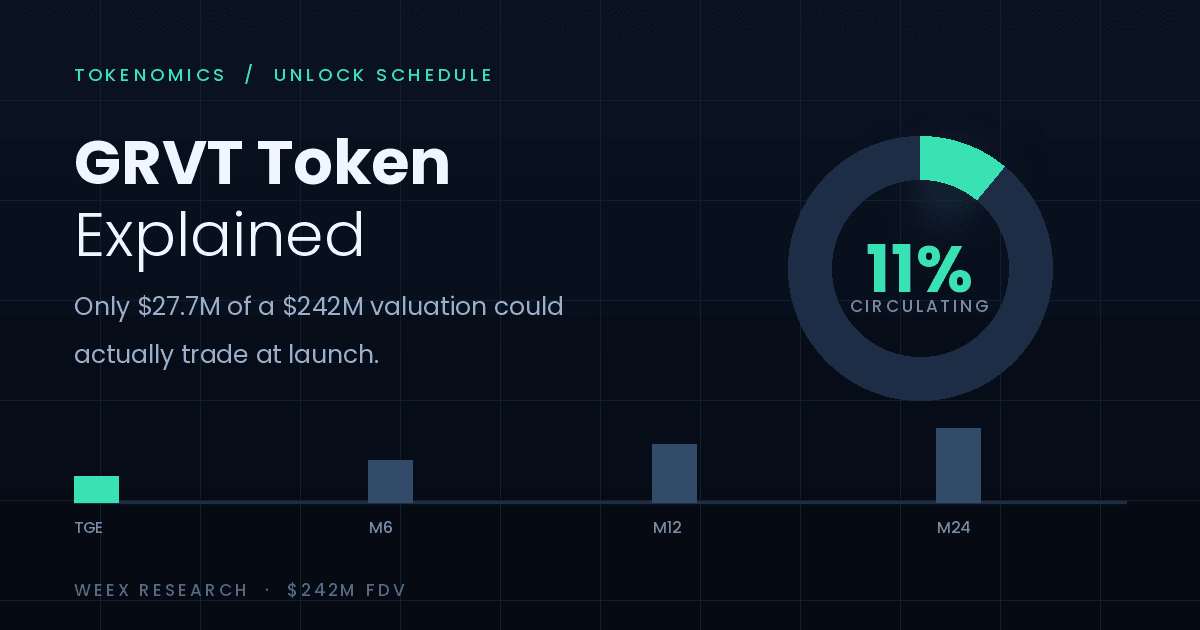
Grvt spent four years building a self-custodial exchange, then launched its token into a market that priced the whole thing at $242 million while only $27.7 million of it could actually trade. That gap — and the unlock calendar that closes it — is the part of the GRVT token story most launch coverage skipped.
The product side is genuinely unusual: one balance that earns yield, holds tokenized institutional funds, and margins perpetuals across crypto, gold, oil and equities, with the user holding the withdrawal key throughout. The token side is more conventional than the product, and it comes with a supply schedule worth reading before you size a position.
What GRVT is: one balance for yield, funds and perps
Grvt (pronounced "gravity") is a self-custodial on-chain wealth platform built on a ZKsync ZK Stack chain. It runs a hybrid design: order matching happens off-chain on a central limit order book, the way a centralized exchange does it, while settlement and custody happen on-chain. Withdrawals are authorized by a key only the user holds, so Grvt cannot move balances on its own — the structural difference from a custodial venue.
The company was founded in 2022 by CEO Hong Yea, who traded at Goldman Sachs and Credit Suisse for close to a decade, CTO Aaron Ong, previously a tech lead on data-privacy frameworks at Meta, and COO Matthew Quek. It has raised roughly $33 million, including a $19 million Series A announced in September 2025 co-led by ZKsync and Further Ventures, an Abu Dhabi sovereign-wealth-backed firm, with EigenCloud and 500 Global also participating.
What separates the platform from a standard perp DEX is the "one balance" architecture. Deposits earn a base yield automatically while remaining usable as collateral, so capital does not sit idle between products. Around 169 perpetual markets span crypto and real-world assets — gold, oil, tokenized equities. On the RWA side, Grvt integrated Centrifuge in mid-May 2026, bringing the Janus Henderson Anemoy US Treasury fund on-platform from a $1 minimum, followed by a Plume integration in late May 2026. Those feed three tokenized yield products — Base, Balanced and Opportunistic — with the Opportunistic tier reaching exposure to instruments like the iShares AAA CLO Active ETF.
This is the part that is hard to replicate. Most DeFi yield is protocol-native and circular. Grvt's is largely institutional paper wrapped for on-chain access, sitting in the same margin account as a leveraged oil perp.
Why only 11.4% of GRVT supply is actually trading
$GRVT went live on July 30, 2026 at 13:00 UTC across GRVT's own spot market and a set of tier-one venues. Here is where it stands on WEEX as of August 3, 2026.
| Metric | Value (WEEX, Aug 3, 2026) |
|---|---|
| GRVT/USDT price | $0.242707 |
| Market cap | $27.744M |
| Circulating supply | 114.312M |
| Float as % of total | 11.43% |
| Total / max supply | 1.000B (fixed, no inflation) |
| Implied fully diluted value | ~$242.7M |
The number that matters is the last one. Market cap and FDV are 8.75x apart. Every dollar of price discovery is happening on a ninth of the supply, which is why the token round-tripped so hard in its first week: CoinMarketCap records an all-time high of $0.4041 on July 30, roughly 40% above where the WEEX pair sat four days later.
There is a second detail in the arithmetic. The community and airdrop allocation is 28% of supply — 280 million tokens — raised from an original 22% before launch. The circulating 114.31 million is close to 40% of that 280 million, and 40% is the standard first tranche under Grvt's airdrop vesting. The better reading, then, is that the float is essentially all airdrop tokens: recipients who paid nothing, holding the only supply that can move. That is not a scandal, but it explains why the order book behaved the way it did, and it means early price is a poor guide to where a broader holder base would clear.
GRVT airdrop vesting and the Multiplier Plan trade-off
Grvt did something most projects do not: it put a 12-month vesting schedule on the airdrop itself, rather than dumping the full community allocation at TGE. The published example structure releases 40% at TGE, then equal tranches at months four, eight and twelve.
| Tranche | Approx. date | Share of allocation |
|---|---|---|
| TGE | July 30, 2026 | 40% |
| Month 4 | late Nov 2026 | 20% |
| Month 8 | late Mar 2027 | 20% |
| Month 12 | late Jul 2027 | 20% |
Layered on top is a Multiplier Plan: defer your first tranche to month four and the allocation carries a 2x multiplier; defer to month eight and it becomes 4x. Grvt is paying holders, in tokens, to not sell — a reasonable design, and an honest one in that the cost is disclosed rather than hidden in a cliff.
What traders usually miss is the second-order effect. A 4x multiplier is only worth taking if the token holds enough value eight months out to justify quadrupling a claim on a fixed supply, and the multiplier itself expands the tokens that eventually hit the market. The plan does not remove sell pressure; it moves it, and enlarges it, in exchange for time. Anyone modelling GRVT should treat late November 2026 as the first real test — the point where deferred and non-deferred supply arrive together against a float that is currently very thin.
-- Price
What the GRVT token buys you — and what it doesn't
$GRVT is explicitly an access and membership token, not an ownership claim. It confers no equity, no profit-share, and no legal claim on Grvt's revenue. What holding or staking it does unlock, per the project's own documentation: reduced trading fees, lower fees on savings products, improved margin efficiency, enhanced yield tiers, priority access to new vaults and curated products, and cashback on the planned Grvt Card.
Value capture, such as it is, runs through buybacks. Grvt has said it intends to direct revenue toward ecosystem reinvestment and token buybacks using a mix of time-weighted average purchases and opportunistic market activity. That is a discretionary program, not a protocol-enforced burn — it depends on the exchange generating fee revenue and management choosing to deploy it that way.
Here is the practical consequence, and it is the one nobody writes down: the token's utility lives on Grvt's platform, but most of its liquidity lives on centralized exchanges. If you buy GRVT on a CEX and leave it there, you own price exposure and nothing else. Fee tiers, yield boosts and vault priority all require the token to sit in a Grvt account. That is a legitimate reason to hold it in either place — just not a reason to confuse the two.
Is GRVT safe? The Bermuda licence and what it covers
Grvt obtained a Class Modified (M) Digital Asset Business License from the Bermuda Monetary Authority in December 2024, and was widely described at the time as the first regulated DEX. The company has said it is pursuing further authorizations, including MiCA in the EU, VARA in Dubai and a capital markets licence in ADGM.
A Class M licence is a real regulatory step, and it is more than most on-chain derivatives venues have. It is also narrower than the headlines suggest: it is a modified, sandbox-tier permission from one jurisdiction, not a global authorization, and it does not insure user funds, guarantee token value, or make the $GRVT token itself a regulated instrument. Self-custody cuts both ways too — the same key control that stops Grvt from moving your funds means a lost key or a malicious signature has no recovery path. The custody-versus-counterparty trade-off is worth understanding before choosing a venue; the DEX vs CEX comparison for perpetuals lays out how the two models fail differently.
GRVT against the venues it's competing with
| Grvt | Hyperliquid | Centralized exchange | |
|---|---|---|---|
| Custody | Self-custody, on-chain settlement | Self-custody | Custodial account |
| Matching | Off-chain CLOB, on-chain settlement | Fully on-chain order book | Internal order book |
| Asset range | Crypto + gold, oil, tokenized equities (~169 perps) | Crypto perps, rotating listings | Crypto spot + perps, fiat rails |
| Yield on idle balance | Automatic base yield on deposits | No native deposit yield | Varies by Earn product |
| Regulatory status | BMA Class M licence (Bermuda) | Unlicensed protocol | Varies by jurisdiction |
The comparison that matters most is the middle column. Grvt and Hyperliquid are chasing the same trader with opposite bets: Hyperliquid put everything on-chain and won on depth and credibility; Grvt kept matching off-chain and bet that RWA breadth, institutional yield and a licence would matter more. Hyperliquid is far ahead on liquidity. Grvt's differentiation is that you cannot short oil against a Treasury-fund position anywhere else without leaving self-custody.
How to buy GRVT on WEEX and what the CEX route costs
If you want price exposure without running a wallet, the spot route is straightforward:
- Create and verify a WEEX account.
- Fund it with USDT, by deposit or card purchase.
- Open the GRVT/USDT spot market and check the order book depth before sizing.
- Use a limit order rather than a market order. On a token with an 11% float, a market order into a thin book is how people pay 2–3% in slippage they never see on the fee schedule.
- Set your exit rules before you enter — specifically around the late-November unlock.
The honest cost of this route: you get liquidity, fiat access and no key-management risk, and you give up every membership benefit the token was designed to deliver. For a trader that is a fine trade. For someone buying GRVT because they believe in the fee discounts and yield tiers, it is the wrong venue for the position.
What to watch before the first GRVT unlock
Three things, in order of importance.
First, the November tranche. It is the first scheduled supply event and it lands against a float that is currently almost entirely airdrop tokens. Watch how much of the community allocation opted into deferral — the higher that share, the lighter November looks and the heavier March 2027 becomes.
Second, whether buybacks actually run. A discretionary buyback funded by exchange revenue is only as good as the revenue. Grvt's platform volume, not the token's chart, is the signal to track.
Third, whether the RWA products get used. Tokenized Treasury and CLO exposure inside a margin account is the genuinely novel piece of the GRVT proposition. If assets flow into the Base, Balanced and Opportunistic funds, the membership utility of the GRVT token has something real underneath it. If they do not, this is another exchange token trading on listing momentum.
The GRVT token is not a bet on a blockchain. It is a bet on whether a self-custodial venue can hold institutional-grade assets and traders in one account — with a supply schedule that will test the conviction of the people who got it for free long before it tests anyone else's.
FAQ
1. What is the GRVT token used for?
$GRVT is an access and membership token for the Grvt platform. Holding or staking it unlocks trading and savings fee discounts, better margin efficiency, higher yield tiers, priority access to new vaults, and cashback on the planned Grvt Card. It carries no equity, profit-share, or claim on Grvt's revenue.
2. When did GRVT launch and what is the total supply?
$GRVT went live on July 30, 2026 at 13:00 UTC. Total and maximum supply is fixed at 1 billion tokens with no inflation. As of August 3, 2026, 114.312 million (11.43%) were circulating, per WEEX market data.
3. How does the GRVT airdrop vesting work?
Airdrop allocations vest over 12 months. The published structure releases 40% at TGE and 20% at each of months four, eight and twelve. Recipients can opt into a Multiplier Plan instead — deferring the first tranche to month four for a 2x multiplier, or to month eight for 4x.
4. Is GRVT a regulated exchange?
Grvt holds a Class Modified (M) Digital Asset Business License from the Bermuda Monetary Authority, granted in December 2024, and has said it is pursuing MiCA, VARA and ADGM authorizations. A Class M licence is a sandbox-tier permission from one jurisdiction — it does not insure user funds or guarantee the token's value.
5. Where can I buy GRVT?
$GRVT trades on Grvt's own spot market and on several centralized exchanges, including the GRVT/USDT pair on WEEX. Buying on a centralized venue gives you price exposure but not the platform membership benefits, which require the token to be held in a Grvt account.
6. Why is GRVT's market cap so much lower than its fully diluted value?
Because only 11.43% of the supply is circulating. At the August 3, 2026 WEEX price of $0.242707, market cap was $27.744 million against a fully diluted value of roughly $242.7 million — an 8.75x gap that closes as vesting tranches unlock through July 2027.
Risk Warning
Crypto assets are highly volatile and you may lose part or all of the capital you commit. $GRVT carries risks specific to its situation: an 11.43% float means thin order books and outsized slippage on market orders, and scheduled vesting tranches through July 2027 represent known future supply against that float. The token is an access instrument with no equity or revenue claim, and the buyback program supporting it is discretionary rather than protocol-enforced. Using the Grvt platform itself adds self-custody risk — a lost key or a malicious signature cannot be reversed — alongside smart-contract, oracle and bridge risk. Perpetual futures on any venue carry leverage risk that can liquidate your full collateral. Regulatory status can change, and a Bermuda Class M licence does not extend protections to users in other jurisdictions. Do your own research and size positions you can afford to lose.
This content is provided for general informational purposes only and doesn't constitute financial, investment, legal, or tax advice. Any events, rewards, online promotions, or related information mentioned herein should not be considered a recommendation, solicitation, or invitation to purchase, sell, trade, or otherwise deal in any crypto assets. Crypto assets are highly volatile and may result in loss. The availability of WEEX services, products, and related events may vary by region. You are responsible for ensuring that your participation is in accordance with applicable local laws and regulations.
You may also like
View morePi Network Hits $0.047 Record Low: Why the Summit Didn't Help
Beginner3 minAltcoinMonad Unlock Nov. 24: Can MON Absorb 16.6 Billion New Tokens?
Beginner3 minAltcoinXRP Under $1: What the Dec. 1 Escrow Unlock Means for Price
Beginner3 minAltcoinZcash NU7 Upgrade: 25-Second Blocks, Same 21M ZEC Supply
Beginner3 minWEEX Product GuideHyperliquid ICE Deal: What US Perps Mean for HYPE Holders
Beginner3 minWEEX Product GuideRipple National Trust Bank: What OCC Approval Means for XRP
Beginner3 minAltcoin
Contents
Popular coins
Latest articles





