What Is Arbitrum (ARB) and How Does This Ethereum Layer 2 Work?

 设为Google首选来源

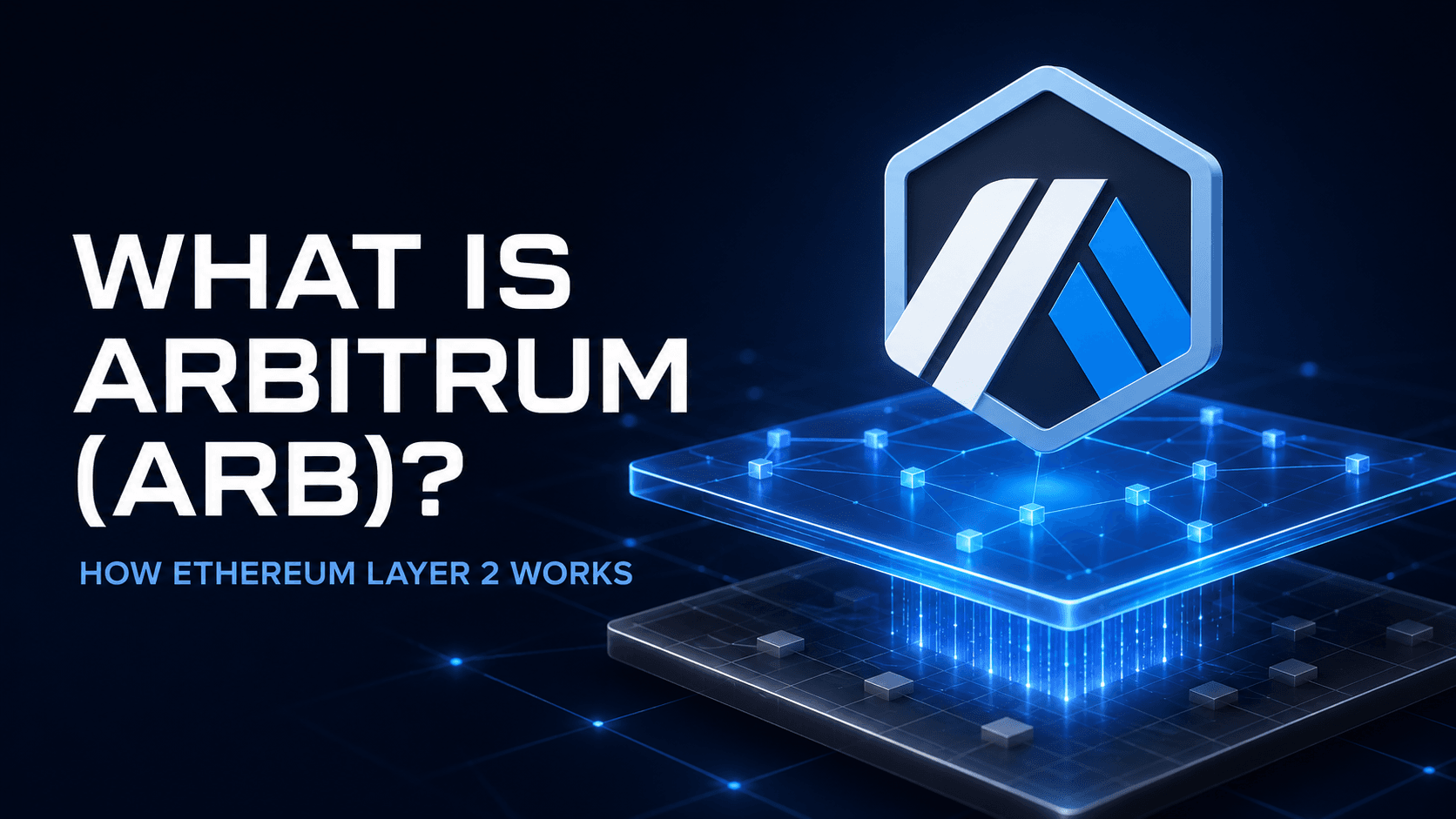
When asking what is Arbitrum, the short answer is that it is a leading Ethereum layer-2 (L2) scaling solution designed to drastically reduce transaction fees and increase throughput while retaining the underlying security of the Ethereum mainnet. To understand how does Arbitrum work, the platform utilizes a technology called Optimistic Rollups to bundle thousands of off-chain transactions into a single batch submitted directly to Ethereum, allowing the native governance asset, as ARB crypto explained, to coordinate decentralized decision-making across its expanding multi-chain ecosystem.
At a Glance / Key Takeaways:
Layer-2 execution engine: Arbitrum processes transactions off-chain via its custom Nitro technology stack, providing up to 10x to 100x lower gas fees compared to Ethereum base layer.
Optimistic Rollup mechanism: Transactions are assumed valid by default, relying on an interactive multi-round fraud proof system to penalize invalid state transitions within a seven-day dispute window.
Dual network strategy: Arbitrum One focuses on high-security decentralized finance (DeFi), while Arbitrum Nova leverages Data Availability Committees (DACs) for ultra-low-cost gaming and social applications.
Native ARB governance: The ARB token grants holders voting power within the Arbitrum DAO, governing treasury allocations, protocol updates, and revenue routing parameters.
Demystifying Ethereum congestion and the need for layer 2 scaling
Ethereum remains the premier platform for smart contracts and decentralized applications, yet its base layer design inherently limits throughput to roughly 15 to 30 transactions per second (TPS). When network activity surges, users compete for block space by bidding higher gas fees, occasionally pricing out everyday participants and slowing settlement times. This structural bottleneck created an urgent market demand for secondary execution layers capable of offloading computation without sacrificing security.
Developed by Offchain Labs and launched in 2021, Arbitrum addresses this bottleneck directly by establishing an execution environment above Ethereum mainnet. Instead of forcing every Ethereum validator to process every single smart contract operation, Arbitrum handles computation off-chain and posts compressed transaction summaries back to layer 1. According to L2Beat data as of September 2026, this architectural efficiency has enabled Arbitrum to capture over 40% of the total value locked (TVL) across all Ethereum layer-2 networks.
Fact: Arbitrum processes an average of 1.5 million to 2.5 million transactions daily, representing significantly higher transaction volume than Ethereum mainnet. Analysis: This high utilization rate proves that off-chain execution environments have successfully transitioned from experimental infrastructure into the primary settlement venues for daily Web3 interaction.
By maintaining full compatibility with the Ethereum Virtual Machine (EVM), developers can deploy existing Solidity smart contracts onto Arbitrum without rewriting their codebase. This seamless migration path attracted major decentralized exchanges, lending protocols, and institutional yield strategies early on, establishing a deep liquidity moat that continues to anchor the layer-2 landscape.
How does Arbitrum work? The inner mechanics of Optimistic Rollups
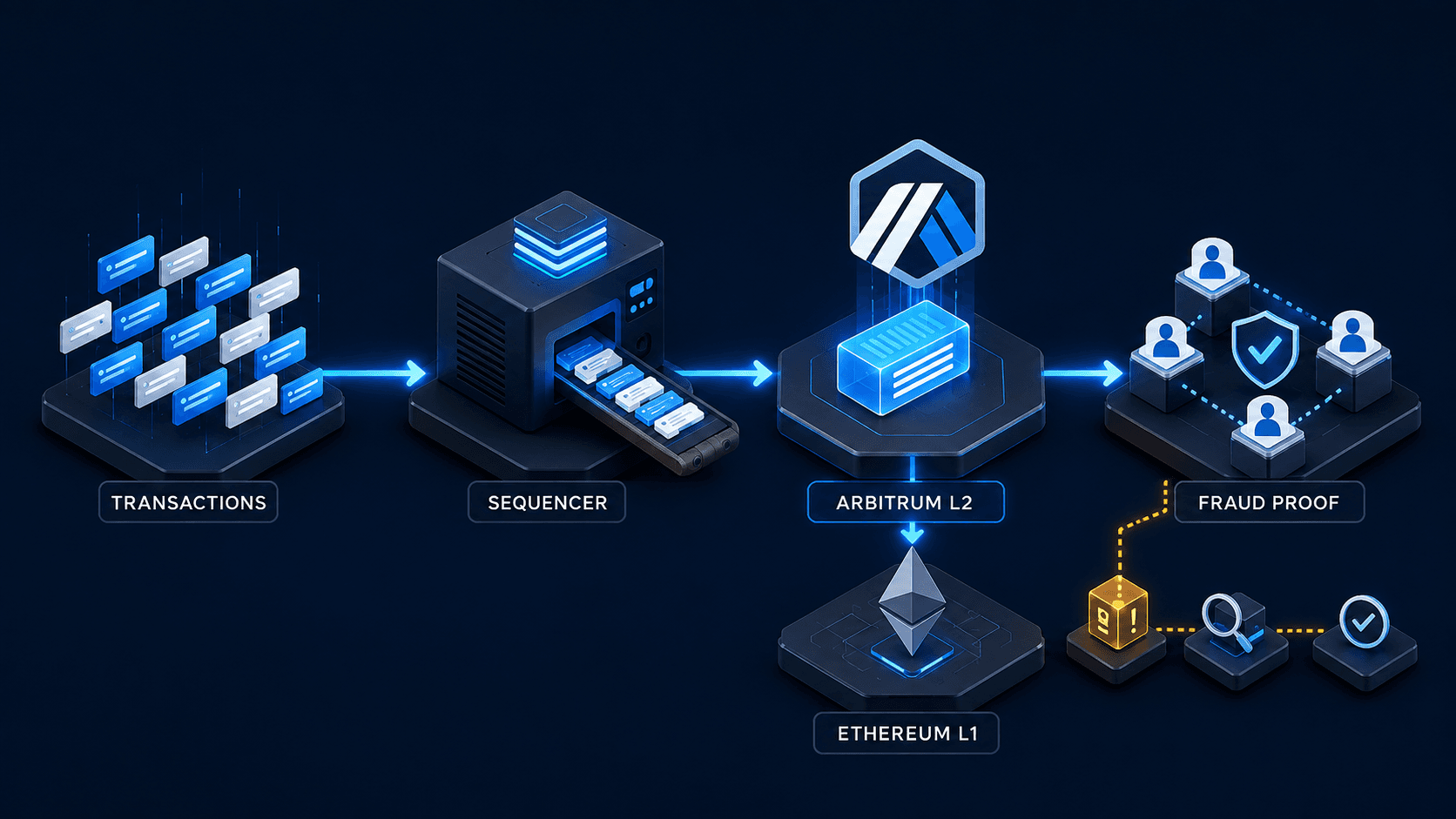
To answer how does Arbitrum work on a technical level, one must examine the mechanics of Optimistic Rollups. The protocol derives its name from its optimistic assumption: every state transition and transaction batch processed by the rollup sequencer is presumed valid unless explicitly challenged by an network validator.
Instead of computing expensive zero-knowledge proofs for every batch upfront, Arbitrum posts the updated state root along with call data to Ethereum. Validators monitor these state roots and have a strict seven-day challenge period to dispute any suspect data. If a validator detects an invalid state transition—such as an unauthorized token transfer or double-spend—they initiate an interactive fraud proof process.
Arbitrum's fraud proof system uses an innovative interactive multi-round approach. Rather than re-executing an entire block on Ethereum mainnet, which would incur exorbitant gas fees, the challenger and the asserter engage in a back-and-forth ping-pong dialogue. They progressively narrow down the disputed transaction to a single instruction step. Once isolated, that single step is executed directly inside an Ethereum smart contract to verify who is telling the truth.
Fact: The party proven wrong during an interactive fraud proof loses their staked ETH collateral, which is partially awarded to the honest validator and partially burned. Analysis: This economic penalty mechanism makes malicious assertions mathematically unprofitable, creating a robust game-theoretic security guarantee that protects user assets.
The central component driving day-to-day operations is the Sequencer. The Sequencer receives user transactions, orders them into a sequence, and returns an instant transaction receipt to the user within milliseconds. Although the Sequencer acts as a centralized entity for rapid ordering, it cannot forge transactions or steal funds. If the Sequencer ever attempts censorship, users retain the capability to bypass it entirely by submitting their transactions directly to the Ethereum layer-1 delayed inbox queue.
-- 价格
The Arbitrum technology stack: Nitro, AnyTrust, and Stylus
Arbitrum’s underlying infrastructure has undergone continuous evolution to increase execution efficiency and developer accessibility. The current architecture relies on three primary software milestones developed by Offchain Labs: Nitro, AnyTrust, and Stylus.
Arbitrum Nitro serves as the underlying core execution engine. Upgraded in mid-2022, Nitro replaced legacy custom virtual machines with standard WebAssembly (Wasm) target architecture. By running a modified version of the core Ethereum client (Go-Ethereum or Geth) inside Wasm, Nitro dramatically improved execution speeds, simplified EVM compatibility, and optimized data compression algorithms to reduce layer-1 data submission costs.
For applications requiring even lower transaction costs than standard rollups, Arbitrum introduced the AnyTrust protocol. While standard rollups post all transaction data directly to Ethereum as call data, AnyTrust introduces a Data Availability Committee (DAC) consisting of trusted external entities. The DAC promises to hold transaction data off-chain and make it available upon request, only posting a cryptographic data availability certificate back to Ethereum.
Fact: AnyTrust reduces transaction fees down to sub-cent levels by avoiding expensive Ethereum call data storage. Analysis: This data availability compromise creates an optimized environment specifically tailored for high-frequency, low-value transactions like blockchain gaming, social media micro-tipping, and high-speed order book derivatives.
Stylus represents the newest frontier in Arbitrum’s execution technology. Introduced to expand developer adoption beyond Solidity, Stylus enables multi-language smart contract development. Developers can write high-performance smart contracts in WebAssembly-compatible languages such as Rust, C, and C++ while maintaining full interoperability with traditional Solidity EVM contracts on the same chain. This innovation dramatically lowers memory overhead and execution costs for compute-heavy algorithms, enabling complex cryptography and AI logic to run on-chain efficiently.
Comparing Arbitrum One, Arbitrum Nova, and Ethereum mainnet
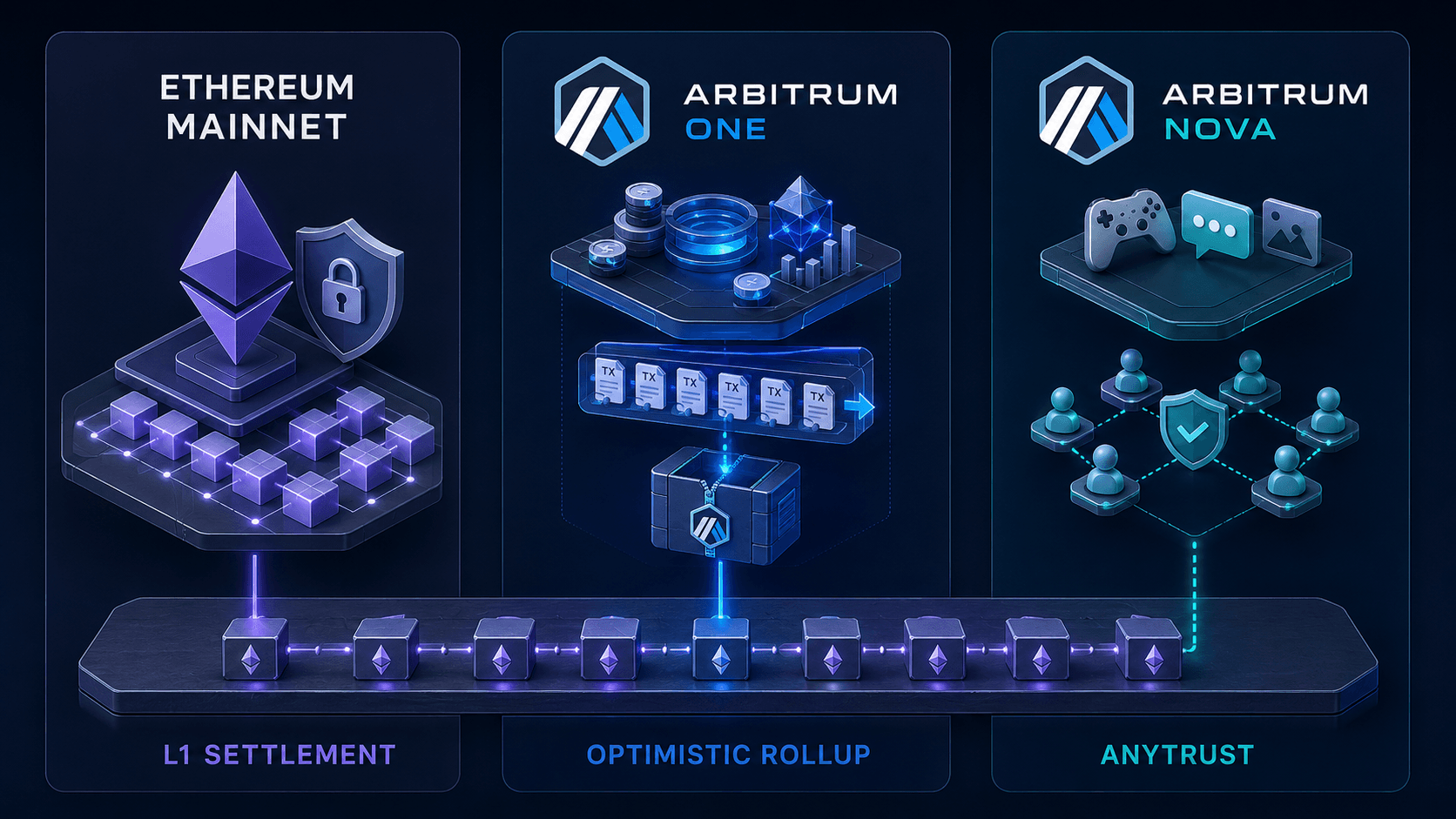
Because the ecosystem operates distinct networks optimized for different use cases, comparing their performance metrics highlights how off-chain architecture caters to varying decentralized application requirements.
| Performance Metric | Ethereum Mainnet (L1) | Arbitrum One (L2 Rollup) | Arbitrum Nova (L2 AnyTrust) |
|---|---|---|---|
| Primary Architecture | Layer-1 Proof of Stake | Optimistic Rollup (Nitro) | AnyTrust (DAC) |
| Transaction Fees | Variable ($1.50 - $20.00+) | Low ($0.01 - $0.10) | Near-Zero (<$0.005) |
| Throughput (TPS) | ~15 - 30 TPS | ~2,000+ TPS capacity | ~5,000+ TPS capacity |
| Data Availability | On-Chain (Ethereum Nodes) | On-Chain (Ethereum Call Data) | Off-Chain (Data Committee) |
| Target Applications | High-Value Settlement | DeFi, Spot DEXs, RWAs | Gaming, Social, Micro-Tx |
Source: Official Arbitrum Developer Documentation and On-Chain Block Explorers, September 2026
Arbitrum One remains the flagship general-purpose chain where security is paramount. Because every byte of transaction data is posted to Ethereum mainnet, it inherits the full security assurances of the base layer. Consequently, it houses the vast majority of institutional capital, decentralized credit markets, and liquidity hubs.
In contrast, Arbitrum Nova utilizes the AnyTrust protocol to achieve maximum cost savings. By relying on the Data Availability Committee, Nova sacrifices a marginal degree of decentralization in exchange for near-instant execution and negligible fees. Major Web3 gaming studios and social applications utilize Nova to ensure frictionless user onboarding where transaction fees are fully abstracted or subsidized.
Furthermore, enterprise entities can deploy custom Layer-3 networks, known as Orbit Chains, directly on top of Arbitrum One or Nova. These dedicated Orbit chains allow businesses to configure custom gas tokens, governance models, and privacy parameters while utilizing Arbitrum as their settlement layer.
ARB crypto explained: Governance, tokenomics, and utility
To understand ARB crypto explained, investors must distinguish between network transaction fees and protocol governance. Unlike Ethereum, where ETH is burned to pay for execution, transaction gas fees on Arbitrum are natively paid in ETH. The native ARB token was distributed in March 2023 via a high-profile community airdrop, explicitly designed as an ERC-20 governance asset rather than a mandatory gas utility token.
Holders of ARB tokens possess voting power within the Arbitrum DAO, a decentralized autonomous organization that controls the network's core treasury and technical upgrades. The DAO oversees crucial administrative duties, including parameter tuning, sequencer fee allocations, ecosystem grant distributions, and licensing approvals for commercial deployment of Orbit chains.
To protect the protocol from malicious governance attacks or rapid software exploits, the Arbitrum DAO is supported by a Security Council. Composed of 9-of-12 multi-signature signers elected periodically by the community, the Security Council holds emergency powers to execute immediate code patches in critical situations without waiting for standard multi-week DAO voting delays.
Fact: The total initial supply of ARB was capped at 10 billion tokens, with allocations split between the DAO treasury, team members, investors, and community users. Analysis: The long-term value accrual of the token relies heavily on how effectively the DAO monetizes the ecosystem, manages Orbit chain licensing fees, and directs liquidity incentives.
In recent years, the utility landscape surrounding ARB has expanded into institutional finance and decentralized trading. As real-world assets (RWAs) and tokenized traditional equities gain traction across layer-2 rails, platforms integrating tokenized financial instruments rely on Arbitrum's deep liquidity pools. For example, centralized order book venues and hybrid platforms, including
As more application-specific Orbit chains launch and pay small licensing fees or revenue shares back to the DAO treasury, the ARB token increasingly acts as a proxy for the economic throughput of the broader Arbitrum universe.
Key risks, challenge periods, and competitive layer 2 outlook
Despite its dominant market position, Arbitrum faces distinct technical, economic, and competitive risks that users and institutional participants must consider. The most notable operational constraint is the seven-day withdrawal delay associated with native optimistic rollups.
When bridging funds from Arbitrum back to Ethereum mainnet via the official canonical bridge, users must wait out the full seven-day fraud-proof dispute window before their assets unlock on layer 1. While third-party liquidity providers and fast-bridging protocols circumvent this delay by charging a small convenience fee to swap assets instantly, the core architecture remains constrained by this dispute timeline.
Fact: Centralized sequencers currently run the majority of rollup transaction ordering across the layer-2 landscape. Analysis: While Offchain Labs has published clear roadmaps toward decentralizing the Sequencer via shared sequencing networks, temporary central points of failure still present minor operational risks regarding potential service outages.
Furthermore, the competitive landscape among layer-2 solutions remains fierce. Zero-knowledge rollups (ZK-rollups) utilize cryptographic validity proofs that eliminate the seven-day challenge period entirely, offering mathematical finality within minutes. As ZK technology matures and reduces its computational costs, optimistic rollups like Arbitrum must continuously innovate—through tools like Stylus and multi-prover frameworks—to maintain their competitive edge in execution speed and cost.
| Risk Category | Structural Challenge | Mitigation Strategy |
|---|---|---|
| Withdrawal Latency | 7-day challenge period for L1 bridging | Third-party liquidity bridges & fast-bridging pools |
| Sequencer Centralization | Single entity orders transactions | Transition toward decentralized, shared sequencer networks |
| Competitive Pressure | ZK-Rollups offer instant finality | Implementation of Stylus, Nitro upgrades, & hybrid ZK-proofs |
| Smart Contract Risk | Exploits in complex L2 contract logic | Rigorous multi-audits & emergency Security Council overrides |
Source: Arbitrum Risk Assessment Framework and L2Beat Analytics, September 2026
Navigating layer-2 assets and participating in decentralized finance requires disciplined capital management. While Arbitrum provides a highly efficient and lower-cost environment for smart contract interaction, users should always verify contract security, manage private keys carefully, and maintain balanced exposure when interacting with volatile crypto assets across emerging network bridges.
Frequently asked questions about Arbitrum
1. What is Arbitrum and how does it lower transaction fees
Arbitrum is an Ethereum layer-2 scaling solution that uses Optimistic Rollups to process transactions off-chain in compressed batches. By removing the heavy computational load from Ethereum mainnet and posting only bundled transaction data back to layer 1, it reduces gas fees by up to 90% or more while maintaining Ethereum-level security.
2. How does Arbitrum work compared to Optimism
While both networks utilize Optimistic Rollups, they differ in how they execute fraud proofs. Optimism utilizes single-round fraud proofs that re-execute disputed transactions entirely on layer 1, whereas Arbitrum uses an interactive multi-round fraud proof system. Arbitrum's approach isolates the specific disputed instruction step off-chain first, resulting in significantly lower gas costs during dispute resolutions.
3. What is the difference between Arbitrum One and Arbitrum Nova
Arbitrum One is a standard Optimistic Rollup that posts all transaction data directly to Ethereum, making it ideal for high-security DeFi and institutional applications. Arbitrum Nova uses the AnyTrust protocol, which relies on an external Data Availability Committee (DAC) to store data off-chain, yielding near-zero transaction fees suited for gaming, social media, and high-frequency micro-transactions.
4. What gives the ARB token value in the ecosystem
The ARB token is the primary governance asset of the Arbitrum DAO. It grants holders voting power over network upgrades, parameter settings, treasury allocations, and revenue-sharing mechanisms derived from Orbit chain licensing fees. Its economic value is directly connected to the growth, adoption, and governance oversight of the entire ecosystem.
5. How long does it take to bridge funds from Arbitrum back to Ethereum
Using the official canonical Arbitrum bridge takes approximately seven days due to the Optimistic Rollup fraud-proof challenge window. However, users seeking immediate transfers can use third-party liquidity bridges, which charge a minimal fee to provide instant cross-chain liquidity without waiting for the settlement period.
本内容仅供参考,不构成任何金融、投资、法律或税务建议。文中提及的任何活动、奖励、线上活动或相关信息,不应被视为对购买、出售或交易任何加密资产的推荐、招揽或邀请。加密资产具有高波动性,存在价值损失风险。WEEX服务、产品及相关活动的可用性可能因地区而异。用户在参与前有责任确保符合当地适用法律法规。
猜你喜欢
新手最佳加密货币平台:按目标选择,而非看品牌

以太坊 Glamsterdam 升级在 Sepolia 测试网上将区块 Gas 上限推至2亿:升级后会有哪些变化?

如何在新加密货币上线前买入:5种途径及其陷阱
以太坊 Glamsterdam 升级:Sepolia 日期及对 ETH 价格的影响
LayerZero 2026/10解锁:巨鲸资金流入之际,ZRO 能否守住2美元?
2026年最佳加密货币钱包 App:如何选择热钱包、冷钱包、托管钱包与 Web3 钱包
Coinbase 封装大零币(cbZEC)是什么?它如何在不具备大零币原生 ZEC 隐私性的情况下将大零币引入 Base
Coinbase Wrapped HYPE(cbHYPE)是什么?它在 Base 上如何运作、1:1 储备支持、风险与 HYPE 转换
什么是 Gno.land (GNOT)?GnoVM、存储押金、代币经济学和 GovDAO 如何运作
SUI期货交易:如何把握突破行情而不被强平

Phantom 钱包与 MetaMask:有什么区别

2026最佳加密货币钱包:适合各类用户的热门选择
区块链浏览器能告诉你什么,又不能告诉你什么

如何查询钱包地址和交易历史
龙虾 (Lobster) 在 WEEX 0手续费:如何买现货与交易期货
Circle 的 Arc 主网上线:它真的能缩小与 Tether 的 USDT 差距吗?

什么是区块链浏览器,它如何运作?