
- Buy Crypto
- Markets
 Futures
- Spot
- Copy Trade
- Earn
- More
$330 Billion Into Bitcoin? Bernstein Predicts Corporate Tsunami Ahead
By: cryptosheadlines|2025/05/08 03:30:02
0
Share
Airdrop Is Live CaryptosHeadlines Media Has Launched Its Native Token CHT. Airdrop Is Live For Everyone, Claim Instant 5000 CHT Tokens Worth Of $50 USDT. Join the Airdrop at the official website, CryptosHeadlinesToken.com As the market digests the latest rally and ETF-driven optimism, a new prediction has turned heads across the crypto-finance spectrum. Global wealth manager Bernstein has dropped a bombshell: corporate treasuries could inject $330 billion into Bitcoin by 2029.It’s a figure that could fundamentally reshape Bitcoin’s role in modern finance—and it’s not just theoretical. The institutional dominoes are already toppling.From Cash Cows to Crypto Bulls, Bernstein: Why Corporations Are Turning to BitcoinIn an era where inflation and geopolitical uncertainty are rewriting capital allocation rules, companies are beginning to question the old-school treasury playbook. No longer content with zero-yielding government bonds or sluggish growth in traditional assets, corporate leaders are increasingly eyeing Bitcoin as a strategic reserve asset.Bernstein’s report suggests that both mega-cap giants and mid-tier firms could reallocate a portion of their balance sheet toward Bitcoin, much like what we saw with MicroStrategy, now rebranded simply as Strategy. That pivot, led by Michael Saylor, put over 555,000 BTC worth $38 billion into the firm’s coffers.“We believe other firms will follow the ‘Strategy’ playbook—not by accident, but by adaptation,” Bernstein analysts noted.Breaking Down the $330 Billion ProjectionThe numbers in Bernstein’s analysis are as bold as they are believable:$124 billion could come from companies replicating Strategy’s aggressive Bitcoin play.$205 billion could flow from other public companies sitting on large cash reserves.Together, this brings potential treasury allocations to a whopping $330 billion by 2029.As of now, public companies hold approximately 720,000 BTC, or 2.4% of Bitcoin’s total supply. Bernstein believes this number could balloon in just four years, especially with regulatory winds shifting in favor of digital assets.MicroStrategy’s Moonshot: Catalyst or Outlier?Let’s not forget: Michael Saylor didn’t just buy Bitcoin. He engineered an entire capital structure around it, issuing debt, selling equity, and doubling down whenever the market blinked.Critics once scoffed at the move. But now, with BTC holding firmly above $63,000 and institutional interest deepening post-ETF approvals, Saylor’s strategy looks more like prophecy than gambling.According to Bernstein, Strategy could account for over one-third of future corporate Bitcoin exposure. While not every company has the risk appetite or capital structure to mirror this model, the broader trend is unmistakable.Why Now? Three Forces Driving the Institutional Bitcoin WaveYield Starvation: With traditional returns fading, Bitcoin offers asymmetric upside as a non-correlated asset.Regulatory Clarity: The U.S. is inching toward a more crypto-friendly legal framework, which will reduce reputational risk for CFOs and boards.Monetary Uncertainty: Bitcoin’s hard cap and deflationary nature appeal to firms hedging against fiat debasement.“You’re not being reckless anymore by buying Bitcoin. You’re being irresponsible by not considering it,” said an unnamed CFO quoted in Bernstein’s report.What Would $330B Mean for Bitcoin’s Price?If history is any guide, capital inflows of that magnitude could supercharge the market.Bitcoin supply is capped at 21 million coins.Over 92% of that supply has already been mined.The remaining float is getting scarcer, especially as ETFs, retail, and now corporate treasuries compete for supply.Many analysts believe that if Bernstein’s forecast materializes, Bitcoin could hit or exceed $200,000 before the end of the decade.Final Thoughts: A New Chapter in Corporate Capital StrategyBernstein’s forecast isn’t just a headline—it’s a tangible roadmap for how crypto could infiltrate the conservative world of treasury management. While retail investors continue to dollar-cost average and traders chase volatility, it’s the boardrooms and CFOs that might quietly trigger Bitcoin’s next supply shock.“The tipping point is near. Bitcoin is no longer fringe—it’s financial strategy,” said digital asset strategist Rachel Kim.If the institutional wave builds as expected, it could mark a seismic shift in how corporations store value, and Bitcoin could become the fastest horse in the race.FAQsWhy are companies considering Bitcoin for their treasuries?Bitcoin offers a hedge against inflation, potential long-term returns, and low correlation to traditional assets.Is it realistic for $330B to flow into BTC by 2029?According to Bernstein, yes—especially if firms follow examples like Strategy and regulatory conditions continue to improve.How much Bitcoin do companies hold now?Roughly 720,000 BTC, or about 2.4% of the total supply, is currently held by public companies.Could this push Bitcoin to $200,000?If demand grows as projected and supply remains constrained, analysts say it’s well within reach.GlossaryCorporate Treasury: The department managing a company’s cash, investments, and financial strategy.MicroStrategy (Strategy): The first major company to convert its treasury into Bitcoin holdings.Supply Shock: A sudden scarcity in available assets, often causing price surges.Asymmetric Upside: An investment opportunity with high potential returns and limited downside.Capital Reallocation: Moving funds from one asset or strategy to another for better performance or risk control.Sources and References:Bitcoin MagazineBitrueCryptonewsTokenPostCoinDeskAInvestTradingView DisclaimerThe price predictions and financial analysis presented on this website are for informational purposes only and do not constitute financial, investment, or trading advice. While we strive to provide accurate and up-to-date information, the volatile nature of cryptocurrency markets means that prices can fluctuate significantly and unpredictably.You should conduct your own research and consult with a qualified financial advisor before making any investment decisions. The Bit Journal does not guarantee the accuracy, completeness, or reliability of any information provided in the price predictions, and we will not be held liable for any losses incurred as a result of relying on this information.Investing in cryptocurrencies carries risks, including the risk of significant losses. Always invest responsibly and within your means.Source link
You may also like

Particle Founder: The entrepreneurial insights I have gained the most from in the past year
Stop lean startup, stop lightning entrepreneurship, and think carefully about what your product aspirations are.

Huang Renxun's latest podcast transcript: The future of Nvidia, the development of embodied intelligence and agents, the explosion of inference demand, and the public relations crisis of artificial intelligence
The competition in the future is not just about whose model is larger or whose computing power is stronger, but also about who understands the industry better, who can embed AI more deeply into real processes, and who can organize these capabilities into a runnable and scalable system.

OKX Ventures Research Report: AI Agent Economic Infrastructure Research Report (Part 1)
The existing infrastructure is hostile to the Agent economy. Agents can think and act independently at the "capability level," but at the "economic level," they are still locked into infrastructure designed for humans.

The migration of settlement rights: B18 and the institutional starting point of on-chain banks
In the traditional system, banks decide the settlement; in the on-chain system, code begins to take over this responsibility.

From Tencent and Circle: Looking at the Simple and Difficult Questions of Investment
The AI narrative continues to ferment, but the recent performance of related stocks varies, with some in the midst of summer and others as if in winter.

The second half of stablecoins no longer belongs to the crypto circle
What Coinbase doesn't want, Mastercard is eager to buy.

Cursor "Shell" Kimi Controversy Reversed: From Copyright Infringement Allegations to Authorized Collaboration, China's Open Source Model Once Again Becomes a Global AI Foundation
Cursor was accused of being based on Kimi K2.5, which sparked controversy, and was later confirmed to be compliant through Fireworks AI due diligence.

The Real Reason Tokens Don't Sell: 90% of Crypto Projects Overlook Investor Relations
Provide an Investor Relations Best Practices Guide for Crypto Projects.

Is the income of pump.fun real, earning a million dollars a day despite the market downturn?
If it can really earn this much, what is the reason for the low price of $PUMP?

The real reason why tokens are not selling: 90% of crypto projects neglect investor relations
Investor Relations Practice Guide for Cryptocurrency Projects.

Who is the true winner of the "Tokenization" narrative?
Virtually everyone benefits, but the reason for the benefit, the timing, and the underlying logic are completely different.

Moss: The Era of AI-Traded by Anyone | Project Introduction
AI Trading Agent is rapidly growing its infrastructure.

Chip Smuggling Case Exposes Regulatory Loophole | Rewire News Evening Update
AI chips have become a strategic asset more sensitive than missiles

How a Structured AI Crypto Trading Bot Won at the WEEX Hackathon
Ritmex demonstrates how disciplined risk control and structured signals can make an AI crypto trading bot more stable and reliable on WEEX, highlighting the importance of combining execution discipline with scalable AI trading systems.

Old Indicator Fails, Three Major New Signals Emerge: BTC True Bottom May Still Be Below $60K
When the grocery shopping auntie on the subway, or Tony the hairdresser, start asking you about BTC, crypto, and cryptocurrency investments, selling immediately will be the only best option.

Meeting OpenClaw Founder at a Hackathon: What Else Can Lobsters Do?
Imperial College London MetaGame: AI Agent × Web3 Landing Three Major Directions.
Huang Renxun's Latest Podcast Transcript: NVIDIA's Future, Embodied Intelligence and Agent Development, Soaring Demand for Inferencing, and AI's PR Crisis
The future of competition is not only about whose model is bigger, whose computing power is stronger, but also about who understands the industry better, who can more deeply integrate AI into real processes, and who can organize these capabilities into a set of executable, scalable systems
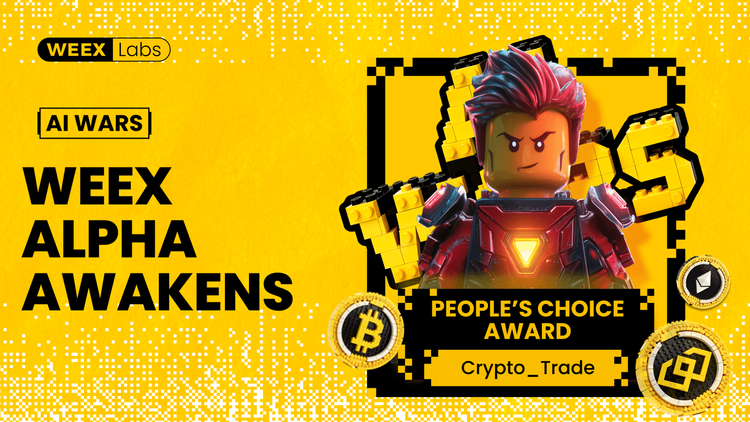
How a Structured AI Crypto Trading Bot Won at the WEEX Hackathon
Crypto_Trade shows how structured inputs and controlled adaptability can build a more stable and reliable AI crypto trading bot within the WEEX AI Trading Hackathon, highlighting a practical path toward scalable AI trading systems.
Particle Founder: The entrepreneurial insights I have gained the most from in the past year
Stop lean startup, stop lightning entrepreneurship, and think carefully about what your product aspirations are.
Huang Renxun's latest podcast transcript: The future of Nvidia, the development of embodied intelligence and agents, the explosion of inference demand, and the public relations crisis of artificial intelligence
The competition in the future is not just about whose model is larger or whose computing power is stronger, but also about who understands the industry better, who can embed AI more deeply into real processes, and who can organize these capabilities into a runnable and scalable system.
OKX Ventures Research Report: AI Agent Economic Infrastructure Research Report (Part 1)
The existing infrastructure is hostile to the Agent economy. Agents can think and act independently at the "capability level," but at the "economic level," they are still locked into infrastructure designed for humans.
The migration of settlement rights: B18 and the institutional starting point of on-chain banks
In the traditional system, banks decide the settlement; in the on-chain system, code begins to take over this responsibility.
From Tencent and Circle: Looking at the Simple and Difficult Questions of Investment
The AI narrative continues to ferment, but the recent performance of related stocks varies, with some in the midst of summer and others as if in winter.
The second half of stablecoins no longer belongs to the crypto circle
What Coinbase doesn't want, Mastercard is eager to buy.


 App
App