
 Buy Crypto
- Markets
 Futures
- Spot
- Copy Trade
- Earn
- More
「Antique Stablecoin」 Depegs Overnight, Evaporating $18 Million: Can Synthetix’s sUSD Still Buy the Dip?



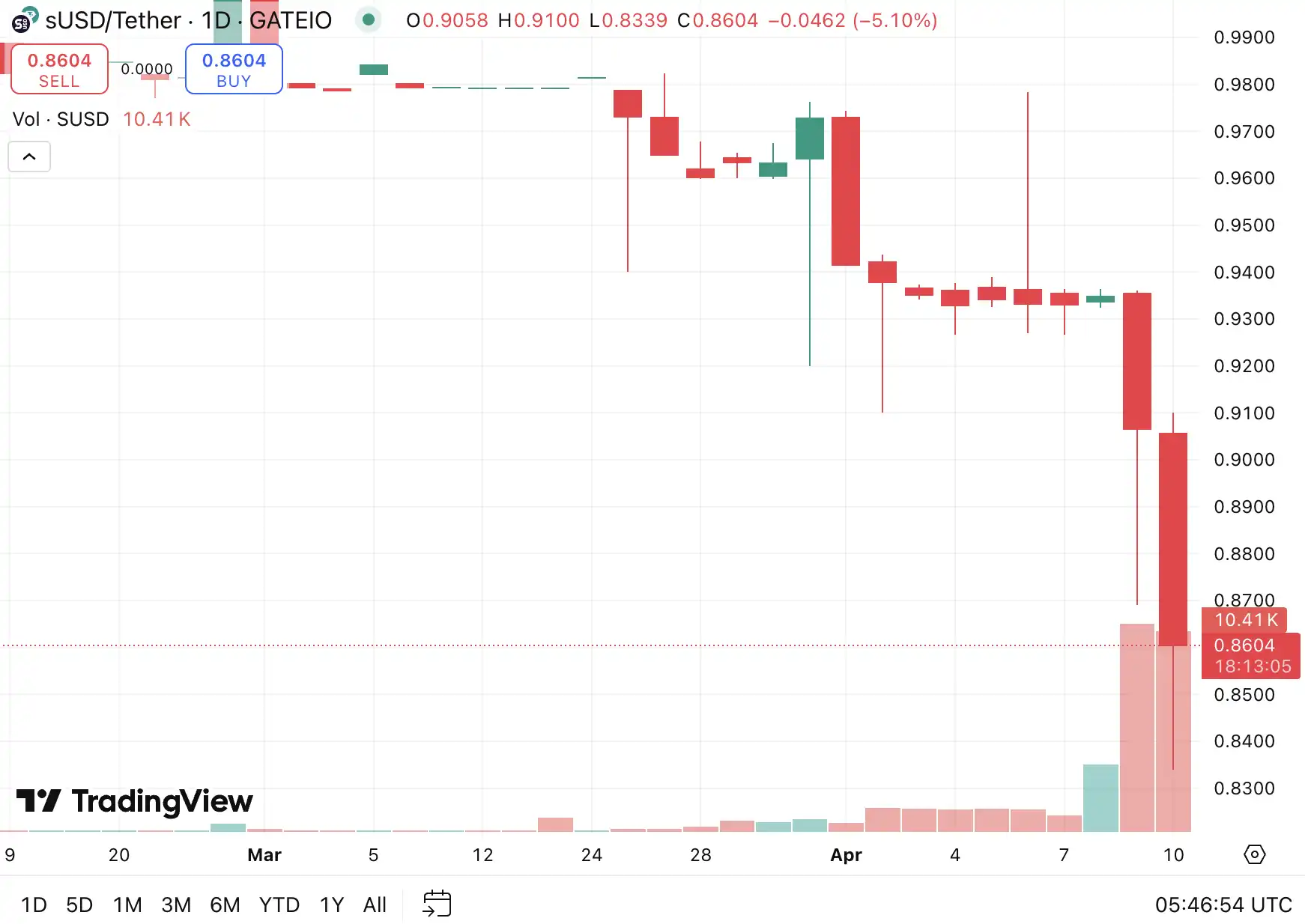
The crypto world is ever-changing, and the "stability" of stablecoins often faces many challenges. On April 10, the stablecoin sUSD in the Synthetix ecosystem experienced a significant deviation from its peg, with the lowest price dropping to $0.834 and currently trading at $0.860, deviating approximately 8% from its $1 anchor. This swift fluctuation quickly sparked community discussions, with many expressing concerns that this could signal a new stablecoin crisis.
Mechanism Upgrade Leads to Short-Term Deviation
Following the event, Synthetix founder Kain Warwick explained the incident via X platform and disclosed that he had sold 90% of his ETH holdings, increasing his SNX position. Warwick stated that the sUSD deviation was not a sign of systemic crisis but rather a temporary "side effect" caused by a crucial mechanism upgrade in Synthetix.
This should be the second deviation event in sUSD history. The last time was on May 17, 2024, although the reasons were different. According to the blockchain security firm Chaos Labs, last year's deviation was mainly due to a large sBTC/wBTC liquidity provider suddenly withdrawing funds, redeeming sUSD through Synthetix's spot synthetic redemption mechanism, and causing a massive sell-off in the related Curve liquidity pool.
For a long time, sUSD's peg relied on a complex debt management mechanism: users collateralize the native token SNX to mint sUSD, and the system maintains its 1:1 peg to the dollar through high collateralization ratios and debt adjustments. With the adjustment of Synthetix's strategic direction, this old mechanism has been gradually removed, replaced by a more efficient, decentralized new system—the "420 Pool" under the SIP 420 proposal. The transition from the old to the new mechanism inevitably brought transitional pains, and the short-term deviation of sUSD is a manifestation of this process.
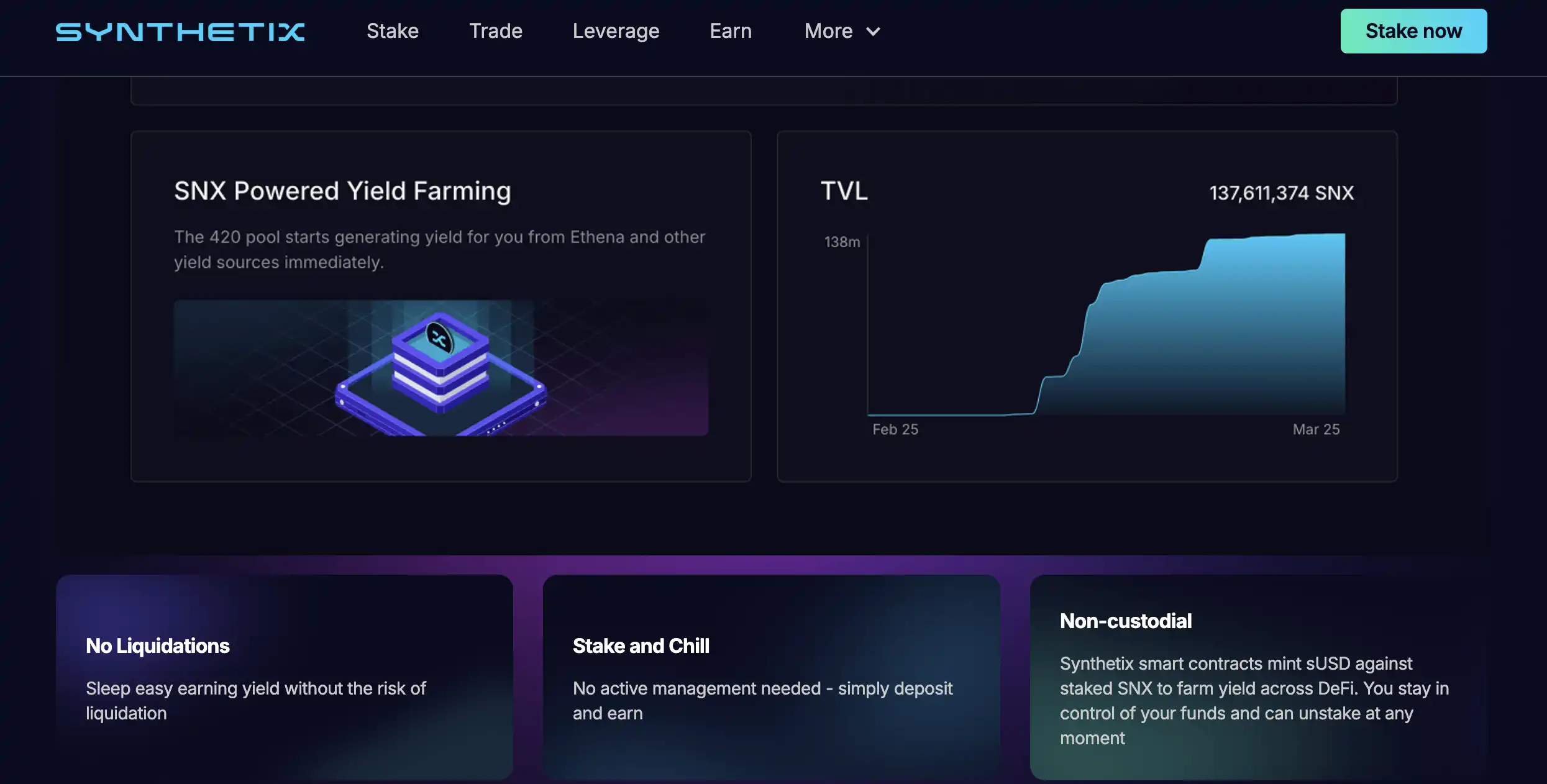
Specifically, under the old mechanism, when the sUSD price dropped below $1, collateralizers could profit by buying back sUSD at a discount and burning debt, naturally driving the price back up. However, with the abandonment of the old mechanism and the new mechanism not yet fully in place, the excess sUSD liquidity in the market temporarily lost effective regulatory means, putting pressure on the price. Warwick emphasized that this volatility is only temporary, and once the new debt management system is fully deployed, the long-term stability of sUSD will be significantly improved. Warwick reiterated the nature of sUSD as a collateralized stablecoin whose value is supported by assets such as SNX, rather than relying on a complex algorithm to adjust supply and demand, fundamentally different from the algorithmic stablecoins that once collapsed.
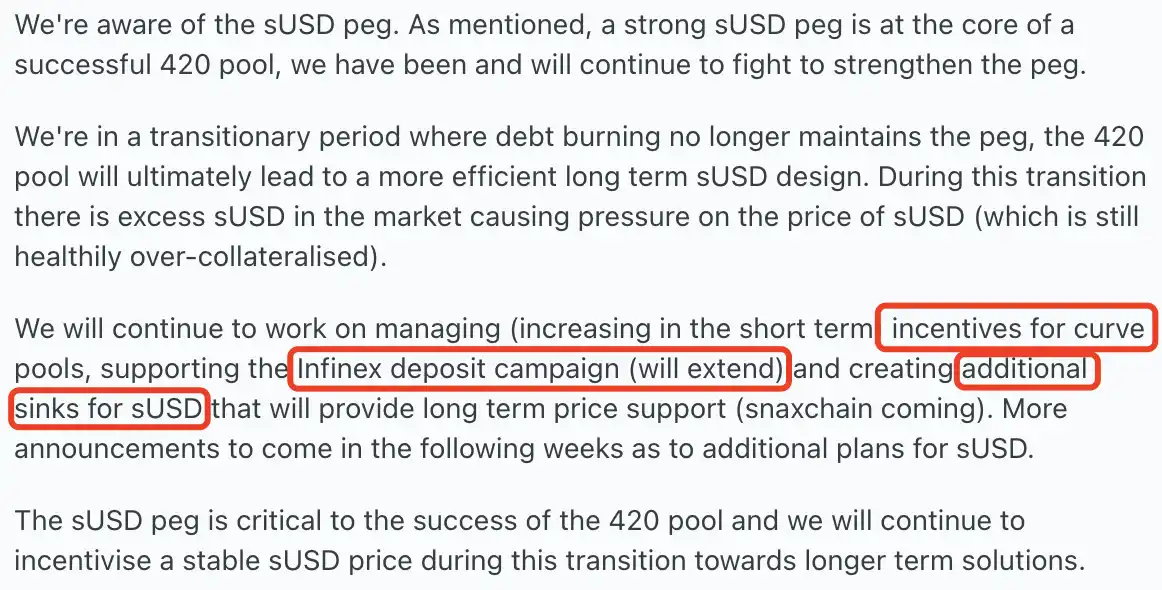
For SNX holders and sUSD users, the team has also developed a detailed plan for the transition period. The Synthetix team further elaborated on the contingency measures through Discord, including strengthening incentives for the Curve liquidity pool in the short term, extending support for Infinex deposit activity, and building a long-term price support system for sUSD.
Attention on "Ancient Stablecoin" Unpegging, What Has Synthetix Been Up to Lately?
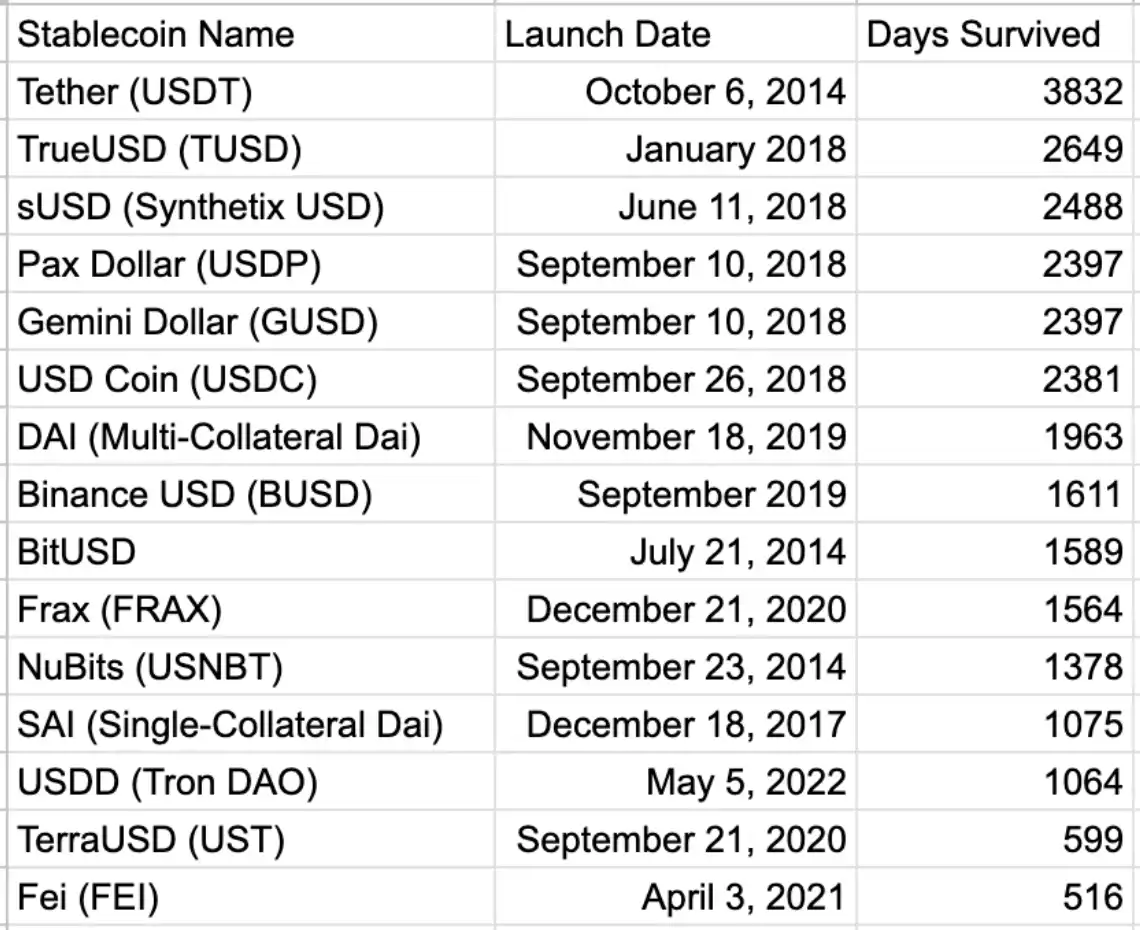
To further understand the current situation of sUSD, let's first review the development history of stablecoins. The origin of stablecoins can be traced back to 2014, a year that witnessed the birth of the first stablecoins: Tether's USDT, BitShares' bitUSD, and Nubits. Although bitUSD and Nubits did not stand the test of time and gradually faded into history, USDT has survived to this day due to its first-mover advantage and strong market adaptability, becoming the world's largest stablecoin by trading volume. The success of USDT has not been without challenges, as its price experienced a significant decoupling in 2017. However, to this day, USDT still holds the top position in the stablecoin market.
2018 was another pivotal year in the development of stablecoins. DeFi emerged, giving rise to several iconic stablecoins. MakerDAO's DAI, Synthetix's sUSD, and Terra's UST made their debut. Meanwhile, the CeFi sector witnessed a second wave of stablecoin craze, including Circle's USDC, TrueUSD (TUSD), Gemini's GUSD, and Paxos' PAX. These projects each had their own characteristics: DAI achieved decentralized anchoring through overcollateralized ETH, sUSD supported a synthetic asset ecosystem with a high collateralization rate through SNX, and USDC boasted a redeemable fiat reserve as its selling point. In this history, different types of stablecoins gradually diverged into two main paths: collateralized and algorithmic. Collateralized stablecoins are backed by real-world assets for higher stability but are susceptible to fluctuations in collateral prices. On the other hand, algorithmic stablecoins adjust supply and demand through smart contracts to maintain peg, theoretically offering greater capital efficiency but are prone to losing control during market volatility.
In 2021, DeFi projects widely recognized the strategic value of proprietary stablecoins, and many protocols began to vigorously develop stablecoin ecosystems. However, Synthetix chose to gradually marginalize sUSD, a decision that is undoubtedly a significant mistake in today's context. The SIP 420 proposal passed in early 2025 brought new opportunities for sUSD. The new mechanism introduced a collective pool model, reduced the collateralization ratio to 200%, and planned to forgive $62 million in historical debt over 12 months, significantly improving capital efficiency and system security. With the old debt destruction mechanism obsolete and the new stable module not yet fully in place, the current unpegging is a result of the transitional period.
Looking around, the competition in the stablecoin space remains fierce. Although sUSD is still the third oldest stablecoin in the cryptocurrency realm, albeit not as prominent as before, its longevity (i.e., Lindy effect) has endowed it with unique resilience. The current mechanism adjustment may just be another upgrade on its evolutionary path.
In the short term, the price of sUSD may continue to fluctuate within a 5-10% discount range, but with ample reserves in its treasury, the likelihood of a complete collapse is low. In the long run, with the implementation of a new mechanism, sUSD is expected to regain its footing in the Synthetix ecosystem. The history of stablecoins tells us that the real strong ones are often survivors who constantly adjust amidst the storms.
You may also like

L1 is dead, Appchain should rise

5 Best AI Agents in 2026: A Beginner's Guide to Crypto's Autonomous Future
Discover the 5 best AI agents in crypto for 2026. Learn how DeFAI agents differ from trading bots and explore top projects like OpenClaw, Virtuals Protocol, and ElizaOS.

Morning News | Kelp DAO suffers an attack with losses of approximately $292 million; RaveDAO responds to rumors of price manipulation; Michael Saylor releases more information related to Bitcoin Tracker

Crypto ETF Weekly | Last week, the net inflow for Bitcoin spot ETFs in the U.S. was $996 million; the net inflow for Ethereum spot ETFs in the U.S. was $275 million

This Week's News Preview | 2026 Hong Kong Web3 Carnival officially held; Trump hosts luncheon for TRUMP token holders

a16z New Post: Predicting the Market, Entering the Fast Forward Phase

Arthur Hayes New Post: It's Now "No Trade" Time
a16z New Article: Predictive Markets Entering Fast-Forward Phase

a16z founder: In the age of Agents, what truly matters has changed

The President of Kyrgyzstan meets with Sun Yuchen, and TRON collaborates with Kyrgyzstan to build a new pattern of digital economy in Central Asia
46 minutes, $292 million stolen, DeFi faces development dilemma again

How to Earn Free USDT in 2026: No High Volume Required (WEEX Poker Party Guide)
Is Joker Crypto legit in 2026 or just another memecoin? Can You Really Earn Passive Income with Joker Crypto in 2026? Learn how Joker staking rewards work, how to earn NFT bonuses, expected APY ranges, gas-fee rebates, and how to avoid crypto scams before joining.

How to Get Free USDT Welcome Bonus in 2026: Earn Up to 700 USDT on WEEX
Legit Free Welcome Bonus 2026: Learn how to earn up to 700 USDT on WEEX with Auto Earn Boost Fest. Increase your balance, activate Auto Earn, and qualify automatically.

AI Agent Payments Just Got Real: Utexo × x402 Brings 50ms USDT Transactions to Internet Scale
Utexo integrates USDT into the x402 protocol, enabling 50ms instant payments embedded natively in HTTP requests. Explore how this breakthrough is rewriting the rules for AI agent payments, API monetization, and the machine-to-machine economy.
DWF Deep Report: AI in DeFi Outperforms Humans in Yield Optimization, but Complex Trades Still Lag Behind by 5 Times

What Separates Smart Money from the Crowd in Crypto? Insights from Freedom of Money
Most crypto traders lose money not because of bad luck, but because they misunderstand how the market really works. From Freedom of Money to the rise and fall of Sam Bankman-Fried, they highlight a key divide in crypto: those who build the market and those who chase it. This reading guide explores essential books that reveal how narrative, regulation, capital, and psychology shape long-term success in the crypto industry.

The Risk Management Core Team has just been ousted, and Aave is now facing a $200 million default.

The $293 million bug wasn't in the code; so, what's the deal with the "DVN Configuration Bug," which led to the largest hack of 2026?
L1 is dead, Appchain should rise
5 Best AI Agents in 2026: A Beginner's Guide to Crypto's Autonomous Future
Discover the 5 best AI agents in crypto for 2026. Learn how DeFAI agents differ from trading bots and explore top projects like OpenClaw, Virtuals Protocol, and ElizaOS.



 App
App