
Being Long 50x Results in $2M Profit: How Did the Hyperliquid 'Insider' Pull It Off?

 Prefer us on Google


What started as an uneventful afternoon with CPI data quickly escalated when the highly anticipated HyperLiquid whale "Insider" once again single-handedly disrupted almost half of the Ethereum smart contract market, capturing the attention of the entire network.
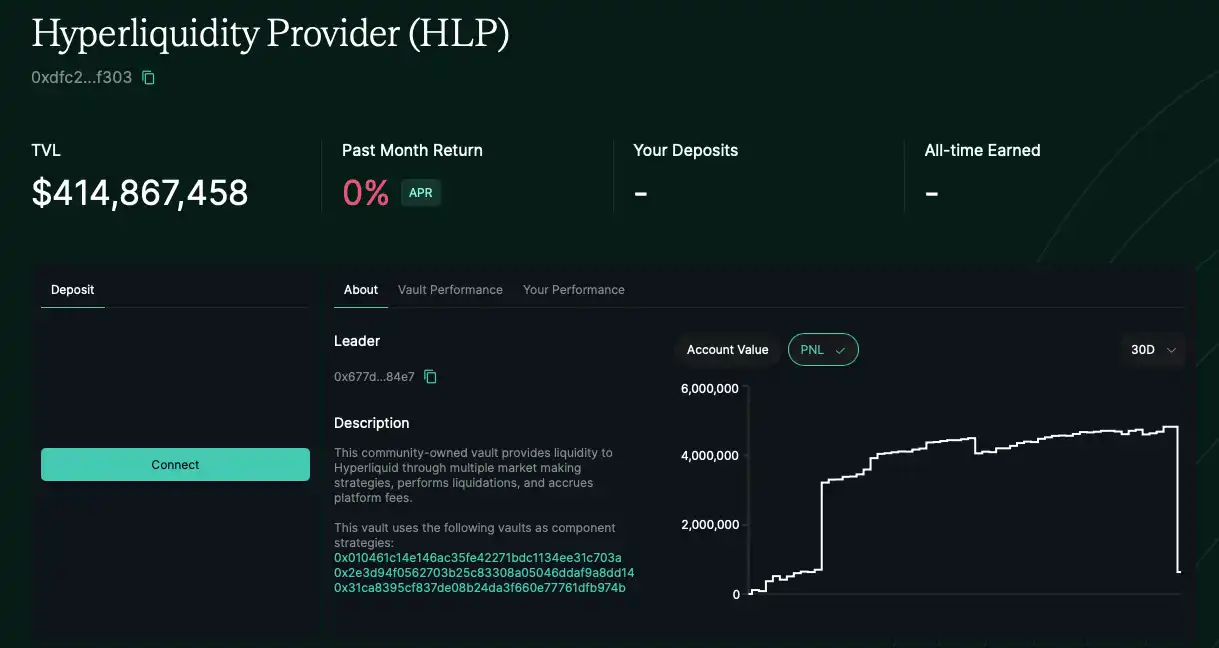
According to official data, due to the long and liquidation operations of the address starting with 0xf3 (hereinafter referred to as the Insider), the HyperLiquid treasury of HLP (Hyperliquidity Provider) suffered a short-term loss of over $4 million.
Related Reading: "Retrospect of HyperLiquid Contract Whale Insider's Market Manipulation, Precise Long and Short Opening and Closing"
So how did this address, once seen by the community as having ultimate insider information, operate, and how did this whale drain liquidity from HyperLiquid? BlockBeats has combined whale operation interpretation and community analysis to outline the specific transaction path and arbitrage strategy.
One Person Drains $4 Million from HyperLiquid, What Did the Insider Do?
On the afternoon of March 12, the Insider (address: 0xf3f496c9486be5924a93d67e98298733bb47057c) deposited $5.22 million into HyperLiquid and opened long positions for ETH and BTC at 50x leverage at prices of $1,884.4 (liquidation price $1,838.2) and $82,003.9 (liquidation price $61,182), respectively. In the previous two days, this Insider executed two ETH ultra-short-term long operations with a 100% win rate, netting $2.2 million.
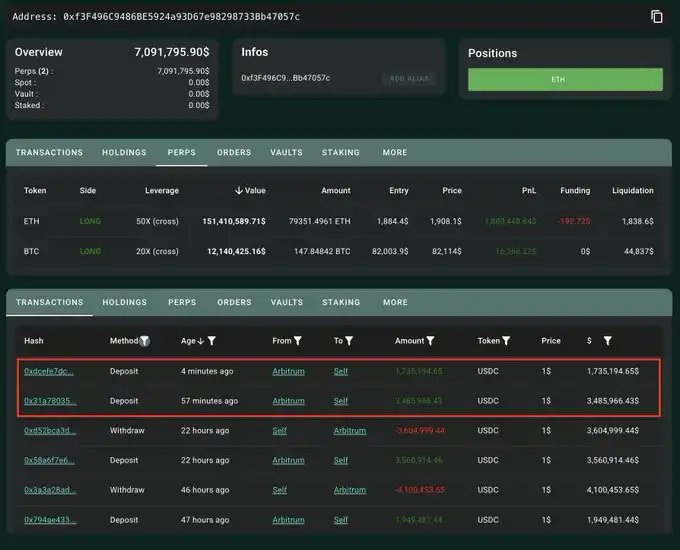
Subsequently, the Insider increased their ETH long position to 72,924.87 coins, worth approximately $138 million, reaching their personal record for the highest single-coin holding. A series of aggressive opening operations brought their unrealized gains to $993,000, but only $29 away from the liquidation price.
Next, the Insider converted all their BTC positions to ETH longs and further bridged $10 million to HyperLiquid as collateral, placing a long order for 5,508.08 ETH at a price of $1,921. At this point, they transferred a total of 15.23 million USDC to HyperLiquid as collateral, increased their ETH long position to 140,000 coins, valued at $270 million, accounting for 24.65% of HyperLiquid's ETH contract total position ($1.1 billion), with an unrealized gain of $3.1 million.

Up to this point, the "Insider" has been operating normally, with a liquidation price of $1,877, below the market price. However, he soon began a jaw-dropping maneuver that shocked everyone.
According to Hyperscan data, the Insider made three consecutive actions at 17:08: liquidation, liquidation, then being liquidated, and subsequently withdrew around $8 million USDC. The price of ETH also plummeted due to this whale trader's liquidation, dropping from around $1,970 to near $1,910 within just 5 minutes.
However, what caught the community's attention was not the massive fluctuation in ETH's price. Even in a highly leveraged situation, the Insider's liquidation price was around $1,877, still a distance from the market price of $1,970.
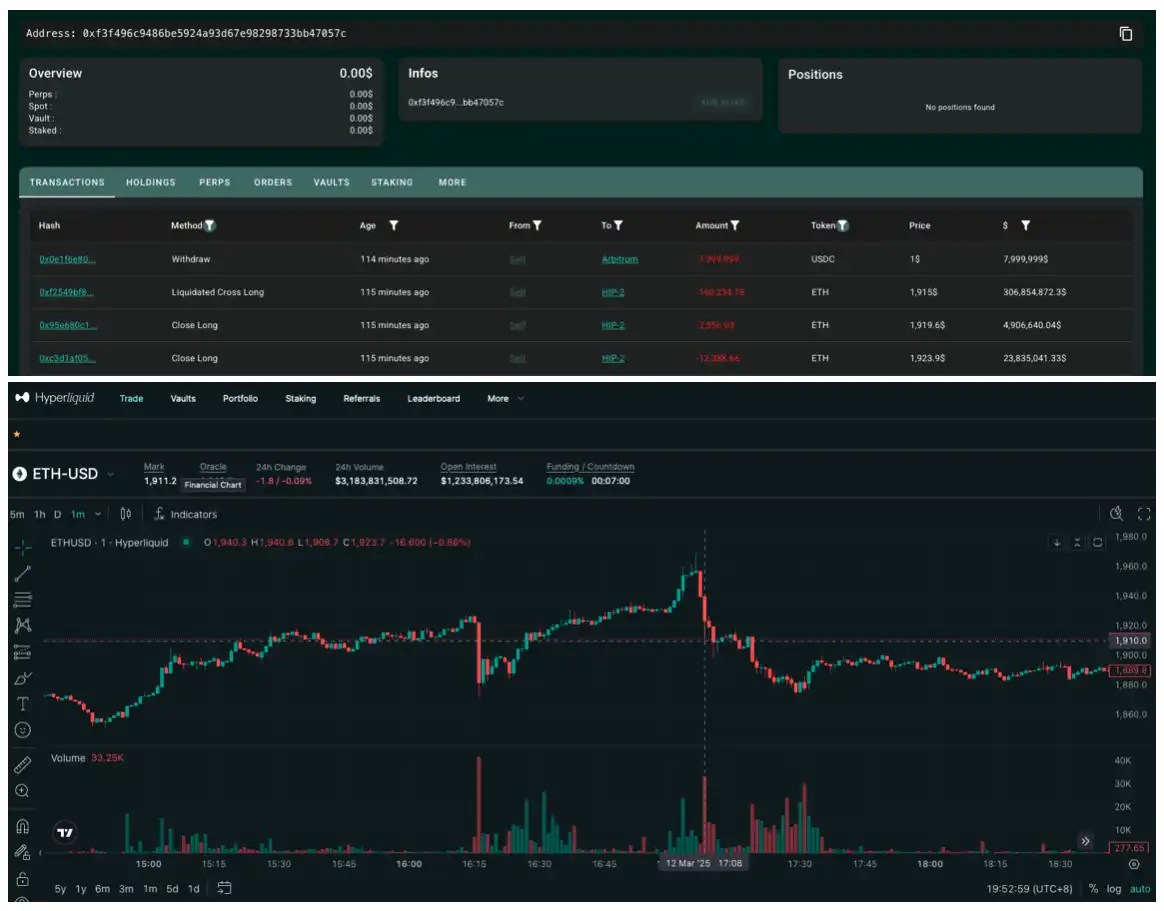
Why did this happen? Upon closer inspection of Hyperscan data, we discovered that the Insider had staged a retro-style "Asset Walkthrough" on-chain.
According to Hyper's blockchain records, while the Insider's long positions were not closed, he made three withdrawal attempts at 17:05. The first attempt failed, showing "Withdrawal amount exceeds single transaction limit" on the front end. The Insider then split the total amount of over $17 million USDC into two transactions of $8 million and $9 million to withdraw the funds.
This exceeded the approximately $15 million collateral provided by him for this operation by nearly $2 million. In other words, with all remaining positions liquidated, the Insider had securely locked in profits of nearly $2 million.
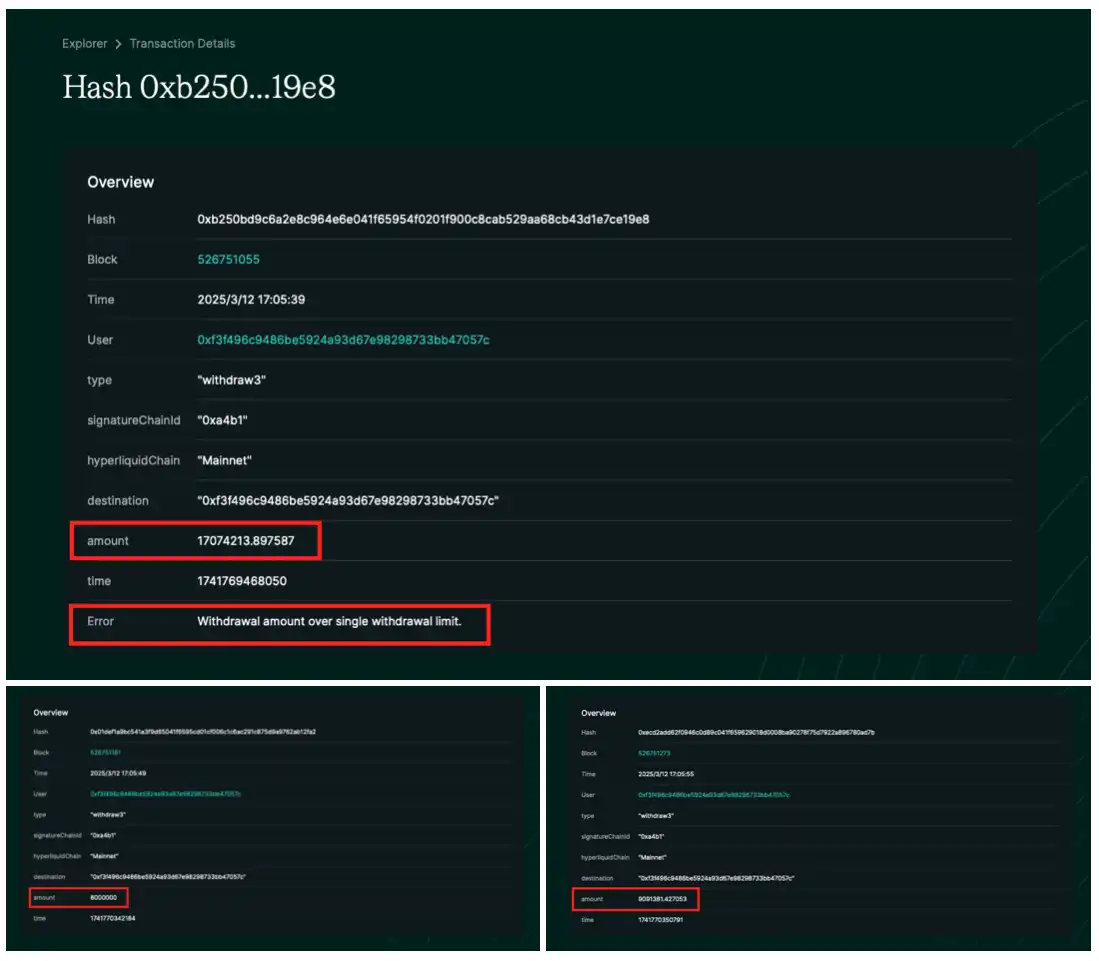
After a large amount of collateral was withdrawn, the liquidation price of the Insider's position quickly rose. At 17:08, over 100,000 ETH long positions were liquidated at $1,915, taken over by the Hyperliquid treasury to complete the liquidation. However, due to the substantial amount involved, the liquidation process resulted in continued ETH price drop losses, ultimately causing HLP to bear the entire loss of approximately $4 million.

After 7 Years, Perp DEX Leader Still Pays the "Tuition Fee"
Shortly after the liquidation event, Hyperliquid released a statement announcing that the maximum leverage for BTC and ETH would be updated to 40x and 25x, respectively, to increase the maintenance margin requirement for larger positions, providing better cushioning for larger position liquidations.
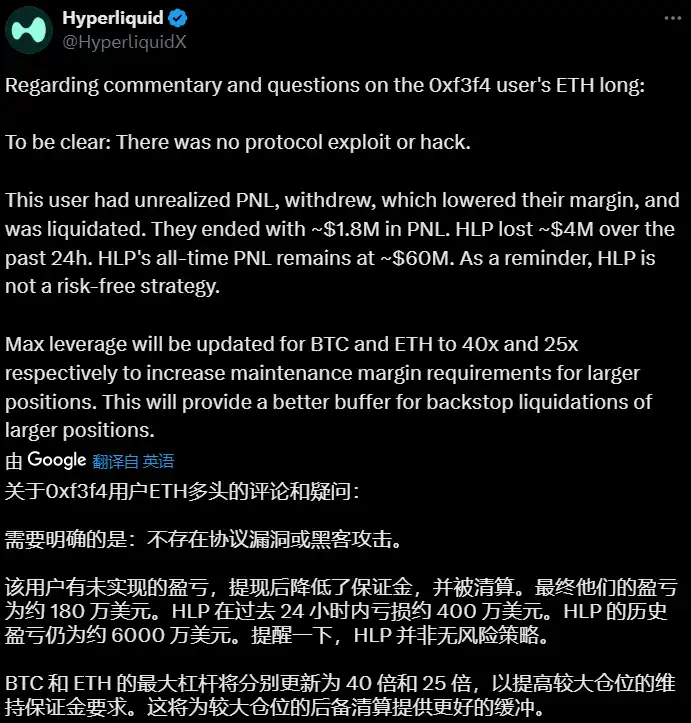
While people marveled at the "insider brother" manipulation, another point that intrigued many community members was: why should Hyperliquid bear the losses when others are liquidated?
HLP is essentially a liquidation fund, with the biggest potential victims being the deposit users of HLP. The main issue that led to this significant hyperliquid loss was the ability to freely withdraw unrealized profits. In addition, there was no restriction on opening leveraged positions with large orders, and the HLP insurance pool would take over the liquidated positions at a fixed price.
Currently, withdrawing unrealized profits is not allowed in most CEXs. Unrealized profits are considered unrealized gains, and withdrawing them without closing the contract is equivalent to advance profit-taking. Large unrealized profits being withdrawn in a short time can easily create significant liquidity risks.
Hyperliquid's liquidity mainly comes from Binance and some other exchanges' external accounts. Since there is no mechanism for positions being passed on in case of liquidation, after Hyperliquid takes over the liquidated orders, they are traded on the secondary market. The reason why the liquidation of 160,000 ETH did not crash the price is that this liquidation was conducted off-exchange and did not appear on the order book but was directly bought by the HLP fund. In the past, with small position liquidations, HLP could take advantage of the price difference after taking over the liquidation. However, this time, the amount of the liquidation was too huge, resulting in a massive loss for HLP after taking over.
Regarding this incident, the well-known KOL Foolish Dragon King explained why CEXs do not allow the withdrawal of unrealized profits. In his tweet, he mentioned that exchanges did not have a liquidation takeover mechanism in the past, and the liquidated positions were directly placed on the market depth. If the liquidated order was not closed, it would be a position transfer, which would be settled in the next settlement period, either downward or upward.
In July 2018, OKX encountered a whale who leveraged 20x from $7,000 BTC to go long and aggressively drove the price up to $8,400, then withdrew all the margin, causing the order to be liquidated. 50,000 unfulfilled BTC sell orders were directly placed at $8,020. If it continued to drop, short positions would profit more than long positions, and all short holders would collectively share the loss from the position transfer. Since then, OKX's futures system has gradually improved, prohibiting moving margin based on unrealized profits to limit such position transfer risks.
Before the liquidation event, HLP's liquidity providers were enjoying approximately a 20% APY. However, this significant loss caused all the liquidity providers to lose all their earnings from the previous month in just a few minutes. This also highlights the risks of investing in DeFi, as liquidity pools are susceptible to price manipulation. The smaller the pool, the greater the risk of price volatility and impermanent loss. Even a relatively liquid pool like HLP struggled to withstand the impact of a black swan event.
Therefore, not all mining opportunities with an APR are stable investments. Once the principal is at risk, withdrawal becomes the primary option.
From the perspective of the recent hyperliquid liquidation event, both HLP and its users suffered significant losses. Investing in DeFi is a high-yield but high-risk endeavor. While the main reason behind this substantial loss was the inadequate contract oversight by the platform, it exposed the immaturity of DeFi, leaving room for undiscovered vulnerabilities to be exploited. Fortunately, this event did not deal a devastating blow to the market. It served as a wake-up call for institutions, liquidity providers, and retail investors alike, reminding all participants to enhance risk management practices and scrutinize protocol vulnerabilities. It's never too late to mend the pen after the sheep are lost.
-- Price
This content is provided for general informational purposes only and doesn't constitute financial, investment, legal, or tax advice. Any events, rewards, online promotions, or related information mentioned herein should not be considered a recommendation, solicitation, or invitation to purchase, sell, trade, or otherwise deal in any crypto assets. Crypto assets are highly volatile and may result in loss. The availability of WEEX services, products, and related events may vary by region. You are responsible for ensuring that your participation is in accordance with applicable local laws and regulations.
You may also like
Einride Plans to Purchase 500 Tesla Semis to Expand Fleet

39,798 Users' Information Compromised at SafePal

Vitalik Buterin Hopes Ethereum Can Achieve Coexistence of UTXO Style and Dynamic State
iPhone X Becomes Obsolete, Apple Stops Service

State Machine Replication Revisited as the Root of Blockchain Technology
Changes to the Salary System in the State Water Agency to Retain Specialists

Trezor Customer Data Exposed Due to ShipMonk Vulnerability, Affecting Users in 7 Countries

Citigroup Maintains Buy Rating on Nebius with Target Price of $278
HJ Heavy Industries Reports Operating Profit of 89.4 Billion Won in First Half of Year

Ministry of Defense Codifies TAF Kolibri-i10 Interceptor Drone: Specifications and Price
fixCleanup3_3_0 Amendment: Strengthening Vault and Loan Verification
Over 11,214 Entrepreneurs Received Tax Benefits Due to the War

Samsung Electro-Mechanics Delays Semiconductor Glass Substrate Investment, Affects GlaSSEM Production Line Construction

OpenClaw Manipulates Waiting List by Cancelling Gym Reservations

GIS Expands Gumi Production Line Due to Increased Orders for AI-oriented MLCCs
Gemini Launches Combo RFQ Sandbox Beta for Prediction Markets

Nasdaq Acquires LeveL Markets to Expand Stock Trading Infrastructure

xStocks Lists 5 Stock Tokens on Hyperliquid
Bybit Sues North Korea Over 1.5 Billion Dollar Hack, Freezes Assets
iPhone 18 Pro Material Costs Expected to Rise by 38%, Memory Share Increases to 34%
Hasu Claims Ethereum's Issue is Insufficient Ecosystem Investment

SK Hynix Acquires $7 Billion to $28 Billion in South Korean Bonds

Perplexity Wins Appeal Against Amazon in AI Shopping Lawsuit

Operation Blackout Seizes Over $15 Billion in Cryptocurrency
Defense Enterprises Must Confirm Critical Status by August 10
Bitcoin ETF: A Paradigm Shift for Investors
Li Qiang Signs State Council Order to Announce Revised Regulations on the Protection of Integrated Circuit Layout Designs
US Treasury May Use Euros to Intervene in Yen
Hu Xiaowei of Prince Group Deported to the United States
Three Factors for Bitcoin's Rise: AI, Regulation, and Options
Einride Plans to Purchase 500 Tesla Semis to Expand Fleet
39,798 Users' Information Compromised at SafePal
Vitalik Buterin Hopes Ethereum Can Achieve Coexistence of UTXO Style and Dynamic State
iPhone X Becomes Obsolete, Apple Stops Service
State Machine Replication Revisited as the Root of Blockchain Technology
Changes to the Salary System in the State Water Agency to Retain Specialists


