
 Buy Crypto
- Markets
 Futures
- Spot
- Copy Trade
- Earn
- More
Binance Research Airdrop Report: How to Successfully Airdrop?

Original Article Title: "Decoding Binance Research Institute's Airdrop Report: From Simple Distribution to Complex Game Theory, Where Is the Future of Airdrops?"
Original Source: DeepTech TechFlow
If there are still newcomers entering the industry, then airdrops are most likely still their first stop.
From simple airdrop farming to complex interactions between projects and users, airdrops have gradually become a mix of love and hate.
For users, the love comes from successful airdrops bringing significant rewards, but the hate stems from complex rules, tedious tasks, and even opaque distribution mechanisms;
For projects, the love is that airdrops can still bring short-term traffic and attention, but wash trading and declining community trust also give them a headache.
People change.
After experiencing multiple rounds of bull and bear markets, cryptocurrency market users still hold on to the expectation of a "free lunch," but their behavior has become more rational. Projects have gradually realized that simple airdrops can no longer meet the needs of community development, and they are now attempting more complex and transparent distribution mechanisms.
For example, Hyperliquid's airdrop was highly praised for rewarding early users, while Redstone's airdrop sparked strong community opposition due to a last-minute change in the distribution ratio.
It's already 2025, can airdrops still play their role?
Recently, Binance Research Institute released a report titled "Where Are Our Airdrops Going?" providing us with an in-depth view. By analyzing the current status, issues, and improvement directions of airdrops, perhaps both projects and users can find better solutions.
DeepTech TechFlow has organized and summarized the core content of this report, with key points as follows.
Key Points
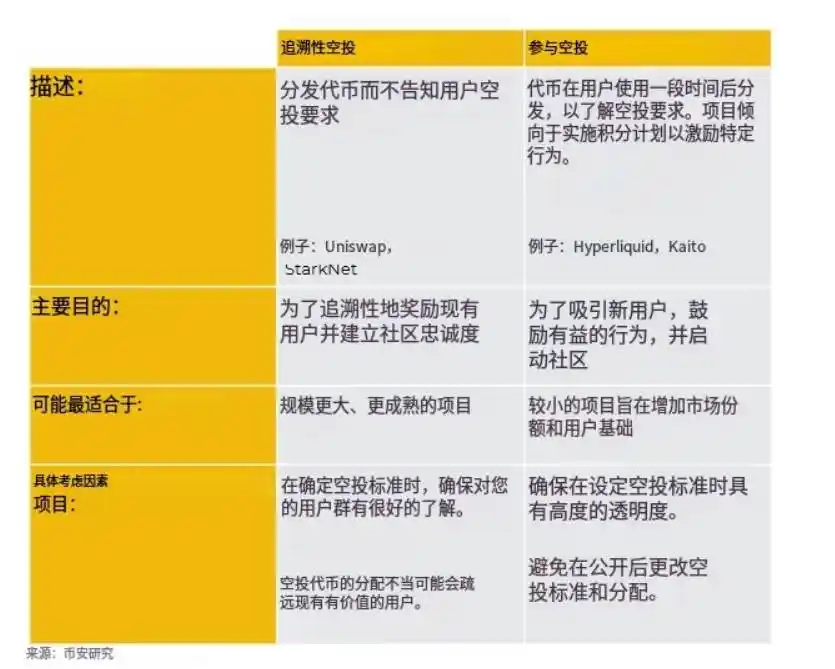
Although the airdrop model still has many shortcomings, its position in the industry cannot be ignored. The two popular classifications of airdrops are:
· Retroactive Airdrops: Mainly reward existing users based on their historical behavior to distribute tokens, aiming to enhance community loyalty.
· Engagement Airdrops: By notifying users in advance and setting task incentives, they attract new users and increase project exposure. It is more suitable for early-stage projects to seize market share and build the initial user base.
· Areas for Improvement: Clear distribution rules and standards help reduce user dissatisfaction and misunderstanding. Project teams need to listen more to the community's voice. Avoid excessive biasing of resources towards internal teams or whales to avoid harming the interests of regular users. The introduction of on-chain monitoring tools and "human identity verification" technology is expected to reduce airdrop gaming behavior, making airdrops more fair and efficient.
Through these key points, the report provides us with a clear framework to help us understand the current state of airdrops and possible future directions.
From Simple Distribution to Complex Game
Since the first airdrop event in 2014, airdrops have a 10-year history in the industry.
The first notable airdrop was Auroracoin in 2014, which aimed to promote the national cryptocurrency to Icelandic residents. At that time, users only needed to enter their national identity number on the Auroracoin website to claim the tokens.
By comparison, the Hyperliquid HYPE airdrop (November 2024) may be one of the largest and most well-received airdrops to date, further solidifying airdrops as a powerful tool for user engagement. With a peak valuation exceeding $100 billion, the HYPE token airdrop surpassed Uniswap to become the largest airdrop calculated by peak price.
However, in response to increased front-running, the project team has also increased the complexity of qualifying for the airdrop.
Unlike early airdrops, today's airdrops usually require users to complete multiple tasks, such as using testnets, participating in social media activities, engaging in governance, downloading mobile applications, and cross-chain fund transfers. These necessary operations often directly benefit the project, such as increasing on-chain activity or enhancing social media exposure.
Current airdrops can be divided into the following two parts.
Type 1: Retroactive Airdrops
Some earlier airdrops, such as Auroracoin, Uniswap, and StarkNet airdrops, did not publicly disclose any relevant information before allocating the airdrop; the purpose was to reward existing community users and enhance their loyalty.
Characteristics:
More user-centric and usually implemented by protocols that already have a large user base and market share. They do not need airdrops to kickstart the initial user group.
Use Cases: Mature protocols used to reward existing users and strengthen community relationships.
Type 2: Engagement Airdrops
By informing users of an upcoming token generation event, incentivizing user participation in specific activities.
· Features:
More project-centric. Mainly used to attract new users and help the project gain initial market share. Often incentivizes user behavior through programs such as point systems.
· Typical Examples: Redstone, Kaito, and Hyperliquid.
· Use Cases:
Emerging projects that need to remain competitive through airdrops and competition protocols (may also use token incentive mechanisms).
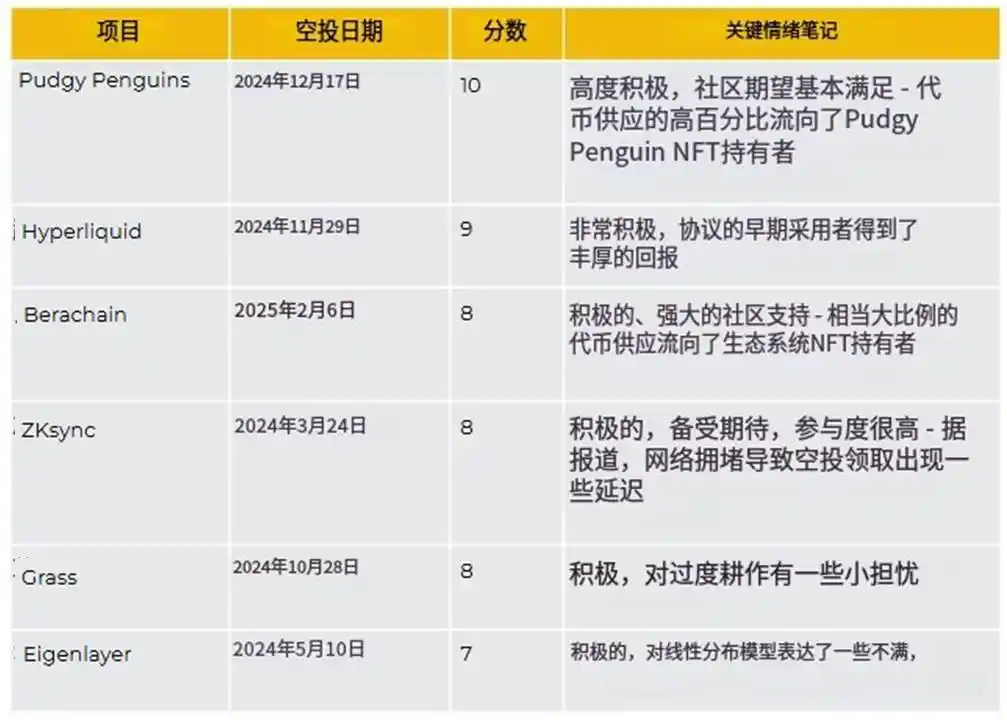
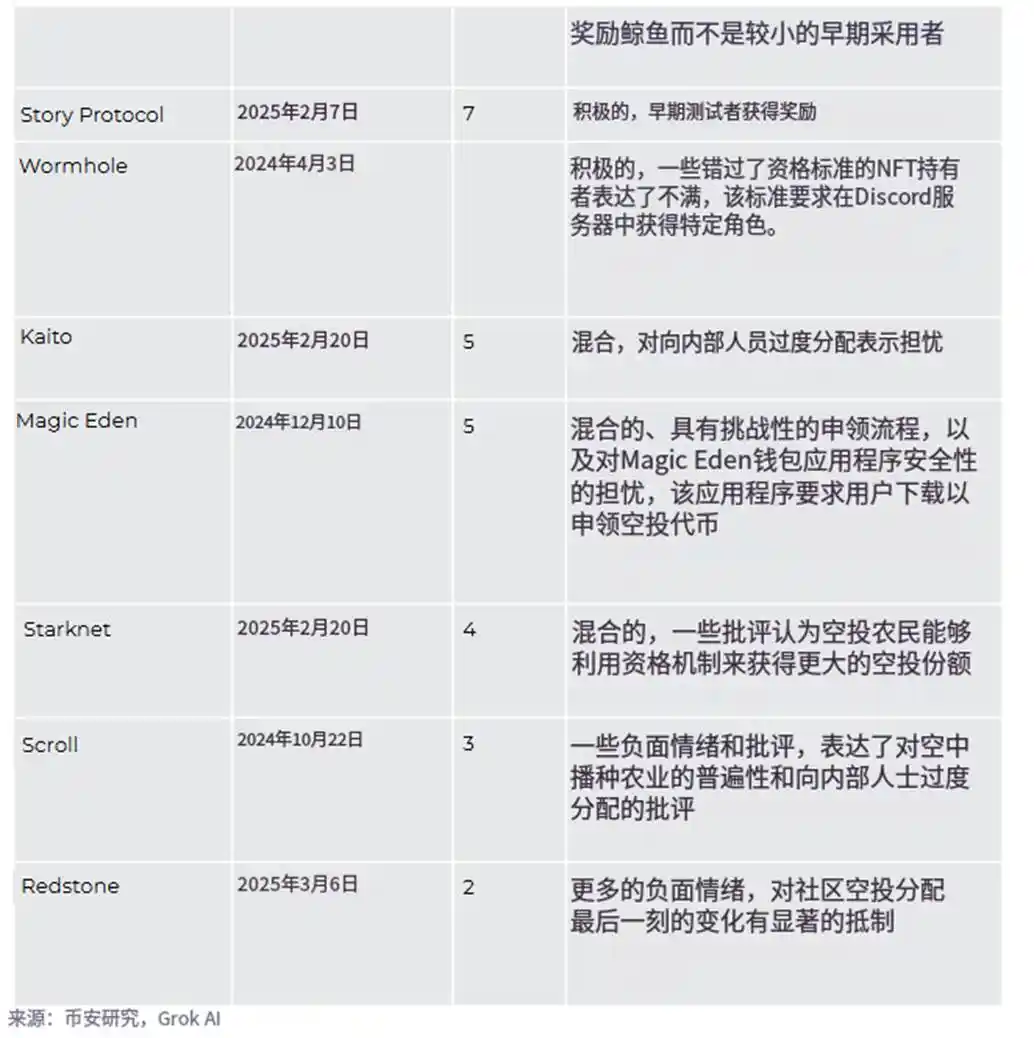
Sentiment Analysis of Token Airdrops in the Past Year
To better understand the recent development of airdrops, this report also utilized Grok AI to conduct a brief sentiment analysis of some significant airdrops in the past year, providing ratings.
Source of sentiment analysis: Posts on X, including but not limited to community feedback, the ratio of positive to negative comments, interaction levels, and specific criticism or praise content.
Grok also reviewed official announcements in online articles, tokenomics, and airdrop eligibility criteria. Sentiment was categorized as positive, negative, or mixed based on the dominant reaction.
Below is the original table from the report, which was translated using AI. Some text may contain ambiguity; however, the scores in the original table reflect the community's varying opinions on different airdrops, with higher scores indicating a more positive sentiment.
Experiences and Lessons from Past Airdrops
Last-Minute Reduction in Allocation
Some crypto projects initially promised to allocate a certain percentage of tokens to the community, but later reduced this percentage, reallocating tokens to insiders or the project treasury. Recently, the Redstone airdrop sparked strong community backlash as the team reduced the community allocation from 9.5% to 5% just before the token distribution date. Many community members viewed this behavior as unfair.
Lesson Learned
· Clearly Define Token Allocation Early: Clearly communicate the token allocation plan before the Token Generation Event (TGE).
· Avoid Last-Minute Changes: Try to refrain from making last-minute adjustments to the allocation.
· Consult Stakeholders When Necessary: If a change to the allocation is indeed necessary, avoid unilateral decisions. Discuss with key stakeholders (such as investors, the community, exchanges) and ensure thorough communication.
Opaque Qualification Criteria and Mismatched Expectations
Some projects conveyed unclear standards for airdrop eligibility, leading to uneven reward distribution that failed to accurately reflect users' actual activities. The October 2024 airdrop of Scroll (distributing 7% of its total SCR token supply, i.e., 70 million tokens) faced criticism due to its arbitrary snapshot mechanism and hidden rules.
Lesson Learned
· Clearly Communicate Allocation Rules: Ensure transparent rules to avoid leaving users with too much guesswork, which often results in misaligned expectations and reality.
· Guard Against Sybil Attacks: Consider using on-chain monitoring tools or Proof-of-Humanity tools to reduce abusive behavior.
Excessive Allocation to Insiders and KOLs
Many projects allocate a larger proportion of tokens to the team, investors, and VCs, leaving a smaller share for the community. For instance, in the February 2025 airdrop of KAITO, 43.3% of tokens were allocated to the team and investors, with only 10% allocated to the community, sparking public debate on the X platform.
Some projects allocate a significant amount of tokens to influencers, who may choose to sell immediately, thereby diluting the token's value and harming the interests of genuine users. Reportedly, KAITO also faced controversy for distributing a large amount of tokens to influencers, who sold the tokens shortly after the Token Generation Event (TGE), impacting the token price and eroding community trust.
Lesson Learned
· Exercise Caution in Allocation Ratios: Learn from token allocation outcomes of projects of similar scale or nature, and pay attention to the market's response to the allocation scheme.
· Implement Vesting Period and Lockup Mechanism: Implementing a vesting period and token lockup for insiders and influencers can reduce early sell pressure post TGE and better align their interests with the project's long-term goals.
Technical Barriers in the Claiming Process
A complex or buggy claiming process can hinder users from claiming tokens, effectively reducing the distribution amount and significantly undermining the intended purpose of the airdrop claiming process.
For example, the December 2024 airdrop by Magic Eden, which aimed to promote its mobile wallet app through the airdrop, reportedly resulted in user frustration rather than anticipation due to feedback on platform-related bugs and unclear instructions.
Learnings
Airdrop claiming is a key first touchpoint for many potential users. Ensure a seamless and user-friendly process to increase the likelihood of user retention.
How to Improve Airdrops?
Enhance Transparency
Set clear objectives: The project team needs to establish clear objectives for the airdrop or token incentive program and ensure these goals align with the project's long-term vision. Clear communication of objectives: Through clear communication, align community actions with the project's goals and vision to reduce dissatisfaction stemming from inconsistent behavior weight allocation.
Boost Community Engagement
The community is a project's core strength: Technology and products can iterate quickly, but community building takes time and patience. The project's long-term success relies on a strong and loyal community. Balancing transparency with engagement: Transparency is foundational, but transparency alone is not enough. The project team needs to engage the community more deeply in project development through interaction and feedback mechanisms to enhance a sense of ownership and loyalty. Challenges of user fluidity: The open crypto industry has lowered user switching costs, so projects must retain users through stronger community stickiness and a sense of ownership.
Enhance Monitoring Mechanisms
Some projects (like LayerZero) have already partnered with on-chain analytics companies (such as Nansen) to identify and exclude airdrop eligibility for "whale attackers" through on-chain data analysis.
As technology advances, on-chain monitoring tools will become more sophisticated and widely applied, making it easier for project teams to detect and mitigate malicious behavior.
"Proof-of-Humanity" tools are expected to help prevent airdrop abuse in the future while protecting user anonymity and privacy. Such tools may become a key means to address the gamification of airdrops issue.
You may also like

Consumer-grade Crypto Global Survey: Users, Revenue, and Track Distribution

Prediction Markets Under Bias

Stolen: $290 million, Three Parties Refusing to Acknowledge, Who Should Foot the Bill for the KelpDAO Incident Resolution?

ASTEROID Pumped 10,000x in Three Days, Is Meme Season Back on Ethereum?

ChainCatcher Hong Kong Themed Forum Highlights: Decoding the Growth Engine Under the Integration of Crypto Assets and Smart Economy

Why can this institution still grow by 150% when the scale of leading crypto VCs has shrunk significantly?

Anthropic's $1 trillion, compared to DeepSeek's $100 billion

Geopolitical Risk Persists, Is Bitcoin Becoming a Key Barometer?

Annualized 11.5%, Wall Street Buzzing: Is MicroStrategy's STRC Bitcoin's Savior or Destroyer?

An Obscure Open Source AI Tool Alerted on Kelp DAO's $292 million Bug 12 Days Ago

Mixin has launched USTD-margined perpetual contracts, bringing derivative trading into the chat scene.
The privacy-focused crypto wallet Mixin announced today the launch of its U-based perpetual contract (a derivative priced in USDT). Unlike traditional exchanges, Mixin has taken a new approach by "liberating" derivative trading from isolated matching engines and embedding it into the instant messaging environment.
Users can directly open positions within the app with leverage of up to 200x, while sharing positions, discussing strategies, and copy trading within private communities. Trading, social interaction, and asset management are integrated into the same interface.
Based on its non-custodial architecture, Mixin has eliminated friction from the traditional onboarding process, allowing users to participate in perpetual contract trading without identity verification.
The trading process has been streamlined into five steps:
· Choose the trading asset
· Select long or short
· Input position size and leverage
· Confirm order details
· Confirm and open the position
The interface provides real-time visualization of price, position, and profit and loss (PnL), allowing users to complete trades without switching between multiple modules.
Mixin has directly integrated social features into the derivative trading environment. Users can create private trading communities and interact around real-time positions:
· End-to-end encrypted private groups supporting up to 1024 members
· End-to-end encrypted voice communication
· One-click position sharing
· One-click trade copying
On the execution side, Mixin aggregates liquidity from multiple sources and accesses decentralized protocol and external market liquidity through a unified trading interface.
By combining social interaction with trade execution, Mixin enables users to collaborate, share, and execute trading strategies instantly within the same environment.
Mixin has also introduced a referral incentive system based on trading behavior:
· Users can join with an invite code
· Up to 60% of trading fees as referral rewards
· Incentive mechanism designed for long-term, sustainable earnings
This model aims to drive user-driven network expansion and organic growth.
Mixin's derivative transactions are built on top of its existing self-custody wallet infrastructure, with core features including:
· Separation of transaction account and asset storage
· User full control over assets
· Platform does not custody user funds
· Built-in privacy mechanisms to reduce data exposure
The system aims to strike a balance between transaction efficiency, asset security, and privacy protection.
Against the background of perpetual contracts becoming a mainstream trading tool, Mixin is exploring a different development direction by lowering barriers, enhancing social and privacy attributes.
The platform does not only view transactions as execution actions but positions them as a networked activity: transactions have social attributes, strategies can be shared, and relationships between individuals also become part of the financial system.
Mixin's design is based on a user-initiated, user-controlled model. The platform neither custodies assets nor executes transactions on behalf of users.
This model aligns with a statement issued by the U.S. Securities and Exchange Commission (SEC) on April 13, 2026, titled "Staff Statement on Whether Partial User Interface Used in Preparing Cryptocurrency Securities Transactions May Require Broker-Dealer Registration."
The statement indicates that, under the premise where transactions are entirely initiated and controlled by users, non-custodial service providers that offer neutral interfaces may not need to register as broker-dealers or exchanges.
Mixin is a decentralized, self-custodial privacy wallet designed to provide secure and efficient digital asset management services.
Its core capabilities include:
· Aggregation: integrating multi-chain assets and routing between different transaction paths to simplify user operations
· High liquidity access: connecting to various liquidity sources, including decentralized protocols and external markets
· Decentralization: achieving full user control over assets without relying on custodial intermediaries
· Privacy protection: safeguarding assets and data through MPC, CryptoNote, and end-to-end encrypted communication
Mixin has been in operation for over 8 years, supporting over 40 blockchains and more than 10,000 assets, with a global user base exceeding 10 million and an on-chain self-custodied asset scale of over $1 billion.

$600 million stolen in 20 days, ushering in the era of AI hackers in the crypto world
Vitalik's 2026 Hong Kong Web3 Summit Speech: Ethereum's Ultimate Vision as the "World Computer" and Future Roadmap
On the same day Aave introduced rsETH, why did Spark decide to exit?
Full Post-Mortem of the KelpDAO Incident: Why Did Aave, Which Was Not Compromised, End Up in Crisis Situation?

After a $290 million DeFi liquidation, is the security promise still there?
ZachXBT's post ignites RAVE nearing zero, what is the truth behind the insider control?




 App
App