
Google AI Paper Destroys $900B Storage Stock, Accused of Faking Experiment

 Prefer us on Google

Original Title: "Google AI Paper Worth $90 Billion Smashes Storage Stocks, Accused of Fabricating Experiments"
Original Source: Deep Tide TechFlow
A Google paper claiming to "compress AI memory usage to 1/6" triggered over $90 billion in market value evaporation for global storage chip stocks such as Micron and SanDisk last week.
However, just two days after the paper was published, the algorithm's opposing party—Dr. Gao Jianyang, a postdoc at the Swiss Federal Institute of Technology in Zurich—released a lengthy open letter accusing the Google team of testing their opponent with a single-core CPU Python script but testing themselves with an A100 GPU, refusing to correct the issue even after being informed before submission. The open letter quickly garnered over 4 million views on Zhihu, was retweeted by the Stanford NLP official account, and sent shockwaves through both the academic and market communities.
The core issue of this controversy is not complex: Did an AI flagship conference paper heavily promoted by Google, directly causing a panic selling of chip stocks worldwide, systematically distort a previously published work and shape a false narrative of performance advantage through deliberately unfair experiments?
What TurboQuant Did: Flattening AI's "Scratch Paper" to One-Sixth of Its Original Size
When a large language model generates an answer, it needs to write and refer back to previously calculated content. These interim results are temporarily stored in memory, known in the industry as the "KV Cache" (Key-Value Cache). The longer the conversation, the thicker this "scratch paper" becomes, leading to higher memory consumption and costs.
The TurboQuant algorithm developed by Google's research team's core selling point is compressing this scratch paper to 1/6 of its original size, claiming zero loss in accuracy and up to an 8x increase in inference speed. The paper was first released on the arXiv academic preprint platform in April 2025, accepted by the top AI conference ICLR 2026 in January 2026, and re-promoted by Google's official blog on March 24.
Technically, the TurboQuant approach can be understood as follows: first, use a mathematical transformation to "clean" messy data into a uniform format, then compress each item using a precomputed optimal compression table, and finally correct compression-induced computation deviations with a 1-bit error correction mechanism. Independent community implementations have verified the basic effectiveness of its compression. The algorithm's mathematical contributions are indeed real.
The controversy is not whether TurboQuant can be used, but what Google did to prove that it is "far beyond its competitors".
Gao Jianyang Open Letter: Three Accusations, Each Hitting the Nail on the Head
At 10 p.m. on March 27th, Gao Jianyang published a long article on Zhihu and simultaneously submitted a formal review on the ICLR official review platform OpenReview. Gao Jianyang is the first author of the RaBitQ algorithm, which was published at the top-level database conference SIGMOD in 2024, addressing a similar problem—efficient compression of high-dimensional vectors.
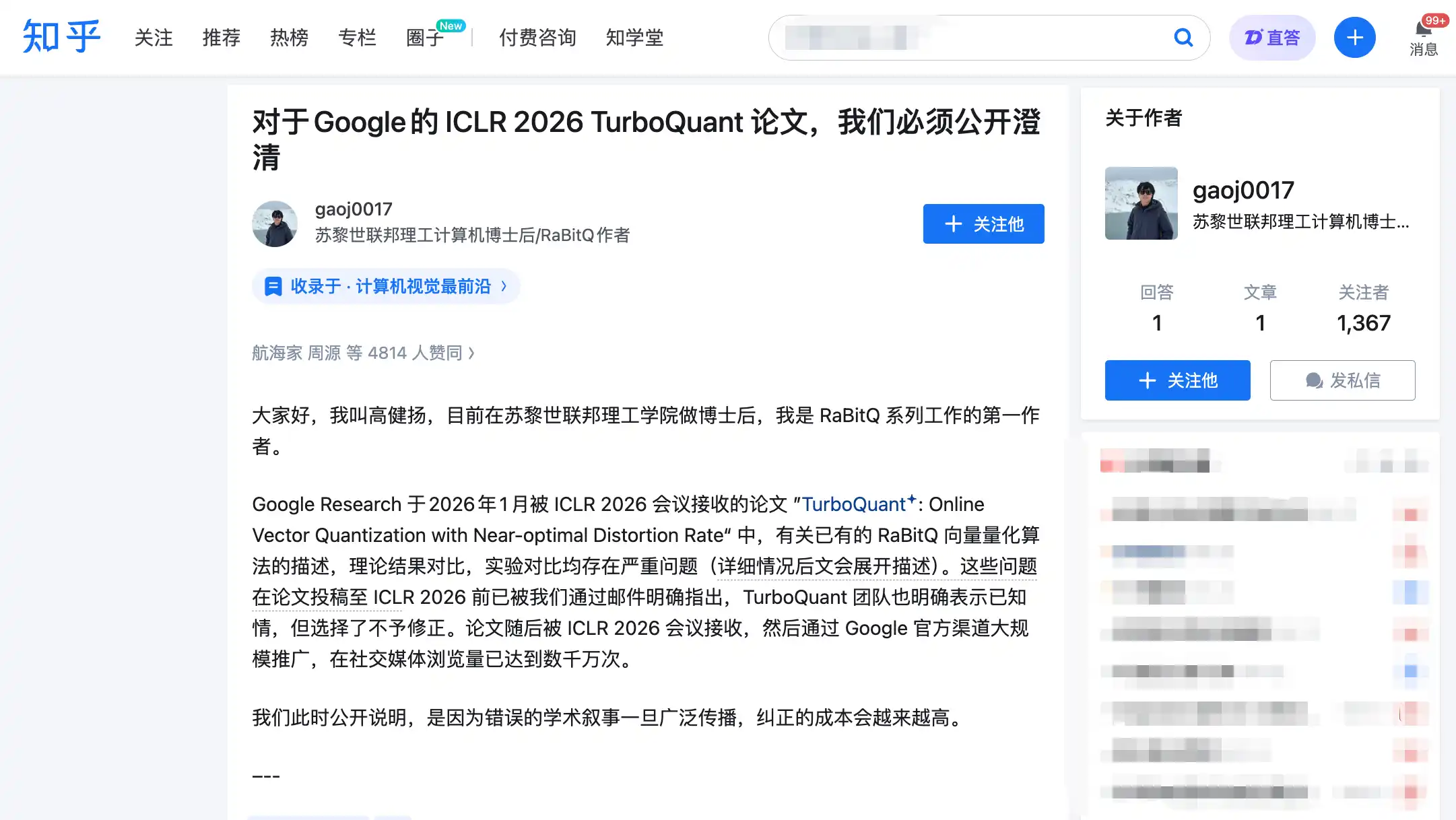
His accusations are divided into three parts, each supported by email records and timelines.
Accusation One: Using someone else's core method without full disclosure.
Both TurboQuant and RaBitQ's technical cores share a key common step: before compressing the data, perform a "random rotation" on the data. The purpose of this step is to transform the originally irregularly distributed data into a predictable uniform distribution, thereby significantly reducing the compression difficulty. This is the most core and closest part of the two algorithms.
The author of TurboQuant also admitted to this in the review response, but never clearly stated in the full paper the connection of this method to RaBitQ. The more critical background is that TurboQuant's second author, Majid Daliri, proactively contacted the Gao Jianyang team in January 2025 to request help debugging a Python version he rewrote based on the RaBitQ source code. The email detailed the replication steps and error messages—in other words, the TurboQuant team is very familiar with the technical details of RaBitQ.
An anonymous ICLR reviewer also independently pointed out that both used the same technology and requested a thorough discussion. However, in the final version of the paper, the TurboQuant team not only did not supplement the discussion but instead moved the (already incomplete) description of RaBitQ from the main text to the appendix.
-- Price
Accusation Two: Baselessly claiming the opponent's theory is "suboptimal."
The TurboQuant paper directly labeled RaBitQ as "theoretically suboptimal," citing that RaBitQ's mathematical analysis was "rather rough." However, Gao Jianyang pointed out that the extended version of the RaBitQ paper has rigorously proven that its compression error reaches the mathematically optimal bound—this conclusion was published at the top conference in theoretical computer science.
In May 2025, the Gao Jianyang team had previously explained the optimality of the RaBitQ theory in detail through multiple rounds of emails. TurboQuant's second author, Daliri, confirmed that all authors had been informed. However, the paper still retained the "suboptimal" wording in the end without providing any rebuttal arguments.
Charge Three: "Left Hand Ties, Right Hand Holds a Knife" in Experiment Comparison.
This is the most damaging accusation in the entire document. Gao Jianyang pointed out that the TurboQuant paper stacked two layers of unfair conditions in the speed comparison experiment:
First, RaBitQ's official optimized C++ code (which supports multithreaded parallelism by default) was provided, but the TurboQuant team did not use it; instead, they used their own translated Python version to test RaBitQ.
Second, when testing RaBitQ, a single-core CPU with multithreading turned off was used, while TurboQuant used an NVIDIA A100 GPU.
The combined effect of these two conditions is that the conclusion seen by readers is "RaBitQ is orders of magnitude slower than TurboQuant," yet there is no way to know that this conclusion was based on the Google team having tied up the opponent's hands and feet before the race. The paper did not adequately disclose the differences in these experimental conditions.
Google's Response: "Random Rotation is a Common Technique, Impossible to Cite Every Use"
According to Gao Jianyang's disclosure, in their email reply in March 2026, the TurboQuant team stated, "The use of random rotation and Johnson-Lindenstrauss transformation is already a standard technique in this field, and we cannot cite every paper that uses these methods."
The Gao Jianyang team believes this is a conceptual switch: the issue is not whether to cite every paper that has used random rotation, but rather that RaBitQ was the first to combine this method with vector compression in an entirely identical problem setup, proving its optimality, and the TurboQuant paper should accurately describe the relationship between the two.
The Stanford NLP Group's official X account retweeted Gao Jianyang's statement. The Gao Jianyang team has published a public comment on the ICLR OpenReview platform and has submitted a formal complaint to the ICLR conference chair and ethics committee. They will also release a detailed technical report on arXiv.
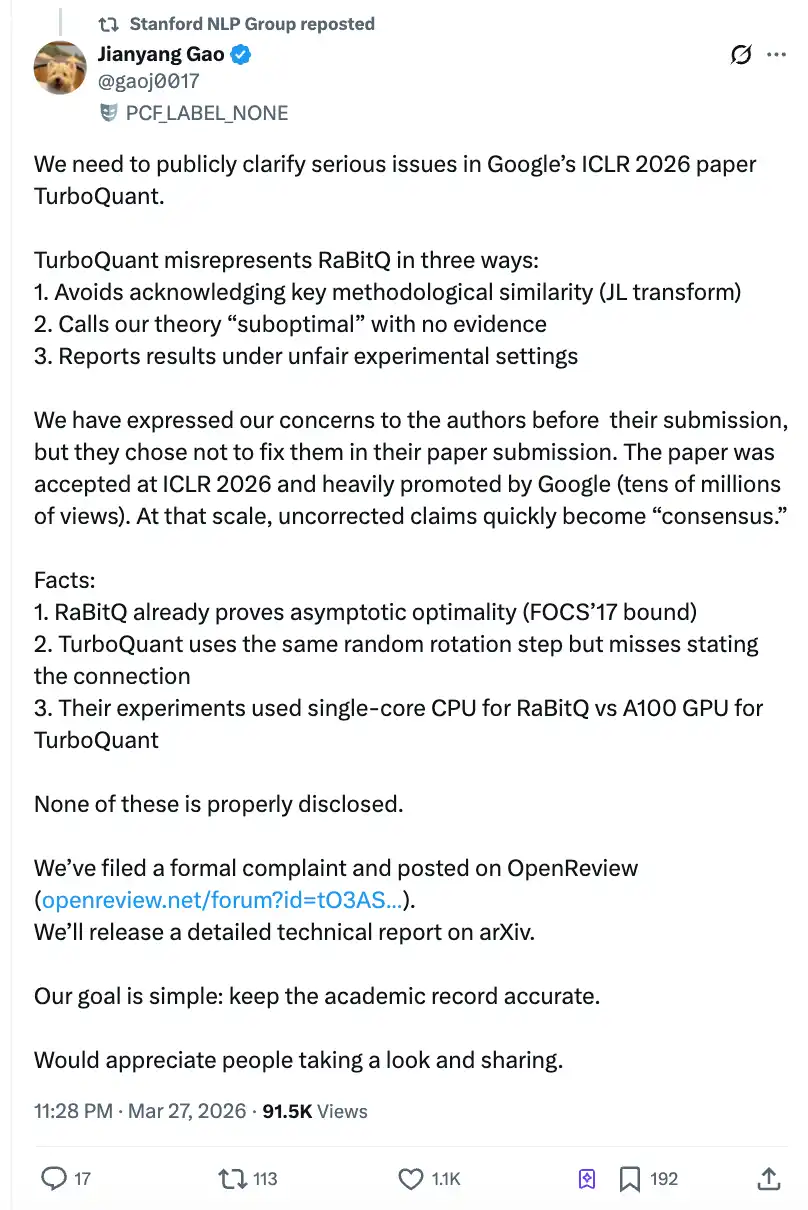
Independent tech blogger Dario Salvati provided a relatively neutral assessment in his analysis: TurboQuant did make a genuine contribution in terms of mathematical approach, but its relationship with RaBitQ is much closer than what the paper portrays.
$900 Billion Market Cap Wipeout: Paper Controversy Amplifies Market Panic
The timing of this academic dispute couldn't have been more delicate. On March 24th, Google's official blog post on TurboQuant coincided with a savage sell-off in the global semiconductor sector. As reported by multiple media outlets including CNBC, Micron Technology saw a more than 20% decline over six consecutive trading days; SanDisk experienced an 11% drop in a single day; SK Hynix in Korea dropped around 6%; Samsung Electronics dropped nearly 5%; and Kioxia in Japan dropped about 6%. The market panic logic is blunt: software compression can reduce AI inference memory requirements by 6 times, leading to a structurally diminished outlook for semiconductor demand.
Morgan Stanley analyst Joseph Moore refuted this logic in a research report on March 26th, maintaining an "overweight" rating for Micron and SanDisk. Moore pointed out that TurboQuant only compressed the KV Cache, a specific type of cache, not overall memory usage, characterizing it as a "normal productivity improvement." Bank of America analyst Andrew Rocha similarly cited the Jevons Paradox, suggesting that efficiency gains reducing costs could actually stimulate larger-scale AI deployment, ultimately boosting memory demand.
Old Paper, New Packaging: The Transmission Chain Risk from AI Research to Market Narrative
According to tech blogger Ben Pouladian's analysis, the TurboQuant paper was actually publicly released in April 2025 and is not new research. Despite this, on March 24th, Google repackaged and promoted it through its official blog, but the market priced it as a new breakthrough. This "old paper, new release" marketing strategy, combined with potential experimental biases in the paper, highlights the systemic risk in the transmission chain from AI research in academic papers to market narratives.
For AI infrastructure investors, when a paper claims to achieve "several orders of magnitude" performance improvement, the first question to ask is whether the benchmark comparison conditions are fair.
The Gao Jianyang team has expressly stated they will continue to address the issue formally. Google has not yet provided a formal response to the specific allegations in the open letter.
This content is provided for general informational purposes only and doesn't constitute financial, investment, legal, or tax advice. Any events, rewards, online promotions, or related information mentioned herein should not be considered a recommendation, solicitation, or invitation to purchase, sell, trade, or otherwise deal in any crypto assets. Crypto assets are highly volatile and may result in loss. The availability of WEEX services, products, and related events may vary by region. You are responsible for ensuring that your participation is in accordance with applicable local laws and regulations.
You may also like

BVNK Founder: Three Stages of Stablecoin Development

Dissecting the Monad 18-Page Sales Pitch: How Does the 0.16% Liquidity Chip Support a $25 Billion Fully Diluted Valuation?
2025 Market Prediction Retrospective: Total Transaction Volume Exceeds $50 Billion, Duopoly Market Share Exceeds 97.5%
With a $1 billion valuation, why couldn't Farcaster pull off a "decentralized" Twitter?

OpenAI and Anthropic, both pre-IPO, want to keep brawling

A four-page internal memo, what is OpenAI up to?

The $590 Billion Dream: How Did the Female Warren Buffett Fall from Grace?

SpaceX to Raise $75 Billion | Rewire News Nightly

「Money Printer」 PUMP.FUN Establishes Investment Arm, Can $3 Million Keep a Good Project?

Key Market Intelligence on January 4th, how much did you miss?
Maduro Gets 'Flash Loan' Attacked by the US, Where Will Venezuela's 'Legendary $60 Billion Bitcoin' Go?
Key Market Information Discrepancy on December 25th - A Must-See! | Alpha Morning Report
Bet on LUNA, $1.8 Billion on the Line in Do Kwon's High-Stakes Gamble

Key Market Information Gap on November 26th - A Must-Read! | Alpha Morning Report

Key Market Information Discrepancy on November 4th, A Must-See! | Alpha Morning Report
October 30th Market Key Insights -- How Much Did You Miss?
$2 Billion "Prediction Game": Is the Forecasting Market Approaching a "Turning Point" Moment?
Key Market Information Discrepancy on October 23rd, a Must-See! | Alpha Morning Report
Teenage Stock Market Wizard Caught in a Melodramatic Family Drama: Bed Partner Secretly Films Recovery Phrase, Steals $160 Million in BTC
Trump Family’s Latest Crypto Venture: WLFI Dominates Market
Key Takeaways: WLFI has propelled the Trump family’s net worth by $5 billion, overshadowing their real estate empire.…

SBF's bro turned 225 million into 5.5 billion in one year

Crypto VC Inflection Point: The Survival Answers of a16z, Dragonfly, Paradigm

Binance vs. Whistleblowers: The $1B Iran Sanctions Breach Allegation
Key Takeaways Former Binance investigators allege over $1 billion in transactions linked to Iran sanctions violations were processed…
Could Stablecoins Fix U.S. Debt? Standard Chartered Projects $1 Trillion in Treasury Demand
Key Takeaways Burgeoning Market: Analysts project the stablecoin market will surge to a $2 trillion market capitalization by…
The "Second Truth" of the Luna Crash: Jane Street Exits Ahead of Plunge
February 10th Market Key Intelligence, How Much Did You Miss?
$5.15 Billion, a Win-Win "Fire Sale"
Old Order's Backlash: Market Predicted to Be 'Paused' in Tennessee

「Whale Shifts 350M Long BTC Position to New Wallet」 Whale liquidates BTC long positions via stop-loss, withdraws $31M in profits, and exits the market.
BTC Returns to $93K as Fed Injects $160B to Rescue Market?
BVNK Founder: Three Stages of Stablecoin Development
Dissecting the Monad 18-Page Sales Pitch: How Does the 0.16% Liquidity Chip Support a $25 Billion Fully Diluted Valuation?
2025 Market Prediction Retrospective: Total Transaction Volume Exceeds $50 Billion, Duopoly Market Share Exceeds 97.5%
With a $1 billion valuation, why couldn't Farcaster pull off a "decentralized" Twitter?
OpenAI and Anthropic, both pre-IPO, want to keep brawling
A four-page internal memo, what is OpenAI up to?

Contents
Latest articles


Latest coin listings on WEEX


