
 Buy Crypto
- Markets
 Futures
- Spot
- Copy Trade
- Earn
- More
Huma Finance 2.0 Officially Launches on Solana, Bringing Composable Yield to DeFi Users

Source: Huma Finance
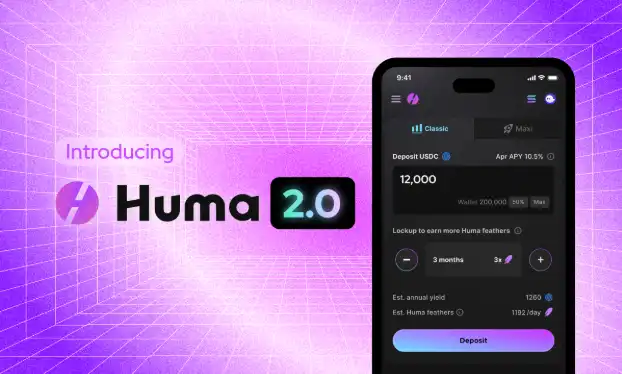
The first Payment Financial Network, Huma Finance, today announced the launch of Huma 2.0, a permissionless, compliant, and composable yield platform built on Solana. This platform opens up stable real yield generated from global payment financing derived from everyday commercial trading activities to users worldwide, marking a significant advancement where the previously elusive double-digit stable yield category, outside the realm of institutional finance, is now widely accessible to individual users. The existing permissioned service has been concurrently rebranded as Huma Institutional, continuing to serve institutions and accredited investors. Users can immediately start depositing on the brand-new Huma 2.0 platform.
Huma 2.0 provides users with diversified liquidity provision participation modes, launching two primary modes to cater to different needs: Classic Mode is designed for users seeking a stable double-digit USDC yield (currently at 10.5% APY, updated monthly) while offering a base reward called Huma Feathers; Maxi Mode is suited for users looking to maximize their accumulation of Huma Feathers, offering a 5x baseline reward rate (but without receiving USDC yield). Users can switch the mode of their existing positions at any time.
DeFi composability is a core feature of Huma 2.0 achieved through the PayFi Strategy Token (PST). This liquid interest LP token enables holders to integrate their Huma positions with leading Solana ecosystem protocols. At launch, users can swap PST for USDC through the aggregator Jupiter, marking the initial step of the integration plan with top Solana DeFi platforms. Subsequently, support will quickly follow on Kamino to use $PST as collateral and to trade future yields via RateX. Participation does not require locking, but users can opt for a 3-month or 6-month term that significantly boosts Huma Feather rewards through a multiplier. It is noteworthy that in the early stages of launch, these reward multipliers will see a substantial increase as part of a limited-time promotion, with particularly attractive bonuses in the Maxi Mode. These features provide users with enhanced flexibility and choice in managing their positions.
In just two years, Huma Finance's Payment Financial Network has rapidly scaled, processing over $3.8 billion in transactions, generating $8 million in annualized revenue. Huma assists partners in earning revenue from its payment finance business. Unlike DeFi yields relying on token incentives, market speculation, or traditional finance's low rates, payment finance yield directly stems from the fees paid by enterprise usage of the network for payment financing and settlement liquidity. Funds typically circulate rapidly within a few days, compounding continuously from fees generated by real-world economic activities. This mechanism enables Huma to consistently offer a stable double-digit USDC yield. Its sustainable model has garnered endorsements from top investors and been recognized by industry analysts such as Messari—payment finance is poised to leverage a $30 trillion market scale.
"Huma 2.0 is not just another yield product—it represents a structural shift." Huma Finance Co-Founder Erbil Karaman stated, "By providing payment institutions with a 24/7 operational and remarkably capital-efficient novel liquidity source, we are creating a new form of yield rooted in real economic activity, with composability and transparency. It finally allows DeFi to tap into a long-standing institutional-exclusive yield source without compromising DeFi's core strengths."
The launch of Huma 2.0 comes at a significant transformation period for the global financial and DeFi ecosystem. As traditional payment infrastructures like SWIFT face challenges in speed and transparency, with trillions of dollars still inefficiently deployed, the demand for blockchain-based modern solutions is increasingly evident—reportedly, stablecoin annual transaction volumes have surpassed $35 trillion. Seizing the opportunity, Huma 2.0 provides efficient settlement liquidity, enabling individuals worldwide to benefit from foundational financial activities—a realm previously dominated by institutions.
Crucially, the revenue generated by payment finance does not fluctuate with the crypto market cycle. Regardless of market boom or slump, underlying economic activities like payment and trade continue to operate, providing a stable source of revenue for Huma. This stability makes double-digit fixed income particularly valuable in bear markets, shining even brighter when speculative gains fade. As DeFi matures, the market is now prepared for such revenue rooted in real-world business (rather than token speculation). Payment finance as the foundational layer is fostering new DeFi strategies, such as Solmate, recently launched by Splyce—combining Huma's $PST yield with SOL liquidity staking, bridging DeFi and productive economic purposes.
Huma 2.0 marks a crucial step in building the new financial future, fundamentally expanding the scope of the financial revolution through an open and inclusive participation model. Early participants can enjoy various reward multipliers, including historical deposit user bonuses and promotion bonuses. As the platform expands more DeFi integrations and plans to become the launch platform's first major project for Jupiter's LFG 2.0—Huma continues to build a truly inclusive financial system.
To learn more about Huma 2.0 or get involved, please visit this link or follow @humafinance on X platform.
About Huma Finance
Huma is the first Payment Finance (PayFi) network, utilizing an open liquidity protocol stack, covering key areas such as cross-border payments, stablecoin debit cards, and trade financing applications. The network targets a market exceeding $30 trillion in total size, aiming to accelerate fund movement in an ever-active world.
This article is a contribution and does not represent the views of BlockBeats.
You may also like

L1 is dead, Appchain should rise

5 Best AI Agents in 2026: A Beginner's Guide to Crypto's Autonomous Future
Discover the 5 best AI agents in crypto for 2026. Learn how DeFAI agents differ from trading bots and explore top projects like OpenClaw, Virtuals Protocol, and ElizaOS.

Morning News | Kelp DAO suffers an attack with losses of approximately $292 million; RaveDAO responds to rumors of price manipulation; Michael Saylor releases more information related to Bitcoin Tracker

Crypto ETF Weekly | Last week, the net inflow for Bitcoin spot ETFs in the U.S. was $996 million; the net inflow for Ethereum spot ETFs in the U.S. was $275 million

This Week's News Preview | 2026 Hong Kong Web3 Carnival officially held; Trump hosts luncheon for TRUMP token holders

a16z New Post: Predicting the Market, Entering the Fast Forward Phase

Arthur Hayes New Post: It's Now "No Trade" Time
a16z New Article: Predictive Markets Entering Fast-Forward Phase

a16z founder: In the age of Agents, what truly matters has changed

The President of Kyrgyzstan meets with Sun Yuchen, and TRON collaborates with Kyrgyzstan to build a new pattern of digital economy in Central Asia
46 minutes, $292 million stolen, DeFi faces development dilemma again

How to Earn Free USDT in 2026: No High Volume Required (WEEX Poker Party Guide)
Is Joker Crypto legit in 2026 or just another memecoin? Can You Really Earn Passive Income with Joker Crypto in 2026? Learn how Joker staking rewards work, how to earn NFT bonuses, expected APY ranges, gas-fee rebates, and how to avoid crypto scams before joining.

How to Get Free USDT Welcome Bonus in 2026: Earn Up to 700 USDT on WEEX
Legit Free Welcome Bonus 2026: Learn how to earn up to 700 USDT on WEEX with Auto Earn Boost Fest. Increase your balance, activate Auto Earn, and qualify automatically.

AI Agent Payments Just Got Real: Utexo × x402 Brings 50ms USDT Transactions to Internet Scale
Utexo integrates USDT into the x402 protocol, enabling 50ms instant payments embedded natively in HTTP requests. Explore how this breakthrough is rewriting the rules for AI agent payments, API monetization, and the machine-to-machine economy.
DWF Deep Report: AI in DeFi Outperforms Humans in Yield Optimization, but Complex Trades Still Lag Behind by 5 Times

What Separates Smart Money from the Crowd in Crypto? Insights from Freedom of Money
Most crypto traders lose money not because of bad luck, but because they misunderstand how the market really works. From Freedom of Money to the rise and fall of Sam Bankman-Fried, they highlight a key divide in crypto: those who build the market and those who chase it. This reading guide explores essential books that reveal how narrative, regulation, capital, and psychology shape long-term success in the crypto industry.

The Risk Management Core Team has just been ousted, and Aave is now facing a $200 million default.

The $293 million bug wasn't in the code; so, what's the deal with the "DVN Configuration Bug," which led to the largest hack of 2026?
L1 is dead, Appchain should rise
5 Best AI Agents in 2026: A Beginner's Guide to Crypto's Autonomous Future
Discover the 5 best AI agents in crypto for 2026. Learn how DeFAI agents differ from trading bots and explore top projects like OpenClaw, Virtuals Protocol, and ElizaOS.



 App
App