
 Buy Crypto
- Markets
 Futures
- Spot
- Copy Trade
- Earn
- More
Synthetix has issued another fix, can sUSD re-anchor?

Original Article Title: "Synthetix Introduces Repair Measures Again, Can sUSD Re-anchor?"
Original Article Author: Azuma, Odaily Planet Daily
Synthetix's stablecoin sUSD has recently attracted market attention due to a prolonged period of being unpegged.
Since the initial signs of being unpegged on March 20, the extent of sUSD's unpegging has continued to increase, dropping below $0.7 at one point, and as of the time of writing, temporarily stabilizing around $0.78. With Synthetix rolling out various error correction measures, sUSD seems to have shown some signs of stabilization at a lower level, but whether it can re-anchor is currently still a rather complex issue.

Analysis of Unpegging Reasons
An analysis of sUSD's unpegging needs to start from Synthetix's repositioning and protocol changes.
Synthetix's original positioning was a Synthetic Assets (Synths) protocol, allowing users to mint synthetic assets tracking the performance of different assets (such as BTC, ETH) through over-collateralization. sUSD is now the only remaining synthetic asset with relatively broad utility, as Synthetix has gradually deprecated the original synthetic asset model in favor of a perpetual contract DEX.
Previously, Synthetix users needed to collateralize SNX to mint sUSD with a 750% collateralization rate—meaning that for every $7.5 worth of SNX collateralized, 1 sUSD could be minted. The issuance mechanism of synthetic assets is similar to the lending market, where collateral is locked up and the synthetic asset becomes a debt-bearing loan. The debt of sUSD is denominated in USD, but the debt of synthetic assets like Bitcoin is denominated in Bitcoin, subject to token price fluctuations. SNX collateralizers need to bear a proportionate global debt within the system, requiring Synthetix to design complex hedging strategies to mitigate risks from price fluctuations. This hedging demand, high collateralization rate, and system complexity have made SNX collateralizers uninterested, leading Synthetix to recently introduce a new model through SIP-420 proposal.
In early 2025, the SIP-420 aimed at simplifying the sUSD minting process and improving sUSD minting efficiency received governance approval. SIP-420 introduced a shared debt pool mechanism, planning to gradually transition the sUSD minting method from an individual collateralization model to a collective fund pool model over 12 months. SNX stakers no longer need to individually mint sUSD and bear personal debt, but can delegate funds to a public pool, thereby achieving a structure with no liquidation and no personal debt. At the same time, SIP-420 also reduced the collateralization ratio of sUSD from 750% to 200% to significantly improve system capital efficiency.
However, with the forgiveness of personal debt, when the sUSD price deviates from the peg value, SNX stakers no longer have an incentive to buy back sUSD at a low price to repay debt (previously, individual collateralizers could buy sUSD at a discount to repay debt at a stable price), and the protocol's original self-anchoring adjustment mechanism is no longer effective. This is also the fundamental reason why sUSD is experiencing off-pegging.
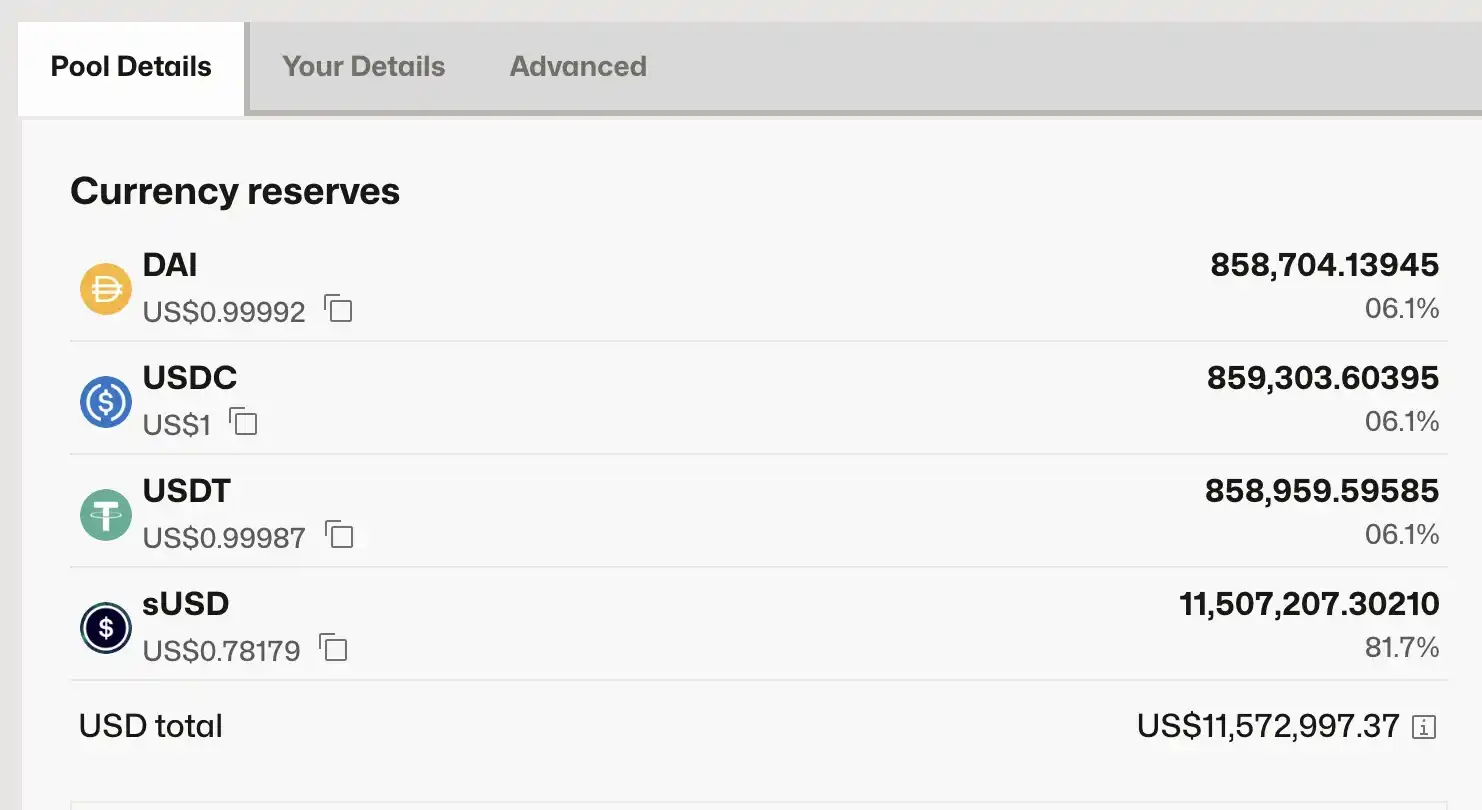
Furthermore, the gradual exacerbation of the off-peg issue is due to the fact that sUSD liquidity is not as abundant as imagined. Taking the largest pool on Curve (sUSD/USDC/DAI/USDT) as an example, out of a total liquidity of approximately $11.51 million, the share of sUSD in the pool is about 81.7%—this means that actual liquidity withdrawal has been significantly consumed during the off-peg process.
Synthetix's Response Plan
On April 2nd, Synthetix founder Kain posted for the first time in response to sUSD's off-peg situation. Kain mentioned that off-pegging occurred because the primary driver of purchasing sUSD (debt management) has been eliminated, and a new mechanism is in transition, hence the temporary off-pegging.

As mentioned earlier, SIP-420 aims to achieve a mechanism transition within 12 months, but the community obviously cannot sit back for 12 months holding an off-peg stablecoin. Therefore, Synthetix recently introduced several additional measures to try to repair sUSD's price. The common keyword in these measures is "incentive."
The first measure is to provide incentives for sUSD liquidity, and in the latest incentive measure, the yield for staking sUSD/sUSDe LP on Convex has reached as high as 49.18%;
The second measure is to provide incentives for sUSD deposits through another project developed by the same team, Infinex. The incentive will last for six weeks, distributing 16,000 OP rewards each week to users depositing over 1,000 sUSD;
The third measure is the latest proposal, which allows users to stake sUSD in the 420 pool, lock it for one year, but will provide 5 million SNX as an incentive.
Evidently, the above three measures are all aimed at addressing the issue of "insufficient sUSD purchasing demand" mentioned by Kain. By providing additional incentives for some broad lockup behaviors, Synthetix hopes to stimulate sUSD's purchasing demand, restrict potential selling pressure on sUSD, and gradually drive the stablecoin's price back to the peg.
Especially for the third measure, which requires stricter conditions and provides greater incentives, Kain also mentioned his expectations for this measure yesterday. He emphasized that the issue is completely solvable, and the team will gradually address the peg-out issue through optimizing the incentive mechanism.
It is worth mentioning that Kain also noted that if SNX stakers do not adopt the newly introduced staking mechanism to help address the sUSD peg-out issue, they will be subject to a "big stick." This implies that after multiple incentive measures, the next step will involve pressuring users who still do not "cooperate" with the repair action through penalty conditions.

As Synthetix has not yet provided a user interface for sUSD staking, staking operations currently require manual handling by the team. Therefore, it is currently impossible to know how many users will ultimately participate in sUSD staking under the incentive, and this will greatly affect the effectiveness of sUSD's repair.
Given the current situation, it is difficult to determine whether Synthetix can stabilize the situation. Although there have been some voices calling for buying the dip in the market, I personally do not recommend rushing to take action. If you cannot resist the temptation of a discount, it is necessary to closely monitor the price performance of SNX to prevent a "price drop, insufficient collateral, exacerbation of discount, panic selling" death spiral.
Alternative Arbitrage Opportunity
Compared to anchoring arbitrage, there seems to be another arbitrage opportunity in the current market—prediction markets.
The prediction market Truemarket has launched a prediction pool on whether sUSD can anchor back before July. The current price for Yes shares is $0.55, and for No shares, it is $0.45.

Since the current price of sUSD is $0.78, and after anchoring back, the price per unit of sUSD will be restored to $1, each Yes share can also change from $0.55 to $1. The existence of this price difference provides a certain arbitrage space.
However, the depth of the prediction pool on Truemarket is relatively small and cannot accommodate large-scale transactions. Therefore, the actual operational space for this strategy is not significant. It is recommended to follow up later to see if other more mainstream prediction markets such as Polymarket will open similar prediction pools and search for potential arbitrage opportunities.
You may also like

The biggest DeFi heist of 2026, hackers easily took advantage of Aave

Will Robots Replace Humans? He Says No!

Binance Coin's Price Skyrockets 15x to All-Time High, Saved by Three Bull Market Lifelines

The organization has accessed the prediction market, but is stuck at the third stage

Head of crypto VC collective shrinks: a16z crypto fund management scale plummets by 40%, Multicoin cut in half

Arthur Hayes New Post: It's "No Trade" Time Now
Claude Opus 4.7 Review: Is It Worthy of the Title of Strongest Model?

DWF In-Depth Report: AI Outperforms Humans in Yield Farming Optimization in DeFi, But Complex Transactions Still Lag Behind 5x
The financial tricks of the crypto giant Kraken

When proactive market makers start to take initiative

Massive Whale Movement: Unstaking $84.96 Million in HYPE Tokens
Key Takeaways A crypto whale, known as TechnoRevenant, has unstaked approximately $84.96 million in HYPE tokens. The tokens…

ListaDAO Addresses Third-Party Contract Vulnerability Concerns
Key Takeaways GoPlus Security revealed a vulnerability in a contract resembling those of ListaDAO. ListaDAO confirmed that their…

Security Risks of Fake Ledger Nano S+ Devices Emerging Through Chinese E-Commerce
Key Takeaways Counterfeit Ledger Nano S+ devices are being sold on Chinese e-commerce platforms, posing significant risks to…

Wave of Cyber Attacks Hits DeFi Protocols Post-Drift Hack
Key Takeaways A significant $280 million attack on Drift Protocol set off a chain of security breaches across…
Tom Lee Says ‘Mini Crypto Winter’ Is Over, Sees Ether Above $60K
Key Takeaways: Tom Lee predicts Ether’s resurgence, projecting it to surpass $60,000 in the coming years. Bitmine suffered…

French Government Tackles Rising Crypto Safety Concerns
Key Takeaways: France is intensifying measures to counter the surge in crypto kidnappings and wrench attacks. Since early…
Europe’s Bitcoin Treasury Playbook Unlikely to Mirror US Strategy: PBW 2026
Key Takeaways: European firms are adapting unique Bitcoin treasury strategies due to distinct financial regulations and market dynamics…
Circle Confronts Lawsuit Over $280M Drift Protocol Hack
Key Takeaways: Circle faces a lawsuit for allegedly aiding in the transfer of $230 million in stolen USDC.…



 App
App