
 Buy Crypto
- Markets
 Futures
- Spot
- Copy Trade
- Earn
- More
WOO X Research: Raydium vs. Pump Fun Showdown, Does LaunchLab Really Have a Wealth-Building Effect?




Original Article Title: "WOO X Research: Raydium vs Pump Fun Showdown, Does LaunchLab Really Create Wealth?"
Original Source: WOO
Background: Raydium Launches Token Issuance Platform LaunchLab
Raydium is the top DEX on Solana, while Pump Fun is the largest Launchpad. Interestingly, despite their different focus and business models, they are still attacking each other in an attempt to capture more revenue.
First, Pump Fun launched PumpSwap, with its daily trading volume stabilizing at around $4 billion recently, approaching Raydium's $6 billion daily trading volume. Raydium officials have pointed out that Pump Fun has contributed as much as 41% of its AMM revenue in the past month. However, after Pump Fun launched PumpSwap on its own, Raydium's traffic plummeted, forcing Raydium to launch LaunchLab to "regain liquidity dominance."
What are the differences between LaunchLab and Pump Fun? What are some notable projects to watch? Let WOO X Research show you.
LaunchLab Basic Introduction
LaunchLab, launched by Raydium, is essentially a "zero-code token issuance tool + automatic liquidity migration service" with two main usage modes:
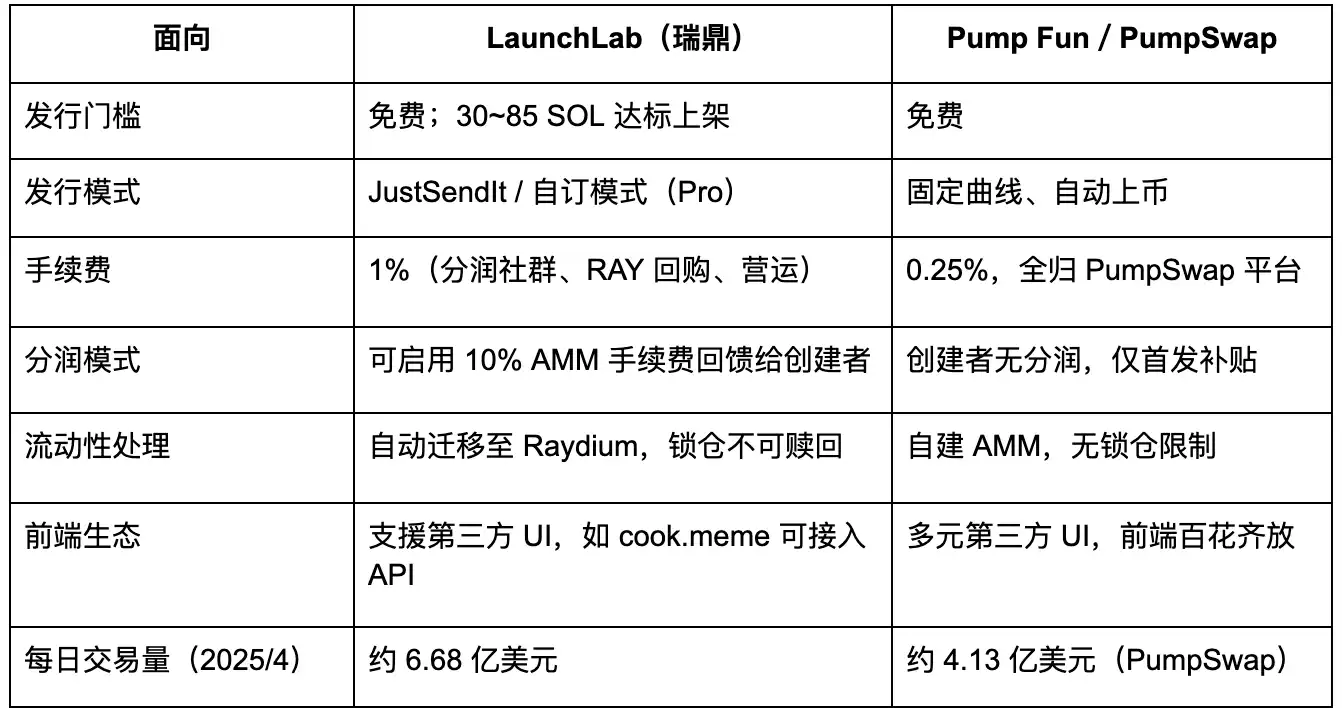
· JustSendIt Mode: Allows users to create tokens with a single click, requiring a preset raise of 85 SOL. Upon successful fundraising, the tokens will automatically migrate to Raydium's AMM, and the LP tokens will be burned to lock liquidity.
· LaunchLab Pro Mode: Allows customization of total supply, minimum raise of 30 SOL for issuance, bonding curve slope, ownership conditions, and whether to enable AMM profit sharing (up to 10% transaction fee rebate to the project team).
In terms of the fee structure, Raydium charges a flat 1% base fee, with 50% going into the "Community Pool," 25% for $RAY buybacks, and 25% for infrastructure and operational funds.
LaunchLab also allows third-party interfaces to access its backend services and build their own coin issuance front-end. The most well-known of these is cook.meme.
cook.meme is the first "meme coin issuance platform" to use the LaunchLab contract but with a self-built UX frontend, emphasizing zero fees, instant transactions, and a clean UI. Upon its release, it attracted many developers to try it out, positioning itself somewhat like a UI replica of Pump Fun, but with the underlying liquidity tied to Raydium.


Raydium adopts this open model not just for traffic redirection but to replicate the content and ecosystem flywheel built through community frontends during Pump Fun's heyday.
LaunchLab vs. Pump Fun
Key Projects
With the launch of LaunchLab, the most direct beneficiary is undoubtedly $RAY (with a 25% fee buyback), and after the announcement of LaunchLab, the price of $RAY rose by about 8%. If LaunchLab can sustain its momentum, the buyback strength of $RAY will continue to increase. When demand exceeds supply, there is an opportunity for price appreciation.
The lifecycle of a LaunchPad depends on how many "Golden Dogs" it can generate. As the platform continues to create wealth effects, user assets will naturally converge on that platform. Once assets are concentrated, the likelihood of the emergence of "Golden Dogs" will also increase, ultimately forming a positive flywheel cycle.
Therefore, the first step of the flywheel is to have Golden Dogs. Unfortunately, within 24 hours of LaunchLab going live, only the graduation token $TIME had a market cap exceeding $1 million. Other tokens like $ARUA, $Gaydium, etc., while experiencing a surge in market value in the early stages, were eventually influenced by overall market dynamics, leading to a high valuation for a single token.
So, what are the narratives behind $TIME, $ARUA, and $Gaydium respectively?
As mentioned earlier, Raydium allows third parties to connect to their routing building platform and issue coins. Currently, three platforms—Raydium, Cook.meme, and Pump Fun Robinhood—have partnered with them, with $TIME being the first meme coin created by Cook.meme. Raydium's own issued coin is $ARUA, which, although deployed earlier than $TIME, had a later launch.
$Gaydium, in addition to the pun, is when Raydium's developers put $Gaydium's contract address on Rytdium's GitHub, but then promptly deleted it less than an hour later, causing a sharp drop in the token's price.
$TIME
· Current Market Cap: $6 million
· All-Time High Market Cap: $8.5 million
· 24 HR Trading Volume: $30.2 million
· Number of Holders: 7,600
Conclusion
Raydium's LaunchLab appears to be a "belated counterattack," but the overall design has already made a systematic response to the advantages of Pump Fun. It not only provides a customizable token issuance model but also expands into an open-front strategy represented by cook.meme, aiming to bring back traffic, fees, and narrative to the Raydium ecosystem.
However, whether LaunchLab can truly create wealth and reignite a meme frenzy depends on three core elements:
1. Whether it can produce strong meme projects;
2. Whether the fee and liquidity design is friendly to retail investors;
3. Whether the ecosystem can rapidly gather front-end tools and generate network effects.
Although it currently appears that all three elements require further effort, LaunchLab has only been open for less than a month. Declaring the platform a failure based on this would be too categorical. The cryptocurrency world is ever-changing, and perhaps the next hundredfold meme may emerge from LaunchLab, so let us wait and see.
This article is contributed content and does not represent the views of BlockBeats.
You may also like

AI Agent Payments Just Got Real: Utexo × x402 Brings 50ms USDT Transactions to Internet Scale
Utexo integrates USDT into the x402 protocol, enabling 50ms instant payments embedded natively in HTTP requests. Explore how this breakthrough is rewriting the rules for AI agent payments, API monetization, and the machine-to-machine economy.

DWF Deep Report: AI in DeFi Outperforms Humans in Yield Optimization, but Complex Trades Still Lag Behind by 5 Times

What Separates Smart Money from the Crowd in Crypto? Insights from Freedom of Money
Most crypto traders lose money not because of bad luck, but because they misunderstand how the market really works. From Freedom of Money to the rise and fall of Sam Bankman-Fried, they highlight a key divide in crypto: those who build the market and those who chase it. This reading guide explores essential books that reveal how narrative, regulation, capital, and psychology shape long-term success in the crypto industry.

The Risk Management Core Team has just been ousted, and Aave is now facing a $200 million default.

The $293 million bug wasn't in the code; so, what's the deal with the "DVN Configuration Bug," which led to the largest hack of 2026?

a16z on Recruitment: How to Choose Between Crypto-Native and Traditional Talent?

The biggest DeFi heist of 2026, hackers easily took advantage of Aave

Will Robots Replace Humans? He Says No!

Binance Coin's Price Skyrockets 15x to All-Time High, Saved by Three Bull Market Lifelines

The organization has accessed the prediction market, but is stuck at the third stage

Head of crypto VC collective shrinks: a16z crypto fund management scale plummets by 40%, Multicoin cut in half

Arthur Hayes New Post: It's "No Trade" Time Now
Claude Opus 4.7 Review: Is It Worthy of the Title of Strongest Model?

DWF In-Depth Report: AI Outperforms Humans in Yield Farming Optimization in DeFi, But Complex Transactions Still Lag Behind 5x
The financial tricks of the crypto giant Kraken

When proactive market makers start to take initiative

Massive Whale Movement: Unstaking $84.96 Million in HYPE Tokens
Key Takeaways A crypto whale, known as TechnoRevenant, has unstaked approximately $84.96 million in HYPE tokens. The tokens…

ListaDAO Addresses Third-Party Contract Vulnerability Concerns
Key Takeaways GoPlus Security revealed a vulnerability in a contract resembling those of ListaDAO. ListaDAO confirmed that their…
AI Agent Payments Just Got Real: Utexo × x402 Brings 50ms USDT Transactions to Internet Scale
Utexo integrates USDT into the x402 protocol, enabling 50ms instant payments embedded natively in HTTP requests. Explore how this breakthrough is rewriting the rules for AI agent payments, API monetization, and the machine-to-machine economy.
DWF Deep Report: AI in DeFi Outperforms Humans in Yield Optimization, but Complex Trades Still Lag Behind by 5 Times
What Separates Smart Money from the Crowd in Crypto? Insights from Freedom of Money
Most crypto traders lose money not because of bad luck, but because they misunderstand how the market really works. From Freedom of Money to the rise and fall of Sam Bankman-Fried, they highlight a key divide in crypto: those who build the market and those who chase it. This reading guide explores essential books that reveal how narrative, regulation, capital, and psychology shape long-term success in the crypto industry.




 App
App