
 Buy Crypto
- Markets
 Futures
- Spot
- Copy Trade
- Earn
- More
Crypto.com Witnesses Absurd Governance Farce, Holder of 70% of Voting Power Forces 700 Billion CRO Inflation

Original Article Title: "Crypto.com Drama Unfolds as 70% Voting Power Enforces 700 Billion CRO Mint"
Original Article Authors: Symbol; Boxmining
Editor's Note: Several weeks ago, Crypto.com put forth a proposal to reissue 700 billion burnt CRO tokens. Throughout the 2-week voting period, the voter turnout failed to meet the required threshold. If sufficient participation was not reached by the deadline, the proposal would be null and void. However, on the day before the cutoff, a sudden influx of 33 billion CRO token holders joined the vote, ultimately overwhelmingly approving the proposal. This last-minute voter was none other than Crypto.com itself.
On Sunday, what seemed like a potentially failed proposal—aimed at minting 700 billion CRO to compensate for the token burn in 2021 and reintroduce it to the market—struggled with a slim lead in favor of the "yes" votes over "no" votes for most of the voting period (March 2-16) and did not reach the required quorum of 33.4% to be effective.
However, at 14:00 UTC on Sunday, a dramatic turn of events occurred when suddenly 33.5 billion CRO tokens were counted as "yes" votes, meeting the required threshold for the proposal to pass and vastly exceeding the minimum standard. The statistics show: 61.18% in favor, 17.61% against, 20.11% abstain, and 0.11% reject; with an overall turnout of 70.18%, far exceeding the required 33.4% quorum.
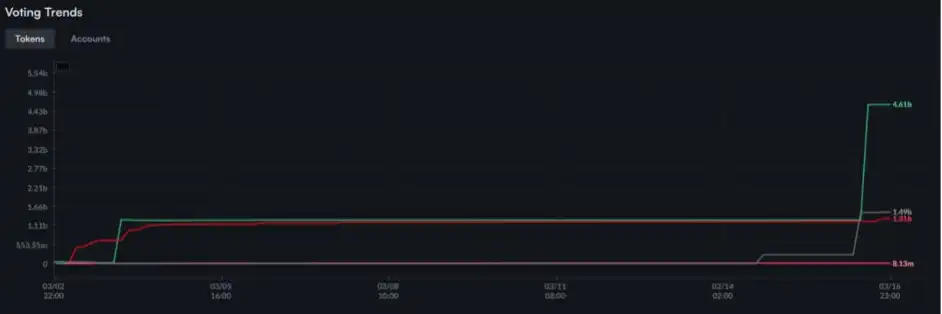
The last-minute surge in votes ultimately led to the proposal's approval. Source: Mintscan
The sudden surge in votes has left many disgruntled CRO holders feeling even more aggrieved, believing that trust between Crypto.com and its holders has been severely damaged. "Very disappointed," commented a CRO whale on Telegram. "They almost all voted at the last minute, setting a malicious and emulatable precedent for other projects."
The crux of the controversy lies in the fact that most of the votes came from large validators operated by Crypto.com. Three independent sources indicate that these validators control between 70% to 80% of the total voting power. As of March 10, only two of its validators—Starship and Falcon Heavy—voted in favor. Despite the "yes" votes accounting for only 11.86%, far below the 77.97% "no" votes and 8.47% abstentions, the peculiar situation did not prevent the proposal from being approved.
A representative for Crypto.com declined to comment on the matter.
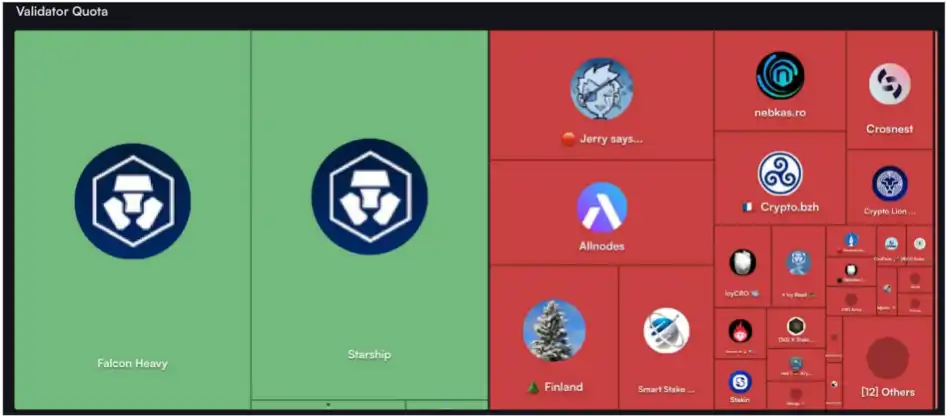
As of the March 10 voting tally, data source: Mintscan
As the vote neared its conclusion, three additional validators controlled by Crypto.com—Electron, Antares, and Minotaur IV—also joined the approval camp; furthermore, two smaller independent validators, Cosmostation and Polkachu.com, indicated their support, although their votes had minimal impact on the final outcome.
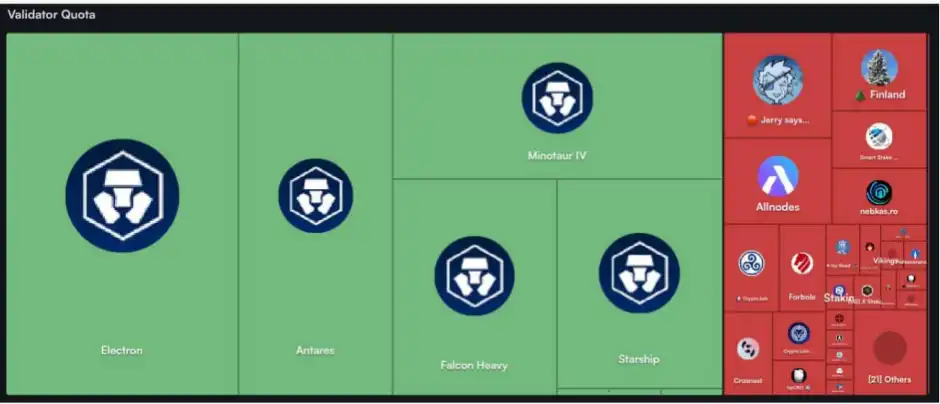
Final voting results, data source: Mintscan
With the proposal's approval, the Cronos blockchain will undergo an upgrade tomorrow, during which 700 billion new tokens will be minted, while the 700 billion tokens burned in 2021 will remain out of circulation. These new tokens will be gradually released according to a five-year vesting schedule and will support various functions, including the potential launch of a CRO ETF.
However, the actions of the Crypto.com team did not stop there. Just a day after the voting ended, the team introduced another proposal to burn 50 million CRO tokens (equivalent to 0.07% of the newly minted tokens) to supplement the three previous burn events of the same amount. A CRO validator who voted against the re-minting proposal on Telegram angrily wrote, "This is an insult to all CRO holders. How dare you propose to burn 50 million tokens on the same day when you're re-minting 700 billion tokens?"
The vote on this new proposal will continue for the next two weeks.
This article is contributed content and does not represent the views of BlockBeats.
You may also like

What Is RWA? What Is RWA in Crypto (Complete 2026 Guide)
Wondering what is RWA in crypto? We explain what RWA is, break down RWA tokenization in simple no-jargon terms, and cover why it's 2026's hottest crypto narrative.

What Is the KelpDAO Attack? What It Means for Aave Users in 2026
KelpDAO suffered a $292M rsETH exploit on April 18, 2026, triggering Aave market freezes and $13B DeFi outflows. Here’s what happened, whether Aave is safe now, and what users should do next.

Is your gold really "within reach"? The geographical blind spots of custodial services behind tokenized gold

Cook Passes the Baton, Anthropic Gears Up | Rewire News Morning Brief

Will the Fed Cut Interest Rates Again? Tonight's Data Is Key

The person taking over Apple has to do something he has never done before

Why Are You Always Losing Money on Polymarket? Because You're Betting on News, While The Rulebook Favors Insiders

Not a Price Hike, but a Supply Shortage? Oil Price Has Crossed the Threshold

a16z: 5 Ways Blockchain Helps AI Agent Infrastructure

Morning News | The Hong Kong Securities and Futures Commission announced the regulatory framework for secondary market trading of tokenized investment products; Strategy increased its holdings by 34,164 bitcoins last week; KAIO completed a strategic fi...
What Is an XRP Wallet? The Best Wallets to Store XRP (2026 Updated)
An XRP wallet lets you safely store, send, and receive XRP on the XRP Ledger. Learn what wallets support XRP and discover the best XRP wallets for beginners and long-term holders in 2026.

What are the Top AI Crypto Coins? Render vs. Akash: 5 Gems Solving the 2026 GPU Crisis
What are the best AI crypto coins for the 2026 cycle? Beyond the hype, we analyze top tokens like RNDR, AKT, and FET that provide real-world solutions to the global GPU shortage and the rise of autonomous agents.

What Is a Token in AI? What Is an AI Token + 3 Gems You Can't Miss in 2026
The era of AI hype has transitioned into an era of utility. As we move through Q2 2026, the market is no longer rewarding "narrative-only" projects. At WEEX Research, we are seeing a massive capital rotation into Decentralized Compute (DePIN) and Autonomous Agent coordination layers. This guide analyzes which AI tokens are capturing institutional liquidity and how to spot high-conviction setups in a maturing market.
Consumer-grade Crypto Global Survey: Users, Revenue, and Track Distribution

Prediction Markets Under Bias

Stolen: $290 million, Three Parties Refusing to Acknowledge, Who Should Foot the Bill for the KelpDAO Incident Resolution?

ASTEROID Pumped 10,000x in Three Days, Is Meme Season Back on Ethereum?

ChainCatcher Hong Kong Themed Forum Highlights: Decoding the Growth Engine Under the Integration of Crypto Assets and Smart Economy
What Is RWA? What Is RWA in Crypto (Complete 2026 Guide)
Wondering what is RWA in crypto? We explain what RWA is, break down RWA tokenization in simple no-jargon terms, and cover why it's 2026's hottest crypto narrative.
What Is the KelpDAO Attack? What It Means for Aave Users in 2026
KelpDAO suffered a $292M rsETH exploit on April 18, 2026, triggering Aave market freezes and $13B DeFi outflows. Here’s what happened, whether Aave is safe now, and what users should do next.


 App
App