
 Buy Crypto
- Markets
 Futures
- Spot
- Copy Trade
- Earn
- More
U.S. Tariff Truce Fiasco: BTC Flash Crashes Below $81K, May Rate Cut Expectation Soars

Original Article Title: "Trump Halts Tariff Roller Coaster Event - Bitcoin Surges to $81K, US Stocks on Wild Ride, Fed Rate Cut Expectation Soars in May"
Original Article Author: Joe, BlockTempo
After a "Black Monday" in Asian stock and cryptocurrency markets yesterday, news broke last night that the Trump administration might pause matching tariffs for 90 days, sparking a strong market rebound and pushing Bitcoin above $80,000.
However, the White House quickly denied this as fake news, causing an instant market confidence collapse and a sharp decline in stocks and Bitcoin. Subsequently, US President Trump issued a tough threat to China once again, stating that if China does not withdraw retaliatory tariffs (China announced a 34% retaliatory tariff last night), the US will raise the existing tariff rate to 50% on the 9th, causing another market shock.
The Dow Jones Index plunged more than 1,700 points intraday, although the closing losses narrowed, and the S&P 500 Index also recorded its worst three-day performance since the 2020 pandemic outbreak. Meanwhile, the EU is waving the flag of negotiation priority but is also prepared to counter with tariffs, casting a shadow over the global trade war.
Bitcoin Surges Above $81K Before Retracing
The cryptocurrency market also experienced volatility last night due to the Trump tariff suspension fake news, with Bitcoin reaching a high of $81,213 but quickly falling back after the White House clarification. As of 9:30 am Taipei time on April 8th, the Bitcoin price is around $79,670, and the Ethereum price is around $1,574. Whether the rebound can continue remains to be seen.
Overall, the current market trend highlights the high uncertainty of the current global economic environment, bringing tremendous pressure to the risk market. Investors must be more cautious when assessing risks and opportunities, closely monitoring subsequent policy directions and economic data changes.

US Stocks See Saw Movement, Nvidia Rebounds
As for US stocks, Apple (AAPL-US) closed at $181.46, plummeting 3.67%. The company's stock price has accumulated a 19% decline over the past three trading days, evaporating nearly $640 billion in market value. There are market rumors that, in order to replenish stock ahead of a potential tariff effective date on the 9th, Apple has initiated emergency logistics plans and is using cargo planes to transport a large number of iPhones and other products from India and China to the US.
Nvidia (NVDA) closed at $97.64, up 3.53%. A Bernstein analyst is bullish on Nvidia, reiterating an "outperform" rating with a target price of $185, expecting its AI server products to potentially be exempt from the latest tariffs under the "USMCA" agreement.
The Dow Industrial Average intraday plunged 1703 points, eventually closing down 349.26 points, a decrease of 0.91%, at 37,965.6 points
The S&P 500 Index fell 11.83 points, or 0.23%, to 5,062.25 points, marking a cumulative decline of over 10% in the past three days, the most severe downturn since the market crash triggered by the early 2020 pandemic
Tech stocks showed resilience as bargain hunters stepped in, with the Nasdaq Composite Index rising 15.48 points, or 0.1%, to 15,603.26 points
Benefiting from a strong rebound in semiconductor stocks, the Philadelphia Semiconductor Index surged against the trend by 97.29 points, or 2.70%, to close at 3,694.95 points
Fed's Closed-Door Meeting Adds Suspense, Rate Cut Expectations Soar
Amid market jitters over tariff news, the Federal Reserve unexpectedly held a previously unannounced closed-door board meeting last night. While the specific discussion topics of the meeting have not been disclosed, this rare move at such a sensitive time has intensified market tension and speculation.
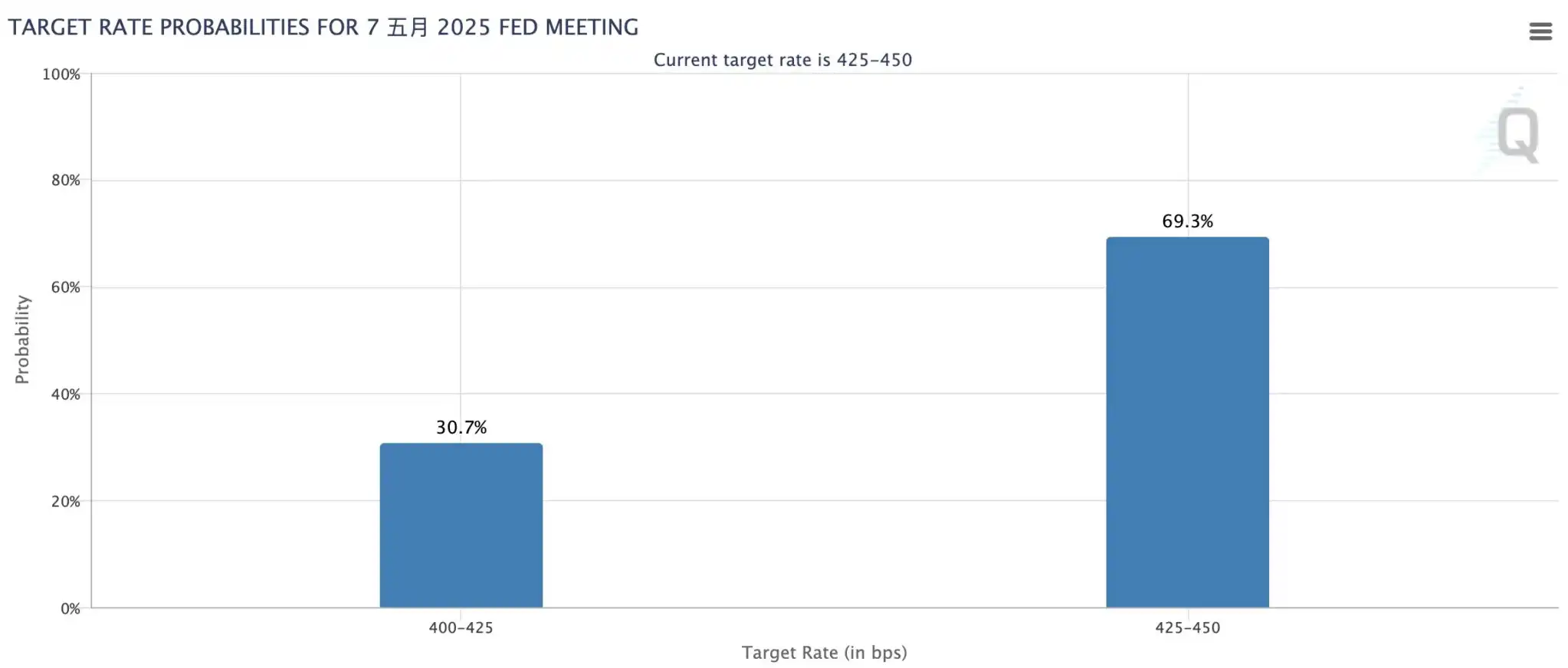
According to the Chicago Mercantile Exchange's (CME) FedWatch tool, market traders currently expect the Fed to cut rates as early as May, with the likelihood increasing from 14% a week ago to 30.7%. This reflects a strong market expectation that, amidst trade war fears and concerns of a potential economic slowdown, the Fed will take a more dovish stance to support the economy.
EU Adopts "Fight-and-Talk" Strategy, Proposes Zero-for-Zero Tariffs
Facing U.S. tariff pressures, the EU reached a consensus at a trade ministers' meeting of the 27 member states held in Luxembourg to prioritize resolving trade disputes through negotiation. EU Trade Commissioner Maros Sefcovic stated that the EU has proposed industrial product "zero-for-zero" tariff negotiations to the U.S., meaning both sides would completely exempt each other from industrial goods tariffs.
However, the EU also made it clear that it would not wait indefinitely. Sefcovic outlined the EU's three key positions:
1. Recognizing the importance of cooperation with the U.S. in strategic areas (such as addressing overcapacity from non-market economies, semiconductor competition, critical raw material supply, etc.)
2. Acknowledging that negotiations with the U.S. will be protracted, currently only in the preliminary stage, as the U.S. sees tariffs as "corrective measures" rather than negotiation chips
3. Pursuing open-ended negotiations while adopting a "three-track approach": defending interests through retaliatory measures, diversifying the market through new trade agreements, and preventing harmful trade diversion effects
In terms of specific actions, regarding the U.S.'s previous tariffs on steel and aluminum products, the European Union is expected to implement the first wave of retaliatory tariffs on April 15, with the related list already submitted to member states and set for a vote on the 9th. The second wave of counterbalancing tariffs is expected to be introduced on May 15.
Currently, the EU's strategy clearly prioritizes "negotiation first, while engaging in talks alongside actions," actively seeking to diversify its trading partners. Dombrovskis specifically mentioned India, Indonesia, Thailand, the Philippines, and Gulf countries, urging to expedite ongoing free trade agreement negotiations. The President of the European Commission vividly expressed that the EU would "focus like a laser beam on 83% of global trade, excluding the United States."
At the same time, the EU is also highly alert to trade diversion risks, especially the potential influx of Chinese products into the EU market due to U.S. tariffs. Dombrovskis recently visited China, with one of the key focuses being on addressing trade imbalances with China, overcapacity, market access, and issues related to Chinese investments in Europe.
You may also like

Anthropic's $1 trillion, compared to DeepSeek's $100 billion

Geopolitical Risk Persists, Is Bitcoin Becoming a Key Barometer?

Annualized 11.5%, Wall Street Buzzing: Is MicroStrategy's STRC Bitcoin's Savior or Destroyer?

An Obscure Open Source AI Tool Alerted on Kelp DAO's $292 million Bug 12 Days Ago

Mixin has launched USTD-margined perpetual contracts, bringing derivative trading into the chat scene.
The privacy-focused crypto wallet Mixin announced today the launch of its U-based perpetual contract (a derivative priced in USDT). Unlike traditional exchanges, Mixin has taken a new approach by "liberating" derivative trading from isolated matching engines and embedding it into the instant messaging environment.
Users can directly open positions within the app with leverage of up to 200x, while sharing positions, discussing strategies, and copy trading within private communities. Trading, social interaction, and asset management are integrated into the same interface.
Based on its non-custodial architecture, Mixin has eliminated friction from the traditional onboarding process, allowing users to participate in perpetual contract trading without identity verification.
The trading process has been streamlined into five steps:
· Choose the trading asset
· Select long or short
· Input position size and leverage
· Confirm order details
· Confirm and open the position
The interface provides real-time visualization of price, position, and profit and loss (PnL), allowing users to complete trades without switching between multiple modules.
Mixin has directly integrated social features into the derivative trading environment. Users can create private trading communities and interact around real-time positions:
· End-to-end encrypted private groups supporting up to 1024 members
· End-to-end encrypted voice communication
· One-click position sharing
· One-click trade copying
On the execution side, Mixin aggregates liquidity from multiple sources and accesses decentralized protocol and external market liquidity through a unified trading interface.
By combining social interaction with trade execution, Mixin enables users to collaborate, share, and execute trading strategies instantly within the same environment.
Mixin has also introduced a referral incentive system based on trading behavior:
· Users can join with an invite code
· Up to 60% of trading fees as referral rewards
· Incentive mechanism designed for long-term, sustainable earnings
This model aims to drive user-driven network expansion and organic growth.
Mixin's derivative transactions are built on top of its existing self-custody wallet infrastructure, with core features including:
· Separation of transaction account and asset storage
· User full control over assets
· Platform does not custody user funds
· Built-in privacy mechanisms to reduce data exposure
The system aims to strike a balance between transaction efficiency, asset security, and privacy protection.
Against the background of perpetual contracts becoming a mainstream trading tool, Mixin is exploring a different development direction by lowering barriers, enhancing social and privacy attributes.
The platform does not only view transactions as execution actions but positions them as a networked activity: transactions have social attributes, strategies can be shared, and relationships between individuals also become part of the financial system.
Mixin's design is based on a user-initiated, user-controlled model. The platform neither custodies assets nor executes transactions on behalf of users.
This model aligns with a statement issued by the U.S. Securities and Exchange Commission (SEC) on April 13, 2026, titled "Staff Statement on Whether Partial User Interface Used in Preparing Cryptocurrency Securities Transactions May Require Broker-Dealer Registration."
The statement indicates that, under the premise where transactions are entirely initiated and controlled by users, non-custodial service providers that offer neutral interfaces may not need to register as broker-dealers or exchanges.
Mixin is a decentralized, self-custodial privacy wallet designed to provide secure and efficient digital asset management services.
Its core capabilities include:
· Aggregation: integrating multi-chain assets and routing between different transaction paths to simplify user operations
· High liquidity access: connecting to various liquidity sources, including decentralized protocols and external markets
· Decentralization: achieving full user control over assets without relying on custodial intermediaries
· Privacy protection: safeguarding assets and data through MPC, CryptoNote, and end-to-end encrypted communication
Mixin has been in operation for over 8 years, supporting over 40 blockchains and more than 10,000 assets, with a global user base exceeding 10 million and an on-chain self-custodied asset scale of over $1 billion.

$600 million stolen in 20 days, ushering in the era of AI hackers in the crypto world
Vitalik's 2026 Hong Kong Web3 Summit Speech: Ethereum's Ultimate Vision as the "World Computer" and Future Roadmap
On the same day Aave introduced rsETH, why did Spark decide to exit?
Full Post-Mortem of the KelpDAO Incident: Why Did Aave, Which Was Not Compromised, End Up in Crisis Situation?

After a $290 million DeFi liquidation, is the security promise still there?
ZachXBT's post ignites RAVE nearing zero, what is the truth behind the insider control?

Vitalik 2026 Hong Kong Web3 Carnival Speech Transcript: We do not compete on speed; security and decentralization are the core
In-depth Analysis of RAVE Events: Short Squeeze, Crash, and Quantitative Financial Models of Liquidity Manipulation

Eve of Ceasefire, US Military Fires on Iranian Vessel | Rewire News Morning Brief

Figma's stock price drops over 7%, will Claude Design be the terminator?

Plunge by 10% Followed by Rebound, Weekend Oil Market Watch

SpaceX Mascot ASTEROID Fast Track $170 million, Stemming from an Unfinished Space Dream

L1 is dead, Appchain should rise
Anthropic's $1 trillion, compared to DeepSeek's $100 billion
Geopolitical Risk Persists, Is Bitcoin Becoming a Key Barometer?
Annualized 11.5%, Wall Street Buzzing: Is MicroStrategy's STRC Bitcoin's Savior or Destroyer?
An Obscure Open Source AI Tool Alerted on Kelp DAO's $292 million Bug 12 Days Ago
Mixin has launched USTD-margined perpetual contracts, bringing derivative trading into the chat scene.
The privacy-focused crypto wallet Mixin announced today the launch of its U-based perpetual contract (a derivative priced in USDT). Unlike traditional exchanges, Mixin has taken a new approach by "liberating" derivative trading from isolated matching engines and embedding it into the instant messaging environment.
Users can directly open positions within the app with leverage of up to 200x, while sharing positions, discussing strategies, and copy trading within private communities. Trading, social interaction, and asset management are integrated into the same interface.
Based on its non-custodial architecture, Mixin has eliminated friction from the traditional onboarding process, allowing users to participate in perpetual contract trading without identity verification.
The trading process has been streamlined into five steps:
· Choose the trading asset
· Select long or short
· Input position size and leverage
· Confirm order details
· Confirm and open the position
The interface provides real-time visualization of price, position, and profit and loss (PnL), allowing users to complete trades without switching between multiple modules.
Mixin has directly integrated social features into the derivative trading environment. Users can create private trading communities and interact around real-time positions:
· End-to-end encrypted private groups supporting up to 1024 members
· End-to-end encrypted voice communication
· One-click position sharing
· One-click trade copying
On the execution side, Mixin aggregates liquidity from multiple sources and accesses decentralized protocol and external market liquidity through a unified trading interface.
By combining social interaction with trade execution, Mixin enables users to collaborate, share, and execute trading strategies instantly within the same environment.
Mixin has also introduced a referral incentive system based on trading behavior:
· Users can join with an invite code
· Up to 60% of trading fees as referral rewards
· Incentive mechanism designed for long-term, sustainable earnings
This model aims to drive user-driven network expansion and organic growth.
Mixin's derivative transactions are built on top of its existing self-custody wallet infrastructure, with core features including:
· Separation of transaction account and asset storage
· User full control over assets
· Platform does not custody user funds
· Built-in privacy mechanisms to reduce data exposure
The system aims to strike a balance between transaction efficiency, asset security, and privacy protection.
Against the background of perpetual contracts becoming a mainstream trading tool, Mixin is exploring a different development direction by lowering barriers, enhancing social and privacy attributes.
The platform does not only view transactions as execution actions but positions them as a networked activity: transactions have social attributes, strategies can be shared, and relationships between individuals also become part of the financial system.
Mixin's design is based on a user-initiated, user-controlled model. The platform neither custodies assets nor executes transactions on behalf of users.
This model aligns with a statement issued by the U.S. Securities and Exchange Commission (SEC) on April 13, 2026, titled "Staff Statement on Whether Partial User Interface Used in Preparing Cryptocurrency Securities Transactions May Require Broker-Dealer Registration."
The statement indicates that, under the premise where transactions are entirely initiated and controlled by users, non-custodial service providers that offer neutral interfaces may not need to register as broker-dealers or exchanges.
Mixin is a decentralized, self-custodial privacy wallet designed to provide secure and efficient digital asset management services.
Its core capabilities include:
· Aggregation: integrating multi-chain assets and routing between different transaction paths to simplify user operations
· High liquidity access: connecting to various liquidity sources, including decentralized protocols and external markets
· Decentralization: achieving full user control over assets without relying on custodial intermediaries
· Privacy protection: safeguarding assets and data through MPC, CryptoNote, and end-to-end encrypted communication
Mixin has been in operation for over 8 years, supporting over 40 blockchains and more than 10,000 assets, with a global user base exceeding 10 million and an on-chain self-custodied asset scale of over $1 billion.



 App
App