
Annualized 11.5%, Wall Street Buzzing: Is MicroStrategy's STRC Bitcoin's Savior or Destroyer?

 Prefer us on Google


After more than two months of Bitcoin fluctuation, there are finally signs of a breakthrough.
Leading the charge for Bitcoin is still our old friend Michael Saylor, and this time he has unleashed a new weapon: STRC.
A quick look through Saylor's recent tweets will show that he has been posting about STRC almost every day. Tropical resort pools, women holding cocktails—these AI-generated low-quality promotional videos send a clear signal: the man who elevated MSTR to the Nasdaq altar is now using the same marketing firepower for STRC.

Why is he doing this? Because STRC is currently Strategy's almost sole tool to convert market funds into BTC buying pressure. Over the past three months, every large-scale BTC purchase announcement by Strategy has been funded through STRC.
What Is STRC
STRC stands for Variable Rate Series A Perpetual Stretch Preferred Stock, a perpetual preferred stock issued by Strategy and listed on Nasdaq in November last year.
Its operation can be outlined as follows:
You spend about $100 to buy one share of STRC. Strategy pays monthly cash dividends at an annualized rate of 11.5%, which is approximately $0.96 per share per month. It has no expiration date, and Strategy is not required to repay the principal.
The stock price is anchored around the $100 face value through monthly dividend rate adjustments: if it falls below 100, the dividend rate increases to attract buyers; if it rises above 100, the dividend rate decreases to bring the price back towards the face value. The upper limit for the monthly dividend rate adjustment is 25 basis points.
Only when the STRC stock price is above $100 can Strategy issue new shares to raise funds at face value—this is the premise of the entire flywheel. After deducting the dividend reserve, the majority of the funds raised are used to purchase BTC.
Saylor has named this product "Short Duration High Yield Credit" or "Bitcoin-Backed Money Market Fund." In the current environment of around 3.5% U.S. Treasury yield, STRC offers a return equivalent to three times that of U.S. Treasuries.
Flywheel
One common misconception about Saylor is that he bought BTC by printing money out of thin air.
He couldn't do that. Saylor cannot just print money; he has to wait for the market to deliver the money to him. For every additional share of STRC issued, there must be a willing buyer at a price of $100.
The buyers of STRC are essentially engaging in a credit "transaction," where the 8% yield offered by STRC over Treasuries compensates for the "Strategy credit risk."
However, what many STRC buyers may not realize is that the funds used to purchase STRC indirectly flow into BTC, magnified threefold.
Strategy has a publicly stated financial goal: a 33% leverage ratio.
Of the total capital structure, perpetual preferred stocks like STRC, STRF, and STRK make up approximately one-third, with the remaining two-thirds coming from MSTR common stock. Saylor refers to this principle as "intelligent leverage." This means that whenever Strategy acquires $1 via STRC, in order to maintain the 33% leverage threshold, they must issue around $2 worth of MSTR to invest alongside in BTC. $1 in STRC + $2 in MSTR = $3 BTC buying pressure.
On April 14, through STRC, Strategy raised approximately $1 billion in a single day. Leveraged threefold, this corresponds to around $3 billion in BTC buy-side pressure, perfectly matching the scale of BTC accumulation in the first two weeks of April.
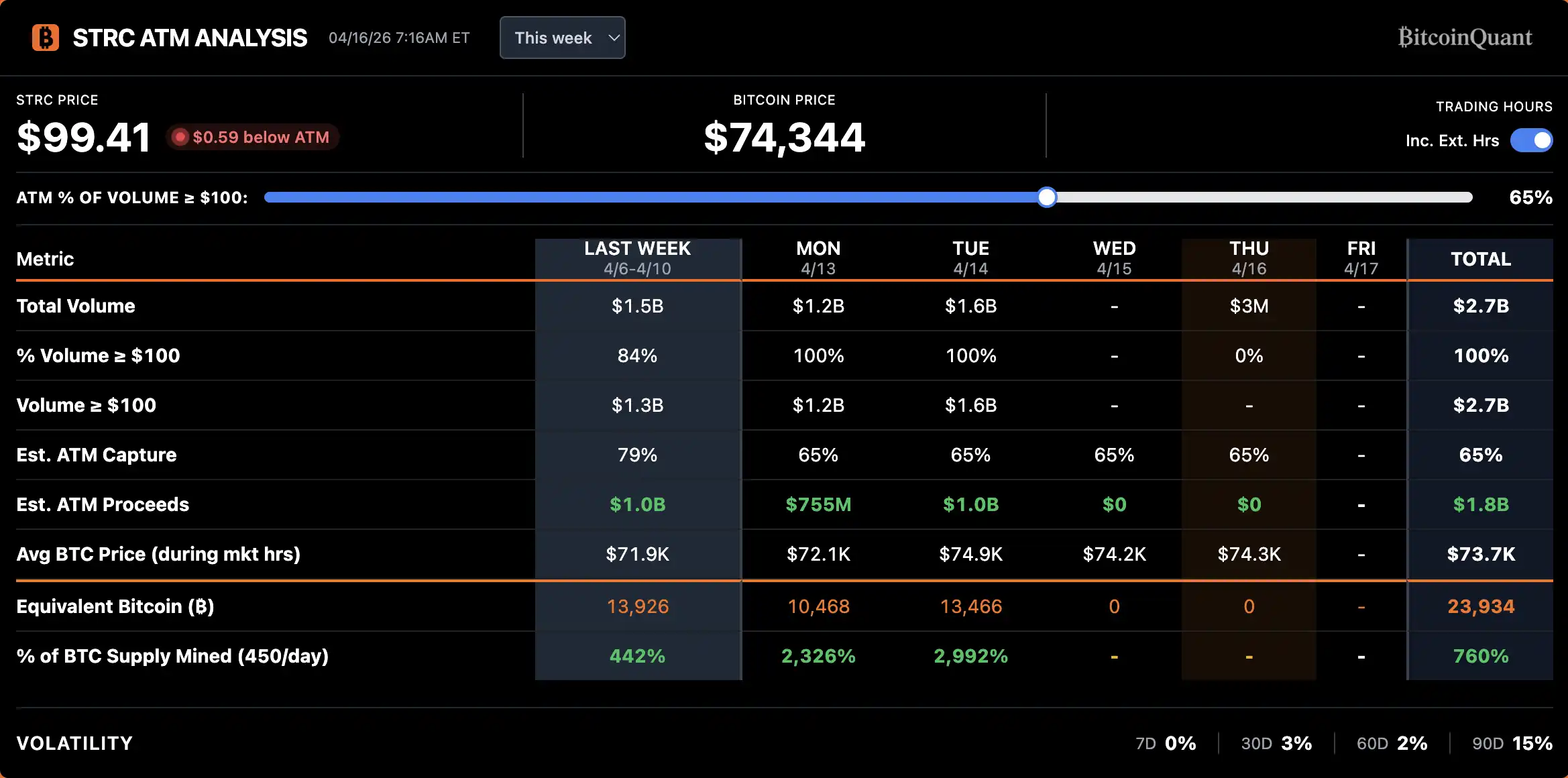
As BTC declines, collateral shrinks, STRC credit risk increases, and Strategy must increase the dividend rate to compensate for the new risk level. However, the higher the dividend rate, the greater the cash flow pressure and the higher the default probability. This creates an unstable feedback loop. During the time when BTC dropped from $120,000 to $60,000 last October, the STRC dividend rate had to be raised from 7% to 11.5% to barely recover the buy-side pressure.
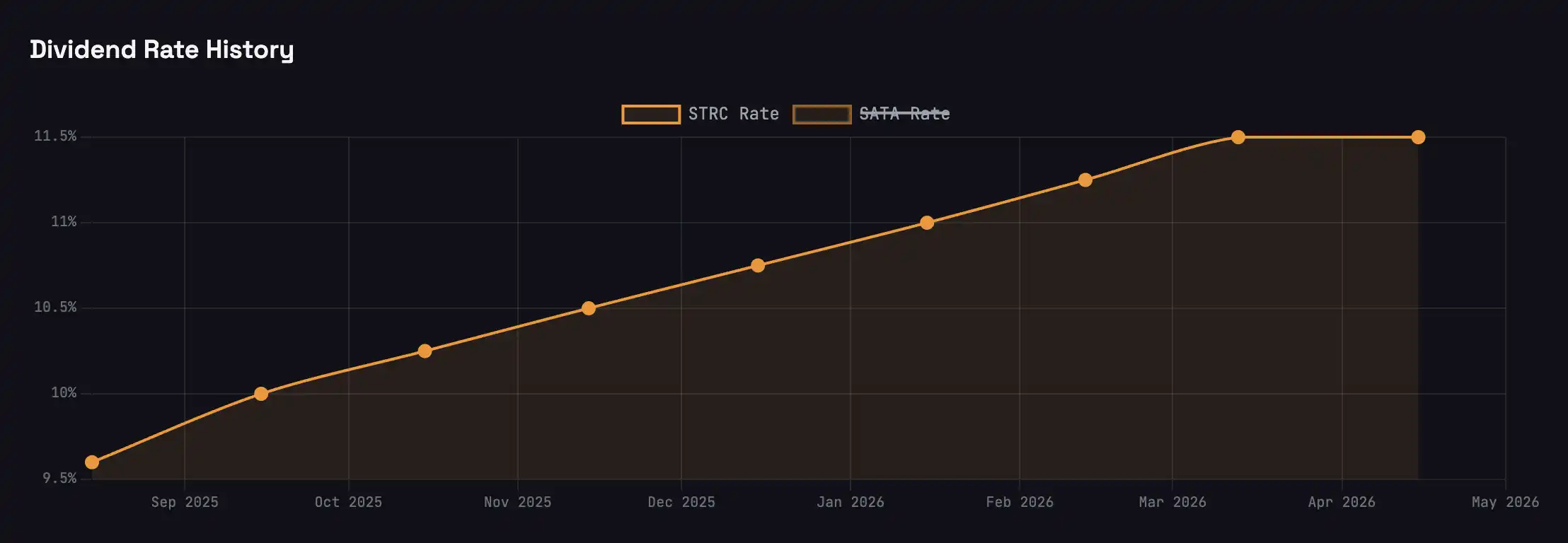
Conversely, when BTC stabilizes and rises, collateral thickens, credit quality improves, and at the same dividend rate, STRC becomes more attractive, further expanding the demand. BlackRock's Preferred and Income Securities ETF in April listed Strategy's preferred shares as the second-largest holding, with the market value increasing from around $200 million in March to $344 million, providing direct endorsement from fixed income institutions of Strategy's current credit status.
The Strategy flywheel has turned positive: more funds buy STRC → Strategy leverages 3x to buy BTC → BTC price is supported → STRC collateral becomes more solid, credit spread tightens → Under the same dividend yield, STRC becomes more attractive → more funds buy STRC.
Ex-Dividend Day Arbitrage
Preferred shares have a dividend distribution mechanism different from bonds. Bonds accrue interest daily, where you earn interest for each day you hold the bond; preferred shares, on the other hand, pay out in a lump sum on fixed dates. For STRC, as long as you hold the stock by the close of the day before the ex-dividend day, you receive the full 96 cents monthly dividend.
This sets up an obvious arbitrage opportunity: rush in to buy a few days before the ex-dividend day, collect the dividend, and sell off the next day. Data from the past few months shows that STRC's average post-ex-dividend day drop is around 20 cents, much less than the 96 cents dividend itself. The net profit from a single ex-dividend arbitrage can reach around 40 to 50 cents per share.
Arbitrageurs will not miss out on this opportunity.
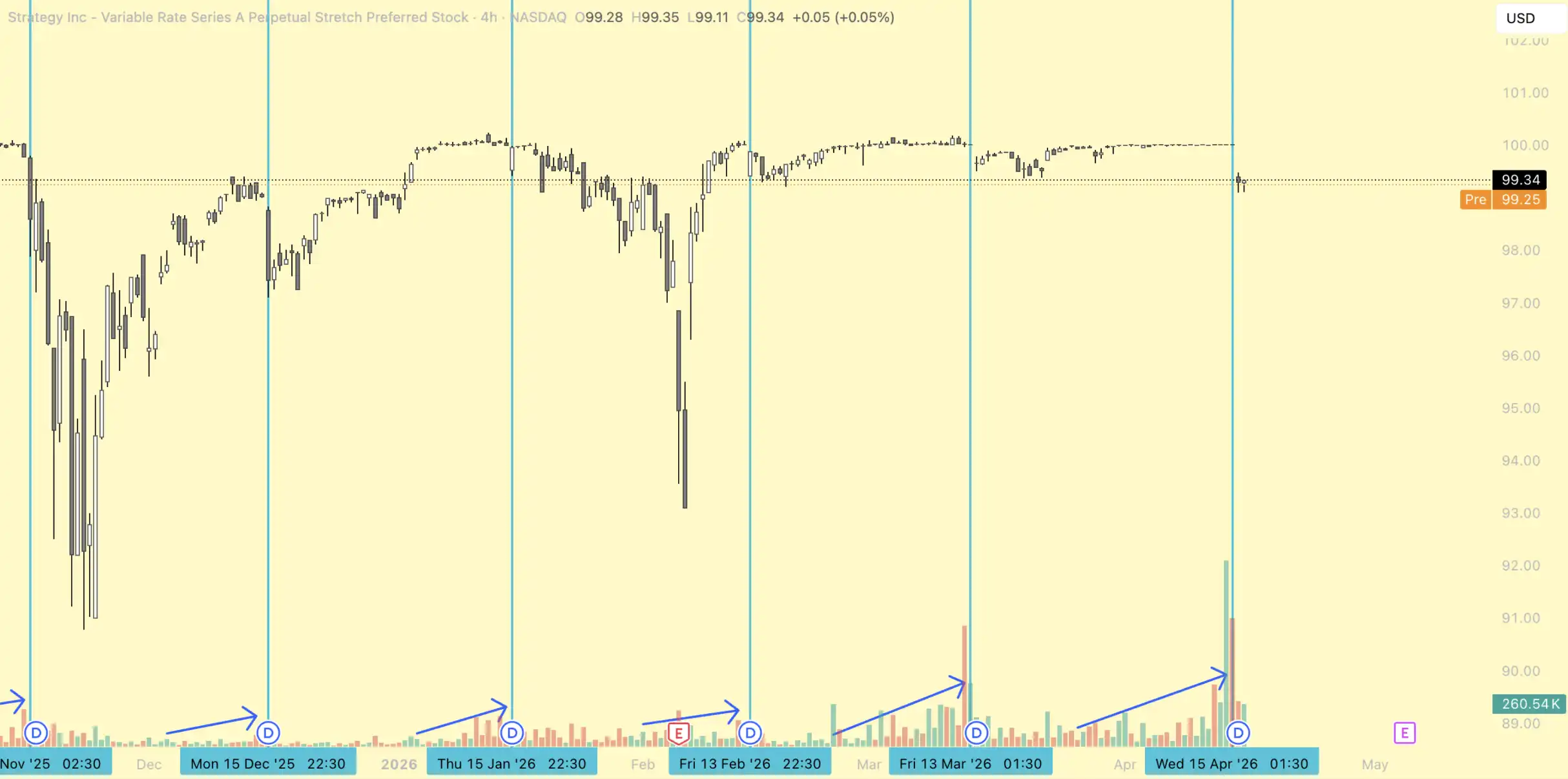
As shown in the chart, the trading volume starts to surge about a week before the ex-dividend day, peaks on or before that day, and quickly subsides after the ex-dividend day. The volume spike in April is significantly steeper than that of March, indicating an increasing number of funds participating in STRC ex-dividend arbitrage.
However, such arbitrage behavior may not be beneficial.
For the STRC product itself, the two to three weeks after the ex-dividend day enter a "dead zone" — liquidity shrinks, bid-ask spreads widen, and the stock price remains below the $100 face value for an extended period. This recurring anchoring failure will erode STRC's positioning as a "money market product," shifting it towards something more akin to a monthly fluctuation bond.
For Saylor, his BTC purchases are easily front-run by arbitrage funds. The STRC issuance is concentrated in the two weeks before the ex-dividend day, meaning his BTC purchases are also concentrated during this period.
Now, arbitrage traders swarm in to buy STRC at the same time each month. They know Saylor is about to use this money to sweep the BTC spot market, so they can buy BTC in advance, wait for Saylor to drive up the price, and then sell at a higher price, raising Saylor's buying cost.
In the recent two weeks, the Coinbase spot premium around the STRC ex-dividend day has significantly increased
There are two possible solutions: either change the dividend distribution frequency, such as shifting from monthly to bi-weekly and spreading out the arbitrage gains, or introduce a more elementary derivative product with more frequent dividends to decentralize the concentrated arbitrage trades.
Sure enough, Saylor took swift action and announced on Saturday that Strategy had submitted a proposal to change the dividend payment frequency of STRC from monthly to bi-monthly. The annual dividend payment obligation and yield remain unchanged.
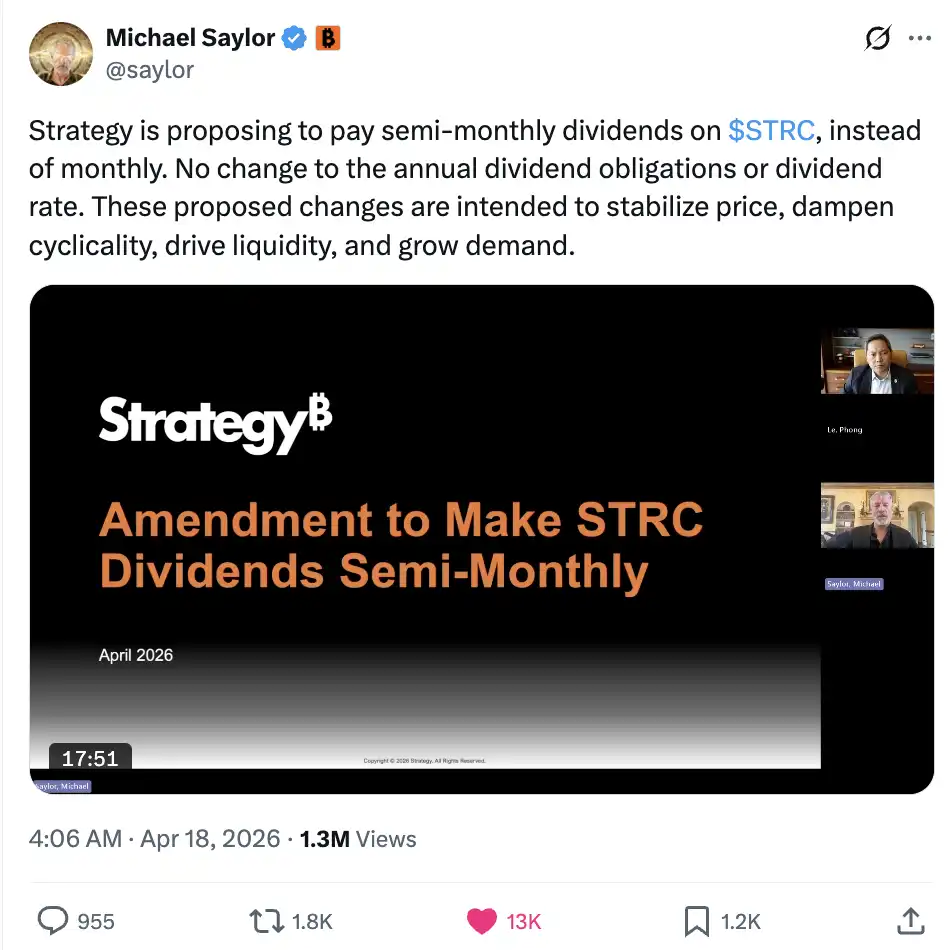
If the proposal is approved, the first bi-monthly dividend will be distributed on July 15.
Bitwise advisor Jeff Park pointed out that currently, there are no corporate bonds in the market using a bi-monthly dividend mechanism, and retail investors' preference for higher-frequency payments has been validated by the success of products such as weekly dividend ETFs.
On a deeper level, Jeff Park sees this as a significant step towards the penetration of the cryptocurrency industry's "streaming payment" vision into traditional capital markets. The frequency of interest payments fundamentally reflects the efficiency of transforming monetary potential energy into kinetic energy, and the digital currency era should break free from artificially imposed time cycle limits.
He believes that STRC has set a new benchmark for traditional enterprises and is excited about the future evolution towards bi-monthly, daily, and even instant payments.
-- Price
The New Narrative of DeFi
The emergence of STRC has injected vitality into the lackluster DeFi market.
For the past year, DeFi stablecoin yields have been on a downward trend. The stablecoin deposits on Aave yield approximately 2% annually, while Ethena's USDe and Sky's USDS are below 4%, and even mainstream stablecoin PT on Pendle struggles to exceed 6%. This level of return corresponds to the risk exposure of AI-era smart contracts, and the risk-return ratio has deterred many DeFi veterans.
DeFi needs a trustworthy and sufficiently large source of income to pull TradFi's money back onto the chain, and STRC conveniently provides this opportunity.
Two projects are currently attempting to package STRC's yield on-chain:
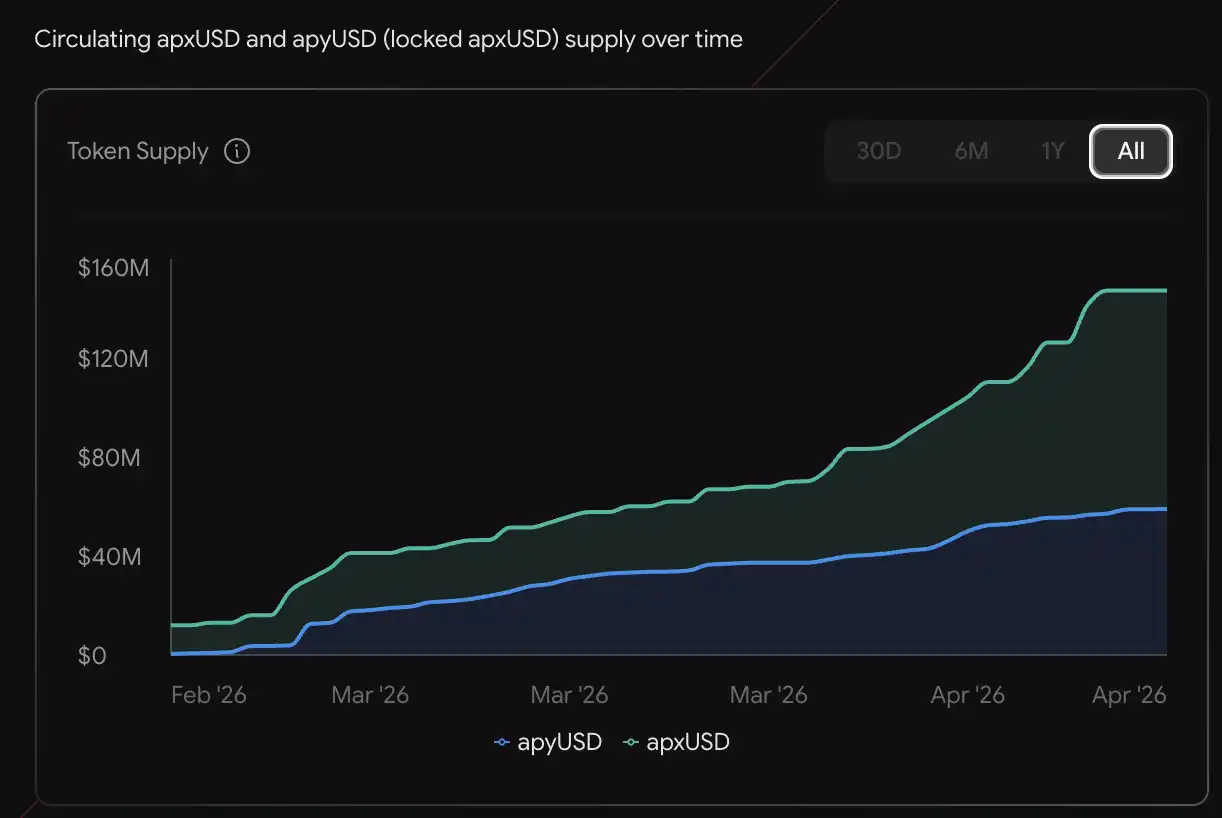
The Apyx Protocol adopts a dual-coin model. apxUSD is the base stablecoin backed by assets like STRC, SATA-like preferred stock, and excess collateral from U.S. Treasuries; apyUSD is the staking version that receives the underlying dividend and interest income, currently offering an annualized yield of about 12.78%. The supply has reached $130 million, with corresponding yield and leverage products on Pendle and Morpho.
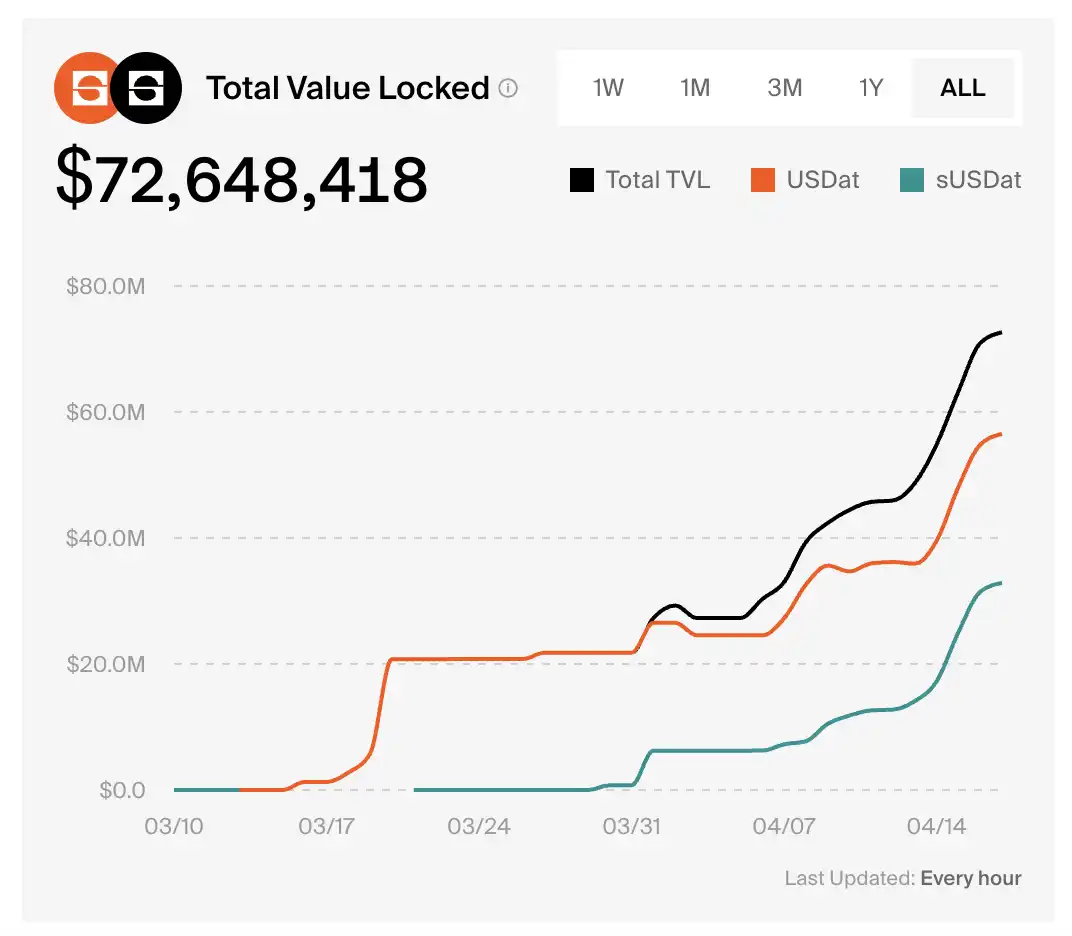
Saturn Credit's sUSDat is a yield-bearing stablecoin that mints STRC rewards, with the protocol's TVL surging from zero to $72.6 million in just over a month.
According to Pendle's market data, the current APY for PT-sUSDat is 9.2%.
The Die Is Cast
As Saylor's carefully crafted financial machine runs more successfully, one question becomes harder to avoid.
The amount of BTC in Strategy's possession now nears 3.5% of the total supply, with a continued pace of billions of dollars per month.
What was BTC's original value proposition? A currency asset that is decentralized, not controlled by any single entity, and resistant to unilateral manipulation by anyone.
When a publicly traded company's perpetual preferred stock becomes BTC—a currency asset that is decentralized, not controlled by any single entity, and resistant to unilateral manipulation by anyone—its primary source of marginal buying pressure, is Bitcoin deviating from its original form?
This content is provided for general informational purposes only and doesn't constitute financial, investment, legal, or tax advice. Any events, rewards, online promotions, or related information mentioned herein should not be considered a recommendation, solicitation, or invitation to purchase, sell, trade, or otherwise deal in any crypto assets. Crypto assets are highly volatile and may result in loss. The availability of WEEX services, products, and related events may vary by region. You are responsible for ensuring that your participation is in accordance with applicable local laws and regulations.
You may also like

Web3: Foreign Media Reports Need for Safer Liquidity Tools in Crypto Collateralized Lending

Babylon TBV Completes Security Audit, Prepares for Aave v4 Mainnet Launch

Uniswap Launches Regulated 'Permissioned Pools'

Aave V4 Launched on Avalanche Network, First Multi-Chain Hub & Spoke Architecture

Aave V4 deposits surpass 275 million

Abraxas Capital Provides Approximately $39 Million in Liquidity to Aave

Aave Labs Proposal to Integrate Maple's syrupUSDG

Abraxas Capital Deposits 8,000 ETH to Aave
Data: Aave's new Monad market surpassed $100 million in deposits within two days of its launch, and total deposits for V4 exceeded $250 million, setting a new record

Data: ParaFi Capital continues to increase its holdings of 56 million SKY, with a total position loss of 1.72 million USD

Aave V3 has been deployed on Monad

Standard Chartered claims that Aave could rise 50 times to $3,500 by 2030

Data: DeFi lending and DEX fees plummeted over 50% in a week, mainly due to leveraged liquidations
Grayscale: Aave's protocol revenue has grown over 6.6 times in the past three years, and AAVE's current valuation is relatively conservative
Data: A certain whale has cumulatively shorted 44,000 ETH, currently facing an unrealized loss of 3.08 million USD
Ethereum 1CO giant whale buys back 5,817 ETH, liquidation price $1,432

The Kelp DAO cross-chain bridge hacker has laundered nearly $220 million of stolen funds, with only $1.7 million remaining untransferred

DeFi has reached its most dangerous moment: the real vulnerabilities are not in the code
Babylon proposes to integrate native Bitcoin collateral on Aave V4 without the need for cross-chain bridges and custody
Kelp DAO announced that rsETH has fully recovered after five weeks of repairs, following a $293 million hacker attack

Morning Report | SpaceX reveals it holds approximately $1.45 billion in Bitcoin; Nvidia's Q1 financial report shows revenue of $81.6 billion; Manus plans to raise $1 billion for buyback business

Kelp DAO Attacker Transfers $175M in Ether Following Exploit
Key Takeaways: The Kelp DAO exploiter has moved $175 million worth of Ether, part of a larger $290…

DeFi Losses Top $600 Million Amid Kelp DAO Exploit and TVL Decline
Key Takeaways: Total DeFi losses have skyrocketed to approximately $1 billion recently, with $600M+ linked directly to the…

Aave TVL Plummets $15 Billion Post-KelpDAO Hack – Future Prospects for AAVE Price?
Key Takeaways: Aave saw a drastic $15.1 billion withdrawal following the KelpDAO hack, nearly a third of its…

Kelp DAO Exploit Fallout Deepens as Attacker Routes $175M in ETH via Privacy Rails
Key Takeaways: The attacker moved $175 million in stolen ETH to new wallets using privacy tools. The exploit…

Aave V4 is progressing smoothly with a phased launch, introducing a dual-layer market isolation architecture
The tokenized market will reach a trillion-dollar scale, but there are still four major obstacles

Standard Chartered Bank: It is expected that by the end of 2028, the scale of on-chain tokenized assets will reach $4 trillion, with DeFi protocols being the biggest beneficiaries
Delphi Digital: Aave's three core markets have structural issues, resulting in an annual loss of approximately 52 million dollars

Aave proposes a "principal retention" charitable donation mechanism: donate profits, not principal
Web3: Foreign Media Reports Need for Safer Liquidity Tools in Crypto Collateralized Lending
Babylon TBV Completes Security Audit, Prepares for Aave v4 Mainnet Launch
Uniswap Launches Regulated 'Permissioned Pools'
Aave V4 Launched on Avalanche Network, First Multi-Chain Hub & Spoke Architecture
Aave V4 deposits surpass 275 million
Abraxas Capital Provides Approximately $39 Million in Liquidity to Aave

Contents
Latest articles


Latest coin listings on WEEX


