
 Buy Crypto
- Markets
 Futures
- Spot
- Copy Trade
- Earn
- More
From Decentralized Utopia to Speculator's Den, Why Has Capital Become the Ruler of Web3?

Original Article Title: Capitalism is killing the soul of web3 everyday
Original Article Author: hmalviya9, Founder of @dyorcryptoapp
Original Article Translation: Translated by Deep
Editor's Note: The article explores the process of Web3's decentralized ideal being gradually eroded by capitalism: initially established by freedom-seeking pioneers, Web3 attracted capitalists due to scarce block space like Bitcoin, then the expansion of new territories like Ethereum and technologies like Layer-2 caused block space to become saturated and value to decline; despite new lands emerging continuously, Web2 users hesitate to migrate due to complexity and risks, while exchanges, market makers, and other major players profit by manipulating the market, ultimately leading Web3 astray from its original purpose and becoming a capital-driven speculative playground.
Below is the original article content (restructured for better readability):
We inhabit two digital planets: Web2 and Web3.
The Web3 planet is quite novel — initially established by pioneers who believed in decentralization, freedom, and self-governance. In its early days, this was a wild, uncharted land with no rulers, only builders.
However, a bridge between Web2 and Web3 was later established. Initially, only a few capitalists from Web2 arrived, drawn by the raw potential of this new world. They stood on the sidelines, observing, analyzing the terrain, understanding the rules, identifying the most valuable territories.
The first large-scale colonization wave began with Bitcoin — the most precious nation on the Web3 island. This was scarce land with clear ownership, where power belonged to those who understood its fundamental principles.
But once the initial settlers took control and accumulated wealth, they began to expand. They realized that Web3 was more than just Bitcoin. There was vast uncharted land waiting to be shaped. Soon, they moved beyond Bitcoin, establishing new territories — Ethereum, Solana, Polkadot, and countless others.
As more land was discovered, the race to claim new nations intensified. Initially, block space was scarce. The earliest blockchains operated under strict constraints — each transaction required space, and space was limited. This scarcity gave block space immense value. Owning a small piece of block space meant having a place in the new digital economy. However, with increased competition, innovation followed.
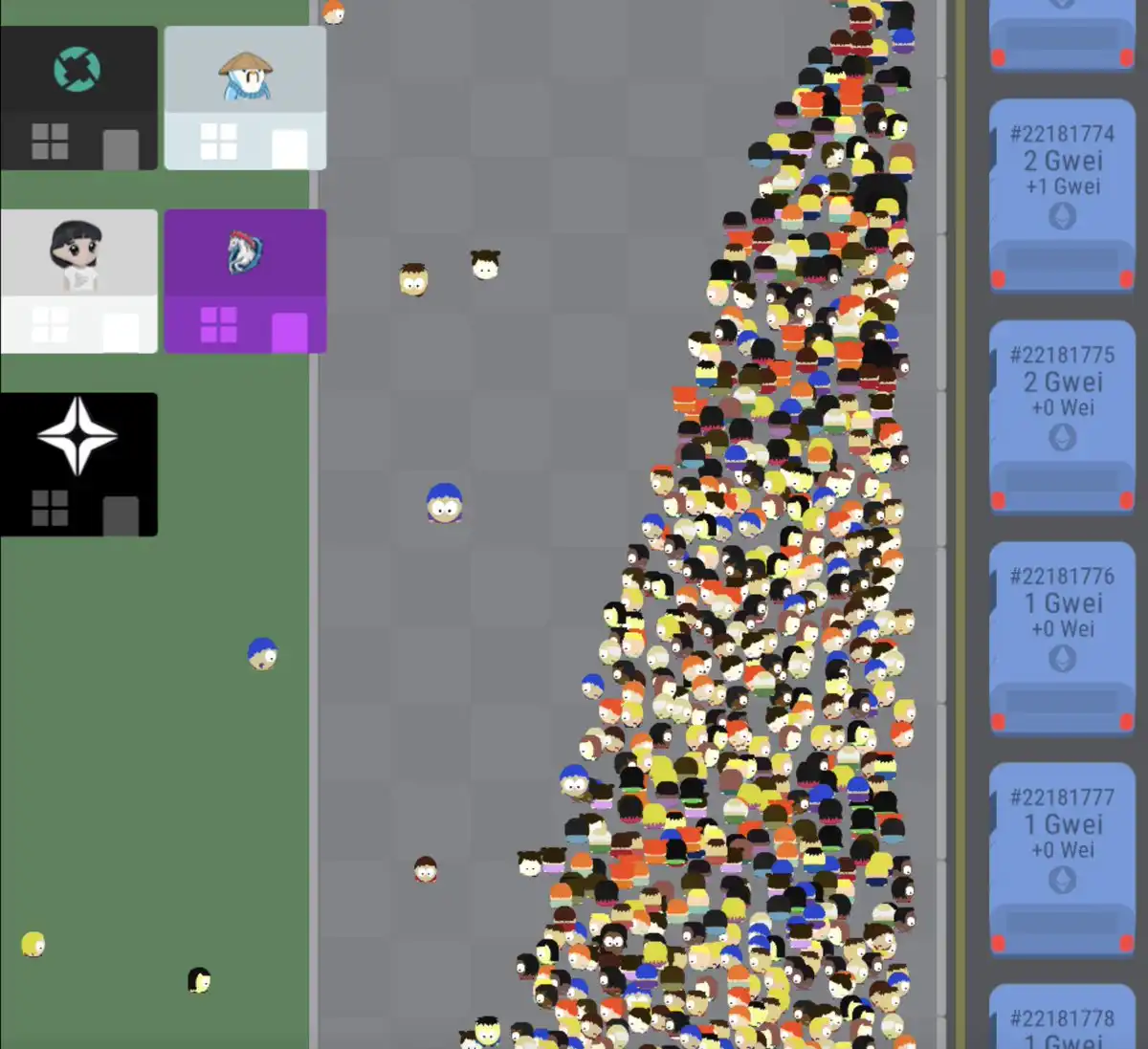
Ethereum Transaction Visualization
More efficient ways of creating block space emerged. Layer 2 solutions, Rollups, sidechains — each brought vast new lands to the Web3 planet. Goods that were once scarce became abundant.
Builders no longer fight for limited space; instead, they have created endless new land to meet the growing settlement demand. However, the proliferation of block space has brought unforeseen consequences.
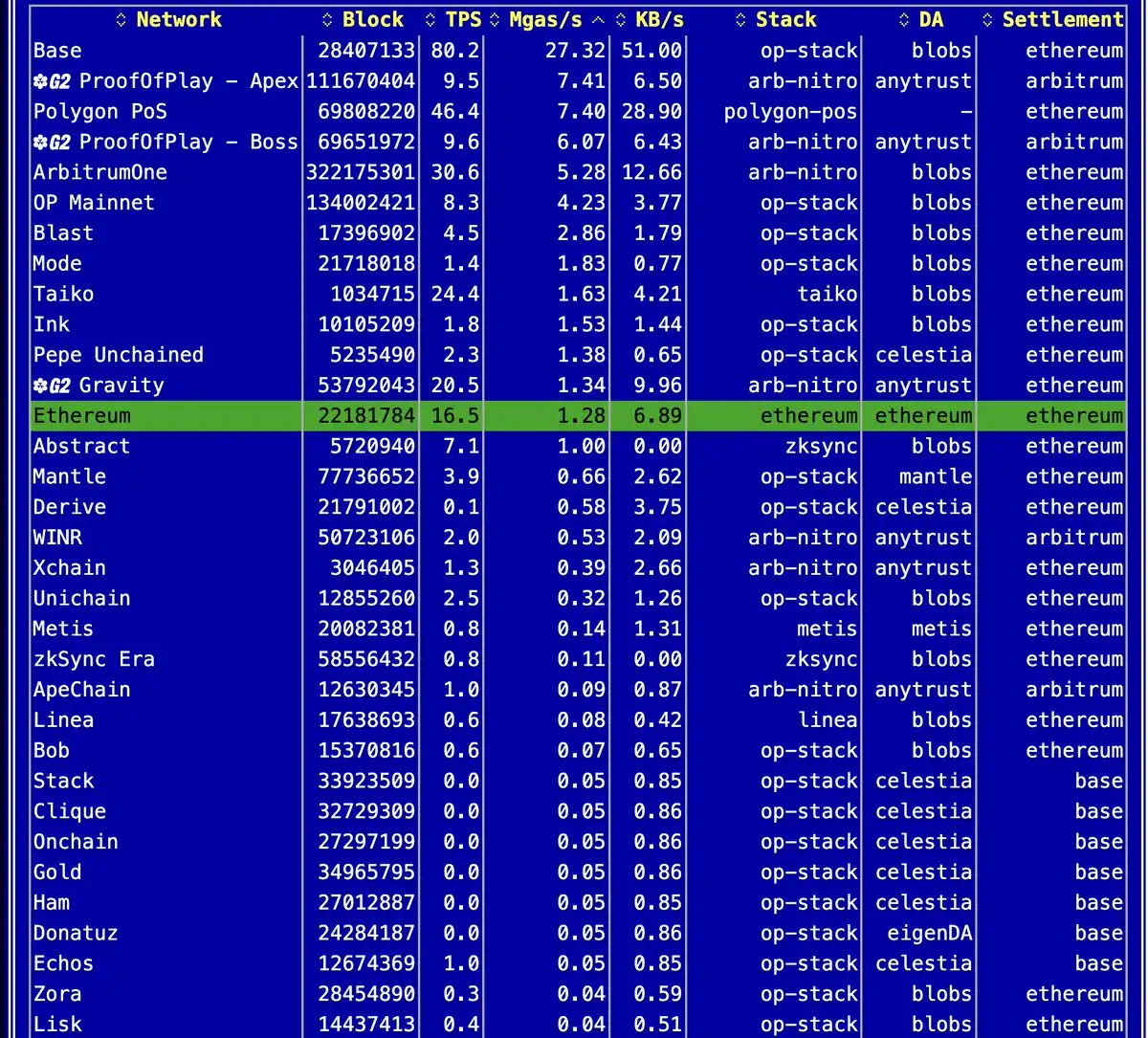
Image Source: rollup.wtf
Once valuable things have become cheap. The cost of storing transactions — once a key economic force — has plummeted. The promise of cheap block space has attracted millions of Web2 settlers, but reality has proven otherwise.
People from Web2 hesitated.
They heard stories of adventurers entering Web3, lured by the promise of wealth, only to be devoured by predators. Some Web2 residents did take the step, drawn to the legend of overnight riches.
They entered Web3, hoping to carve out a place in the new economy. Many started by purchasing small plots of land — various tokens, each promising future value. They traded, speculated, and started businesses, believing they were in the early days of the next great revolution.
But they did not realize that Web3 had long been structured by the earliest settlers and the most powerful capitalists. While the rules of the game were not explicitly stated, those who controlled this land knew it well. As more Web2 people moved in, they unwittingly found themselves in a predicament. The complexity of Web3 is daunting.

There are too many new nations, each with its own rules, and scams disguised as opportunities abound. The big players control the flow of information, manipulate the market, inflate values, and pull the rug out from under unsuspecting settlers' feet.
The Web3 world has become a playground for those who know how to extract wealth from the ignorant. Even though block space is cheaper than ever, adoption remains slow. The dream of a mass migration from Web2 to Web3 is crumbling.
The new land promised a seamless user experience but never reached the level of familiarity and convenience that Web2 offered. The additional promise of quick rewards is not enough to impress people — Web2 individuals have seen too many compatriots get burned.
They watched as entire nations in Web3 rose and fell overnight, wealth changing hands in the blink of an eye. Ordinary people hesitated, unable to see through the chaos. However, in the turmoil, a thriving marketplace emerged.
Web3's real estate — tokens — became the lifeblood of its economy. Everything is up for sale. Every nation has its own assets, unique value, and promises for the future. The trading floor never closes, driven by speculation, manipulation, and greed.
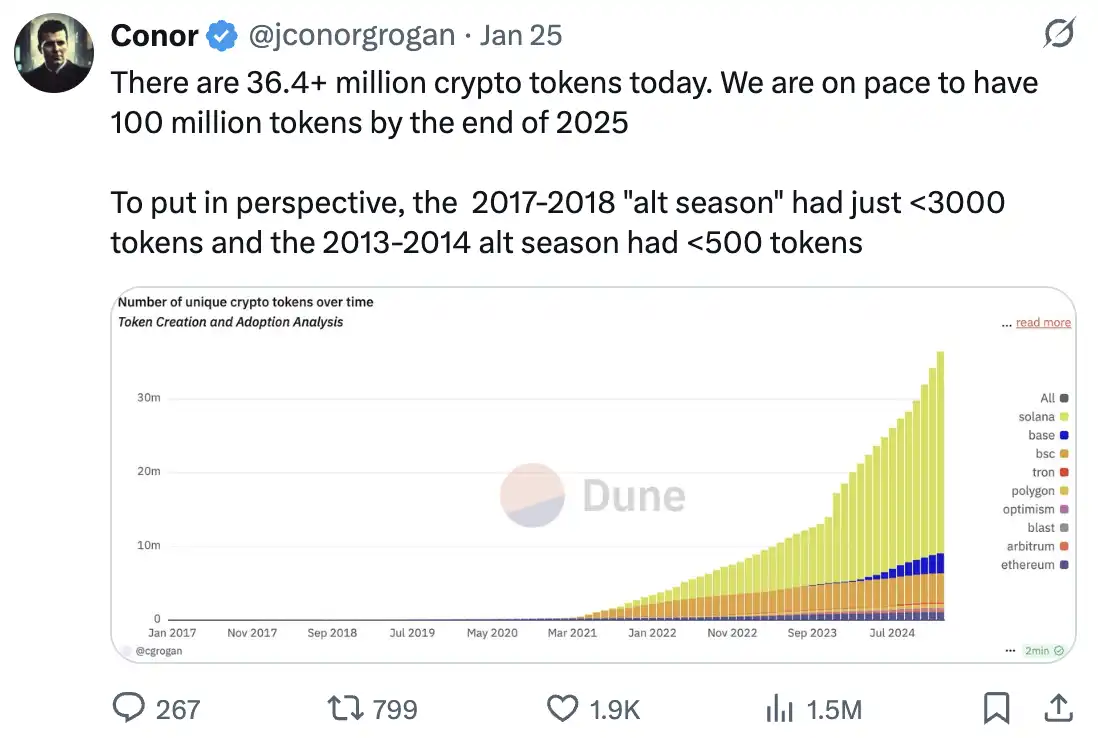
Some countries experience temporary prosperity, only to decline as attention shifts. New land is minted daily, sold to the highest bidder for a quick flip profit. The cycle continues endlessly. And as settlers struggle, the true beneficiaries of Web3 thrive.
Bridge operators — exchanges — act as gatekeepers, controlling the flow of assets between Web2 and Web3.
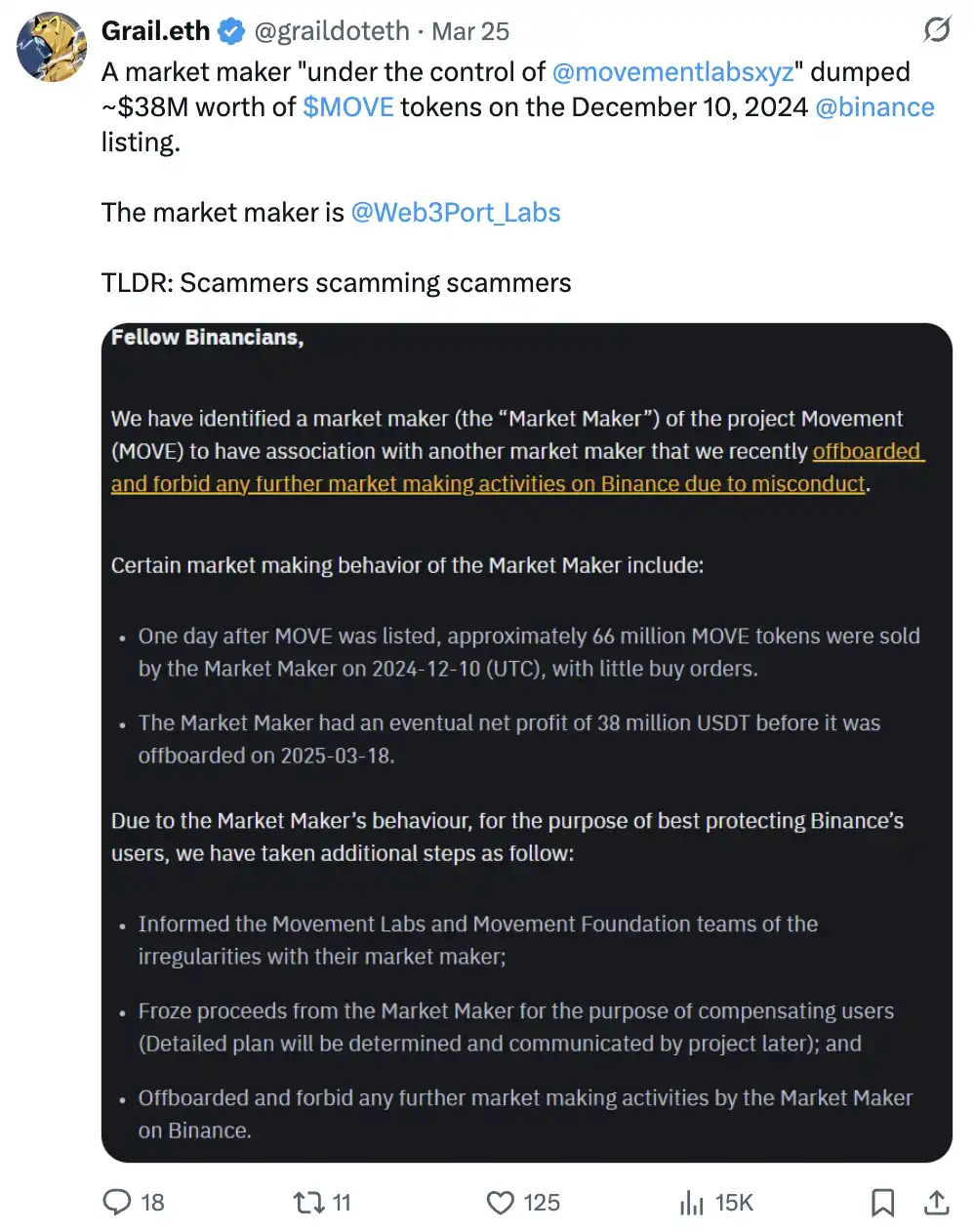
In short: scammers scamming scammers.
They profit with each entry and exit. Market makers — the hidden force managing liquidity — ensure every transaction is watched and taxed. Developers build continuously, not always for innovation, but to create more sellable land. And what of the marketers? They weave stories, craft narratives, selling dreams to the next hopeful settlers.
The dark side of Web3 is that it is no longer truly decentralized. The early vision of a freely open digital frontier has been replaced by the harsh reality of capital.
The same forces that dominated Web2 have infiltrated Web3. They settle not just inhabit but reshape this planet to suit their needs. Thus, the Web3 world expands, becoming an endless frontier of digital land, speculation, and fleeting opportunities.
The dream of true decentralization still exists. Settlers continue to arrive, hoping to strike it rich, but in the end, most leave poorer than they arrived.
Meanwhile, those who hold the system continue to extract, build, and control, ensuring this planet remains shaped by them.
You may also like

ChainCatcher Hong Kong Themed Forum Highlights: Decoding the Growth Engine Under the Integration of Crypto Assets and Smart Economy

Why can this institution still grow by 150% when the scale of leading crypto VCs has shrunk significantly?

Anthropic's $1 trillion, compared to DeepSeek's $100 billion

Geopolitical Risk Persists, Is Bitcoin Becoming a Key Barometer?

Annualized 11.5%, Wall Street Buzzing: Is MicroStrategy's STRC Bitcoin's Savior or Destroyer?

An Obscure Open Source AI Tool Alerted on Kelp DAO's $292 million Bug 12 Days Ago

Mixin has launched USTD-margined perpetual contracts, bringing derivative trading into the chat scene.
The privacy-focused crypto wallet Mixin announced today the launch of its U-based perpetual contract (a derivative priced in USDT). Unlike traditional exchanges, Mixin has taken a new approach by "liberating" derivative trading from isolated matching engines and embedding it into the instant messaging environment.
Users can directly open positions within the app with leverage of up to 200x, while sharing positions, discussing strategies, and copy trading within private communities. Trading, social interaction, and asset management are integrated into the same interface.
Based on its non-custodial architecture, Mixin has eliminated friction from the traditional onboarding process, allowing users to participate in perpetual contract trading without identity verification.
The trading process has been streamlined into five steps:
· Choose the trading asset
· Select long or short
· Input position size and leverage
· Confirm order details
· Confirm and open the position
The interface provides real-time visualization of price, position, and profit and loss (PnL), allowing users to complete trades without switching between multiple modules.
Mixin has directly integrated social features into the derivative trading environment. Users can create private trading communities and interact around real-time positions:
· End-to-end encrypted private groups supporting up to 1024 members
· End-to-end encrypted voice communication
· One-click position sharing
· One-click trade copying
On the execution side, Mixin aggregates liquidity from multiple sources and accesses decentralized protocol and external market liquidity through a unified trading interface.
By combining social interaction with trade execution, Mixin enables users to collaborate, share, and execute trading strategies instantly within the same environment.
Mixin has also introduced a referral incentive system based on trading behavior:
· Users can join with an invite code
· Up to 60% of trading fees as referral rewards
· Incentive mechanism designed for long-term, sustainable earnings
This model aims to drive user-driven network expansion and organic growth.
Mixin's derivative transactions are built on top of its existing self-custody wallet infrastructure, with core features including:
· Separation of transaction account and asset storage
· User full control over assets
· Platform does not custody user funds
· Built-in privacy mechanisms to reduce data exposure
The system aims to strike a balance between transaction efficiency, asset security, and privacy protection.
Against the background of perpetual contracts becoming a mainstream trading tool, Mixin is exploring a different development direction by lowering barriers, enhancing social and privacy attributes.
The platform does not only view transactions as execution actions but positions them as a networked activity: transactions have social attributes, strategies can be shared, and relationships between individuals also become part of the financial system.
Mixin's design is based on a user-initiated, user-controlled model. The platform neither custodies assets nor executes transactions on behalf of users.
This model aligns with a statement issued by the U.S. Securities and Exchange Commission (SEC) on April 13, 2026, titled "Staff Statement on Whether Partial User Interface Used in Preparing Cryptocurrency Securities Transactions May Require Broker-Dealer Registration."
The statement indicates that, under the premise where transactions are entirely initiated and controlled by users, non-custodial service providers that offer neutral interfaces may not need to register as broker-dealers or exchanges.
Mixin is a decentralized, self-custodial privacy wallet designed to provide secure and efficient digital asset management services.
Its core capabilities include:
· Aggregation: integrating multi-chain assets and routing between different transaction paths to simplify user operations
· High liquidity access: connecting to various liquidity sources, including decentralized protocols and external markets
· Decentralization: achieving full user control over assets without relying on custodial intermediaries
· Privacy protection: safeguarding assets and data through MPC, CryptoNote, and end-to-end encrypted communication
Mixin has been in operation for over 8 years, supporting over 40 blockchains and more than 10,000 assets, with a global user base exceeding 10 million and an on-chain self-custodied asset scale of over $1 billion.

$600 million stolen in 20 days, ushering in the era of AI hackers in the crypto world
Vitalik's 2026 Hong Kong Web3 Summit Speech: Ethereum's Ultimate Vision as the "World Computer" and Future Roadmap
On the same day Aave introduced rsETH, why did Spark decide to exit?
Full Post-Mortem of the KelpDAO Incident: Why Did Aave, Which Was Not Compromised, End Up in Crisis Situation?

After a $290 million DeFi liquidation, is the security promise still there?
ZachXBT's post ignites RAVE nearing zero, what is the truth behind the insider control?

Vitalik 2026 Hong Kong Web3 Carnival Speech Transcript: We do not compete on speed; security and decentralization are the core
In-depth Analysis of RAVE Events: Short Squeeze, Crash, and Quantitative Financial Models of Liquidity Manipulation

Eve of Ceasefire, US Military Fires on Iranian Vessel | Rewire News Morning Brief

Figma's stock price drops over 7%, will Claude Design be the terminator?




 App
App