
 Buy Crypto
- Markets
 Futures
- Spot
- Copy Trade
- Earn
- More
200 Million Gasless Transactions in One Month, Is Account Abstraction a Trend or a Bubble?

Original Article Title: The Real State of Gasless Web3
Original Article Author: Stacy Muur, Cryptocurrency Researcher
Original Article Translation: DeepSeek
Editor's Note: The article summarizes that within 30 days, 89 projects on 9 blockchains achieved over 2 million gasless transactions through ERC-4337 smart wallets, saving approximately $11,700 in gas fees, demonstrating the significant potential of the Paymaster payment model to enhance on-chain activity. However, the surge in transaction volume may mask the true user demand, as one-time activities such as NFT minting and airdrops lead to a short-term spike in wallet numbers but with low retention rates, while a few games, DeFi, and infrastructure apps show deeper levels of reuse. Data indicates that while Gas sponsorship can attract users, sustained engagement relies on attractive applications. ERC-4337 has driven the mainstream adoption of gasless transactions but faces technical complexity and cost challenges. The future EIP-7702 is expected to further simplify and expedite its adoption.
The following is the original content (slightly reorganized for better readability):
Within a mere 30 days, 89 projects on 9 blockchains facilitated over 2 million gasless transactions, saving up to $11,700 in gas fees.
The wave of gasless transactions across multiple chains indicates that solutions like those in ERC-4337 smart wallets, where fees are paid by Paymasters, can rapidly boost on-chain activity.
Paymaster-Driven Adoption May Mask True User Demand
· The surge in transaction volume may not necessarily reflect genuine user interest, especially when a small number of wallets (such as traders, bots) repeatedly call contracts.
· One-time airdrops, free minting, or claiming activities may lead to a short-term spike in wallet numbers, but subsequent usage rates are extremely low.
New wallet numbers for NFTs, games, and token projects have seen a surge, but many wallets are used only for one-off operations (such as minting or claiming rewards) rather than ongoing engagement.
On the other hand, a few applications have demonstrated deeper, repetitive usage, typically driven by more engaging game loops, repetitive DeFi actions, or infrastructure-level services.
These findings indicate that ERC-4337 smart wallets are reshaping on-chain activity, showcasing both the power of Gas sponsorship to attract users and the need for attractive, reusable applications to maintain user engagement.
@0xKofi has built an authoritative dashboard to track this explosive growth, with data provided by @base.
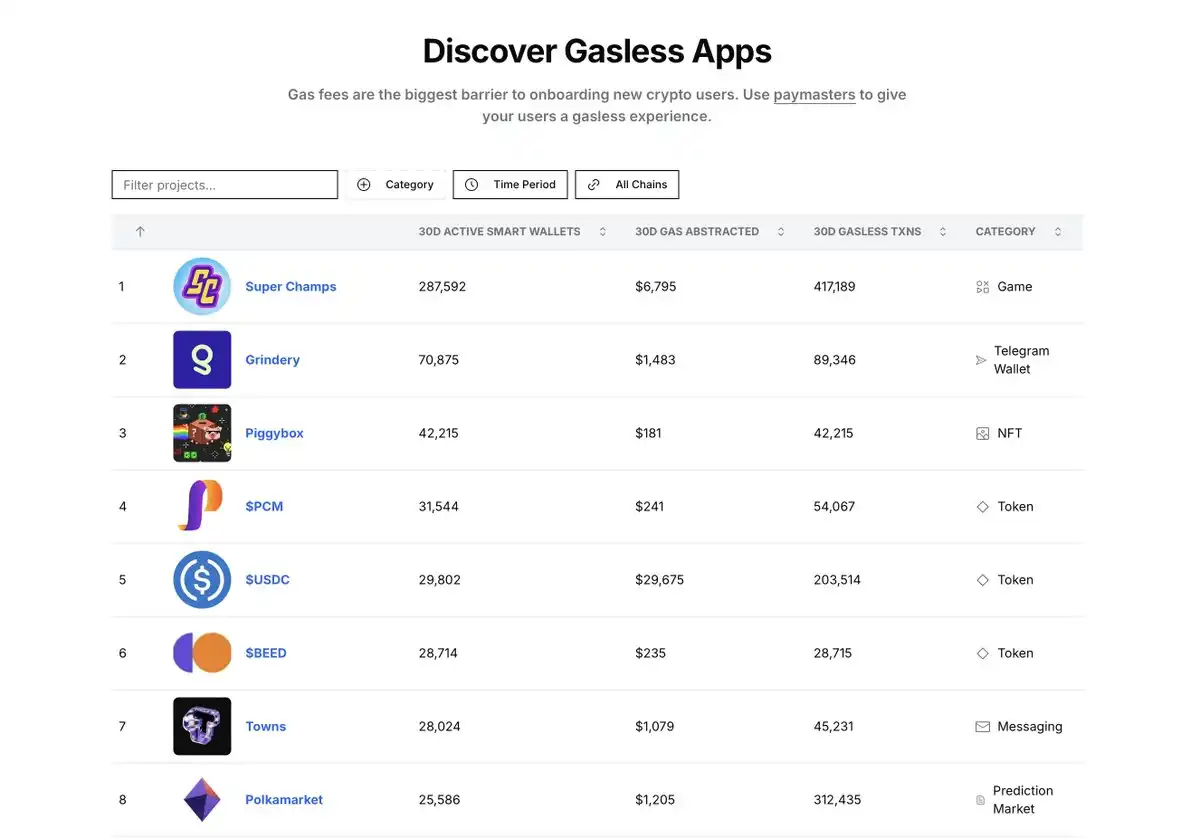
Key Metrics
· 89 unique apps/protocols
· Approximately 724,000 active smart wallets
· Approximately $11,700 waived in Gas fees
· Approximately 2,087,799 Gasless transactions
Development of ERC-4337
The rapid growth of Gasless transactions is part of a larger trend. In 2024, ERC-4337 accounts executed over 103 million User Operations (UserOps), more than 10 times the 8.3 million in 2023. 87% of these transactions had their fees paid by Paymasters, enabling a Gasless experience.
From the monthly Paymaster Gas expenditure chart, we can observe the following evolution:
· Early Adoption (2023): Little expenditure before mid-2023, with Optimism leading the early adoption.
· Growth Phase (Late 2023): By October 2023, monthly expenditure steadily increased to around $400,000.
· Peak Activity (April 2024): Expenditure surged to around $700,000, primarily driven by Base.
· Recent Trends (Late 2024 to Early 2025): After reaching a new high in November to December 2024 (around $630,000), monthly Gas expenditure has significantly dropped in early 2025, down to around $150,000 in February.
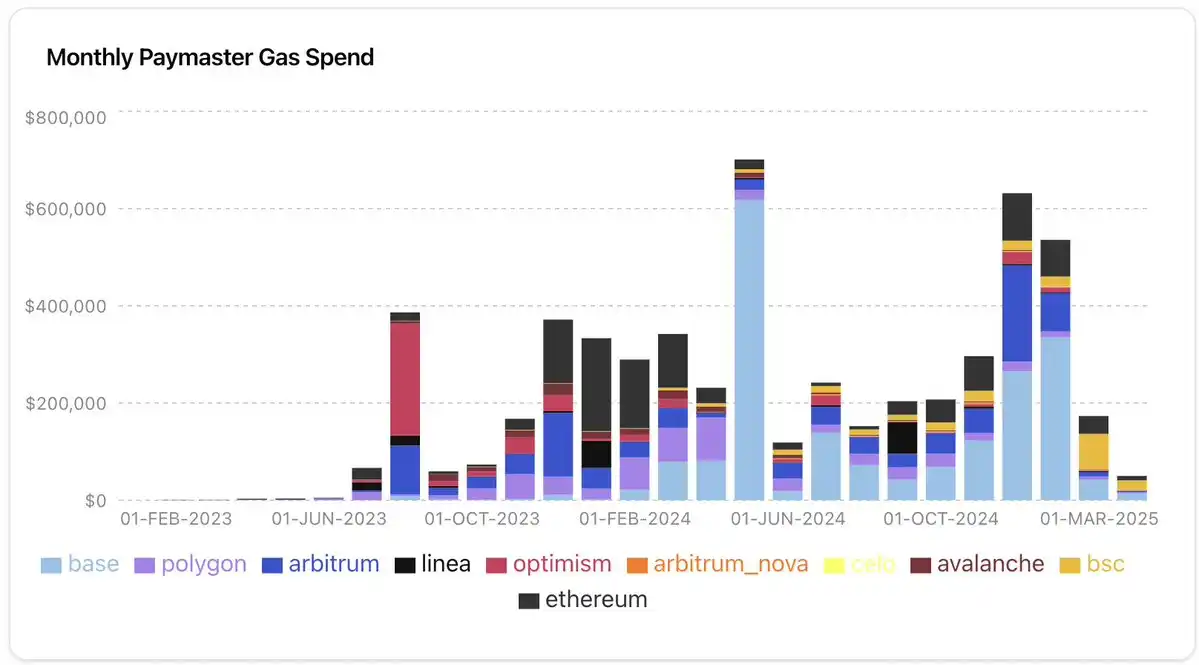
Through Paymaster, apps and users have spent over $3.4 million on UserOp fees, with main providers including @biconomy, @pimlicoHQ, @coinbase, and @Alchemy. Despite the market contraction, overall spending in the first quarter of 2025 shows a downward trend, with @base ($391,117), @ethereum ($121,053), and @BNBCHAIN (approximately $112,493) still leading.
On-Chain Activity Ranking
· Base (43.2%): Entertainment and Social Hub — Dominant in Gaming (76.8%).
· Polygon (21.4%): Community Engagement Layer — NFTs (50.7%) and Telegram Wallet (42.3%).
· Optimism (8.5%): Security-Focused — Emphasizing Infrastructure Resilience.
· Celo (7.4%): Niche Expertise — Forecasting Market.
· BSC (4.2%): Value Transfer Layer — Token-Focused, Highest Gas Costs.
Data Analysis
Before delving into data analysis, it is crucial to understand two key metrics:
· Tx/Wallet (Transactions per Wallet) — Measures the average number of transactions completed per wallet. A low value (e.g., ~1.0) indicates one-time usage activities (e.g., minting NFTs or claiming airdrops). A high value (e.g., ~25) indicates repeated engagement (e.g., active trading, gaming, or bot operations).
· Cost/Tx (Cost per Transaction) — Represents the average cost per transaction. In a Gasless system, it reflects the fee waived per transaction rather than the fee paid by the user.
1. NFT Projects: Numerous Wallets Usually = One-Time Accounts
· Piggybox: → Approximately 1 tx/wallet, ~$0.004/transaction.
· Somon Badge: → Approximately 1.4 tx/wallet, ~$0.007/transaction.

Interpretation: The 1:1 wallet-to-transaction ratio (Piggybox) strongly suggests minting or claiming activity. Piggybox is an NFT obtained during EARN'M registration, plus a lottery box that may yield EARNM tokens.
One-Time Surge: Many wallets engage in only one transaction (initial minting/claiming) and do not return thereafter, hence the near-perfect 1:1 ratio.
Ranking: Due to many new wallets engaging in minting, Piggybox ranks high on the overall leaderboard. However, if excluding one-time wallets, it might drop from the top five, indicating very low retention rates.
2. Token: Concentration of Token Transactions in a Few Projects
The list includes 26 token projects, far exceeding other categories. Two tokens, $BVRP and $USDC, accounted for over 667k transactions, representing the majority of the transaction volume.
· $BVRP: → ~25 tx/wallet at $0.012/tx.
· $USDC: → ~4.6 tx/wallet at $0.21/tx.
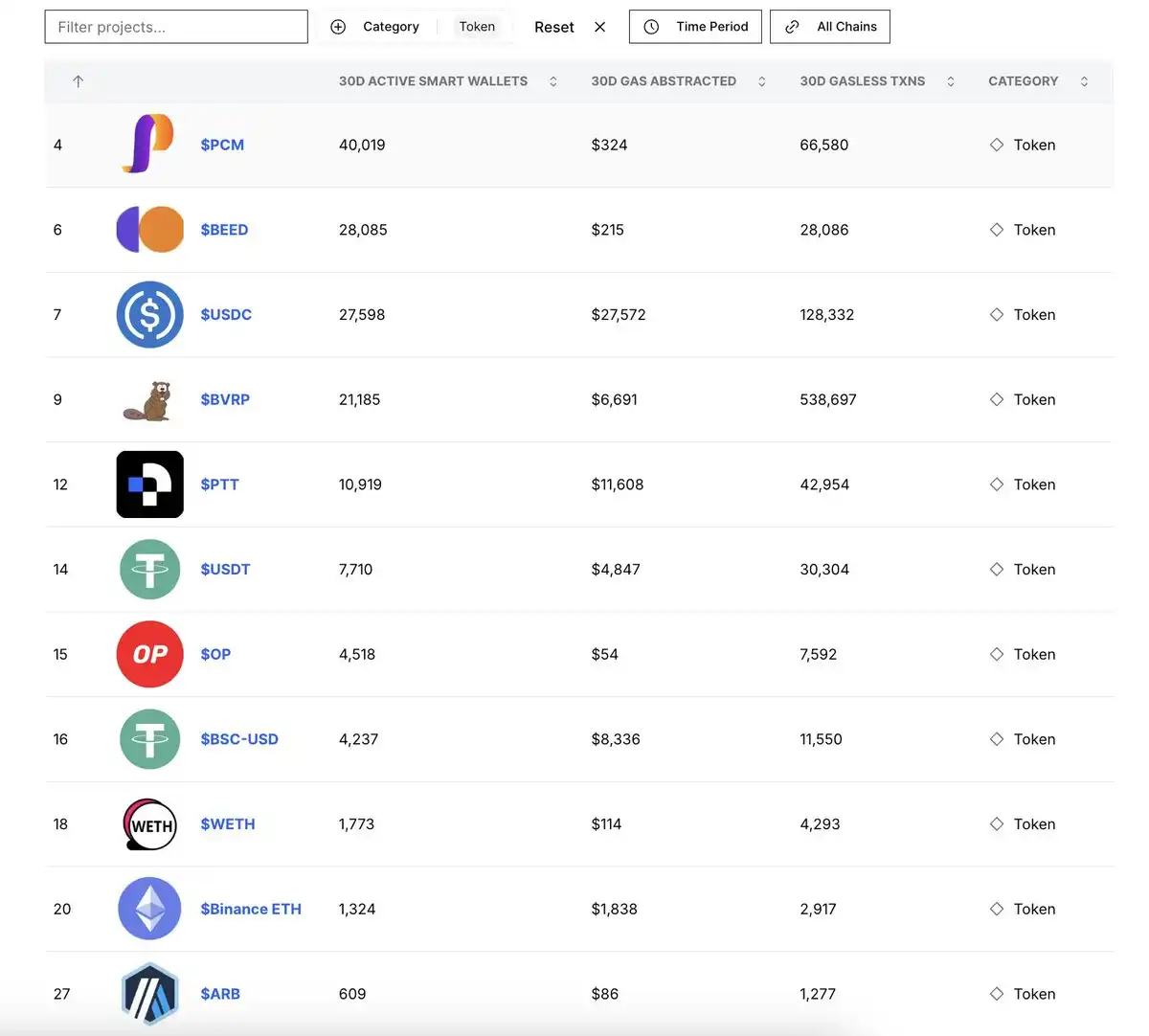
Interpretation:
· This concentration indicates that not all "token" projects are equally active; rather, a few heavyweight projects are driving the total volume.
· $BVRP demonstrates high transaction activity relative to the number of wallets, indicating high user engagement on these platforms, with frequent automated or repetitive transactions.
3. Gaming: One "Hit Game," but Attention Needed on Wallet/Transaction Ratio
· @SuperChampsHQ: → Approximately 1.49 tx/wallet, ~$0.017/transaction.
· @BLOCKLORDS: → Approximately 42 tx/wallet, ~$0.009/transaction.
· @miracleplay_cn: → Approximately 14 tx/wallet, ~$0.012/transaction.
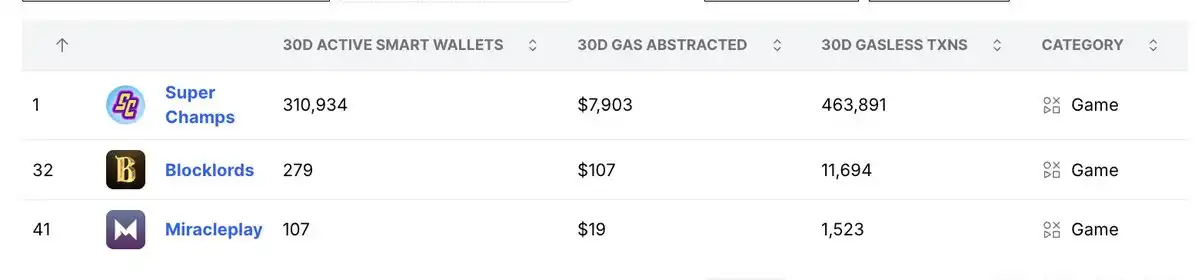
Interpretation:
· Super Champs dominate the overall gaming usage (463k vs. the sum of others at ~13k), but each wallet executes only about 1-2 transactions.
· Blocklords has fewer wallet numbers but an extremely high transactions per wallet ratio (~42). This is often related to robot-driven repetitive operations, as Blocklords' David Johansson stated: "They are fighting robots."
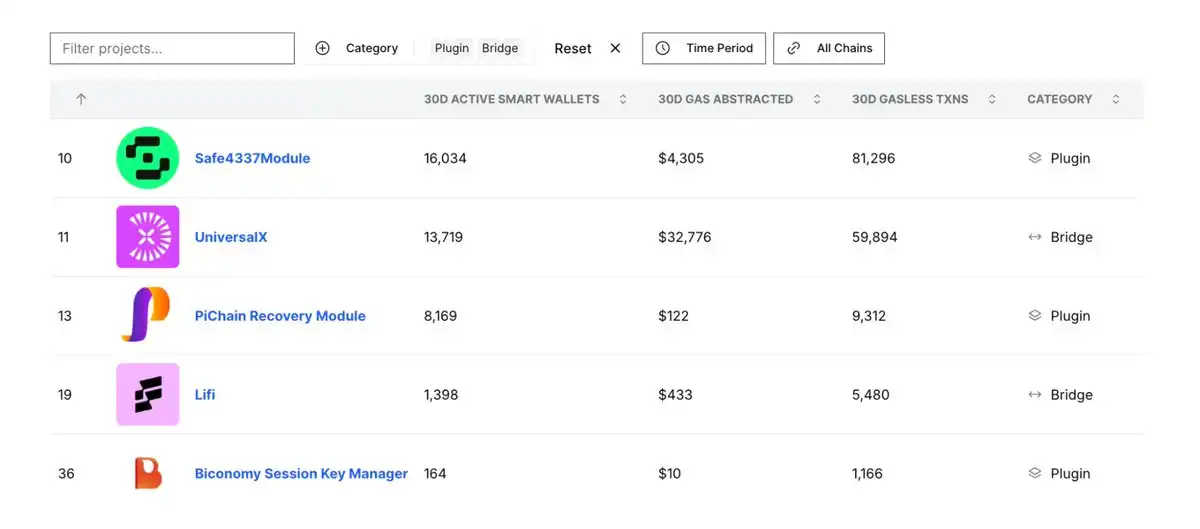
4. Bridging and Plugins: Moderate but Stable Usage, High Gas Costs
· UniversalX: → Approximately 4.4 tx/wallet, ~$0.55/transaction.
· Safe4337Module: → Approximately 5.1 tx/wallet, ~$0.053/transaction.
Interpretation:
· Behind-the-Scenes Tools: Infrastructure tools like bridges and plugins do not have the same "headline" transaction volume as tokens or games, but they maintain stable usage due to multiple dApp dependencies.
· Ecosystem Health Metrics: The moderate usage of infrastructure services indicates their real utility, rather than hype-driven spikes.
5. Chain Specialization Is Emerging
· @base: 99.5% of gaming wallet activity (310,934 out of 312,361 wallets).
· @0xPolygon: Dominant in NFT/social activity (87% of ecosystem NFT wallets).
· @BNBCHAIN: Leading in high-value bridge transactions (23.2% of all Gasless transactions).
· @Celo: Strong performance in prediction markets (25,574 wallets, 12.7 tx/wallet).
6. Cross-Chain Cost Differences
A 100x cost difference between different chains is driving specific application categories to concentrate on particular chains:
· Ethereum: $2.41 per Gasless transaction (highest).
· BSC: $0.50 per Gasless transaction.
· Base: $0.02 per Gasless transaction (lowest among major chains).
· Polygon: $0.03 per Gasless transaction. Argument: A 100x cost structure difference between different chains will lead to specific application categories concentrating on particular chains, regardless of technical similarities. Games and social apps are economically unfeasible on high-cost chains.
Overall Situation
· NFT adoption may involve minting to tens of thousands of wallets at once (e.g., Piggybox), but the reuse rate is extremely low.
· Infrastructure (bridges, plugins) remains stable with moderate transaction volume, usually with high per-transaction costs (bridges) or stable off-chain usage (plugins).
· The differences in per-wallet transaction counts across all categories highlight distinct usage patterns: some highly repetitive, while others are purely one-off interactions.
· Finally, the engagement of a large number of projects is close to zero, indicating that relying solely on free Gas is insufficient to generate demand; dApps need a real value proposition to retain users.
Summary
Account abstraction and Gas sponsorship can indeed boost transaction volume and user onboarding, but the real test is repeat engagement. By combining wallet counts, waived Gas fees, and no-Gas transaction volumes, the data highlights the phenomenon of concentrated usage within each category, often stemming from one or two star dApps or large-scale one-time claim events. Projects like Piggybox demonstrate how a near 1:1 ratio of wallets to transactions can propel an NFT project to the top ranks but may quickly fall off after filtering out one-time accounts. Meanwhile, bridge and plugin solutions demonstrate more stable moderate transaction volumes, reflecting the ecosystem's true needs rather than transient hype.
The Role of the ERC-4337 Smart Wallet
All these trends—Gasless gaming, seamless DeFi, chain specialization—are driven by the ERC-4337 Smart Wallet.
Unlike traditional EOAs (Externally Owned Accounts), smart wallets introduce automation, security, and flexibility, significantly enhancing the user experience.
What Is an ERC-4337 Smart Wallet?
A smart contract wallet or smart wallet is a programmable Ethereum account that enhances the user experience through the following functionalities:
Batch Transactions—Users can batch multiple operations (e.g., approve + swap on a DEX) into a single transaction.
Gas Fee Abstraction—Users do not need to hold ETH to pay gas fees; the fees can be covered by a sponsor or paid with other tokens.
Security—Users can authenticate themselves through passwords, social recovery, or multi-factor authentication instead of using less secure seed phrases.
How Does Gasless Transaction Work?
When a user initiates a transaction, the Paymaster (a special type of smart contract) can step in to pay the Gas fee or allow the user to pay using any held ERC-20 token. This significantly lowers the barrier of entry for new users, making blockchain applications seamless like Web2 apps.
However, ERC-4337 also faces significant adoption challenges, with the aforementioned retention issues possibly stemming directly from the following key limitations:
· Technical Barriers: Complex components like UserOperations, Bundlers, and EntryPoint contracts pose a steep learning curve for regular users and developers.
· Cost Concerns: While Gasless transactions are beneficial for users, implementing the full stack may be costly, and the profitability of Bundlers is unstable during Gas fluctuations.
· Reliability Issues: Network congestion can lead to transaction delays, and complex validation logic introduces potential security vulnerabilities.
· User Experience Gap: Multi-chain fragmentation results in inconsistent wallet experiences, hindering seamless cross-chain management.
Conclusion
Account abstraction and Gas sponsorship have successfully boosted transaction volume and new wallet registrations, but the real challenge is sustained engagement. Data shows:
· Many dApps experience one-time spikes in usage (such as NFT minting, airdrops), rather than long-term retention.
· A few projects drive the majority of activity, while many others struggle to attract genuine user demand.
· Bridging and infrastructure solutions demonstrate more stable usage rates, highlighting real utility over hype.
While ERC-4337 has achieved Gasless transactions and improved user experience, its complexity and cost barriers limit mainstream adoption. EIP-7702 addresses these issues by:
· Allowing EOAs to engage in account abstraction: The core issue with ERC-4337 was excluding EOAs, requiring users to switch to a smart contract wallet. EIP-7702 resolves this by allowing EOAs to temporarily adopt smart contract code, enabling access to Gas sponsorship (paying fees with ERC-20 tokens) and batch transactions (such as approving and spending ERC-20 tokens in a single transaction).
· Simplify Complexity and Cost: Allow EOA to temporarily adopt smart contract functionality, reduce the need for permanent wallet contracts, lower Gas expenses, and decrease reliance on Entry Points or Bundlers.
· Improve Efficiency: Introduce transaction type 0x04 for batch EOA operations, providing a more streamlined alternative to ERC-4337 UserOps.
· Simplify Infrastructure: Restrict smart contract code to transaction execution, reducing reliance on alternative mempools and Bundlers.
· Empower Developers: Integrate with ERC-4337 and provide a flexible, low-friction upgrade path.
While ERC-4337 laid the foundation, EIP-7702 will make smart wallets cheaper, simpler, more accessible, accelerating the next wave of Web3 adoption.
You may also like

Morning News | The Hong Kong Securities and Futures Commission announced the regulatory framework for secondary market trading of tokenized investment products; Strategy increased its holdings by 34,164 bitcoins last week; KAIO completed a strategic fi...

What Is an XRP Wallet? The Best Wallets to Store XRP (2026 Updated)
An XRP wallet lets you safely store, send, and receive XRP on the XRP Ledger. Learn what wallets support XRP and discover the best XRP wallets for beginners and long-term holders in 2026.

What are the Top AI Crypto Coins? Render vs. Akash: 5 Gems Solving the 2026 GPU Crisis
What are the best AI crypto coins for the 2026 cycle? Beyond the hype, we analyze top tokens like RNDR, AKT, and FET that provide real-world solutions to the global GPU shortage and the rise of autonomous agents.

What Is a Token in AI? What Is an AI Token + 3 Gems You Can't Miss in 2026
The era of AI hype has transitioned into an era of utility. As we move through Q2 2026, the market is no longer rewarding "narrative-only" projects. At WEEX Research, we are seeing a massive capital rotation into Decentralized Compute (DePIN) and Autonomous Agent coordination layers. This guide analyzes which AI tokens are capturing institutional liquidity and how to spot high-conviction setups in a maturing market.

Consumer-grade Crypto Global Survey: Users, Revenue, and Track Distribution

Prediction Markets Under Bias

Stolen: $290 million, Three Parties Refusing to Acknowledge, Who Should Foot the Bill for the KelpDAO Incident Resolution?

ASTEROID Pumped 10,000x in Three Days, Is Meme Season Back on Ethereum?

ChainCatcher Hong Kong Themed Forum Highlights: Decoding the Growth Engine Under the Integration of Crypto Assets and Smart Economy

Why can this institution still grow by 150% when the scale of leading crypto VCs has shrunk significantly?

Anthropic's $1 trillion, compared to DeepSeek's $100 billion

Geopolitical Risk Persists, Is Bitcoin Becoming a Key Barometer?

Annualized 11.5%, Wall Street Buzzing: Is MicroStrategy's STRC Bitcoin's Savior or Destroyer?
An Obscure Open Source AI Tool Alerted on Kelp DAO's $292 million Bug 12 Days Ago

Mixin has launched USTD-margined perpetual contracts, bringing derivative trading into the chat scene.
The privacy-focused crypto wallet Mixin announced today the launch of its U-based perpetual contract (a derivative priced in USDT). Unlike traditional exchanges, Mixin has taken a new approach by "liberating" derivative trading from isolated matching engines and embedding it into the instant messaging environment.
Users can directly open positions within the app with leverage of up to 200x, while sharing positions, discussing strategies, and copy trading within private communities. Trading, social interaction, and asset management are integrated into the same interface.
Based on its non-custodial architecture, Mixin has eliminated friction from the traditional onboarding process, allowing users to participate in perpetual contract trading without identity verification.
The trading process has been streamlined into five steps:
· Choose the trading asset
· Select long or short
· Input position size and leverage
· Confirm order details
· Confirm and open the position
The interface provides real-time visualization of price, position, and profit and loss (PnL), allowing users to complete trades without switching between multiple modules.
Mixin has directly integrated social features into the derivative trading environment. Users can create private trading communities and interact around real-time positions:
· End-to-end encrypted private groups supporting up to 1024 members
· End-to-end encrypted voice communication
· One-click position sharing
· One-click trade copying
On the execution side, Mixin aggregates liquidity from multiple sources and accesses decentralized protocol and external market liquidity through a unified trading interface.
By combining social interaction with trade execution, Mixin enables users to collaborate, share, and execute trading strategies instantly within the same environment.
Mixin has also introduced a referral incentive system based on trading behavior:
· Users can join with an invite code
· Up to 60% of trading fees as referral rewards
· Incentive mechanism designed for long-term, sustainable earnings
This model aims to drive user-driven network expansion and organic growth.
Mixin's derivative transactions are built on top of its existing self-custody wallet infrastructure, with core features including:
· Separation of transaction account and asset storage
· User full control over assets
· Platform does not custody user funds
· Built-in privacy mechanisms to reduce data exposure
The system aims to strike a balance between transaction efficiency, asset security, and privacy protection.
Against the background of perpetual contracts becoming a mainstream trading tool, Mixin is exploring a different development direction by lowering barriers, enhancing social and privacy attributes.
The platform does not only view transactions as execution actions but positions them as a networked activity: transactions have social attributes, strategies can be shared, and relationships between individuals also become part of the financial system.
Mixin's design is based on a user-initiated, user-controlled model. The platform neither custodies assets nor executes transactions on behalf of users.
This model aligns with a statement issued by the U.S. Securities and Exchange Commission (SEC) on April 13, 2026, titled "Staff Statement on Whether Partial User Interface Used in Preparing Cryptocurrency Securities Transactions May Require Broker-Dealer Registration."
The statement indicates that, under the premise where transactions are entirely initiated and controlled by users, non-custodial service providers that offer neutral interfaces may not need to register as broker-dealers or exchanges.
Mixin is a decentralized, self-custodial privacy wallet designed to provide secure and efficient digital asset management services.
Its core capabilities include:
· Aggregation: integrating multi-chain assets and routing between different transaction paths to simplify user operations
· High liquidity access: connecting to various liquidity sources, including decentralized protocols and external markets
· Decentralization: achieving full user control over assets without relying on custodial intermediaries
· Privacy protection: safeguarding assets and data through MPC, CryptoNote, and end-to-end encrypted communication
Mixin has been in operation for over 8 years, supporting over 40 blockchains and more than 10,000 assets, with a global user base exceeding 10 million and an on-chain self-custodied asset scale of over $1 billion.

$600 million stolen in 20 days, ushering in the era of AI hackers in the crypto world
Vitalik's 2026 Hong Kong Web3 Summit Speech: Ethereum's Ultimate Vision as the "World Computer" and Future Roadmap
On the same day Aave introduced rsETH, why did Spark decide to exit?
Morning News | The Hong Kong Securities and Futures Commission announced the regulatory framework for secondary market trading of tokenized investment products; Strategy increased its holdings by 34,164 bitcoins last week; KAIO completed a strategic fi...
What Is an XRP Wallet? The Best Wallets to Store XRP (2026 Updated)
An XRP wallet lets you safely store, send, and receive XRP on the XRP Ledger. Learn what wallets support XRP and discover the best XRP wallets for beginners and long-term holders in 2026.
What are the Top AI Crypto Coins? Render vs. Akash: 5 Gems Solving the 2026 GPU Crisis
What are the best AI crypto coins for the 2026 cycle? Beyond the hype, we analyze top tokens like RNDR, AKT, and FET that provide real-world solutions to the global GPU shortage and the rise of autonomous agents.
What Is a Token in AI? What Is an AI Token + 3 Gems You Can't Miss in 2026
The era of AI hype has transitioned into an era of utility. As we move through Q2 2026, the market is no longer rewarding "narrative-only" projects. At WEEX Research, we are seeing a massive capital rotation into Decentralized Compute (DePIN) and Autonomous Agent coordination layers. This guide analyzes which AI tokens are capturing institutional liquidity and how to spot high-conviction setups in a maturing market.



 App
App