
 Buy Crypto
- Markets
 Futures
- Spot
- Copy Trade
- Earn
- More
After April 2nd, What Will the Crypto Market Look Like? | Trader's Insight

April 2, 2025, is destined to be a key milestone in the global financial markets, as President Trump is expected to announce corresponding tariff measures at 3:00 p.m. on Wednesday in the White House Rose Garden (3:00 a.m. Beijing time the next day).
Due to concerns about the tariff threat, the U.S. stock market experienced a sharp decline on March 28, with the tech sector leading the plunge. The market value of the seven tech giants (including Apple, Microsoft, Amazon, etc.) evaporated by about $505 billion, and the Philadelphia Semiconductor Index fell by 2.95%. This was the largest single-day drop since the U.S. stock market crash on March 10, marking a severe adjustment at the end of the first quarter of 2025.
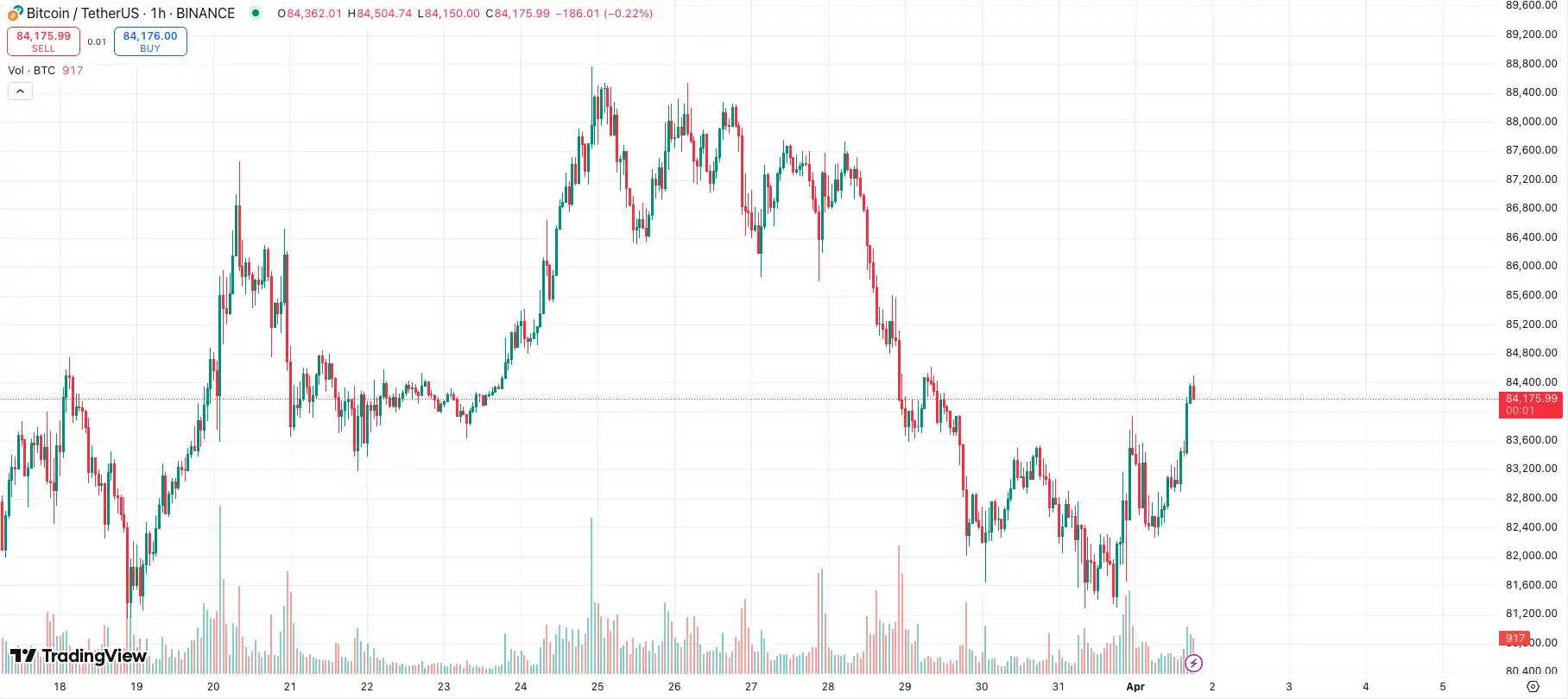
Spilling over to the crypto market, Bitcoin dropped from $84,000 on the afternoon of March 29 to $81,644 in 8 hours, a drop of over 3%. It then rebounded to $83,536 at 6 p.m. on March 30 but failed to hold the gains, falling to $81,565 by 6 a.m. on March 31. The total market capitalization of cryptocurrencies fell from a peak of $3.9 trillion to $2.9 trillion, a 25% decline. Trading volume plummeted from $126 billion after the November 5 election to $35 billion, shrinking by about 70%.
Whether in public or private conversations, Trump has claimed that tariffs are a "win-win" policy that can bring manufacturing jobs back to the U.S. and generate trillions of dollars in new revenue for the federal government. He also stated that allowing advisors to dissuade him from implementing higher tariffs during his first term was a mistake; now he believes that imposing a simple uniform tariff rate on most imported goods will help prevent exemptions from undermining the tariff's effectiveness.
Trump has openly praised the benefits of import taxes, even calling "tariff" the "most beautiful word" in the dictionary and stating that the tariff policy of the 19th century brought about the economic peak in American history. Some allies have even envisioned declaring April 2 as a federal holiday in commemoration of the anniversary of the imposition of tariffs. Trump's former chief strategist in the first term, Steve Bannon, even suggested, "Rather than celebrating Trump's birthday, it is better to establish a 'Liberation Day' as a national holiday to pay tribute to the jobs, skills, and trade that have returned to the U.S. and its workers."
The most likely option to be adopted is the proposal publicly put forward this month by Treasury Secretary Scott Bennett: imposing tariffs on 15% of countries identified by the White House as the worst trading partners, which represent nearly 90% of U.S. imports. In addition, Trump has also advanced other tariff policies that cover all countries but target specific industries. He imposed a 25% tariff on all car imports on Wednesday and hinted at similar measures for industries such as pharmaceuticals and timber.
However, the market's biggest concern is still the sustained uncertainty caused by policy flip-flops, a "blunt knife cutting flesh" type of risk that is forcing traders to reevaluate their second-quarter investment thesis. BlockBeast has compiled analysts' insights from a macroscopic game theory, technical patterns, policy variables, and other dimensions of analysis, combining long and short chip conversion signals and historical structural replication paths to reveal potential trading opportunities and pitfalls in the eye of the storm.
Macro Analysis
1. Whether VAT is included (bearish if yes, bullish if no)
If the reciprocal tariff as previously mentioned considers VAT, then the equivalent tax rate will be higher than expected.
2. Whether Mexico has a tariff exemption (bullish if yes, bearish if no)
As previously stated, in the Lutnick tariff system, Mexico's tariffs are an extension of domestic policy, hoping for their cooperation to promote North American inner cycling for negotiation facilitation. Mexico is the U.S.'s 2nd largest trading partner, and if an exemption can be achieved, inflation pressure will be slightly reduced.
3. How the U.S. Dollar Index responds
The tariffs trigger supply-side-driven inflation, and supply inflation and the strength of the dollar will react to each other—the rebound of DXY at the bottom will hedge part of the tariff effect; if DXY continues to decline, future inflationary pressure will increase.
The strength of the dollar is an amplifier of supply-side inflation, and if the dollar appreciates, inflation pressure will relatively weaken.
4. Expected Changes
The macro environment in Q1 was not bad, with ample liquidity, QT slowing, and 10-year yield and DXY falling. However, starting from February, with changes in policy expectations, the crypto market has seen multiple "Black Mondays" during U.S. stock futures trading hours, from deepseek valuation compression, to weekend sudden Mexico tariff retaliation, to recession-expectation trading. In summary, there are only three expected changes:
①"Reinflation expectation" brought by tariffs
②"Recession expectation" caused by softening economic data and Fed's wait-and-see approach leading to stagflation
③"Adjustment expectation" that valuations post-pandemic are too high
Personally, in trading, if these three expectations cannot be reversed, it will be difficult to reverse the 78,000-91,000 range previously priced in the chart. So far, I haven't seen any concessions on tariffs, so if they exceed expectations, look for divergences to take reverse actions.
A bullish opportunity for 2025 may arise from the impact of tariffs settling + the expectation reversal brought by tax reduction bills (there are no signs of tax reduction bills yet, so wait patiently).
Actually, up to now, Bitcoin's safe-haven sentiment has improved a lot. The morning after the opening of U.S. stock index futures, all indices have dropped sharply, mainly because it is almost the 2nd [of the month], facing the uncertainty of tariffs, many investors have chosen to hedge. Currently, the Nasdaq futures are down more than 1.2%, S&P 500 futures are down 0.75%, and Asian market investors have taken the lead to exit.
Now the market is waiting for Trump's final tariff implementation, and what the market is most worried about is not a one-time tariff, but Trump's repeated adjustments to the tariff, which may make the market feel more at risk.
But it is important to note that rising difficulty does not necessarily mean a decline, because it is still event-driven. Perhaps at some point, Trump will reverse again, that’s what makes it difficult. The second quarter may be more challenging compared to the first quarter, with inflation, tariffs, the Fed maintaining rates, and Japan raising rates all potentially affecting the risk market. The April tariff will be a key reason for the increasing difficulty in the risk market, and the assessment of tariffs cannot be easily summarized in a single sentence. It's more about "game theory."
This is the ASR-VC daily channel during the last round of oscillation before the bull market turned bearish, which indeed has some similarities to the current situation;
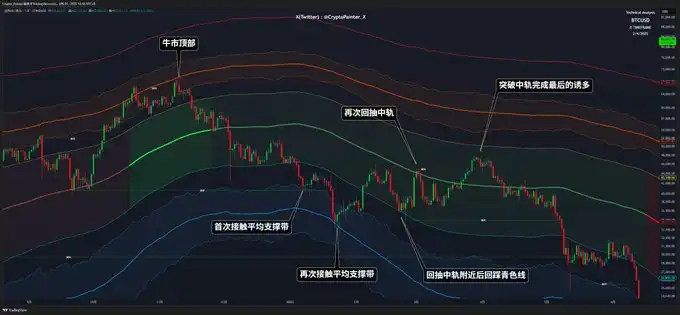
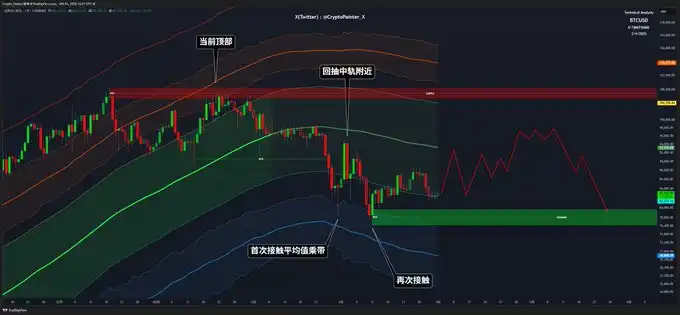
I have drawn on the chart a potential path that replicates a similar structure. The general idea is that if this is the final stage of the bull to bear transition, then we still need to wait for one last bull trap.
Still, I do not recommend simple pattern matching. The inductive method does not work well in the market, but understanding the previous structural trends and their reasons, and applying the same logical deduction to the present, is still feasible.
Personal opinion: each party essentially subdivides the tariffs into multiple scenarios, with the core being the previously discussed mild version and the most hardline version. Other scenarios oscillate between these two versions. What needs to be considered for market performance is:
1) If it’s the most hardline version, will the days after the 2nd be the peak of uncertainty for a period in the future? Because the most hardline version will definitely trigger the most pessimistic market expectations and cause a huge impact. After that, each country will negotiate with the U.S. separately, because the worst-case scenario has already appeared. Subsequent negotiations, once there is any progress, will boost market confidence.
2) If it's the mild version, the market should be fine that day, and confidence will naturally improve. However, the subsequent game will definitely be back and forth. So after the market surges on the 2nd and 3rd, it will move in a start-and-stop manner, taking two steps forward and one or two steps back, and the back-and-forth grind will also take a long time.
Technical Analysis
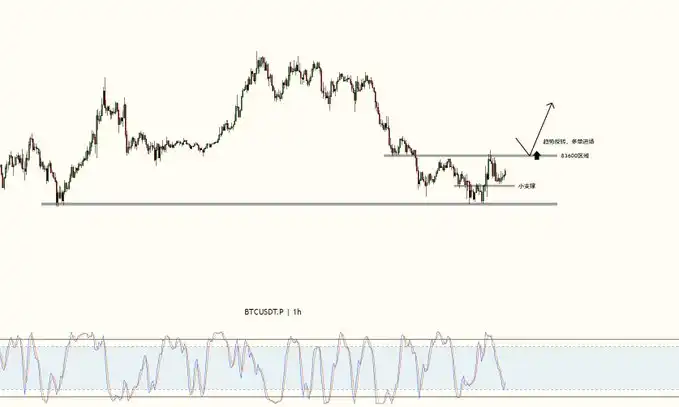
Currently, the 1H chart is still in a downtrend box, but there is a short-term reversal pattern within the box, accompanied by a bullish crossover on indicators. First, it will retest the 83600 area, observing the potential resistance.
The next opportunity to enter a long position is already marked on the chart and involves executing a "breakout-retest rebound" strategy.
In the short term, BTC continues its downtrend. A false breakout above the 83000 resistance level appeared on the 4H chart, and now the price has dropped back down. In the short term, it is expected to drop to 79.5 to form the first low, then rebound after the tariff announcement on Wednesday, creating a bullish sentiment, followed by a double bottom around 78k. Refer to the chart below for the trend.
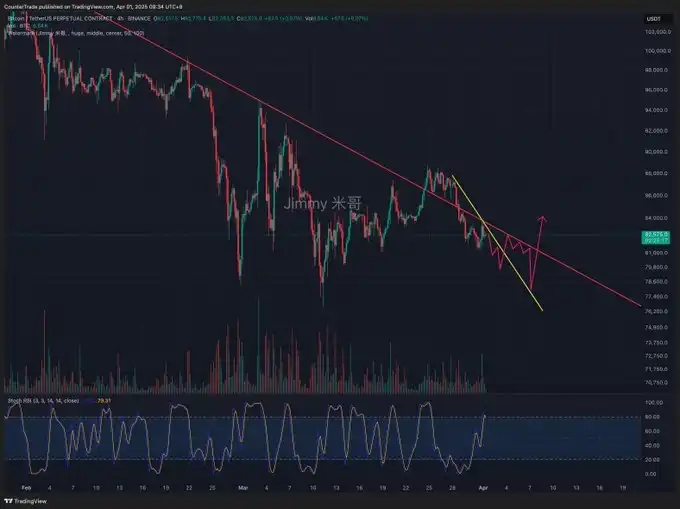
1. Channels are a very weak structure, as they exist to be broken, based on my experience;
2. If we consider the drop from 109000 to 76000 as the first stage of the entire decline, the rebound from 76000 to the present has not completed, as shown in the chart:
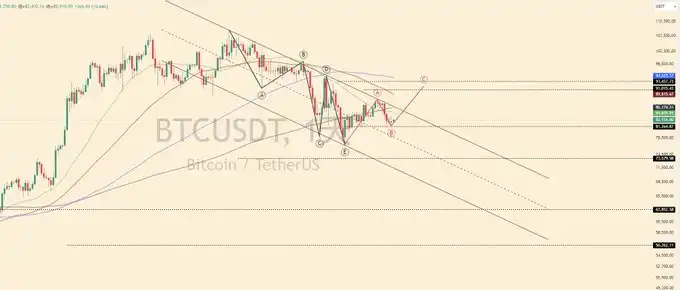
3. Continuous selling pressure requires a technical indicator reset.
Subjective Speculation:
1. The current hype is driven by expectations of inflation due to tariffs and the impending recession, rather than an actual recession about to occur. As I mentioned in my previous post, we need to observe price action leading up to April 2nd when the boot drops. When emotions and prices reach a critical point, look for opportunities to take a contrarian position;
2. Fact 1: The fact that we are currently undergoing a long/short transformation, with daily moving averages turning downwards, MA30, MA60, MA120 forming a bearish alignment. From both a technical and macro perspective, there is no possibility of a bullish reversal. Fact 2: If this adjustment is aimed at correcting the significant uptrend from 15476 to 109000, then the scale of this correction will be significant. Significant corrections always involve back-and-forth movements rather than a straight downward trajectory. Therefore, no reversal does not mean no rebound.
3. Unloading Assumption Round: In a situation where the downside capital is insufficient and a small amount of capital can control the market trend, the cost for institutional funds to control the market is reduced. The back-and-forth manipulation helps raise the average price at which institutional funds unload. Shitcoins can lie flat and die, showing weak-handed unloading behavior. However, high-quality assets like the large-cap cryptocurrency have the confidence to unload at a high position.
The upcoming trend may unfold in two possible ways.
The first possibility is to retest below 81200 to achieve complete resonance in indicators, confirming a major bottom. The second is to start rebounding from here, with 81200 as the bottom (although not a strong resonance, the phenomenon of bottoming out with two resonances exists).
Considering the news backdrop, I believe that after the tariff conclusion on April 2nd, we can roughly determine the direction (final drop vs. bottoming rebound). Given that this is the first time the Acc indicator has turned green since March 11, it is definitely not advisable to be completely out of the market at this point.
You may also like

Prediction Markets Under Bias

Stolen: $290 million, Three Parties Refusing to Acknowledge, Who Should Foot the Bill for the KelpDAO Incident Resolution?

ASTEROID Pumped 10,000x in Three Days, Is Meme Season Back on Ethereum?

ChainCatcher Hong Kong Themed Forum Highlights: Decoding the Growth Engine Under the Integration of Crypto Assets and Smart Economy

Why can this institution still grow by 150% when the scale of leading crypto VCs has shrunk significantly?

Anthropic's $1 trillion, compared to DeepSeek's $100 billion

Geopolitical Risk Persists, Is Bitcoin Becoming a Key Barometer?

Annualized 11.5%, Wall Street Buzzing: Is MicroStrategy's STRC Bitcoin's Savior or Destroyer?

An Obscure Open Source AI Tool Alerted on Kelp DAO's $292 million Bug 12 Days Ago

Mixin has launched USTD-margined perpetual contracts, bringing derivative trading into the chat scene.
The privacy-focused crypto wallet Mixin announced today the launch of its U-based perpetual contract (a derivative priced in USDT). Unlike traditional exchanges, Mixin has taken a new approach by "liberating" derivative trading from isolated matching engines and embedding it into the instant messaging environment.
Users can directly open positions within the app with leverage of up to 200x, while sharing positions, discussing strategies, and copy trading within private communities. Trading, social interaction, and asset management are integrated into the same interface.
Based on its non-custodial architecture, Mixin has eliminated friction from the traditional onboarding process, allowing users to participate in perpetual contract trading without identity verification.
The trading process has been streamlined into five steps:
· Choose the trading asset
· Select long or short
· Input position size and leverage
· Confirm order details
· Confirm and open the position
The interface provides real-time visualization of price, position, and profit and loss (PnL), allowing users to complete trades without switching between multiple modules.
Mixin has directly integrated social features into the derivative trading environment. Users can create private trading communities and interact around real-time positions:
· End-to-end encrypted private groups supporting up to 1024 members
· End-to-end encrypted voice communication
· One-click position sharing
· One-click trade copying
On the execution side, Mixin aggregates liquidity from multiple sources and accesses decentralized protocol and external market liquidity through a unified trading interface.
By combining social interaction with trade execution, Mixin enables users to collaborate, share, and execute trading strategies instantly within the same environment.
Mixin has also introduced a referral incentive system based on trading behavior:
· Users can join with an invite code
· Up to 60% of trading fees as referral rewards
· Incentive mechanism designed for long-term, sustainable earnings
This model aims to drive user-driven network expansion and organic growth.
Mixin's derivative transactions are built on top of its existing self-custody wallet infrastructure, with core features including:
· Separation of transaction account and asset storage
· User full control over assets
· Platform does not custody user funds
· Built-in privacy mechanisms to reduce data exposure
The system aims to strike a balance between transaction efficiency, asset security, and privacy protection.
Against the background of perpetual contracts becoming a mainstream trading tool, Mixin is exploring a different development direction by lowering barriers, enhancing social and privacy attributes.
The platform does not only view transactions as execution actions but positions them as a networked activity: transactions have social attributes, strategies can be shared, and relationships between individuals also become part of the financial system.
Mixin's design is based on a user-initiated, user-controlled model. The platform neither custodies assets nor executes transactions on behalf of users.
This model aligns with a statement issued by the U.S. Securities and Exchange Commission (SEC) on April 13, 2026, titled "Staff Statement on Whether Partial User Interface Used in Preparing Cryptocurrency Securities Transactions May Require Broker-Dealer Registration."
The statement indicates that, under the premise where transactions are entirely initiated and controlled by users, non-custodial service providers that offer neutral interfaces may not need to register as broker-dealers or exchanges.
Mixin is a decentralized, self-custodial privacy wallet designed to provide secure and efficient digital asset management services.
Its core capabilities include:
· Aggregation: integrating multi-chain assets and routing between different transaction paths to simplify user operations
· High liquidity access: connecting to various liquidity sources, including decentralized protocols and external markets
· Decentralization: achieving full user control over assets without relying on custodial intermediaries
· Privacy protection: safeguarding assets and data through MPC, CryptoNote, and end-to-end encrypted communication
Mixin has been in operation for over 8 years, supporting over 40 blockchains and more than 10,000 assets, with a global user base exceeding 10 million and an on-chain self-custodied asset scale of over $1 billion.

$600 million stolen in 20 days, ushering in the era of AI hackers in the crypto world
Vitalik's 2026 Hong Kong Web3 Summit Speech: Ethereum's Ultimate Vision as the "World Computer" and Future Roadmap
On the same day Aave introduced rsETH, why did Spark decide to exit?
Full Post-Mortem of the KelpDAO Incident: Why Did Aave, Which Was Not Compromised, End Up in Crisis Situation?

After a $290 million DeFi liquidation, is the security promise still there?
ZachXBT's post ignites RAVE nearing zero, what is the truth behind the insider control?

Vitalik 2026 Hong Kong Web3 Carnival Speech Transcript: We do not compete on speed; security and decentralization are the core



 App
App