
 Buy Crypto
- Markets
 Futures
- Spot
- Copy Trade
- Earn
- More
AI Moat: How Can Crypto Capital and AI Agents Dance Together?



Original Article Title: Crypto AI Moats: Where Capital and Agents Converge
Original Article Authors: @Defi0xJeff, @steak_studio Lead
Original Article Translation: zhouzhou, BlockBeats
Editor's Note: Cryptographic AI empowers autonomous intelligent agents to manage assets, optimize cash flow, and operate autonomously within the DeFi ecosystem. Compared to Web2 AI, it can access decentralized data, leverage open model collaboration, and accelerate evolution. With the development of DeFi, Darwinian AI, and decentralized infrastructure, AI will not only be an assistant but a direct participant in the on-chain economy, enabling asset holding, trading, and value creation. Crypto AI combines programmable currency with intelligent agents to build a decentralized economic system, accelerating the arrival of autonomous intelligent agent economics and breaking through the limitations of Web2 AI.
The following is the original content (slightly reorganized for readability):
As the market tightens, capital is gradually concentrating on stronger fundamentals, and the next wave of innovation in the AI field is accelerating its collision with the core moat of the crypto world.
Here are several key areas where crypto x AI may further converge, showcasing and solidifying the native AI applications in crypto.
The most direct synergy between AI and crypto: capital efficiency and yield optimization.
DeFi - On-Chain Yield
Stablecoins
RWA
Spot & Perpetual Contract Trading
Lending Markets
Yield Markets (Interest / Rewards)
DeFi has always been at the core of the crypto world, providing globally accessible on-chain yield and trading opportunities. The incorporation of AI can more efficiently capture and optimize this value, enabling better utilization of idle capital. For example, DeFi can be used as a tool to hedge against inflation or to generate excess returns through AI strategies.
Stablecoins: as a core use case of cryptocurrency, encompassing nearly all on-chain transaction scenarios.
RWA: tokenizing assets such as government bonds, debt, real estate, DePIN loans, GPU computing power, and bringing them on-chain.
Spot & Perpetual Contract Trading: optimizing transaction fees and returns.
Lending Markets: enhancing fund utilization through a more efficient lending mechanism to achieve superior returns.
Yield Market: Introducing a new interest rate market to enhance yield optimization capabilities.
Crypto = DeFi = Capital Flow and Value Accrual. Web3 AI may be better suited for this than closed Web2 systems, as the openness and incentive mechanisms of blockchain and tokenomics allow AI to efficiently manage funds.
Although DeFi AI is still in its early stages, there have been some exciting developments:
· @gizatechxyz's stablecoin yield optimization AI agent has surpassed $1M TVL, with a trading volume of $6M, achieving a yield 83%+ higher than traditional lending strategies.
· @Cod3xOrg has launched the Sophon Spark trading agent competition, where agents compete for a $1.5M reward and enhance their trading capabilities through data-optimized AI.
· @autonolas has introduced Modius & Optimus, serving as personal portfolio management AI agents. Their team is the only one supporting users to run AI agents locally and recently launched the $1M Olas Accelerator Program.
· Projects like @HeyAnonai, @AIWayfinder, @slate_ceo, among others, are exploring more user-friendly DeFi gateways, albeit still in the early stages.
Why Are AI Agents Suitable for DeFi?
AI agents can continuously optimize yield and manage risk 24/7, intelligently adjusting positions. MPC (Multi-Protocol Compatible) is driving deep integration of DeFi with AI, enabling AI agents to access on-chain data and integrate more protocols. In the next year, AI agents may handle a significant amount of on-chain transactions, automate DeFi operations, and enhance yield optimization capabilities.
Key Areas to Watch:
Teams driving technological advancements and building developer ecosystems (hackathons, competitions, workshops, etc.).
Teams focusing on privacy, verifiability, and non-custodial models to ensure users truly control AI agents.
Growth metrics of AI agents, such as AUA (Agent Under Management) / TVL (Total Value Locked).
Beyond DeFi, AI is igniting an evolutionary race. Crypto AI is not just a yield optimization tool; it is accelerating the natural selection of AI agents and teams—only the strongest AI agents and teams can survive and thrive.
The Darwinian Law of AI Evolution (Natural Selection)
@opentensor (AI Compute Network)
@AlloraNetwork (Machine Learning / Prediction)
@BitRobotNetwork (Robotics)
Darwinism: The concept that "species evolve through natural selection." In other words, this is the AI team's "Hunger Games" — either driving technological advancement and receiving incentives or being phased out by the market.
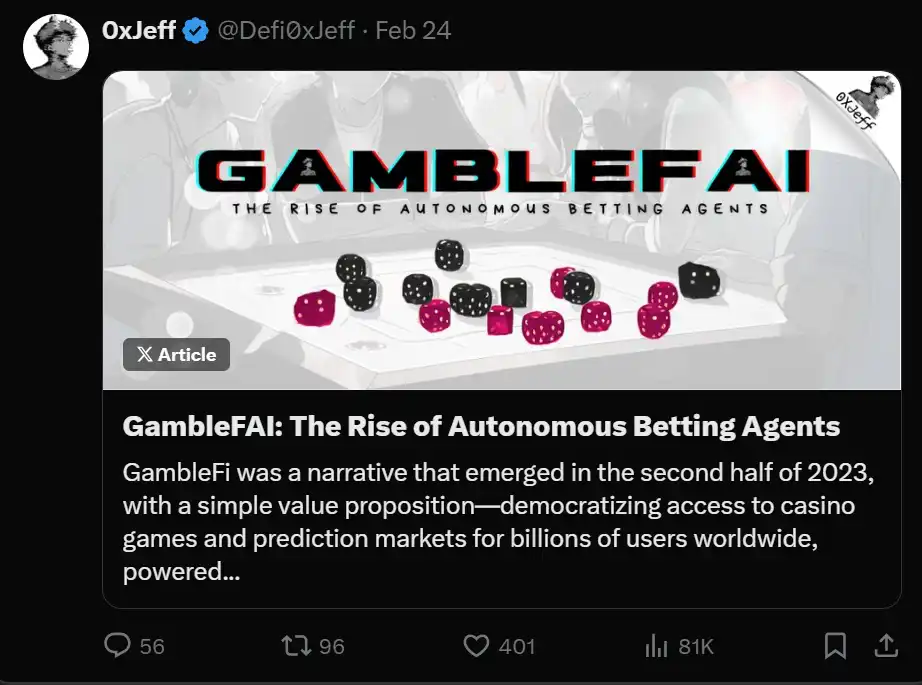
Web3 AI provides the most suitable infrastructure for AI evolution, accelerating the process of natural selection through token incentives, inflation/deflation mechanisms. Bittensor has been at the forefront of driving this trend, with many teams building technology around its subnets (such as SN6, 41, 44), especially in the GambleFAI (prediction market) domain, leveraging AI/ML prediction capabilities to gain a competitive edge in the market.
Allora is harnessing the power of machine learning to accelerate and enhance their models, covering a wide range of financial prediction use cases. Allora's model is similar to Bittensor but focuses on financial prediction. Instead of using subnets, it has established "Topics" (specific financial prediction use cases), where development teams can compete in these areas, with the top-performing teams receiving the most incentives.
Best Use Case:
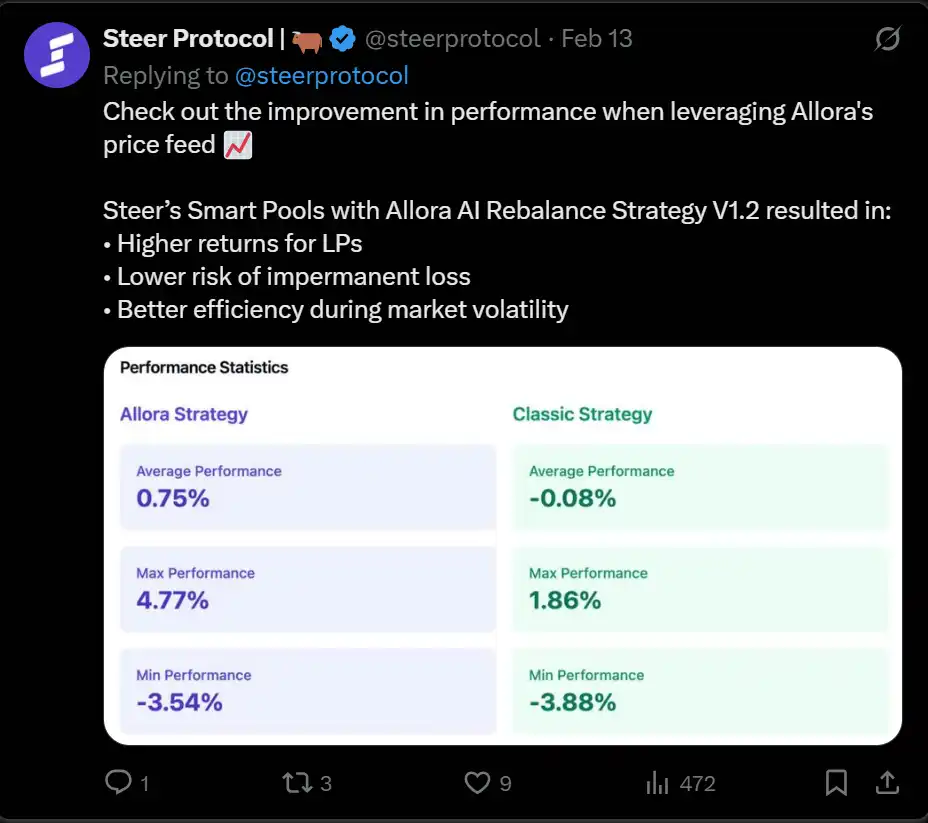
Allora is collaborating with @steerprotocol to utilize AI-driven liquidity provision strategies to maximize returns on holdings while reducing impermanent loss (IL).
Bit Robot is developed by the @frodobots team, who are also the team behind @SamIsMoving (within the @virtuals_io ecosystem). Currently, there is limited information about Bit Robot, but they plan to build an ecosystem similar to Bittensor, focusing on robotics technology. Their subnets will represent different aspects of the robotics field, such as data, hardware, visual models, LLM, etc.
Focus Areas: $TAO price trends, dTAO ecosystem growth, how consumer apps/agents leverage subnet technology, Allora ecosystem integration, case studies, and Token Generation Events (TGE).
Key Elements of Decentralized Infrastructure:
Data
Model Training
Verifiability
Confidentiality
DePIN (GPU)
This type of infrastructure supports open collaboration, open innovation, and prevents the monopolization of technological innovation by a few centralized players. As mentioned in my previous article, with the advancement of DeFAI and Darwinian AI evolution, we will see continued adoption of these infrastructures, especially as more mature and clear use cases emerge.
In the short to medium term, the areas that interest me the most are:
Social & Emotional Data:
· @KaitoAI Yap Leaderboard and the recently launched Yaps Open Protocol, allowing teams to build products based on Yap scores
· @aixbt_agent tracking & mapping Alpha/Social trends on Twitter
· @cookiedotfun providing AI agent marketplace/social intelligence
On-chain Data:
· Currently, in the on-chain data space, we have not seen an absolute leader like in social & emotional data.
Other Data Players
· Data Fetching: @getgrass_io utilizing idle bandwidth for data collection
· Data Ownership: @vana incentivizing data ownership through DataDAOs
· Secure Computation: @nillionnetwork introducing Blind Compute, its applications, and the upcoming $NIL TGE (launching soon)
For further reading on the data space:

About DePIN (GPU)
There are currently two interesting protocols emerging that facilitate the securitization of GPU assets through on-chain lending, helping data centers and operators to massively scale their GPU businesses.
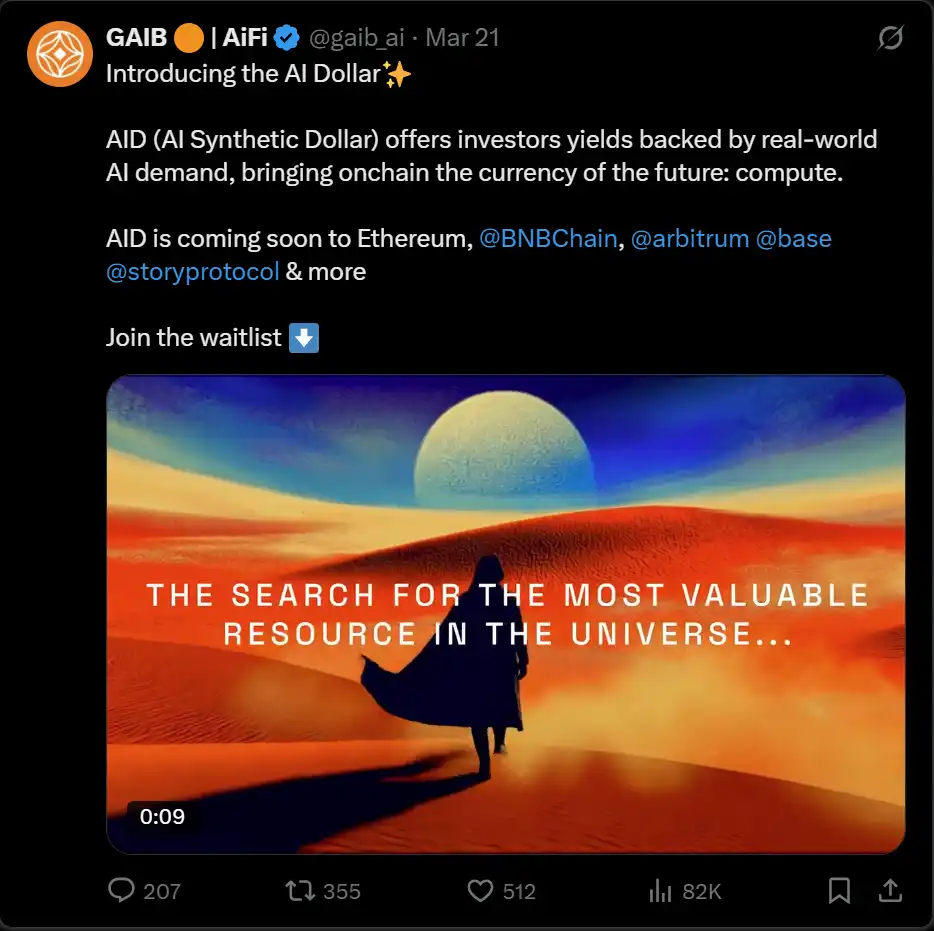
Due to the continued growth of AI, the demand for computing power will never cease, and data centers will always need capital to expand operations. Therefore, projects like @gaib_ai and @metastreetxyz are connecting DeFi liquidity with borrowing demands, enabling on-chain DePIN rewards while providing capital support to GPU operators.
Gaib AI Dollar:
MetaStreet USDAI:

Key Takeaways
Crypto-native AI solves challenges that Web2 AI cannot overcome. Crypto AI not only provides computational power to intelligent agents but also endows them with transactional capabilities, enabling AI to manage assets, optimize cash flows, and autonomously operate in an open and permissionless network. Crypto AI is shaping a brand-new world where intelligent agents can:
· Freely move funds within the DeFi ecosystem without centralized intermediaries;
· Access decentralized data streams unreachable by Web2, gaining access to a richer source of information;
· Evolve faster through open models and collaborative ecosystems compared to closed systems.
In essence, Crypto AI turns scenarios that Web2 AI cannot replicate at scale into reality: the combination of programmable money and autonomous intelligent agents creates a fully verifiable, composable economic system. With the continued maturity of DeFi, Darwinian AI, and decentralized infrastructure, we will see AI not just as an assistant but as a direct participant in on-chain economies.
AI is not just smarter but also capable of autonomously holding, transacting, optimizing, and creating value; this is the true moat of Crypto AI.
You may also like

Morning News | The Hong Kong Securities and Futures Commission announced the regulatory framework for secondary market trading of tokenized investment products; Strategy increased its holdings by 34,164 bitcoins last week; KAIO completed a strategic fi...

What Is an XRP Wallet? The Best Wallets to Store XRP (2026 Updated)
An XRP wallet lets you safely store, send, and receive XRP on the XRP Ledger. Learn what wallets support XRP and discover the best XRP wallets for beginners and long-term holders in 2026.

What are the Top AI Crypto Coins? Render vs. Akash: 5 Gems Solving the 2026 GPU Crisis
What are the best AI crypto coins for the 2026 cycle? Beyond the hype, we analyze top tokens like RNDR, AKT, and FET that provide real-world solutions to the global GPU shortage and the rise of autonomous agents.

What Is a Token in AI? What Is an AI Token + 3 Gems You Can't Miss in 2026
The era of AI hype has transitioned into an era of utility. As we move through Q2 2026, the market is no longer rewarding "narrative-only" projects. At WEEX Research, we are seeing a massive capital rotation into Decentralized Compute (DePIN) and Autonomous Agent coordination layers. This guide analyzes which AI tokens are capturing institutional liquidity and how to spot high-conviction setups in a maturing market.

Consumer-grade Crypto Global Survey: Users, Revenue, and Track Distribution

Prediction Markets Under Bias

Stolen: $290 million, Three Parties Refusing to Acknowledge, Who Should Foot the Bill for the KelpDAO Incident Resolution?

ASTEROID Pumped 10,000x in Three Days, Is Meme Season Back on Ethereum?

ChainCatcher Hong Kong Themed Forum Highlights: Decoding the Growth Engine Under the Integration of Crypto Assets and Smart Economy

Why can this institution still grow by 150% when the scale of leading crypto VCs has shrunk significantly?

Anthropic's $1 trillion, compared to DeepSeek's $100 billion

Geopolitical Risk Persists, Is Bitcoin Becoming a Key Barometer?

Annualized 11.5%, Wall Street Buzzing: Is MicroStrategy's STRC Bitcoin's Savior or Destroyer?
An Obscure Open Source AI Tool Alerted on Kelp DAO's $292 million Bug 12 Days Ago

Mixin has launched USTD-margined perpetual contracts, bringing derivative trading into the chat scene.
The privacy-focused crypto wallet Mixin announced today the launch of its U-based perpetual contract (a derivative priced in USDT). Unlike traditional exchanges, Mixin has taken a new approach by "liberating" derivative trading from isolated matching engines and embedding it into the instant messaging environment.
Users can directly open positions within the app with leverage of up to 200x, while sharing positions, discussing strategies, and copy trading within private communities. Trading, social interaction, and asset management are integrated into the same interface.
Based on its non-custodial architecture, Mixin has eliminated friction from the traditional onboarding process, allowing users to participate in perpetual contract trading without identity verification.
The trading process has been streamlined into five steps:
· Choose the trading asset
· Select long or short
· Input position size and leverage
· Confirm order details
· Confirm and open the position
The interface provides real-time visualization of price, position, and profit and loss (PnL), allowing users to complete trades without switching between multiple modules.
Mixin has directly integrated social features into the derivative trading environment. Users can create private trading communities and interact around real-time positions:
· End-to-end encrypted private groups supporting up to 1024 members
· End-to-end encrypted voice communication
· One-click position sharing
· One-click trade copying
On the execution side, Mixin aggregates liquidity from multiple sources and accesses decentralized protocol and external market liquidity through a unified trading interface.
By combining social interaction with trade execution, Mixin enables users to collaborate, share, and execute trading strategies instantly within the same environment.
Mixin has also introduced a referral incentive system based on trading behavior:
· Users can join with an invite code
· Up to 60% of trading fees as referral rewards
· Incentive mechanism designed for long-term, sustainable earnings
This model aims to drive user-driven network expansion and organic growth.
Mixin's derivative transactions are built on top of its existing self-custody wallet infrastructure, with core features including:
· Separation of transaction account and asset storage
· User full control over assets
· Platform does not custody user funds
· Built-in privacy mechanisms to reduce data exposure
The system aims to strike a balance between transaction efficiency, asset security, and privacy protection.
Against the background of perpetual contracts becoming a mainstream trading tool, Mixin is exploring a different development direction by lowering barriers, enhancing social and privacy attributes.
The platform does not only view transactions as execution actions but positions them as a networked activity: transactions have social attributes, strategies can be shared, and relationships between individuals also become part of the financial system.
Mixin's design is based on a user-initiated, user-controlled model. The platform neither custodies assets nor executes transactions on behalf of users.
This model aligns with a statement issued by the U.S. Securities and Exchange Commission (SEC) on April 13, 2026, titled "Staff Statement on Whether Partial User Interface Used in Preparing Cryptocurrency Securities Transactions May Require Broker-Dealer Registration."
The statement indicates that, under the premise where transactions are entirely initiated and controlled by users, non-custodial service providers that offer neutral interfaces may not need to register as broker-dealers or exchanges.
Mixin is a decentralized, self-custodial privacy wallet designed to provide secure and efficient digital asset management services.
Its core capabilities include:
· Aggregation: integrating multi-chain assets and routing between different transaction paths to simplify user operations
· High liquidity access: connecting to various liquidity sources, including decentralized protocols and external markets
· Decentralization: achieving full user control over assets without relying on custodial intermediaries
· Privacy protection: safeguarding assets and data through MPC, CryptoNote, and end-to-end encrypted communication
Mixin has been in operation for over 8 years, supporting over 40 blockchains and more than 10,000 assets, with a global user base exceeding 10 million and an on-chain self-custodied asset scale of over $1 billion.

$600 million stolen in 20 days, ushering in the era of AI hackers in the crypto world
Vitalik's 2026 Hong Kong Web3 Summit Speech: Ethereum's Ultimate Vision as the "World Computer" and Future Roadmap
On the same day Aave introduced rsETH, why did Spark decide to exit?
Morning News | The Hong Kong Securities and Futures Commission announced the regulatory framework for secondary market trading of tokenized investment products; Strategy increased its holdings by 34,164 bitcoins last week; KAIO completed a strategic fi...
What Is an XRP Wallet? The Best Wallets to Store XRP (2026 Updated)
An XRP wallet lets you safely store, send, and receive XRP on the XRP Ledger. Learn what wallets support XRP and discover the best XRP wallets for beginners and long-term holders in 2026.
What are the Top AI Crypto Coins? Render vs. Akash: 5 Gems Solving the 2026 GPU Crisis
What are the best AI crypto coins for the 2026 cycle? Beyond the hype, we analyze top tokens like RNDR, AKT, and FET that provide real-world solutions to the global GPU shortage and the rise of autonomous agents.
What Is a Token in AI? What Is an AI Token + 3 Gems You Can't Miss in 2026
The era of AI hype has transitioned into an era of utility. As we move through Q2 2026, the market is no longer rewarding "narrative-only" projects. At WEEX Research, we are seeing a massive capital rotation into Decentralized Compute (DePIN) and Autonomous Agent coordination layers. This guide analyzes which AI tokens are capturing institutional liquidity and how to spot high-conviction setups in a maturing market.



 App
App