
 Buy Crypto
- Markets
 Futures
- Spot
- Copy Trade
- Earn
- More
Deeply Hidden in Privacy, Written Before Nillion Coin Launch

Original Article Title: "Deep Privacy, Written Before the Nillion Coin Launch"
Original Article Author: Lord Zuo
Chariots reveal horsepower, Bi Gan sees people's hearts. NIL reaches for the sky, XMR delisted in the meantime.
Blockchain originated from privacy technology, especially cryptography. From elliptic curves to zero-knowledge proofs, all prove the success of privacy economics in the Web 3.0 era.
However, things are never perfect. From XMR frequently delisted from CEX/DEX, to the Tornado Cash founder's arrest, you will find that even if Nillion can list on Binance, the hacker spirit of privacy projects is receding. Their final product delivery capability is also far from perfect.
In refining privacy products, blockchain projects in the same category need to learn from their Web2 counterparts to improve their execution.
Proton Proves Privacy Can Be a Well-Functioning Product
Privacy is a Feature,Not a Product.
Mere talk of privacy as a product enhancement is meaningless. In other words, privacy also needs PMF. Giants such as Google and Meta can invade privacy while making it irresistible, thanks to convenience and network effects. Plug and play, ubiquitous usage in both personal and office settings lead to eventual acceptance of everything Google has to offer.

Image Description: Giant Fine, Image Source: Proton
In this regard, the regulatory authorities have failed miserably with the fine-as-management model. Taking the legendary fine against Google of 2.974 billion USD as an example, Google would probably earn it back in just 16 days. Yet, these fines cannot become the income of European tech companies, making them further powerless against Google.
Faced with this issue, Proton's approach is to build its own ecosystem, starting from CERN (European Organization for Nuclear Research). Scientific researchers' inherently pure reputation is higher than that of commercial companies. With cryptographic technology, open-source code, and product audits, the privacy products they build truly have practical significance—you can achieve the same functionalities without using Google's ecosystem.
Of course, the current network effects and economies of scale are still unable to compete with the giants. However, compared to blockchain peers, the products they offer are sufficient for daily use and qualify as a Google Alternative.
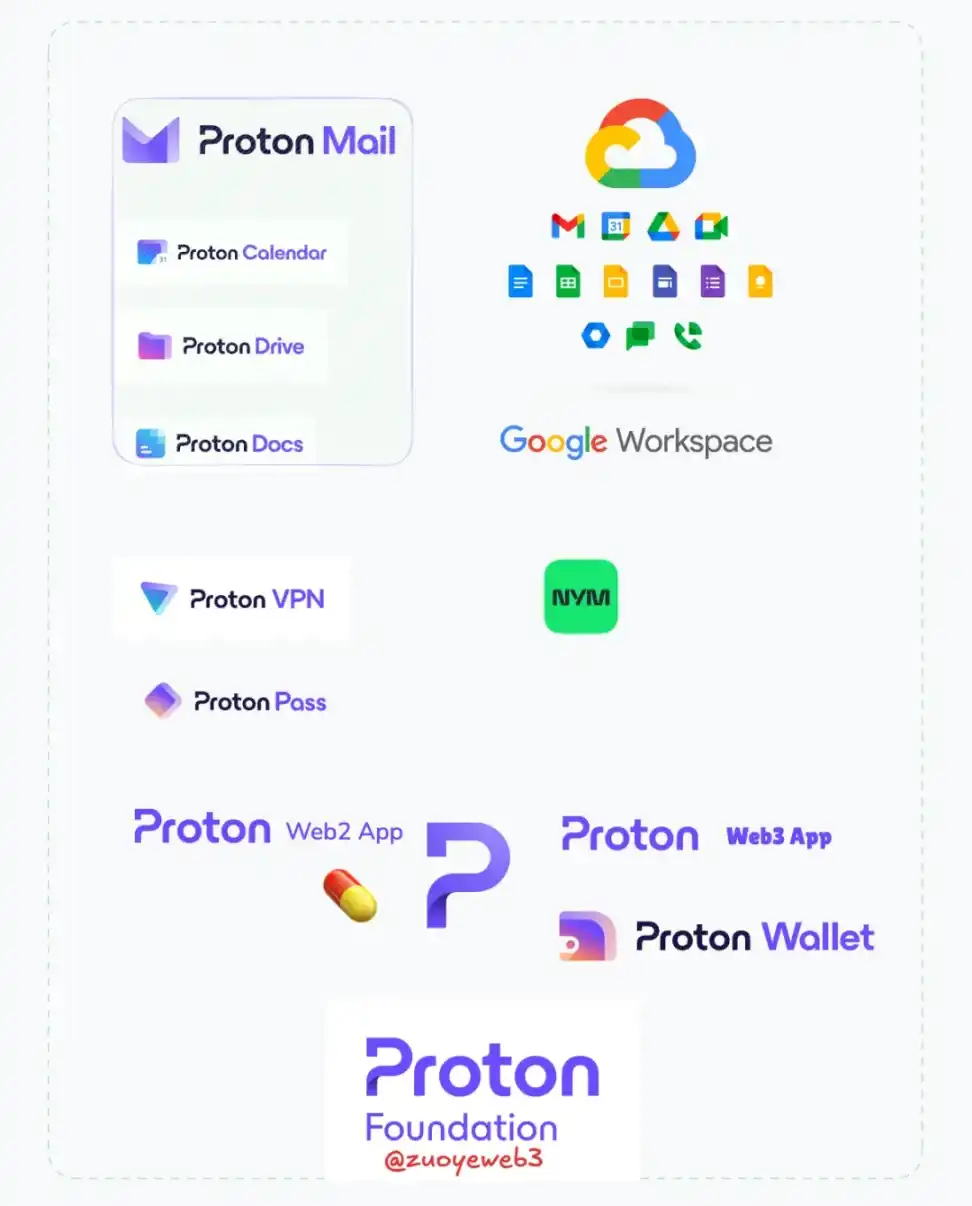
Image Description: Proton Product and Partial Comparison, Image Source: @zuoyeweb3
Compared to the Google Workspace suite, the current Proton is mainly centered around Proton Mail's own competitive products. It is worth mentioning that Proton Mail is also a favorite of Twitter, Square, and other founder Jack Dorsey.
Proton Mail is different from typical email products in that it does not require binding a phone number to use, and it supports end-to-end encryption mode to ensure the privacy of email transmission. Before Telegram became regulated, using Proton Mail in conjunction with TG's end-to-end mode could basically establish a relatively high-level commercial privacy experience.
Of course, after Telegram's decline, Proton Mail combined with Signal can also meet the privacy surfing needs of most people.
Similar to Telegram, Proton has also begun to enter the Web3 field. Its first product is the Proton Wallet. Unlike transaction-oriented products such as Bitget Wallet and Binance Wallet, Proton Wallet is extremely restrained and has relatively simple functionality.
The significance of Proton lies in proving the feasibility of building products based on privacy technology. Different from the ad-based profit model of traditional giants, Proton adopts a paid system. In contrast to the tokenomics system of its Web3 peers, Proton has not taken the step of issuing tokens, which we can call:
The tokenless implementation of encryption technology.
From Skiff to Nillion, Tokenization of Encryption Technology
If Proton is considered Don Quixote, then Skiff, Nym, Privasea to Nillion are the dwarfs, who have not yet found their own PMF, but the token (Snow White) is one step ahead.
On February 9, 2024, Notion announced the acquisition of Skiff. This is also the first case of a Web2 major product acquiring a Web3 startup. Pioneering a new industry trend without taking the token issuance route. On another note, Stripe's acquisition of Bridge was actually the second time.
Skiff and Google Suite are also quite similar, ranging from an IPFS-based document suite to an encrypted email service. However, there is a huge problem: the UI is extremely unattractive, providing a poor user experience. This is also the biggest issue with current Web3 products, as they are hindered by the slow and expensive nature of the blockchain's underlying technology, making it difficult to compete with Web2 counterparts when developing large-scale products.
Proton is a suitable Google alternative, but Skiff is not a qualified Proton alternative.
Furthermore, the development of other Web3 privacy products has been less than satisfactory. Nym has gradually shifted its focus to the VPN field, Privasea with an FHE focus emphasizes more on AI integration, and today's Nillion is still stuck in the previous cycle's MPC narrative.
Yes, narratives are cyclical. The concepts of MPC and Blind Computation (Blind Compute, NBC) built by Nillion are derivative narratives in the Ethereum and ZK applications within the L2/Rollup domain. AA wallets and MPC paradigms fall into this category. With Ethereum's weak price performance, privacy-focused products are being abandoned by the market. The most glaring example is that FHE did not become the next step for ZK. Reference article: FHE is the next step for ZK, says encryption technology.
It's not that privacy technology is unimportant; it's that the combination of privacy technology and tokens is no longer essential or, at least, not important in the current stage.
Without privacy technology, Proton cannot establish its own business logic and product matrix; this is the key to achieving Product-Market Fit. However, for products like Nillion, investments from Binance and Hack VC seem to be more crucial.
As for the concept of Blind Computation, the Trust Layer, the multi-ecosystem, and privacy AI are not Nillion's true sources of profit. We all know this very well. Nillion's only product may truly be its token. From this perspective, at least Nym really needs to go after the VPN market.
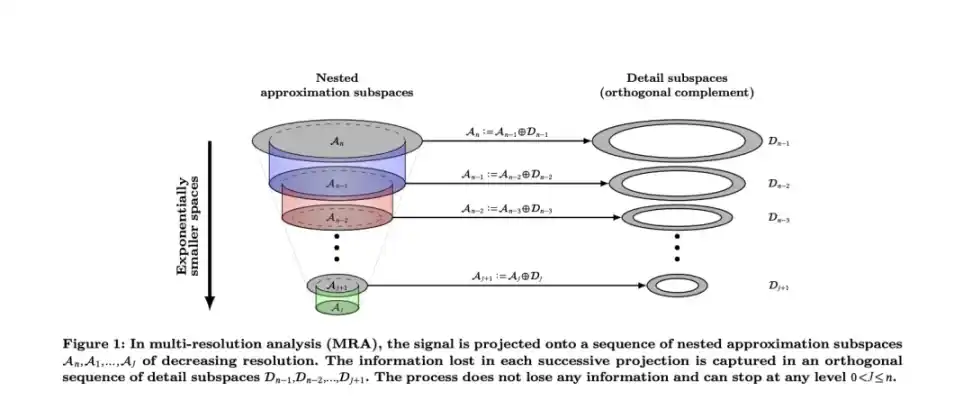
Image Description: Nillion's latest paper, Image Source: Nillion
In its latest technical paper, Nillion's research focus remains on the practical application of MPC. Traditional secure-sharing MPC algorithms lead to a drastic increase in data volume during computation, and Nillion is researching how to reduce algorithm complexity to improve computational efficiency.
Well, let's take a look at the Nillion token's listing performance. As the saying goes, this kind of Web3 privacy technology combined with AI cannot find a real application scenario because neither OpenAI nor DeepSeek consider these factors. If a new product adds privacy technology to seize market share from them, then it would be a meaningful pioneering move.
If it lacks meaning, then let's turn our attention to @Optimism; it truly believes that privacy is crucial.

However, while Privacy is Good, there still needs to be a Privacy Product to demonstrate it. Mere discussions of MPC / ZK / TEE / FHE / AI without solving any problems are meaningless. Everyone can chant slogans that do not address the issue, but in the end, it will harm the social credibility of the underlying technology.
The consequences have already emerged. Now, people are talking about L2 color shifts, which will also make people feel like ZK is a scam.
Following the significant loss at Bybit due to Safe, silence is not limited to Vitalik; it also includes frontend developers and multi-signature mechanisms.
Conclusion
Monero, the XMR cryptocurrency, may feel somewhat unfamiliar to people in today's BNB Chain Meme Express era, but it should be regarded as the final attempt, after Bitcoin, to truly consider the integration of cryptographic technology and its own application scenarios.
On February 7, 2024, two days before Skiff officially "joined" Notion, XMR was delisted from Binance, "withdrawing" from its largest source of liquidity. Perhaps since then, so-called privacy technologies are all akin to F-47, merely part of a win-learning process, albeit the Web3 privacy economics has not completely collapsed.
You may also like

Morning News | The Hong Kong Securities and Futures Commission announced the regulatory framework for secondary market trading of tokenized investment products; Strategy increased its holdings by 34,164 bitcoins last week; KAIO completed a strategic fi...

What Is an XRP Wallet? The Best Wallets to Store XRP (2026 Updated)
An XRP wallet lets you safely store, send, and receive XRP on the XRP Ledger. Learn what wallets support XRP and discover the best XRP wallets for beginners and long-term holders in 2026.

What are the Top AI Crypto Coins? Render vs. Akash: 5 Gems Solving the 2026 GPU Crisis
What are the best AI crypto coins for the 2026 cycle? Beyond the hype, we analyze top tokens like RNDR, AKT, and FET that provide real-world solutions to the global GPU shortage and the rise of autonomous agents.

What Is a Token in AI? What Is an AI Token + 3 Gems You Can't Miss in 2026
The era of AI hype has transitioned into an era of utility. As we move through Q2 2026, the market is no longer rewarding "narrative-only" projects. At WEEX Research, we are seeing a massive capital rotation into Decentralized Compute (DePIN) and Autonomous Agent coordination layers. This guide analyzes which AI tokens are capturing institutional liquidity and how to spot high-conviction setups in a maturing market.

Consumer-grade Crypto Global Survey: Users, Revenue, and Track Distribution

Prediction Markets Under Bias

Stolen: $290 million, Three Parties Refusing to Acknowledge, Who Should Foot the Bill for the KelpDAO Incident Resolution?

ASTEROID Pumped 10,000x in Three Days, Is Meme Season Back on Ethereum?

ChainCatcher Hong Kong Themed Forum Highlights: Decoding the Growth Engine Under the Integration of Crypto Assets and Smart Economy

Why can this institution still grow by 150% when the scale of leading crypto VCs has shrunk significantly?

Anthropic's $1 trillion, compared to DeepSeek's $100 billion

Geopolitical Risk Persists, Is Bitcoin Becoming a Key Barometer?

Annualized 11.5%, Wall Street Buzzing: Is MicroStrategy's STRC Bitcoin's Savior or Destroyer?
An Obscure Open Source AI Tool Alerted on Kelp DAO's $292 million Bug 12 Days Ago

Mixin has launched USTD-margined perpetual contracts, bringing derivative trading into the chat scene.
The privacy-focused crypto wallet Mixin announced today the launch of its U-based perpetual contract (a derivative priced in USDT). Unlike traditional exchanges, Mixin has taken a new approach by "liberating" derivative trading from isolated matching engines and embedding it into the instant messaging environment.
Users can directly open positions within the app with leverage of up to 200x, while sharing positions, discussing strategies, and copy trading within private communities. Trading, social interaction, and asset management are integrated into the same interface.
Based on its non-custodial architecture, Mixin has eliminated friction from the traditional onboarding process, allowing users to participate in perpetual contract trading without identity verification.
The trading process has been streamlined into five steps:
· Choose the trading asset
· Select long or short
· Input position size and leverage
· Confirm order details
· Confirm and open the position
The interface provides real-time visualization of price, position, and profit and loss (PnL), allowing users to complete trades without switching between multiple modules.
Mixin has directly integrated social features into the derivative trading environment. Users can create private trading communities and interact around real-time positions:
· End-to-end encrypted private groups supporting up to 1024 members
· End-to-end encrypted voice communication
· One-click position sharing
· One-click trade copying
On the execution side, Mixin aggregates liquidity from multiple sources and accesses decentralized protocol and external market liquidity through a unified trading interface.
By combining social interaction with trade execution, Mixin enables users to collaborate, share, and execute trading strategies instantly within the same environment.
Mixin has also introduced a referral incentive system based on trading behavior:
· Users can join with an invite code
· Up to 60% of trading fees as referral rewards
· Incentive mechanism designed for long-term, sustainable earnings
This model aims to drive user-driven network expansion and organic growth.
Mixin's derivative transactions are built on top of its existing self-custody wallet infrastructure, with core features including:
· Separation of transaction account and asset storage
· User full control over assets
· Platform does not custody user funds
· Built-in privacy mechanisms to reduce data exposure
The system aims to strike a balance between transaction efficiency, asset security, and privacy protection.
Against the background of perpetual contracts becoming a mainstream trading tool, Mixin is exploring a different development direction by lowering barriers, enhancing social and privacy attributes.
The platform does not only view transactions as execution actions but positions them as a networked activity: transactions have social attributes, strategies can be shared, and relationships between individuals also become part of the financial system.
Mixin's design is based on a user-initiated, user-controlled model. The platform neither custodies assets nor executes transactions on behalf of users.
This model aligns with a statement issued by the U.S. Securities and Exchange Commission (SEC) on April 13, 2026, titled "Staff Statement on Whether Partial User Interface Used in Preparing Cryptocurrency Securities Transactions May Require Broker-Dealer Registration."
The statement indicates that, under the premise where transactions are entirely initiated and controlled by users, non-custodial service providers that offer neutral interfaces may not need to register as broker-dealers or exchanges.
Mixin is a decentralized, self-custodial privacy wallet designed to provide secure and efficient digital asset management services.
Its core capabilities include:
· Aggregation: integrating multi-chain assets and routing between different transaction paths to simplify user operations
· High liquidity access: connecting to various liquidity sources, including decentralized protocols and external markets
· Decentralization: achieving full user control over assets without relying on custodial intermediaries
· Privacy protection: safeguarding assets and data through MPC, CryptoNote, and end-to-end encrypted communication
Mixin has been in operation for over 8 years, supporting over 40 blockchains and more than 10,000 assets, with a global user base exceeding 10 million and an on-chain self-custodied asset scale of over $1 billion.

$600 million stolen in 20 days, ushering in the era of AI hackers in the crypto world
Vitalik's 2026 Hong Kong Web3 Summit Speech: Ethereum's Ultimate Vision as the "World Computer" and Future Roadmap
On the same day Aave introduced rsETH, why did Spark decide to exit?
Morning News | The Hong Kong Securities and Futures Commission announced the regulatory framework for secondary market trading of tokenized investment products; Strategy increased its holdings by 34,164 bitcoins last week; KAIO completed a strategic fi...
What Is an XRP Wallet? The Best Wallets to Store XRP (2026 Updated)
An XRP wallet lets you safely store, send, and receive XRP on the XRP Ledger. Learn what wallets support XRP and discover the best XRP wallets for beginners and long-term holders in 2026.
What are the Top AI Crypto Coins? Render vs. Akash: 5 Gems Solving the 2026 GPU Crisis
What are the best AI crypto coins for the 2026 cycle? Beyond the hype, we analyze top tokens like RNDR, AKT, and FET that provide real-world solutions to the global GPU shortage and the rise of autonomous agents.
What Is a Token in AI? What Is an AI Token + 3 Gems You Can't Miss in 2026
The era of AI hype has transitioned into an era of utility. As we move through Q2 2026, the market is no longer rewarding "narrative-only" projects. At WEEX Research, we are seeing a massive capital rotation into Decentralized Compute (DePIN) and Autonomous Agent coordination layers. This guide analyzes which AI tokens are capturing institutional liquidity and how to spot high-conviction setups in a maturing market.



 App
App