
 Buy Crypto
- Markets
 Futures
- Spot
- Copy Trade
- Earn
- More
Ethereum ETF Funds Experience Severe Outflows, Staking Difficulty Aggravates Ecosystem Crisis?



Original Title: "Ethereum's Growing Pains: From ETF 'Hemorrhage' to On-Chain Fatigue, Can ETF Staking Boost the Market?"
Original Author: Nancy, PANews
Ethereum is going through a prolonged period of growing pains, with price continuing to be under pressure, on-chain activity seeing a significant decline, and continuous outflows from spot ETF funds... These signs are gradually eroding market confidence in its growth potential. As the U.S. crypto regulatory environment quietly shifts, several ETF issuers have recently submitted Ethereum ETF staking proposal applications to the U.S. SEC. For Ethereum, which currently lacks a clear demand catalyst, this change is also seen by the market as a key variable for Ethereum to emerge from its slump in the short term.
ETF Funds Hemorrhaging, ETF Staking Approval to be Announced Earliest this Month
Currently, Ethereum spot ETF funds are experiencing continuous outflows, further denting market confidence. According to SoSoValue data, since the beginning of this year, U.S. Ethereum spot ETFs have seen net outflows of over $400 million in March, with a net outflow of nearly $240 million year-to-date. In contrast, although Bitcoin spot ETFs have also seen significant outflows in the past two months, the overall net inflow this year still exceeds $790 million, with the outflows this month shrinking by 74.9% compared to February.
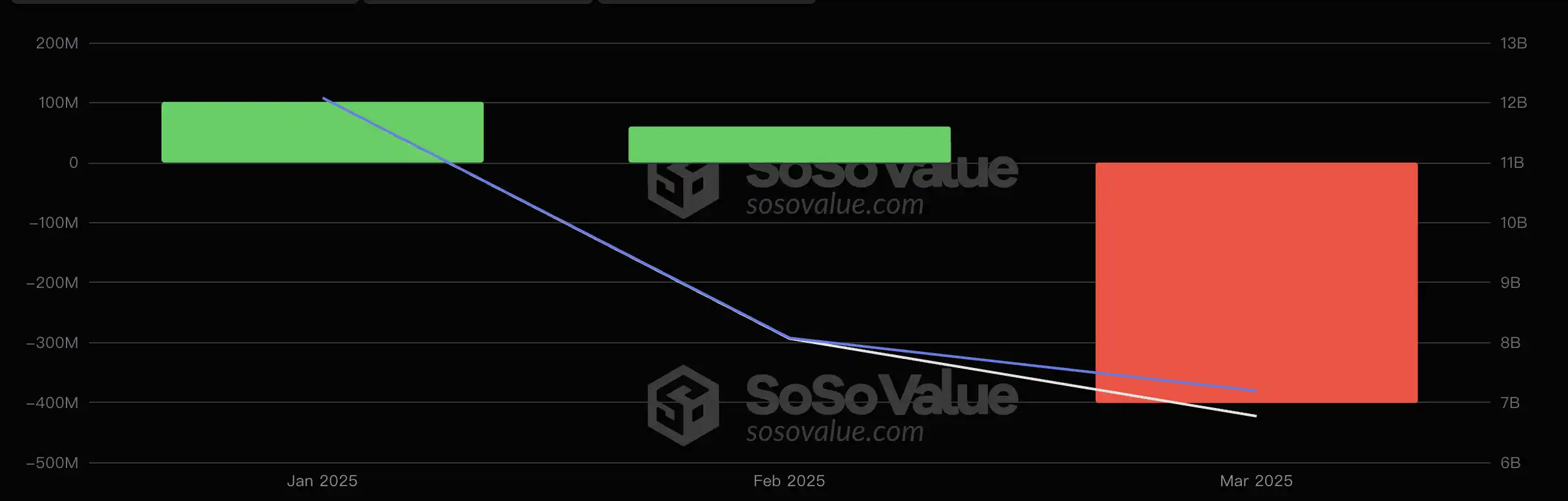
Ethereum ETF Monthly Inflows Year-to-Date
In response, Robert Mitchnick, Head of BlackRock's Digital Assets Division, believes that approval for staking may be a "huge leap" for Ethereum ETFs. He recently stated that the demand for Ethereum ETFs has been lackluster since their launch in July last year, but the situation could change if some regulatory issues hindering their development are resolved. It is widely believed that compared to the explosive growth of funds tracking Bitcoin, Ethereum ETFs' success has been "unremarkable." Although this is a "misconception," the inability of these funds to earn staking rewards may be a limiting factor in their development.
ETFs are a very attractive tool, but for today's ETH, an ETF without staking is not perfect, as staking rewards are a crucial part of generating investment returns in this space. This is not an issue that is particularly easy to solve; it's not like... a new government just flipping a switch and it all happens. There are many quite complex challenges to overcome. If these hurdles can be overcome, then there will be a quantum leap in seeing activity around these ETF products.
In fact, since February this year, many issuers including 21Shares, Grayscale, Fidelity, Bitwise, and Franklin have successively submitted proposals for Ethereum ETF staking. Among them, 21Shares was the earliest institution to submit the relevant application and received formal SEC acceptance on February 20th. According to the SEC approval process, the institution must make a preliminary decision within 45 days after submitting the 19b-4 filing, including whether to accept, reject, or delay. Starting from February 12th, the preliminary decision time for 21Shares' Ethereum ETF staking application is March 29th, which may actually be extended to the next working day, March 31st, due to weekends, and the latest final decision is expected to be made within 240 days, by October 9th.
In the market's view, the introduction of staking for Ethereum ETF is considered to have multiple potential advantages. In terms of investment return, the current annualized staking yield for Ethereum is about 3.12%. Compared to Bitcoin spot ETFs that rely solely on price fluctuations, the Ethereum ETF can generate additional returns for the held ETH through staking. This feature is particularly attractive to institutional investors and may help reverse the current weak demand situation. In terms of price driving, staking locked ETH will reduce market circulation, alleviate selling pressure, and potentially drive up the ETH price.
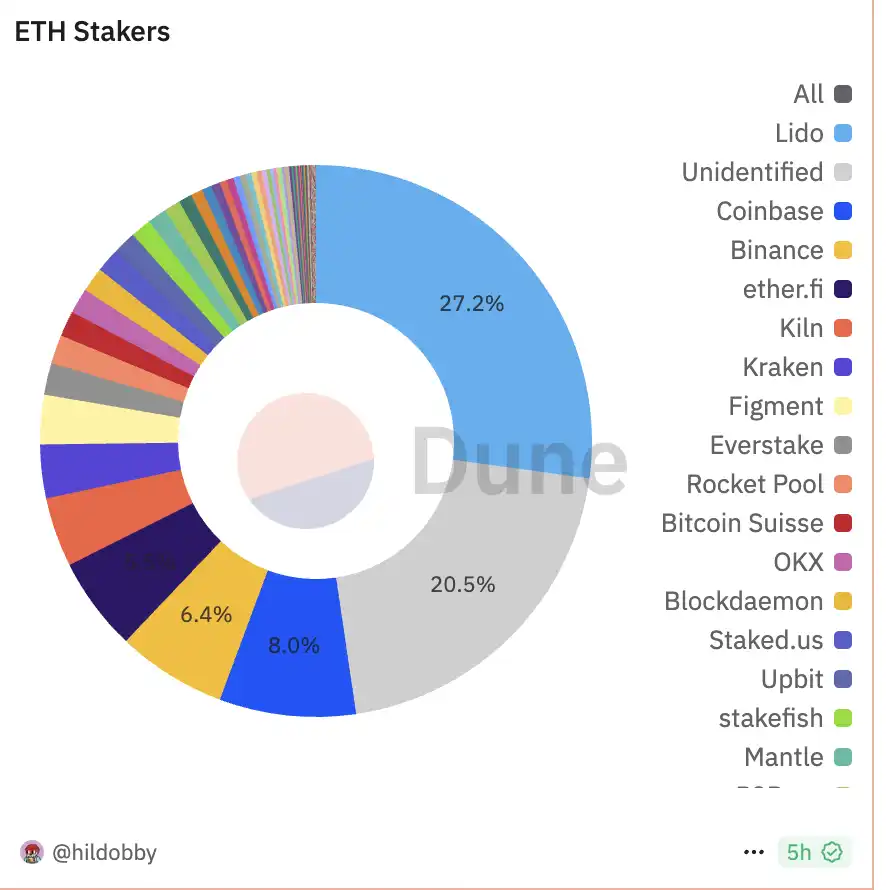
Dune data shows that as of March 24th, the total Ethereum staked on the Beacon Chain exceeded 34.199 million ETH, with staked ETH accounting for 27.85% of the total supply. If ETFs join the staking ranks, this ratio will further increase. In terms of network security, ETF participation in staking will increase the number of Ethereum network validators, enhance decentralization, and alleviate concerns in the community about the centralization risk of liquidity staking protocols like Lido. Dune data shows that as of March 24th, the liquidity staking protocol Lido alone occupies 27.28% of the Ethereum staking share.
However, for the sake of operational simplicity and regulatory compliance, the staking design of an Ethereum spot ETF may weaken its attractiveness to investment institutions. Taking the staking feature application document submitted by 21Shares as an example, its staking process is managed by the custodian Coinbase which safeguards the ETH, using a "point-and-click staking" model, meaning that through a simplified interface, the ETF can directly stake the ETH it holds without transferring the assets to a third-party protocol (such as Lido or Rocket Pool), thereby reducing security risks associated with asset transfers.
Furthermore, all staking rewards generated are owned by the ETF Trust as the issuer's revenue, rather than being directly distributed to investors. According to Dune data, compared to centralized exchanges such as Coinbase and Binance, decentralized staking derivatives like Lido and ether.fi are still the mainstream choice for ETH staking. Based on available information, none of the Ethereum spot ETF issuers have explicitly allowed staking rewards to be directly shared with investors. However, given the loosening of U.S. regulations and increased market competition, the possibility of introducing this mechanism cannot be ruled out.
Furthermore, Ethereum spot ETFs also face a challenge in staking efficiency. Due to the strict limitations of the Ethereum staking entry and exit mechanism (allowing a maximum of 8 nodes to enter and 16 nodes to exit per epoch, with an epoch generated every 6.4 minutes), the flexibility of ETFs is restricted. This limitation becomes more prominent during market volatility, as investors are unable to exit promptly, potentially exacerbating selling pressure.
For example, the current Ethereum spot ETF holds a total value of approximately $6.77 billion worth of ETH, which, at an ETH price (around $2064), equates to approximately 3.28 million ETH. Therefore, the entry time for staking is around 57.69 days, while the exit time is 28.47 days. This queuing mechanism fails to meet investor demand, and liquidity staking platforms that bypass these mechanisms are also excluded from ETF staking.
However, the Pectra upgrade (EIP-7251) increases the staking cap for individual validation nodes from 32 ETH to 2048 ETH, significantly enhancing staking efficiency. This change not only reduces the queuing time for entry and exit staking but also lowers the technical barrier. In the latest 153rd Ethereum All Core Developers' Call (ACDC) meeting, developers have decided to postpone the confirmation of the Pectra mainnet activation date, possibly delaying it until after May.
From this perspective, compared to the availability of staking functionality, issues such as reward distribution and efficiency are crucial factors affecting the demand for Ethereum spot ETFs.
On-chain Activity Remains Sluggish, ETF Staking Dilemma Unresolved
Even if Ethereum spot ETFs introduce staking functionality, their impact on circulating supply and market sentiment is limited, making it difficult to fundamentally reverse the competitive pressure and growth bottlenecks facing the Ethereum ecosystem. Currently, the sustained low on-chain activity, intensified L2 scaling effects, and challenges from other high-performance blockchains are all contributing to weakening Ethereum's market dominance.
From the perspective of ETF staking impact, as of now, Ethereum's staking rate is approximately 27.78%. The U.S. Ethereum spot ETF holds 2.84% of the total ETH, and even if all these ETFs participate in staking, it would only raise the staking rate to around 30.62%, an increase of 2.84%. This slight change has a minor impact on ETH's circulating supply and is still insufficient to be a decisive force driving price upward.
In contrast, the staking rates of other PoS competitive chains are much higher than Ethereum, such as Sui with a staking rate of 77.13%, Aptos at 75.83%, and Solana at 64.39%. While Ethereum has room for staking growth, the scale of ETF funds and staking potential are unlikely to constitute the dominant buying power in the market. The symbolic significance of staking is greater than its actual effect.
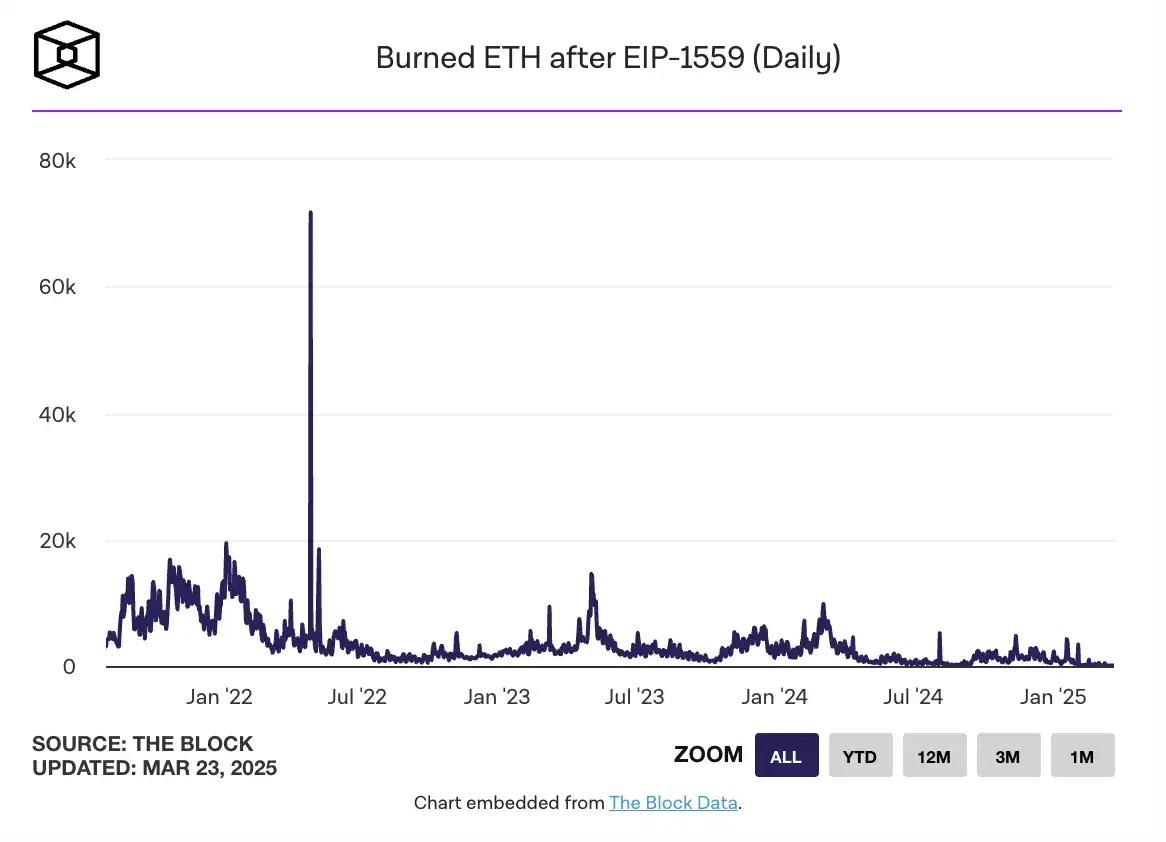
Furthermore, the continuous decline in on-chain activity data further highlights the fatigue of the Ethereum ecosystem. According to The Block data, as of March 22, the amount of ETH burned due to transaction fees on the Ethereum network has decreased to 53.07 ETH, approximately equivalent to $10.6K, hitting a historical low. Ultrasound.money data shows that based on the last 7 days, the annual supply growth rate of ETH is 0.76%. Moreover, Ethereum's on-chain active addresses, transaction volume, and number of transactions have all declined in recent weeks, indicating a waning vitality of the Ethereum ecosystem.
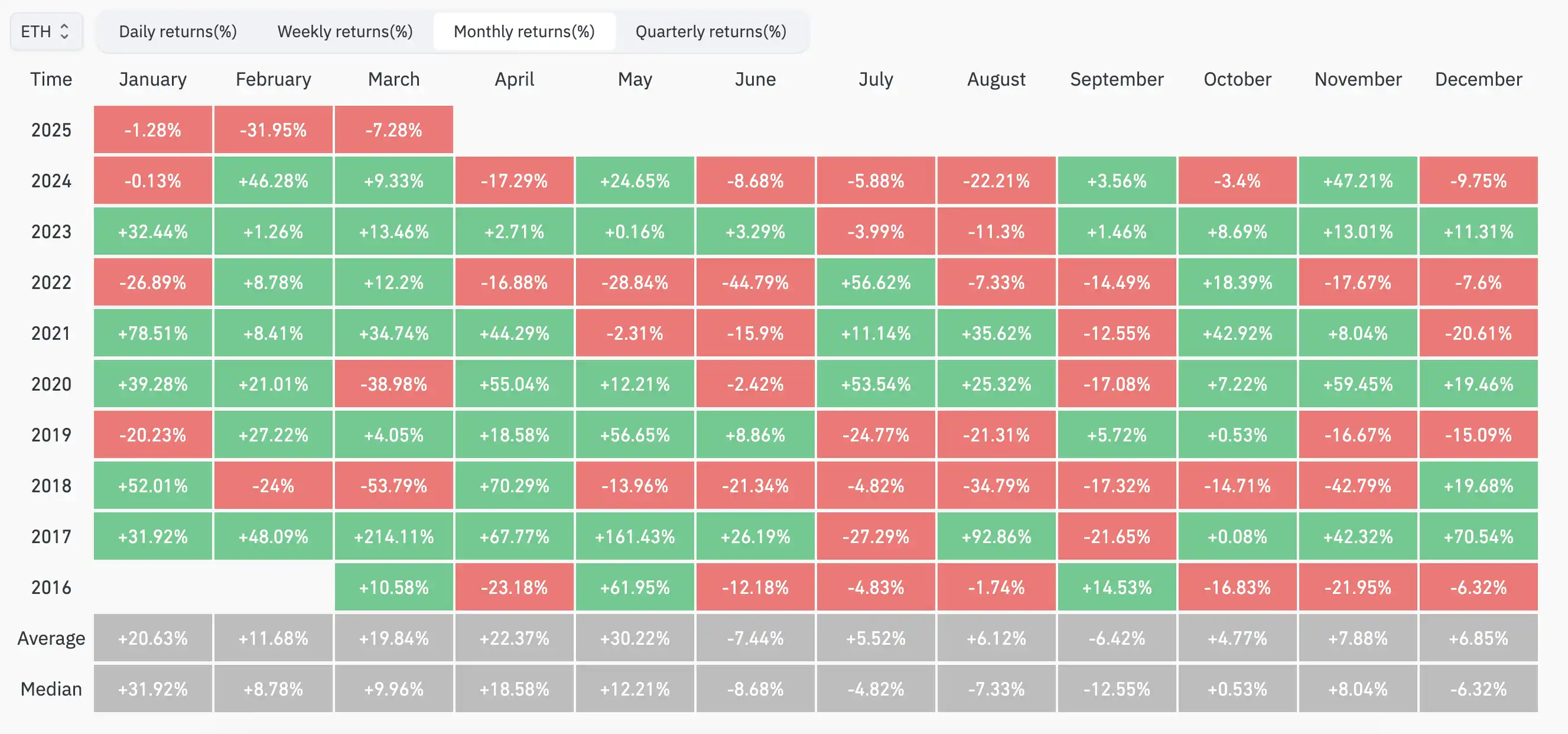
At the same time, Ethereum recorded its worst performance in Q1 of this year. Coinglass data shows that Ethereum experienced its worst start to a year in nearly a quarter in Q1 2025, with negative returns for three consecutive months: January: -1.28% (historical average return: +20.63%, median: +31.92%); February: -31.95% (historical average return: +11.68%, median: +8.78%); March: -7.28% (historical average return: +19.55%, median: +9.96%).
The challenges facing Ethereum stem from multiple structural issues. For instance, although L2 solutions such as Arbitrum and Optimism have significantly reduced transaction costs through Rollup technology, they have also diverted transaction volume away from the mainnet. The proportion of L2 transactions has surpassed that of the mainnet, leading to a decrease in mainnet gas fees and ETH burn. More critically, the transaction fees generated by L2 mostly stay within their ecosystems (such as Optimism's OP tokenomics) rather than flowing back to ETH. For example, Ethereum's market share is being eroded by other blockchains like Solana due to its lack of competitiveness in high-performance application scenarios.
Standard Chartered Bank has also revised its end-of-2025 ETH target price from $10,000 to $4,000 in its latest report, and made several key assessments: L2 Scaling Weakens ETH Market Cap: L2 solutions originally intended to enhance Ethereum's scalability (such as Coinbase's Base) have led to a $500 billion market cap evaporation; ETH/BTC Ratio Expected to Continue Declining: It is projected to fall to 0.015 by the end of 2027, reaching the lowest level since 2017; Future Growth May Depend on RWAs: If RWA tokenization develops rapidly, ETH may still maintain its 80% security market share, but the Ethereum Foundation would need to pursue a more proactive business strategy (such as taxing L2), although this possibility is low.
Overall, although Ethereum's ETF pledging can to some extent affect ETH supply and holder returns, it cannot directly address core challenges such as ecosystem competition, L2 diversion, or market sentiment downturn. Ethereum still needs to seek a profound breakthrough in both technology and narrative.
You may also like

Consumer-grade Crypto Global Survey: Users, Revenue, and Track Distribution

Prediction Markets Under Bias

Stolen: $290 million, Three Parties Refusing to Acknowledge, Who Should Foot the Bill for the KelpDAO Incident Resolution?

ASTEROID Pumped 10,000x in Three Days, Is Meme Season Back on Ethereum?

ChainCatcher Hong Kong Themed Forum Highlights: Decoding the Growth Engine Under the Integration of Crypto Assets and Smart Economy

Why can this institution still grow by 150% when the scale of leading crypto VCs has shrunk significantly?

Anthropic's $1 trillion, compared to DeepSeek's $100 billion

Geopolitical Risk Persists, Is Bitcoin Becoming a Key Barometer?

Annualized 11.5%, Wall Street Buzzing: Is MicroStrategy's STRC Bitcoin's Savior or Destroyer?

An Obscure Open Source AI Tool Alerted on Kelp DAO's $292 million Bug 12 Days Ago

Mixin has launched USTD-margined perpetual contracts, bringing derivative trading into the chat scene.
The privacy-focused crypto wallet Mixin announced today the launch of its U-based perpetual contract (a derivative priced in USDT). Unlike traditional exchanges, Mixin has taken a new approach by "liberating" derivative trading from isolated matching engines and embedding it into the instant messaging environment.
Users can directly open positions within the app with leverage of up to 200x, while sharing positions, discussing strategies, and copy trading within private communities. Trading, social interaction, and asset management are integrated into the same interface.
Based on its non-custodial architecture, Mixin has eliminated friction from the traditional onboarding process, allowing users to participate in perpetual contract trading without identity verification.
The trading process has been streamlined into five steps:
· Choose the trading asset
· Select long or short
· Input position size and leverage
· Confirm order details
· Confirm and open the position
The interface provides real-time visualization of price, position, and profit and loss (PnL), allowing users to complete trades without switching between multiple modules.
Mixin has directly integrated social features into the derivative trading environment. Users can create private trading communities and interact around real-time positions:
· End-to-end encrypted private groups supporting up to 1024 members
· End-to-end encrypted voice communication
· One-click position sharing
· One-click trade copying
On the execution side, Mixin aggregates liquidity from multiple sources and accesses decentralized protocol and external market liquidity through a unified trading interface.
By combining social interaction with trade execution, Mixin enables users to collaborate, share, and execute trading strategies instantly within the same environment.
Mixin has also introduced a referral incentive system based on trading behavior:
· Users can join with an invite code
· Up to 60% of trading fees as referral rewards
· Incentive mechanism designed for long-term, sustainable earnings
This model aims to drive user-driven network expansion and organic growth.
Mixin's derivative transactions are built on top of its existing self-custody wallet infrastructure, with core features including:
· Separation of transaction account and asset storage
· User full control over assets
· Platform does not custody user funds
· Built-in privacy mechanisms to reduce data exposure
The system aims to strike a balance between transaction efficiency, asset security, and privacy protection.
Against the background of perpetual contracts becoming a mainstream trading tool, Mixin is exploring a different development direction by lowering barriers, enhancing social and privacy attributes.
The platform does not only view transactions as execution actions but positions them as a networked activity: transactions have social attributes, strategies can be shared, and relationships between individuals also become part of the financial system.
Mixin's design is based on a user-initiated, user-controlled model. The platform neither custodies assets nor executes transactions on behalf of users.
This model aligns with a statement issued by the U.S. Securities and Exchange Commission (SEC) on April 13, 2026, titled "Staff Statement on Whether Partial User Interface Used in Preparing Cryptocurrency Securities Transactions May Require Broker-Dealer Registration."
The statement indicates that, under the premise where transactions are entirely initiated and controlled by users, non-custodial service providers that offer neutral interfaces may not need to register as broker-dealers or exchanges.
Mixin is a decentralized, self-custodial privacy wallet designed to provide secure and efficient digital asset management services.
Its core capabilities include:
· Aggregation: integrating multi-chain assets and routing between different transaction paths to simplify user operations
· High liquidity access: connecting to various liquidity sources, including decentralized protocols and external markets
· Decentralization: achieving full user control over assets without relying on custodial intermediaries
· Privacy protection: safeguarding assets and data through MPC, CryptoNote, and end-to-end encrypted communication
Mixin has been in operation for over 8 years, supporting over 40 blockchains and more than 10,000 assets, with a global user base exceeding 10 million and an on-chain self-custodied asset scale of over $1 billion.

$600 million stolen in 20 days, ushering in the era of AI hackers in the crypto world
Vitalik's 2026 Hong Kong Web3 Summit Speech: Ethereum's Ultimate Vision as the "World Computer" and Future Roadmap
On the same day Aave introduced rsETH, why did Spark decide to exit?
Full Post-Mortem of the KelpDAO Incident: Why Did Aave, Which Was Not Compromised, End Up in Crisis Situation?

After a $290 million DeFi liquidation, is the security promise still there?
ZachXBT's post ignites RAVE nearing zero, what is the truth behind the insider control?




 App
App