
 Buy Crypto
- Markets
 Futures
- Spot
- Copy Trade
- Earn
- More
Interview with Independent Developer Haole: Working in Big Tech by Day, Building Dreams on the Blockchain by Night | Base Builder Talk

The announcement that EOS has been rebranded as Vaulta and is transitioning to become a Web3 bank has stirred up many OGs in the crypto community. From ICOs, DeFi Summer, GameFi, NFTs, to meme coins, the narrative shift in the crypto world has once again reaffirmed its brutal yet romantic nature.
In this edition of Base Builder Talk, our guest is Haole, the developer of the Farcaster protocol client Recaster. He has witnessed the rise and fall of Steemit, the first decentralized social media platform, experienced the frenzy of DeFi Summer, and, amidst the prophecy of AI devouring everything, has chosen to develop independently, navigating outside the mainstream to diligently build the applications he needs and believes in.
This stems not only from his pure passion for technology but is deeply rooted in a philosophical inquiry: whether to accept data nourishment within the comfortable centralized "matrix" or to choose the red pill leading to data sovereignty in the "real world." In the current age of the AI tidal wave and Web2 giants fortifying data barriers, Haole's persistence appears particularly commendable.
Building a product is not just about solving specific problems but also about embodying the open network ideal of "data belonging to users," injecting a counter-current of resistance and humanistic warmth into a digital world increasingly monopolized and defined by algorithms. His story encapsulates the sobriety and steadfastness of a technological idealist amidst the clamor of the crypto wave.
Below is the full interview:
BlockBeats: Please introduce yourself and share what led you into the crypto space.
Haole: I am currently a developer at a small factory in North America. Around 2016, I entered the crypto space when I needed to transfer money between China and the U.S. I found the traditional channels very cumbersome, with layers of verification and slow transfer speeds, realizing that the hard-earned money did not truly belong to me. This realization led me to learn about Bitcoin, read related books, and explore more and more crypto projects.
Using Bitcoin for cross-border transactions between China and the U.S. was very risky due to high volatility. There was a project called BitShares, which was a first-generation decentralized exchange. It had RMB gateways, reducing volatility and making deposits and withdrawals very convenient.
Because of this project, I became a fan of BitShares' founder, BM (Daniel Larimer), and delved into BitShares, Steemit, and EOS.
Related reading: "From Steemit to friend.tech: Tracing the 7-year Evolution History of SocialFi"
In the following cycles, I have been involved in ICOs, DeFi, NFTs, and Memes. However, I have always played in my spare time and have not joined any blockchain companies. Mainly because I feel that this industry has a strong speculative element, with too few long-term projects, and companies die too quickly.
BlockBeats: Didn't you become a scientist?
Haole: During the DeFi Summer period, I was also considered half a scientist, played around with some scripts, but later found that the time cost was high, and holding Bitcoin was more profitable. After going through these cycles, I also realize more that holding Bitcoin is the best strategy with the highest cost-effectiveness.
BlockBeats: Over the past year or two, from Recaster to Modbot, then to Newcaster, and a payment product, which projects have you been involved in part-time?
Haole: This year, I have mainly worked on Recaster, a client based on the Farcaster protocol. Modbot and Newcaster are tools in the Farcaster ecosystem, and I have not invested too much time in them.
As for the payment product you mentioned, called Depal, it is a cryptocurrency-based payment platform that only I am currently using.
Creating this product was to solve a KYC + fee problem. Exchanges like Coinbase are similar to traditional channels, charging a percentage of the payment amount, but the actual transaction cost is only a few cents. With large volumes, there is still a significant profit margin.
However, this product can only be considered a toy. To truly commercialize it, trust and a profitable business model need to be addressed.
BlockBeats: Apart from solving your own needs, do you also aim to accumulate project experience by creating these products?
Haole: There are mainly two purposes. One is to solve my own needs and create a product that satisfies me. If it can help others, I would be even happier. The second is to learn a new technology stack to use in my full-time work, which can be seen as Web3 empowering Web2.
BlockBeats: Using Web3 to give back to Web2 is quite interesting. You mentioned in a statement that the average engineer entering the crypto industry can make money. Now everyone thinks AI is the way to go, that the crypto industry is too chaotic and not promising, but bias actually signifies opportunity. Looking back on this cycle, are you still satisfied with your initial judgment?
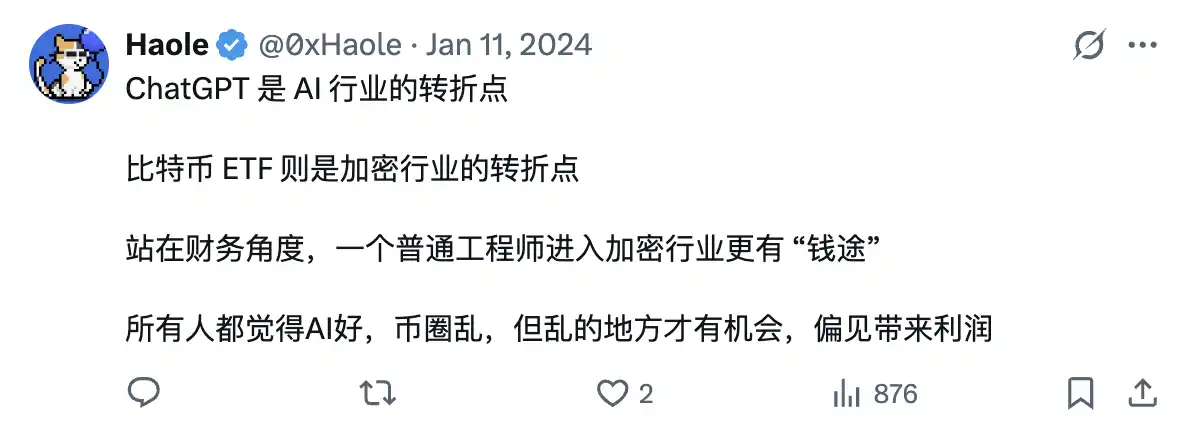
Haole: That tweet was actually posted in early 2024, right before the start of the bull market. At that time, everyone was chasing the AI trend, and the cryptocurrency industry was relatively quiet. The subsequent price increase from $30,000 to $40,000 indeed proved this point, showing that biases can lead to opportunities and profits. However, the recent market reversal has revealed that AI is the real deal.
BlockBeats: Was that around the time when the Bitcoin ETF concept was just starting to be hyped?
Haole: Exactly, that was the timing. The more people view the cryptocurrency industry with a biased perspective, the easier it is to identify undervalued assets. When everyone is going crazy, it's usually a sign that it's time to exit.
BlockBeats: And what were the outcomes?
Haole: In this cycle, Bitcoin performed quite well, but during the meme season and FOMO phase, I experienced some losses. This cycle has once again proven that ordinary people are only suitable for holding Bitcoin. Meme coins are all worthless coins with no underlying value, and coins with no value ultimately go to zero.
Development Practices and Ecosystem Consideration of the Farcaster Client
BlockBeats: Why did you decide to develop a client for the Farcaster protocol?
Haole: Bitcoin solved the problem of private property rights, but when it comes to data ownership, there isn't a good solution. Web2 social platforms profit from user data; although they allow you to download your data, you can't access all platform data. Yet, platforms can utilize global data to create data monopolies. In the AI era, platforms like Reddit, X, and Xiaohongshu are further restricting their APIs, strengthening their data barriers.
Decentralized social platforms are an attempt to address this issue. Due to network effects, it's known to be difficult, but since there are teams actually working on it, I'm willing to participate and support the effort.
Currently, Farcaster seems to have the most funding and the most practical technology team. They have been working for 3-4 years, the founder enjoys interacting with the community, and the team has weekly product iterations. They are one of the few teams in the crypto industry focused on the long term, so I prefer to contribute to Farcaster.

Recaster Custom Logo
BlockBeats: So you were in a traditional tech company, working within that value system and ruleset, and then you also had this Open Network, data belongs to everyone kind of mindset in your head. Did they not clash in your mind?
Haole: It's because I saw too much of Web2, where everyone makes money by monopolizing information, so I felt there should be another way to disrupt or restrict. Just like how Bitcoin can hedge against the overissuance of fiat currency, decentralized social platforms are also a hedge against the information monopoly of these large tech industry giants. Although progress is difficult, this is the right direction worth long-term investment.
BlockBeats: Farcaster co-founder Varun once said in an interview that building applications and communities is really, really difficult. It took a team of 20 people a year to build Warpcast. It's unrealistic to expect other teams to fully commit to Farcaster's development from the start and invest 100% without users. How much have you invested in this development process? Time, energy, funds?
Related Reading: "Farcaster Co-founder Interview: Exploring the Future of Decentralized Social Networks"
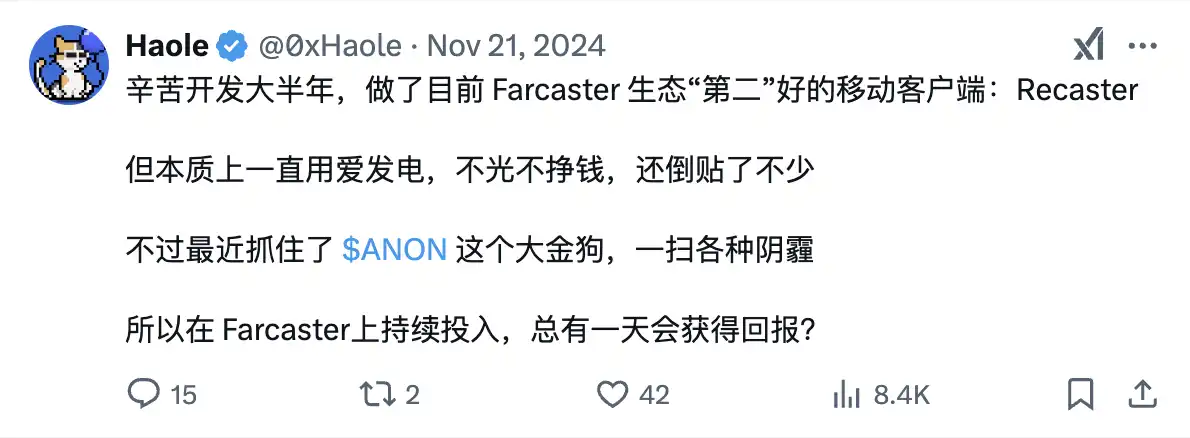
Haole: They needed to develop the protocol layer, front end, back end, and mobile end simultaneously, so the cost was relatively high. The community now has Neynar providing the backend API, and my development focus is mainly on the mobile end. I haven't invested much time, mainly using weekends and evenings. In the early stages, I invested approximately 20-30 hours per week, now it's less, around 10 hours, and it's been going on for almost a year.
Funding-wise, I haven't hired anyone; I've been independently developing. The main expense is Neynar's service fee, $250 a month, plus miscellaneous server costs, keeping the overall monthly cost below $300, which is quite cheap.
BlockBeats: BlockBeats: Supercast (another frontend application of the Farcaster protocol) is now considered to have been acquired, and the founder Woj has also joined the Farcaster protocol team. How do you think Recaster's future will unfold?
Haole: Currently, Farcaster has very few daily active users (DAU), and without funding, it's challenging to sustain a full-time team of over 2 people. The acquisition of Supercast is considered a good outcome.
Recaster is quite unique; as mentioned earlier, it has very low costs, does not require funding, and has no commercialization needs. I am only responsible to myself and only want to polish it into a product that satisfies me. As long as the Farcaster protocol remains alive, Recaster will continue to exist.
If one day Recaster becomes popular with many users, reaching 10,000 to 20,000 daily active users, I might consider full-time development.
BlockBeats: How do you interpret the Farcaster protocol developing its own client behavior?
Haole: It's quite good, and I agree with it. Many say the Farcaster team lacks the blockchain spirit and cannot build protocols. But the fundamental issue now is not the protocol; it's about how to bring more people into the decentralized world. A slightly centralized pragmatic approach is actually better in the early stages. However, the Farcaster protocol is open enough; for most core functions, I don't need official permission to develop.
BlockBeats: How do you see the competitive relationship between Warpcast and Tako, the other frontends of the Farcaster protocol?
Haole: It's hard to say there's competition; everyone is small and looking for their product-market fit. Any team exploring decentralized social platforms should be supported and encouraged. Our real opponent is the Web2 data monopoly platforms, and I often communicate with the Tako team, helping each other.
BlockBeats: Throughout this process, you have always persisted as a lone wolf, which is truly remarkable.
Haole: Because my costs are low, and I am currently not focused on profitability, I just want to do something meaningful. If I were to form a team, think about making money, it would create pressure, making it harder to persist.
BlockBeats: Have you ever thought about the failure of Recaster? What would be the reason for not being able to continue?
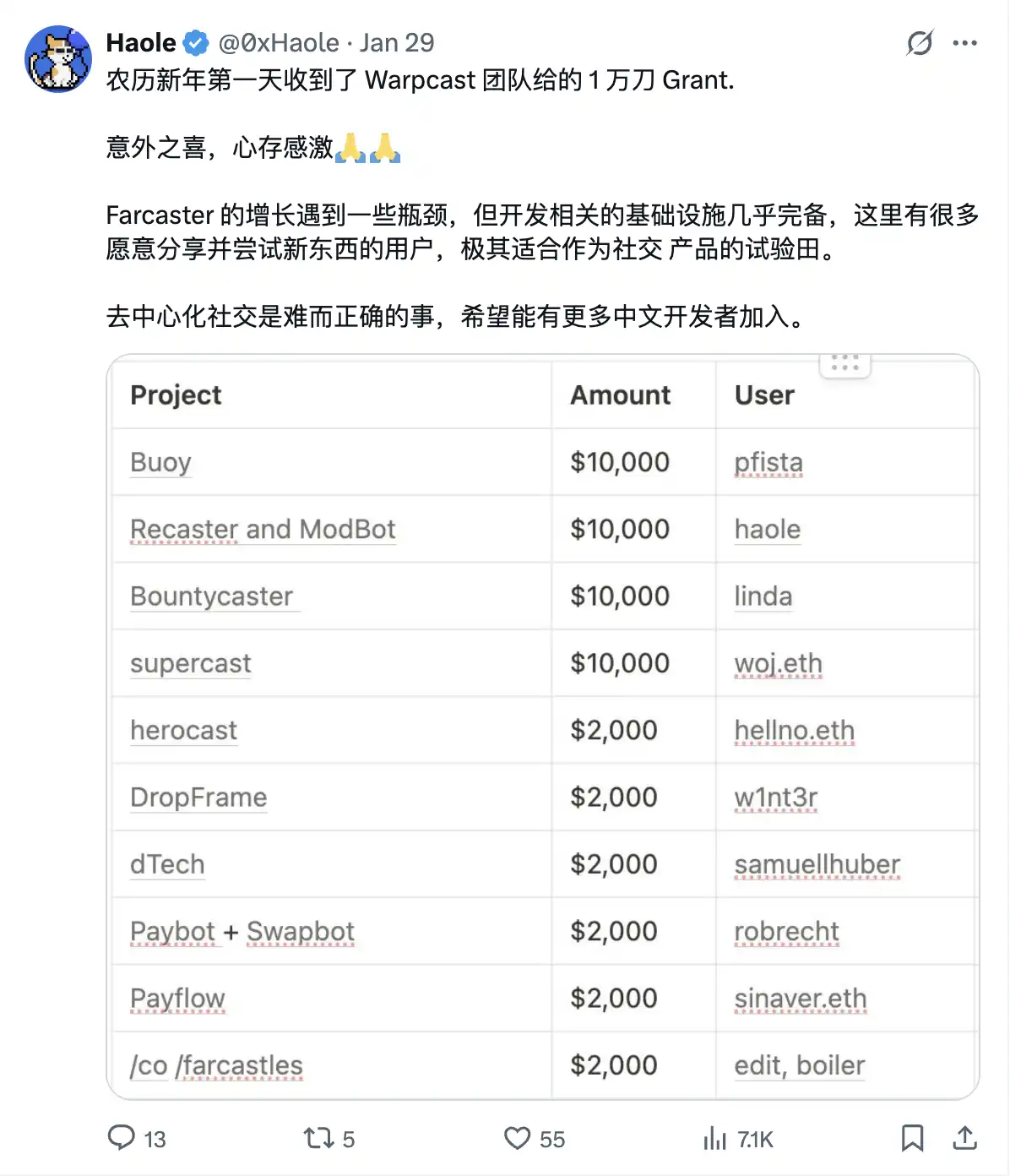
Haole: As long as the Farcaster protocol is alive, this product will be too, because my costs are too low. The annual maintenance cost is less than $5000, and the Farcaster team has provided $10,000 in grants. Even without spending money, it's enough to sustain for another two years. If I can't continue, it can only mean that the Farcaster protocol itself is dead.
The Evolution of Developers in the AI Wave
BlockBeats: You have expressed on social media how AI has helped you. What is your biggest insight during this AI wave?
Haole: AI will eventually replace programmers. Its development and execution capabilities have already surpassed those of most people. I can only say that I understand the constantly emerging new requirements in reality better than AI does.
BlockBeats: So, can we say that the role of a product manager will surpass that of an engineer responsible for execution and implementation?
Haole: Perhaps in the future, AI can proactively identify needs and directly help people achieve them. Both product managers and implementation engineers may have the same fate.
However, there is one thing that AI can never replace—the relationships and communication between real people. The real-world problem is that unless you meet offline, in the online world, it's hard to tell which accounts belong to real individuals.
BlockBeats: How do you view the combination of AI agents and Crypto? Some say that in the future, AI in social media will have its own identity, combined with a Crypto payment system, making it indistinguishable from a real person. This virtual world will then become very interesting, and some investors have mentioned the resurgence of the metaverse.
Haole: I still prefer the real world. Just like in "The Matrix," choosing the red pill or the blue pill, I would choose the red pill. The path of reality comes with pain, imperfection, but it's genuine, showing the value of human life.
BlockBeats: Having this kind of passion is still very helpful for product development.
Haole: Yes, especially when you have children. After years of hard study, coming out and not being as good as AI, it's a very sad thing. What is the meaning of one's existence?
BlockBeats: So what is your answer to this question?
Haole: I haven't come up with an answer yet. I've just been thinking all the time, perhaps it's a human weakness, greed, fear, anger, sorrow, that can bring different brilliance to this world...
BlockBeats: Looking forward to you sharing your answer online in the future.
The Survival Philosophy of Indie Developers
BlockBeats: You have spent 10 years in the United States. Do you think there are any differences in developer culture between the U.S. and China?
Haole: Many students are starting their own businesses, and I often help them with their projects and provide oversight. Chinese engineers are indeed excellent, strong in technology and very hardworking. Domestic teams use Feishu for remote collaboration, which is highly efficient, much better than Slack. However, entrepreneurship in China is more practical. People mainly come together to make money, with fewer idealistic individuals. Teams like the recently emerged Deepseek team are quite idealistic, but maybe after everyone has made enough money, they will pursue something else.
BlockBeats: After three cycles, what are some of the differences you have noticed in different developer ecosystems?
Haole: In 2016 and 2017, when I first entered the field, my faith was not firm enough. I entered and exited the circle several times, so my impression of the developer ecosystem is not particularly deep. The DeFi Summer was the most exciting year, with many projects that were eye-opening. It turned out that blockchain could do this (although in the end, it was found that they did not solve any practical problems). In this cycle, there is almost no excitement. The crypto industry has become an extension of the U.S. dollar hegemony, becoming a laborer for the dollar.
BlockBeats: So, do you now only have faith in Bitcoin in terms of blockchain?
Haole: Making data more open is also a belief.
BlockBeats: Are there any experiences from independent developers that can be shared with other developers in the blockchain industry?
Haole: Strictly speaking, I am not a true independent developer. Although I am independently developing in form, true independent development should refer to a full-time and commercially viable model. In my current situation, which is not profit-oriented, I am not suitable as an example. True independent developers must find PMF (Product-Market Fit). Only when your product gains market acceptance and users are willing to pay for it, can it be considered a true achievement of independence.
However, from the perspective of tangible returns, trying to make big money through independent development may not be the optimal choice. Although there are success stories, when factoring in probabilities, it is overall far less stable and reliable than joining a large company.
If you really want to pursue independent development, you must control costs. Do not blindly spend money, and the importance of marketing outweighs writing code. Truly good products require time to refine—whether it be a year, two years, or even five years— the value of time investment is the best moat.
You may also like

Consumer-grade Crypto Global Survey: Users, Revenue, and Track Distribution

Prediction Markets Under Bias

Stolen: $290 million, Three Parties Refusing to Acknowledge, Who Should Foot the Bill for the KelpDAO Incident Resolution?

ASTEROID Pumped 10,000x in Three Days, Is Meme Season Back on Ethereum?

ChainCatcher Hong Kong Themed Forum Highlights: Decoding the Growth Engine Under the Integration of Crypto Assets and Smart Economy

Why can this institution still grow by 150% when the scale of leading crypto VCs has shrunk significantly?

Anthropic's $1 trillion, compared to DeepSeek's $100 billion

Geopolitical Risk Persists, Is Bitcoin Becoming a Key Barometer?

Annualized 11.5%, Wall Street Buzzing: Is MicroStrategy's STRC Bitcoin's Savior or Destroyer?

An Obscure Open Source AI Tool Alerted on Kelp DAO's $292 million Bug 12 Days Ago

Mixin has launched USTD-margined perpetual contracts, bringing derivative trading into the chat scene.
The privacy-focused crypto wallet Mixin announced today the launch of its U-based perpetual contract (a derivative priced in USDT). Unlike traditional exchanges, Mixin has taken a new approach by "liberating" derivative trading from isolated matching engines and embedding it into the instant messaging environment.
Users can directly open positions within the app with leverage of up to 200x, while sharing positions, discussing strategies, and copy trading within private communities. Trading, social interaction, and asset management are integrated into the same interface.
Based on its non-custodial architecture, Mixin has eliminated friction from the traditional onboarding process, allowing users to participate in perpetual contract trading without identity verification.
The trading process has been streamlined into five steps:
· Choose the trading asset
· Select long or short
· Input position size and leverage
· Confirm order details
· Confirm and open the position
The interface provides real-time visualization of price, position, and profit and loss (PnL), allowing users to complete trades without switching between multiple modules.
Mixin has directly integrated social features into the derivative trading environment. Users can create private trading communities and interact around real-time positions:
· End-to-end encrypted private groups supporting up to 1024 members
· End-to-end encrypted voice communication
· One-click position sharing
· One-click trade copying
On the execution side, Mixin aggregates liquidity from multiple sources and accesses decentralized protocol and external market liquidity through a unified trading interface.
By combining social interaction with trade execution, Mixin enables users to collaborate, share, and execute trading strategies instantly within the same environment.
Mixin has also introduced a referral incentive system based on trading behavior:
· Users can join with an invite code
· Up to 60% of trading fees as referral rewards
· Incentive mechanism designed for long-term, sustainable earnings
This model aims to drive user-driven network expansion and organic growth.
Mixin's derivative transactions are built on top of its existing self-custody wallet infrastructure, with core features including:
· Separation of transaction account and asset storage
· User full control over assets
· Platform does not custody user funds
· Built-in privacy mechanisms to reduce data exposure
The system aims to strike a balance between transaction efficiency, asset security, and privacy protection.
Against the background of perpetual contracts becoming a mainstream trading tool, Mixin is exploring a different development direction by lowering barriers, enhancing social and privacy attributes.
The platform does not only view transactions as execution actions but positions them as a networked activity: transactions have social attributes, strategies can be shared, and relationships between individuals also become part of the financial system.
Mixin's design is based on a user-initiated, user-controlled model. The platform neither custodies assets nor executes transactions on behalf of users.
This model aligns with a statement issued by the U.S. Securities and Exchange Commission (SEC) on April 13, 2026, titled "Staff Statement on Whether Partial User Interface Used in Preparing Cryptocurrency Securities Transactions May Require Broker-Dealer Registration."
The statement indicates that, under the premise where transactions are entirely initiated and controlled by users, non-custodial service providers that offer neutral interfaces may not need to register as broker-dealers or exchanges.
Mixin is a decentralized, self-custodial privacy wallet designed to provide secure and efficient digital asset management services.
Its core capabilities include:
· Aggregation: integrating multi-chain assets and routing between different transaction paths to simplify user operations
· High liquidity access: connecting to various liquidity sources, including decentralized protocols and external markets
· Decentralization: achieving full user control over assets without relying on custodial intermediaries
· Privacy protection: safeguarding assets and data through MPC, CryptoNote, and end-to-end encrypted communication
Mixin has been in operation for over 8 years, supporting over 40 blockchains and more than 10,000 assets, with a global user base exceeding 10 million and an on-chain self-custodied asset scale of over $1 billion.

$600 million stolen in 20 days, ushering in the era of AI hackers in the crypto world
Vitalik's 2026 Hong Kong Web3 Summit Speech: Ethereum's Ultimate Vision as the "World Computer" and Future Roadmap
On the same day Aave introduced rsETH, why did Spark decide to exit?
Full Post-Mortem of the KelpDAO Incident: Why Did Aave, Which Was Not Compromised, End Up in Crisis Situation?

After a $290 million DeFi liquidation, is the security promise still there?
ZachXBT's post ignites RAVE nearing zero, what is the truth behind the insider control?




 App
App