
 Buy Crypto
- Markets
 Futures
- Spot
- Copy Trade
- Earn
- More
「MakerDAO Veteran」 Leads $12 Million Investment Round, A Comprehensive Guide to the 'Gold Mine' Chronicle in the Oracle Space

As the first quarter of 2025 just ended, we have witnessed many impressive performances. The TVL of DeFi surpassed $300 billion, and the valuation of the RWA market approached $500 billion.
The demand for high-quality on-chain data is increasing. Projects like Ondo Finance and Franklin Templeton, which tokenize government bonds, saw a 40% surge in on-chain product monthly trading volume. Everyone is eagerly connecting off-chain data with on-chain assets. As oracles serve as Web3's "information carriers," responsible for bringing off-chain data on-chain, this bridge is becoming the new favorite for capital competition.
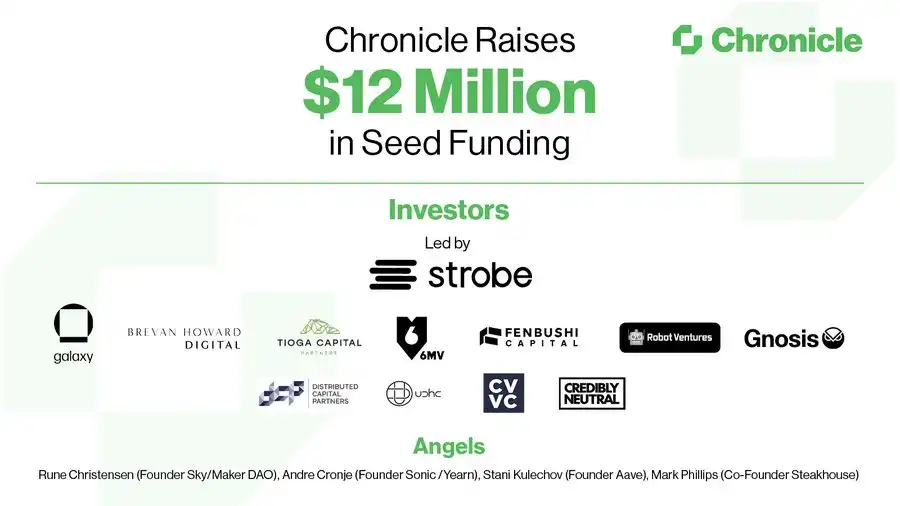
On March 25, according to BlockBeats, the Ethereum oracle Chronicle completed a $12 million funding round. The round was led by Strobe (formerly Blocktower Venture Capital), with participation from Brevan Howard, 6th Man Ventures, and others. Perhaps this "mining race" has only just begun.
What Is Chronicle?
The Super Data Guardian of DeFi and RWA
Chronicle is a oracle infrastructure platform dedicated to providing data support for DeFi and RWA. Chronicle aims to connect on-chain financial systems with real-world data through reliable data transmission, addressing the trust and accuracy issues blockchain faces when obtaining external data.
As a key component, oracles are responsible for providing external data to smart contracts (such as price, asset value, etc.) and play an indispensable role in DeFi and RWA.

Imagine if there were no oracle, smart contracts in DeFi would be like travelers without a map, unable to accurately reach their destination. The arrival of Chronicle equips these contracts with a GPS, ensuring that they can quickly find precise coordinates when dealing with crucial information like price and asset value.
Currently, the oracle market has formed a certain competitive landscape, with Chainlink leading the field and other projects such as Band Protocol and API3 continuing to grow. According to market observations, the oracle track has steadily grown over the past few years, especially in the RWA field, where there is an urgent market demand to reliably bring off-chain asset data (such as U.S. Treasury bond yields) on-chain.
Chronicle is the successor of one of the earliest oracle technologies in the Ethereum ecosystem, created by the MakerDAO founding team, continuing its pioneering role in DeFi data infrastructure.
DeFi Veteran Leading the Way in Oracle Mining
The leadership team of Chronicle is led by Niklas Kunkel, who is a core founding member of MakerDAO (now Sky). Niklas previously played a key role in MakerDAO as part of the oracle team, responsible for designing and optimizing its data feed system.
MakerDAO is a DeFi pioneer that issued the USD-pegged stablecoin DAI (now USDS) through smart contract technology and built a trustless collateralized lending ecosystem. Since its launch in 2017, its core innovation has been to ensure the stability of DAI through overcollateralization (e.g., ETH) and an oracle price feed mechanism, paving the way for decentralized stablecoins.
After rebranding to Sky in 2024, the project underwent further upgrades, introducing USDS and SKY tokens, expanding into savings (Sky Money), and RWA integration, aiming to transition from a single stablecoin system to a comprehensive on-chain financial ecosystem. As of March 2025, Sky's total value locked remains among the top in DeFi.
The success of its stablecoin DAI is closely tied to a reliable oracle system providing real-time price data for DAI, accumulating valuable experience in anti-manipulation and multi-source verification, directly empowering Chronicle's data accuracy and security design. Additionally, Sky's on-chain RWA data practices (e.g., bond yield feeds) serve as a real-world blueprint for Chronicle's "validated assets" oracle.
The team inherits industry resources and reputation from Sky, and Sky's success fundamentally serves as both a technological endorsement and a market proving ground for Chronicle, with Niklas accumulating rich experience in this process. Moreover, many team members also come from MakerDAO.
Looking at its funding team, Strobe is an investment firm focused on blockchain and crypto technology, with its predecessor Blocktower having a widespread presence in DeFi and RWA. Brevan Howard is a globally renowned hedge fund that has been actively exploring the crypto market in recent years. 6th Man Ventures is well-known for investing in early-stage blockchain projects.
This luxurious investment lineup not only provides funding support to Chronicle but also brings industry resources and credibility endorsement. The financing will be mainly used for product research and development, indicating that the team is accelerating the pace of technology implementation.
Chronicle's Distinction: Not All Oracles Understand RWA
Chronicle takes a different path. Unlike generalist oracles like Chainlink, it focuses on data support for tokenized assets, introducing a "Verified Real-World Asset" (RWA) oracle tailored to provide accurate data for on-chain assets such as U.S. Treasuries and real estate. With the RWA market recently gaining momentum, Chronicle's move can be seen as strategically positioning itself ahead of time, seizing a first-mover advantage.
Chronicle's service covers both the DeFi and RWA sectors. DeFi requires real-time price data to support lending, trading, and other functions, while RWAs need to bring off-chain asset data on-chain. Although both have overlapping oracle needs, they each have their focus areas. Chronicle's dual positioning, delving deep into RWA to migrate off-chain asset data like bond yields and property valuations onto the chain, caters to both sectors simultaneously.
As of March 26, 2025, Chronicle's specific products have not yet fully launched. Considering the use of funds (mainly for product manufacturing and development), the project is likely still in the development or internal testing phase. The core product, the "Verified Real-World Asset" oracle, is expected to be released shortly.
Summary
This project, Chronicle, inherits MakerDAO's technical lineage while carrying its ambition, targeting the two trends of DeFi and RWA. Founder Niklas Kunkel leads a seasoned DeFi team back into the oracle race, securing a $12 million investment. With full support from the capital markets, its bold move lies in focusing on RWA, launching the "Verified Real-World Asset" oracle specifically to provide accurate data for tokenized assets, addressing the issue of on-chain assets lacking reliable data.
Although the product is still in development, for investors and developers looking to seize the DeFi and RWA synergy opportunity, Chronicle may be the "hidden gem" worth keeping a close eye on.
You may also like

Consumer-grade Crypto Global Survey: Users, Revenue, and Track Distribution

Prediction Markets Under Bias

Stolen: $290 million, Three Parties Refusing to Acknowledge, Who Should Foot the Bill for the KelpDAO Incident Resolution?

ASTEROID Pumped 10,000x in Three Days, Is Meme Season Back on Ethereum?

ChainCatcher Hong Kong Themed Forum Highlights: Decoding the Growth Engine Under the Integration of Crypto Assets and Smart Economy

Why can this institution still grow by 150% when the scale of leading crypto VCs has shrunk significantly?

Anthropic's $1 trillion, compared to DeepSeek's $100 billion

Geopolitical Risk Persists, Is Bitcoin Becoming a Key Barometer?

Annualized 11.5%, Wall Street Buzzing: Is MicroStrategy's STRC Bitcoin's Savior or Destroyer?

An Obscure Open Source AI Tool Alerted on Kelp DAO's $292 million Bug 12 Days Ago

Mixin has launched USTD-margined perpetual contracts, bringing derivative trading into the chat scene.
The privacy-focused crypto wallet Mixin announced today the launch of its U-based perpetual contract (a derivative priced in USDT). Unlike traditional exchanges, Mixin has taken a new approach by "liberating" derivative trading from isolated matching engines and embedding it into the instant messaging environment.
Users can directly open positions within the app with leverage of up to 200x, while sharing positions, discussing strategies, and copy trading within private communities. Trading, social interaction, and asset management are integrated into the same interface.
Based on its non-custodial architecture, Mixin has eliminated friction from the traditional onboarding process, allowing users to participate in perpetual contract trading without identity verification.
The trading process has been streamlined into five steps:
· Choose the trading asset
· Select long or short
· Input position size and leverage
· Confirm order details
· Confirm and open the position
The interface provides real-time visualization of price, position, and profit and loss (PnL), allowing users to complete trades without switching between multiple modules.
Mixin has directly integrated social features into the derivative trading environment. Users can create private trading communities and interact around real-time positions:
· End-to-end encrypted private groups supporting up to 1024 members
· End-to-end encrypted voice communication
· One-click position sharing
· One-click trade copying
On the execution side, Mixin aggregates liquidity from multiple sources and accesses decentralized protocol and external market liquidity through a unified trading interface.
By combining social interaction with trade execution, Mixin enables users to collaborate, share, and execute trading strategies instantly within the same environment.
Mixin has also introduced a referral incentive system based on trading behavior:
· Users can join with an invite code
· Up to 60% of trading fees as referral rewards
· Incentive mechanism designed for long-term, sustainable earnings
This model aims to drive user-driven network expansion and organic growth.
Mixin's derivative transactions are built on top of its existing self-custody wallet infrastructure, with core features including:
· Separation of transaction account and asset storage
· User full control over assets
· Platform does not custody user funds
· Built-in privacy mechanisms to reduce data exposure
The system aims to strike a balance between transaction efficiency, asset security, and privacy protection.
Against the background of perpetual contracts becoming a mainstream trading tool, Mixin is exploring a different development direction by lowering barriers, enhancing social and privacy attributes.
The platform does not only view transactions as execution actions but positions them as a networked activity: transactions have social attributes, strategies can be shared, and relationships between individuals also become part of the financial system.
Mixin's design is based on a user-initiated, user-controlled model. The platform neither custodies assets nor executes transactions on behalf of users.
This model aligns with a statement issued by the U.S. Securities and Exchange Commission (SEC) on April 13, 2026, titled "Staff Statement on Whether Partial User Interface Used in Preparing Cryptocurrency Securities Transactions May Require Broker-Dealer Registration."
The statement indicates that, under the premise where transactions are entirely initiated and controlled by users, non-custodial service providers that offer neutral interfaces may not need to register as broker-dealers or exchanges.
Mixin is a decentralized, self-custodial privacy wallet designed to provide secure and efficient digital asset management services.
Its core capabilities include:
· Aggregation: integrating multi-chain assets and routing between different transaction paths to simplify user operations
· High liquidity access: connecting to various liquidity sources, including decentralized protocols and external markets
· Decentralization: achieving full user control over assets without relying on custodial intermediaries
· Privacy protection: safeguarding assets and data through MPC, CryptoNote, and end-to-end encrypted communication
Mixin has been in operation for over 8 years, supporting over 40 blockchains and more than 10,000 assets, with a global user base exceeding 10 million and an on-chain self-custodied asset scale of over $1 billion.

$600 million stolen in 20 days, ushering in the era of AI hackers in the crypto world
Vitalik's 2026 Hong Kong Web3 Summit Speech: Ethereum's Ultimate Vision as the "World Computer" and Future Roadmap
On the same day Aave introduced rsETH, why did Spark decide to exit?
Full Post-Mortem of the KelpDAO Incident: Why Did Aave, Which Was Not Compromised, End Up in Crisis Situation?

After a $290 million DeFi liquidation, is the security promise still there?
ZachXBT's post ignites RAVE nearing zero, what is the truth behind the insider control?




 App
App