
 Buy Crypto
- Markets
 Futures
- Spot
- Copy Trade
- Earn
- More
meme Coin Crashes 50% Across the Board, Did Binance Pull an April Fools' Day Prank on the Market?



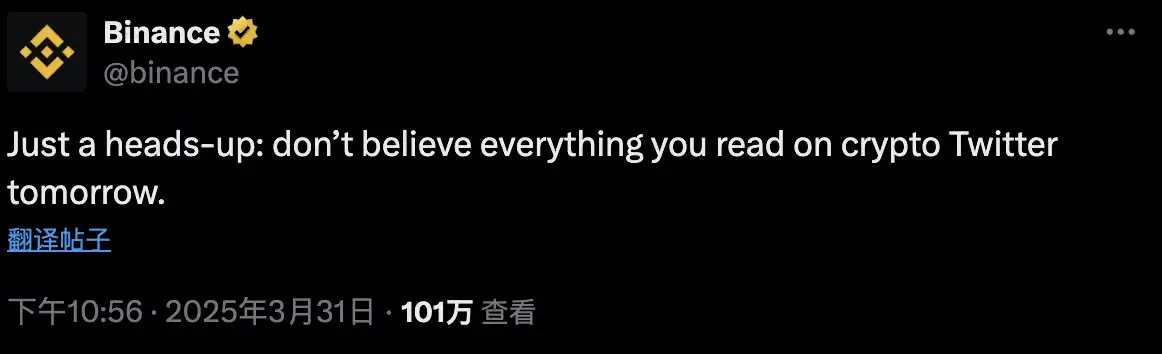
On April 1st, Binance had a rough April Fools' Day, and the market fell victim to a costly joke. First, $GUN was suspected by the community to be engaging in rug pulling or whale dumping, but this matter has yet to be conclusively resolved. Following one announcement, a more serious chain reaction crash occurred later that night. What kind of joke did Binance play on us this April Fools' Day?
Announcement Turmoil
Initial Announcement
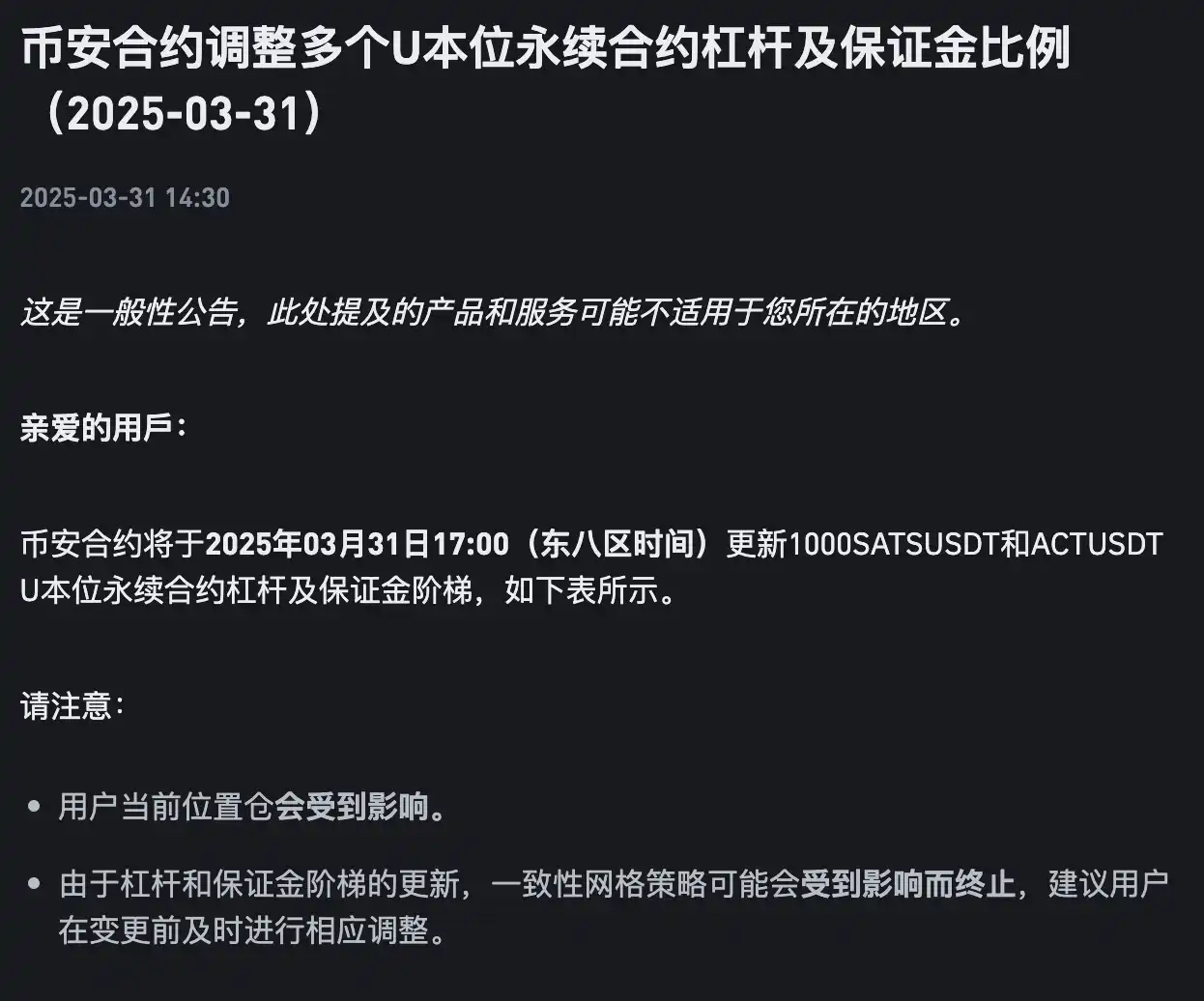
The genesis of this plummet can be traced back to an announcement made yesterday. On March 31st at 14:30, Binance released the announcement "Binance Futures will update 1000SATSUSDT and ACTUSDT U perpetual contract leverage and margin tier at 17:00 on the same day," warning users that their current position might be affected and that due to the leverage and margin tier update, the consistency grid strategy may be terminated. Users were advised to make necessary adjustments promptly before the change.
Subsequent Amendment Announcement
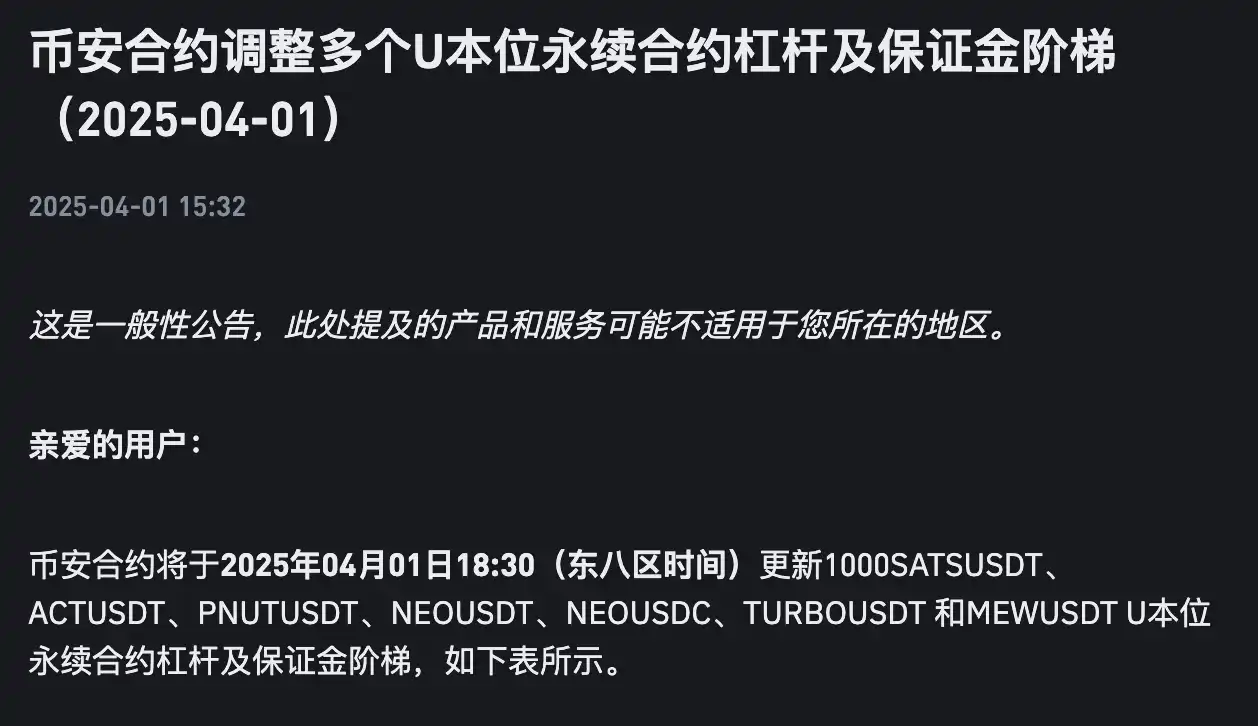
Just one day later, on April 1st at 15:32, Binance once again issued an announcement stating, "Binance Futures will update 1000SATSUSDT, ACTUSDT, PNUTUSDT, NEOUSDT, NEOUSDC, TURBOUSDT, and MEWUSDT U perpetual contract leverage and margin tier on April 1, 2025, at 18:30". This announcement not only further modified the previous day's newly updated $ACT position limit "by further reducing the lower leverage position limit by 50%," but also gave users less than a 3-hour reaction time.
Marketwide Meltdown
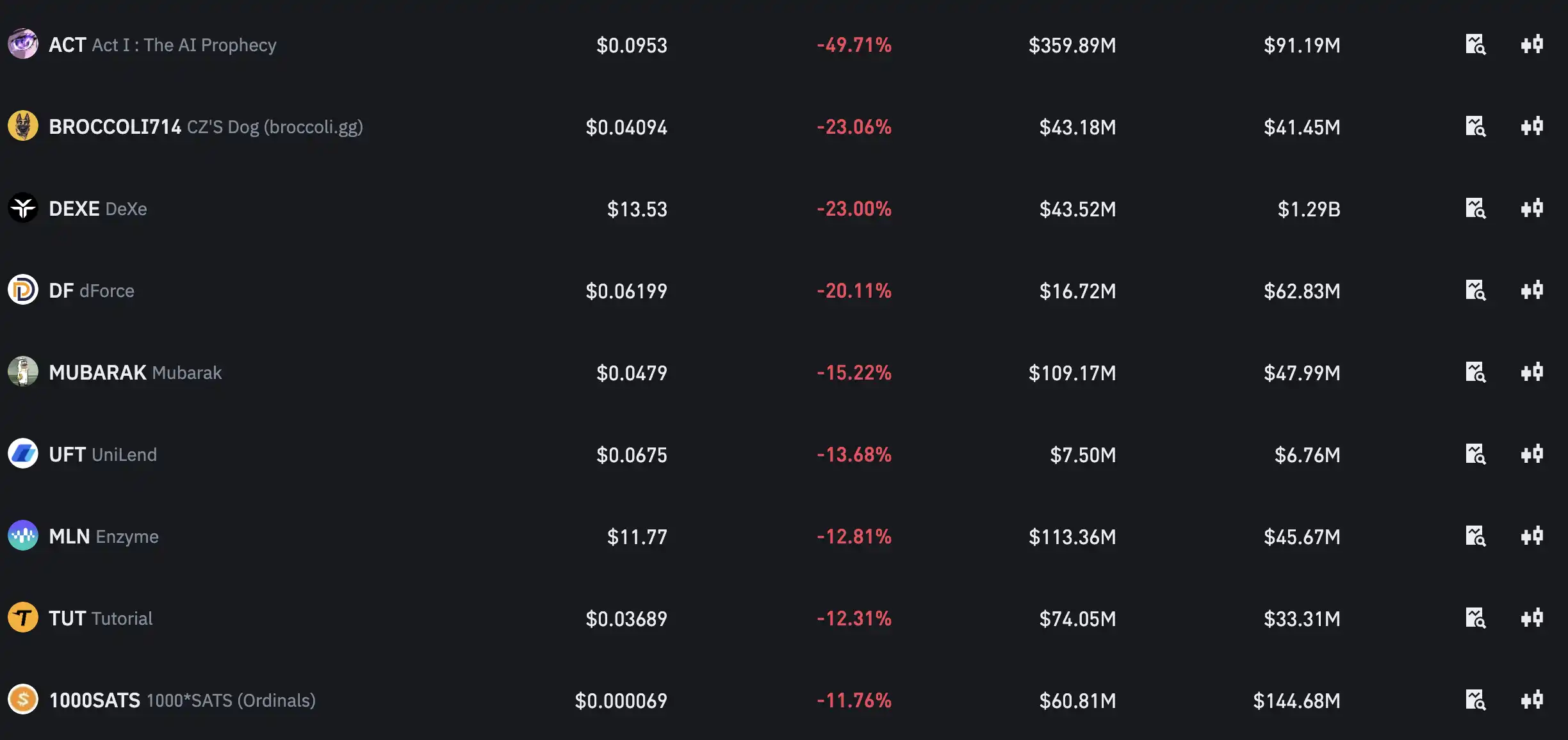
Several tokens such as ACT, DEXE, HIPPO, BANANAS31, TST, PNUT, and others experienced nearly simultaneous drops of up to 50%. Within a span of just 5 minutes from 18:30 to 18:35, the total value of ACT contract holdings on the Binance platform plummeted by 76.53%, dropping from $94.1286 million to $22.0932 million. This instantly ignited the community, clearly indicating that the impact of Binance's rule changes far exceeded everyone's expectations, leading to widespread speculation about the cause of the crash.
Liquidity Provider Suspicion
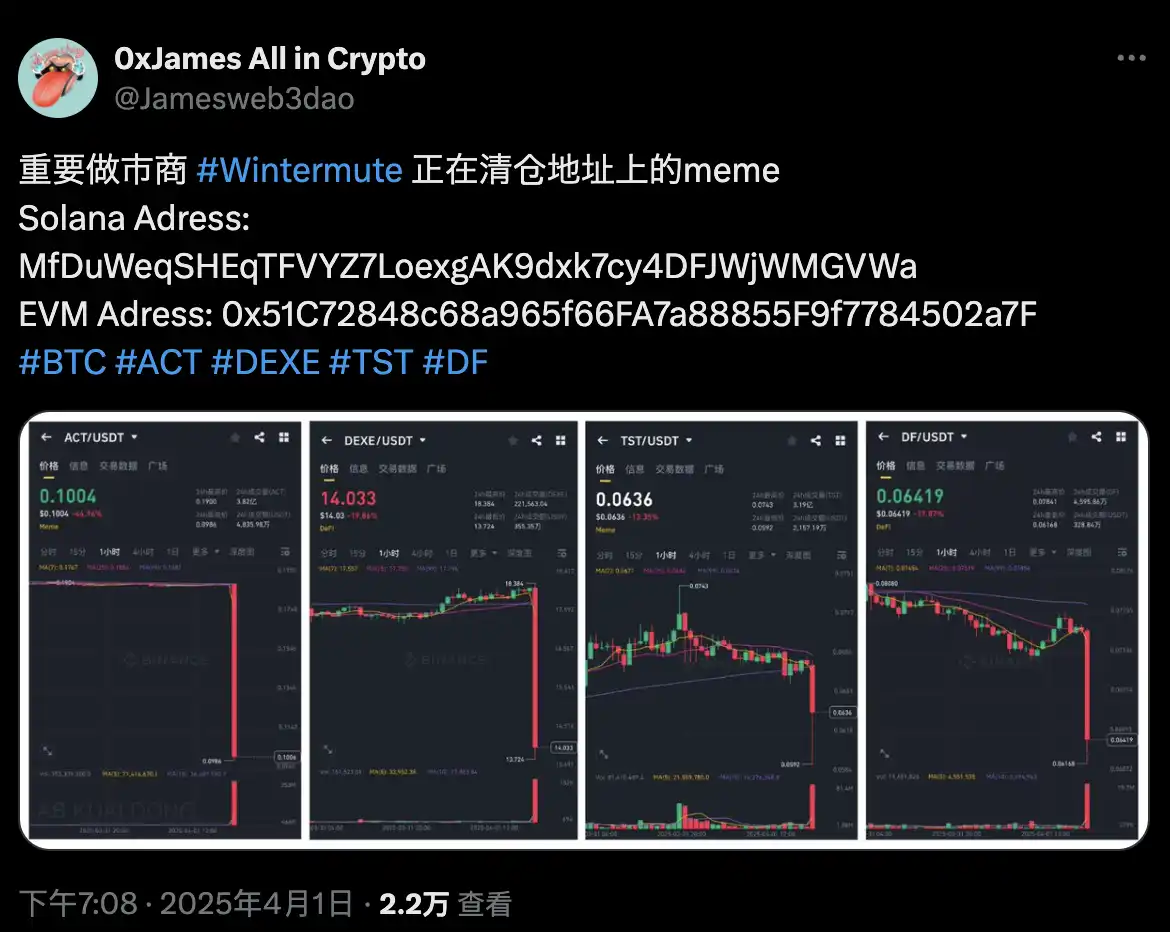
The first to be suspected was the liquidity provider, with WinterMute as the liquidity provider for the biggest loser $ACT and multiple MemeCoins thrust into the spotlight. Twitter KOL 0xJames observed addresses related to WinterMute were liquidating their Meme positions on-chain. Wintermute dumped approximately $250,000 worth of ACT tokens in half an hour through Raydium.
Liquidity Provider Clarification
However, some people, after analyzing the situation, don't believe this to be the case. A Web3 philosopher stated, "There is a clear time delay between CEX dumping and on-chain liquidation behavior. If WinterMute wanted to liquidate Meme, it would not align with the principle of maximizing profits."
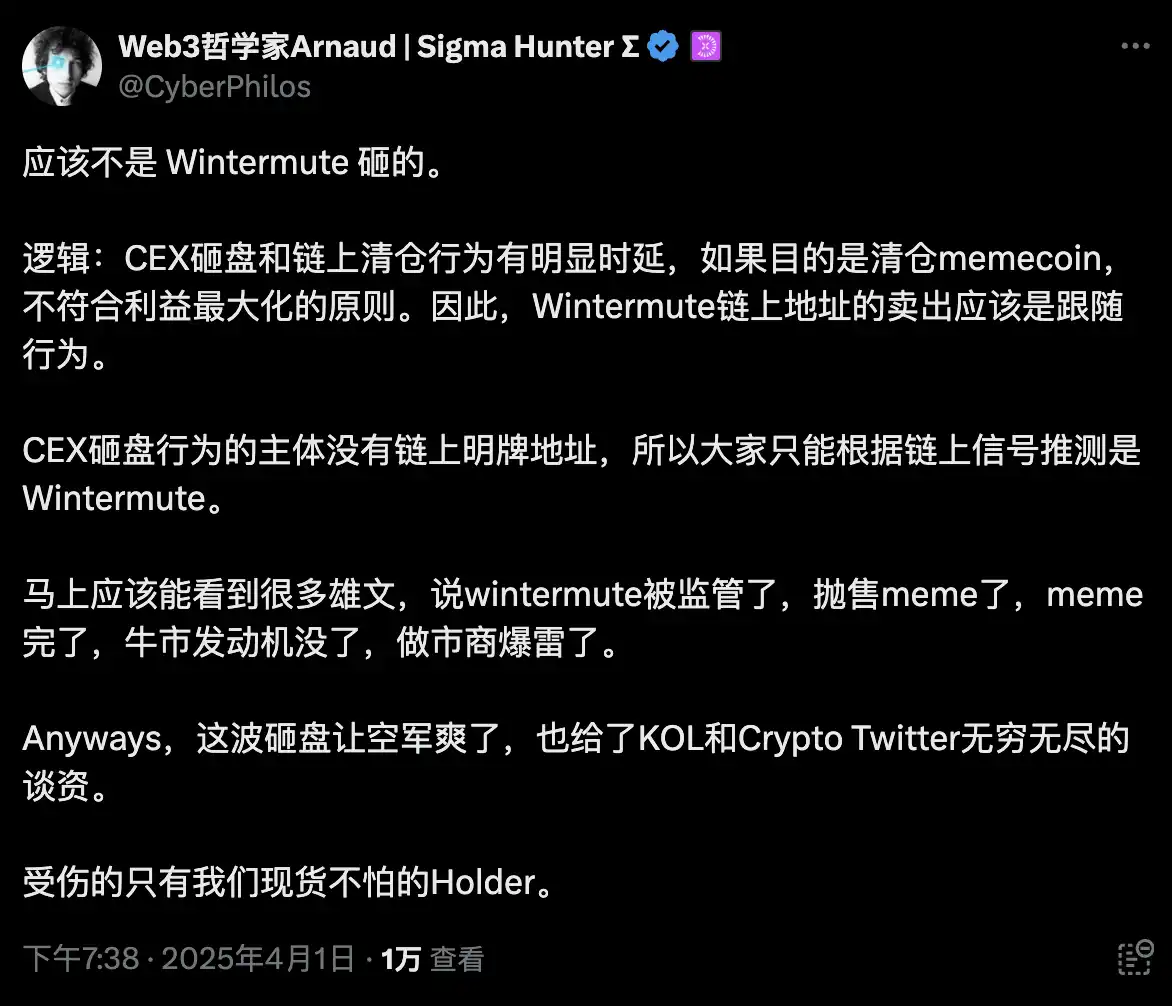
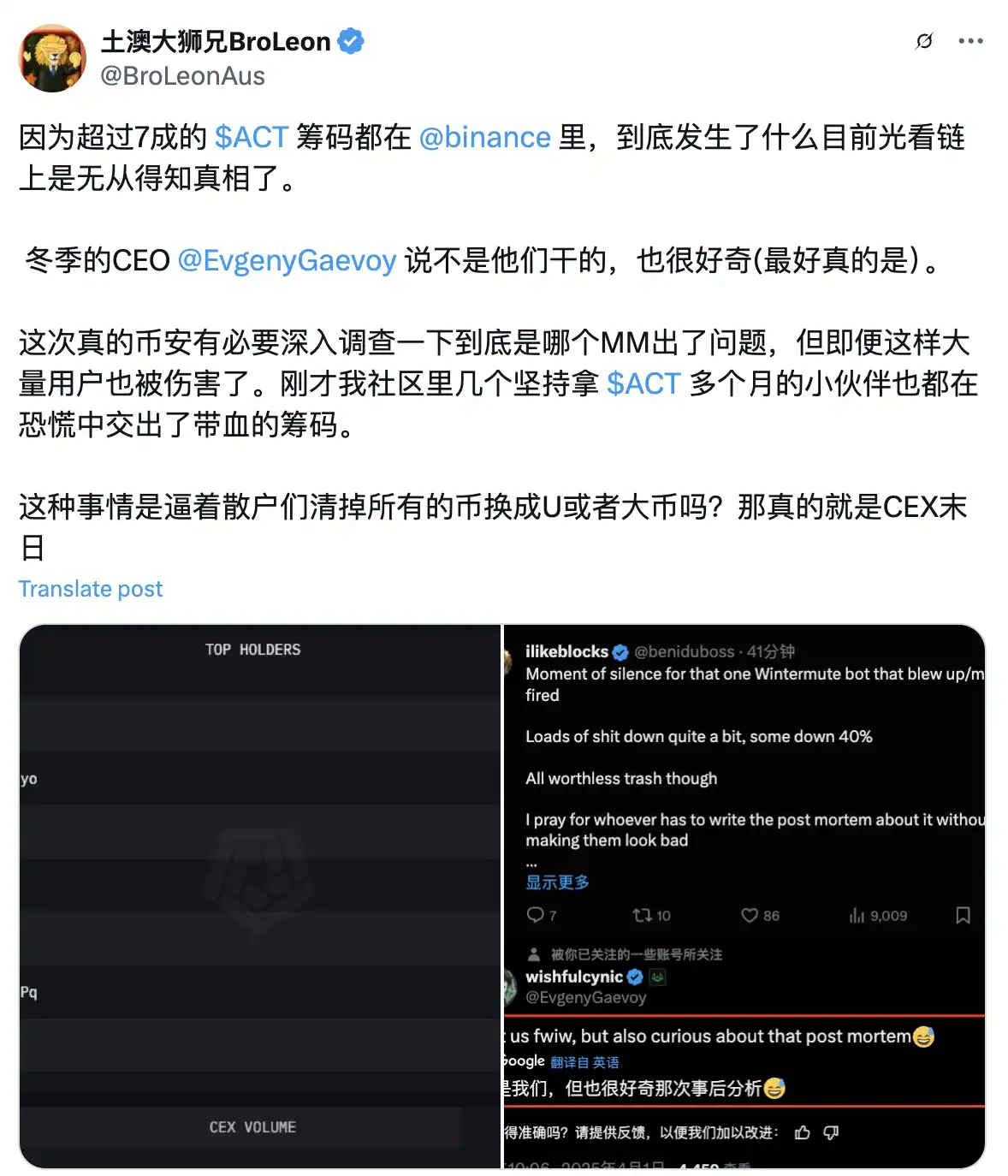
WinterMute's founder and CEO, Evgeny Gaevoy, later responded to a skeptic and left a remark saying, "It's not our thing, and we are also curious about the post-mortem analysis of what actually happened," indicating that the on-chain selling behavior was a reaction to drastic token price fluctuations and automated arbitrage in the AMM pool.

Australian lion BroLeon expressed skepticism towards Gaevoy's explanation, mentioning that 70% of $ACT chips are on exchanges, and the truth cannot be ascertained only from on-chain data. He hopes Binance can conduct a thorough investigation and provide a satisfactory answer; otherwise, it will have a highly negative impact on the market.
Binance Rule Change Factor
Of course, some also believe it was not a liquidity provider dumping but a change in Binance's rules. Firstly, the rule adjustment directly affected market liquidity. Binance adjusted the contract's position limit and leverage multiplier to reduce market risk. However, this had a significant impact on liquidity providers. The lowered position limit forced them to reduce their holdings, even leading to forced liquidation. The reduced leverage also compelled them to decrease leveraged positions. Liquidity providers typically hold spot and contract positions to hedge risks. If their holdings exceed the new limit or if funds are insufficient after leverage reduction, the system forcibly liquidates, selling in the contract market and reducing the contract price.
As the spot and contract price spreads continued to widen, coupled with arbitrage bots buying low in the contract market and selling high in the spot market, profiting from the narrowing spread, the bots sold extensively in the spot market, further depressing the spot price. As the liquidity providers were liquidated, causing the contract price to fall, coupled with arbitrage bots causing the spot price to drop, the overall market sentiment turned to panic, with retail investors following suit, leading to a chain reaction crash, resulting in a complete collapse of the Memecoin market.
Crypto KOL and former FTX Community Partner Benson Sun commented on this, saying, "Before Binance changes the rules, it should first assess how many positions will be liquidated. If the position of a market maker is large, they should also be notified in advance. As an industry leader, I hope Binance can handle this incident properly."
The Truth Remains a Mystery
After experiencing suspicions from the market regarding market makers, Binance rule mistakes, and even internal misconduct, KOL Zishi stated that none of this is related and only stated the facts. Meanwhile, He Yi commented with a sigh under this tweet, showing his helplessness.
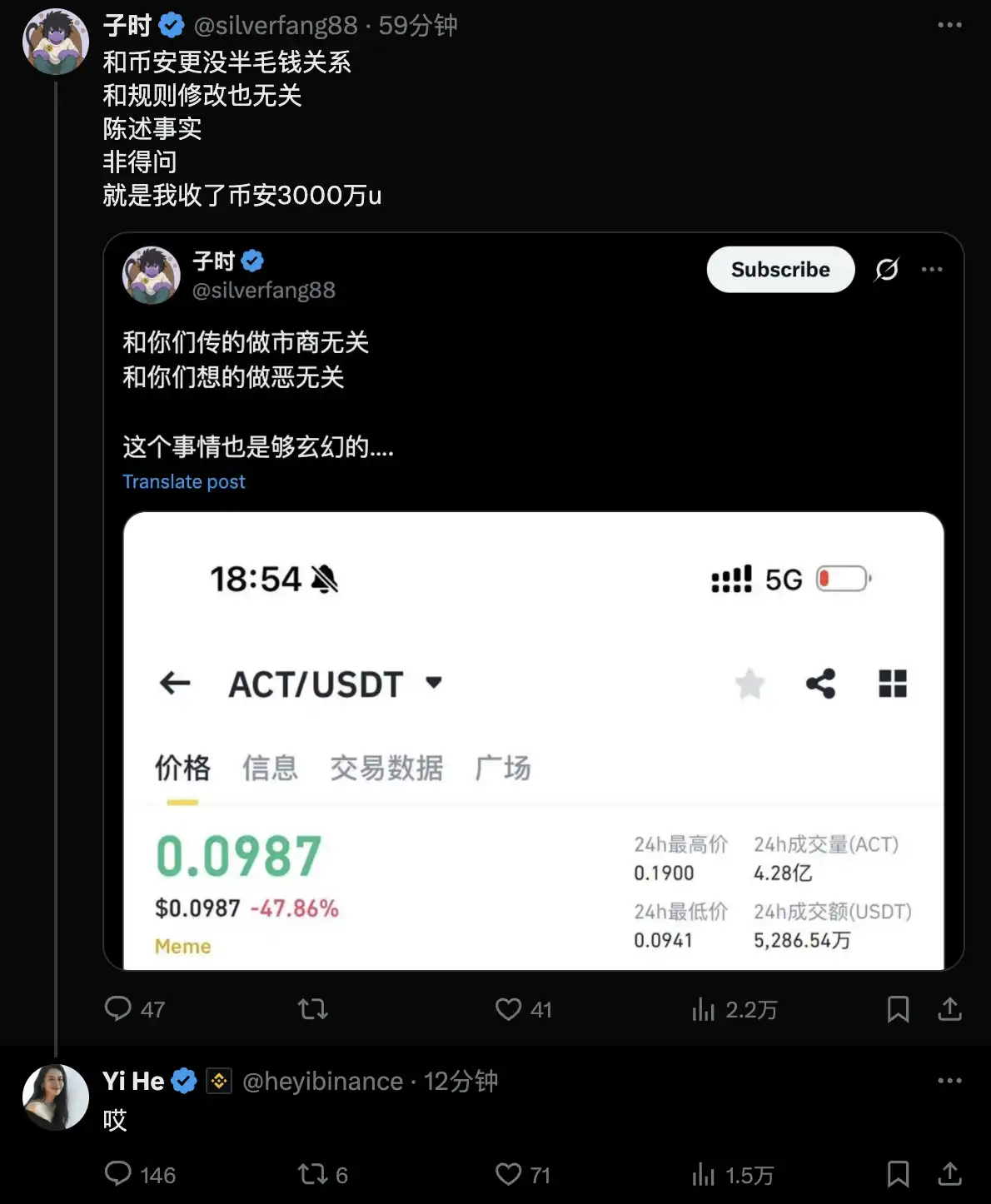
At the time of publication, He Yi tweeted that the corresponding team is preparing a detailed response, and it is still impossible to make a judgment at present. Recently, the beleaguered Binance has indeed encountered some issues that need to be addressed. BlockBeats will continue to follow this matter and report on it.
You may also like

Prediction Markets Under Bias

Stolen: $290 million, Three Parties Refusing to Acknowledge, Who Should Foot the Bill for the KelpDAO Incident Resolution?

ASTEROID Pumped 10,000x in Three Days, Is Meme Season Back on Ethereum?

ChainCatcher Hong Kong Themed Forum Highlights: Decoding the Growth Engine Under the Integration of Crypto Assets and Smart Economy

Why can this institution still grow by 150% when the scale of leading crypto VCs has shrunk significantly?

Anthropic's $1 trillion, compared to DeepSeek's $100 billion

Geopolitical Risk Persists, Is Bitcoin Becoming a Key Barometer?

Annualized 11.5%, Wall Street Buzzing: Is MicroStrategy's STRC Bitcoin's Savior or Destroyer?

An Obscure Open Source AI Tool Alerted on Kelp DAO's $292 million Bug 12 Days Ago

Mixin has launched USTD-margined perpetual contracts, bringing derivative trading into the chat scene.
The privacy-focused crypto wallet Mixin announced today the launch of its U-based perpetual contract (a derivative priced in USDT). Unlike traditional exchanges, Mixin has taken a new approach by "liberating" derivative trading from isolated matching engines and embedding it into the instant messaging environment.
Users can directly open positions within the app with leverage of up to 200x, while sharing positions, discussing strategies, and copy trading within private communities. Trading, social interaction, and asset management are integrated into the same interface.
Based on its non-custodial architecture, Mixin has eliminated friction from the traditional onboarding process, allowing users to participate in perpetual contract trading without identity verification.
The trading process has been streamlined into five steps:
· Choose the trading asset
· Select long or short
· Input position size and leverage
· Confirm order details
· Confirm and open the position
The interface provides real-time visualization of price, position, and profit and loss (PnL), allowing users to complete trades without switching between multiple modules.
Mixin has directly integrated social features into the derivative trading environment. Users can create private trading communities and interact around real-time positions:
· End-to-end encrypted private groups supporting up to 1024 members
· End-to-end encrypted voice communication
· One-click position sharing
· One-click trade copying
On the execution side, Mixin aggregates liquidity from multiple sources and accesses decentralized protocol and external market liquidity through a unified trading interface.
By combining social interaction with trade execution, Mixin enables users to collaborate, share, and execute trading strategies instantly within the same environment.
Mixin has also introduced a referral incentive system based on trading behavior:
· Users can join with an invite code
· Up to 60% of trading fees as referral rewards
· Incentive mechanism designed for long-term, sustainable earnings
This model aims to drive user-driven network expansion and organic growth.
Mixin's derivative transactions are built on top of its existing self-custody wallet infrastructure, with core features including:
· Separation of transaction account and asset storage
· User full control over assets
· Platform does not custody user funds
· Built-in privacy mechanisms to reduce data exposure
The system aims to strike a balance between transaction efficiency, asset security, and privacy protection.
Against the background of perpetual contracts becoming a mainstream trading tool, Mixin is exploring a different development direction by lowering barriers, enhancing social and privacy attributes.
The platform does not only view transactions as execution actions but positions them as a networked activity: transactions have social attributes, strategies can be shared, and relationships between individuals also become part of the financial system.
Mixin's design is based on a user-initiated, user-controlled model. The platform neither custodies assets nor executes transactions on behalf of users.
This model aligns with a statement issued by the U.S. Securities and Exchange Commission (SEC) on April 13, 2026, titled "Staff Statement on Whether Partial User Interface Used in Preparing Cryptocurrency Securities Transactions May Require Broker-Dealer Registration."
The statement indicates that, under the premise where transactions are entirely initiated and controlled by users, non-custodial service providers that offer neutral interfaces may not need to register as broker-dealers or exchanges.
Mixin is a decentralized, self-custodial privacy wallet designed to provide secure and efficient digital asset management services.
Its core capabilities include:
· Aggregation: integrating multi-chain assets and routing between different transaction paths to simplify user operations
· High liquidity access: connecting to various liquidity sources, including decentralized protocols and external markets
· Decentralization: achieving full user control over assets without relying on custodial intermediaries
· Privacy protection: safeguarding assets and data through MPC, CryptoNote, and end-to-end encrypted communication
Mixin has been in operation for over 8 years, supporting over 40 blockchains and more than 10,000 assets, with a global user base exceeding 10 million and an on-chain self-custodied asset scale of over $1 billion.

$600 million stolen in 20 days, ushering in the era of AI hackers in the crypto world
Vitalik's 2026 Hong Kong Web3 Summit Speech: Ethereum's Ultimate Vision as the "World Computer" and Future Roadmap
On the same day Aave introduced rsETH, why did Spark decide to exit?
Full Post-Mortem of the KelpDAO Incident: Why Did Aave, Which Was Not Compromised, End Up in Crisis Situation?

After a $290 million DeFi liquidation, is the security promise still there?
ZachXBT's post ignites RAVE nearing zero, what is the truth behind the insider control?

Vitalik 2026 Hong Kong Web3 Carnival Speech Transcript: We do not compete on speed; security and decentralization are the core





 App
App