
 Buy Crypto
- Markets
 Futures
- Spot
- Copy Trade
- Earn
- More
The Wisdom of Becoming a Money-Making KOL as Told by a 110K-Follower Influencer

Original Article Title: "Today's Morning Read -- Insights on Becoming a Money-Making KOL"
Original Article Author: Brother Leon from Down Under
Lately, the discussions on how to become a Key Opinion Leader (KOL) and how to land major deals have resurged. Along with this, the question of "Are there no noblemen in today's world?" arises. Many people quickly amass tens of thousands of followers, jump on a trend, and then proclaim themselves as KOLs ready to take on deals.
From my observations, I've noticed that many people haven't grasped some key points. Today, let's share some insights. If you aspire to become a true KOL in the crypto world, capable of landing sizable deals, then I suggest you pay close attention.

This full-content piece contains 2100 words and will take about 7 minutes to read. If you find it helpful, please consider saving, liking, and sharing it. This will motivate me to write the next piece in this series.
Lately, many people have asked me, "How can I make money as a KOL?"
What I want to say is: Genuine KOLs who earn big money are never those who initially set out to make money this way.
They simply have something to say, something to express, and then, unintentionally, they make money.
On the other hand, those who are focused on money from the start end up with nothing.
The abbreviation KOL stands for Key Opinion Leader, typically translated into Chinese as Key Opinion Leader.
So, although some now jokingly refer to crypto KOLs as being as common as dogs and the internet is full of pseudo-celebrities, in my opinion, strictly defined, many people are more suitable to be called "internet celebrities" rather than KOLs.
A KOL is not a joke re-poster, not a drama-stirring machine, not a provider of hot pics for fans; a KOL is someone who can consistently offer independent insights in a certain community and resonate with others.
Here's an example: @myhongkongdoll, a doll sister, falls into my categorization as a KOL. Although she is famous for distributing benefits to outsiders in the community, many of the opinions she shares on Twitter are ones I agree with and am influenced by.
Genuine money-making KOLs start with having "someone who listens to what you say and can take it in," and then move on to having "someone who pays for what you offer."
Influencer or KOL
Many people have a misconception, thinking that as long as they become popular, they will automatically become a major Key Opinion Leader (KOL) and should be able to land big brand deals. Therefore, in the recent past, there have been countless dramas, controversies, scandals, boundary-pushing behavior, public stunts, and chaotic situations on social media, with the belief that as long as a post generates traffic, they have succeeded.
In reality, I believe they have somewhat confused the Web2 "influencer economy" with the Web3 KOL economy. Does having a highly engaged post always guarantee receiving substantial brand deals? Not necessarily. While brand deals will surely come, legitimate projects that can make money may not always reach out.
The foundation of the Web2 influencer economy is that even an average person who becomes popular due to some random factor can effortlessly engage in live streaming and product endorsements. Since fans are always going to buy something, the prices across various channels are quite similar, making it interchangeable where they make their purchases.
The worst-case scenario for influencer product endorsements is promoting products with no quality, overpriced items, or unethical aspects. After all, physical goods are protected by national laws and regulations, so how much can you manipulate that?
However, Web3 is a different story. Over 95% of brand deals in this space are intended to scam, including rug pulls and malicious links. If you promote such products, your loyal followers may end up losing money, or even worse, losing everything.
I previously exposed a so-called "KOL" promoting a rug pull project, which rug pulled within a day, causing my community members to lose tens of thousands of dollars. When asked to compensate, he pitifully claimed to have only a few thousand dollars in his wallet and even sent me a screenshot, which was quite amusing.
In summary, if you are solely focused on accepting brand deals to create content, your output is prone to losing its essence. Over time, your content may become more generic, pandering, and ambiguous. Eventually, you will turn into an account with no stance, no uniqueness, and no pricing power.
So What's the Right Approach? Deep Dive
You should first ask yourself: In which field do I know slightly more than others? Just being slightly more knowledgeable than 95% of the people is adequate. Then, within this field, consistently voice out your opinions.
When your influence affects someone's decision-making, drives a narrative, or initiates a mini-trend, then you have already become a KOL.
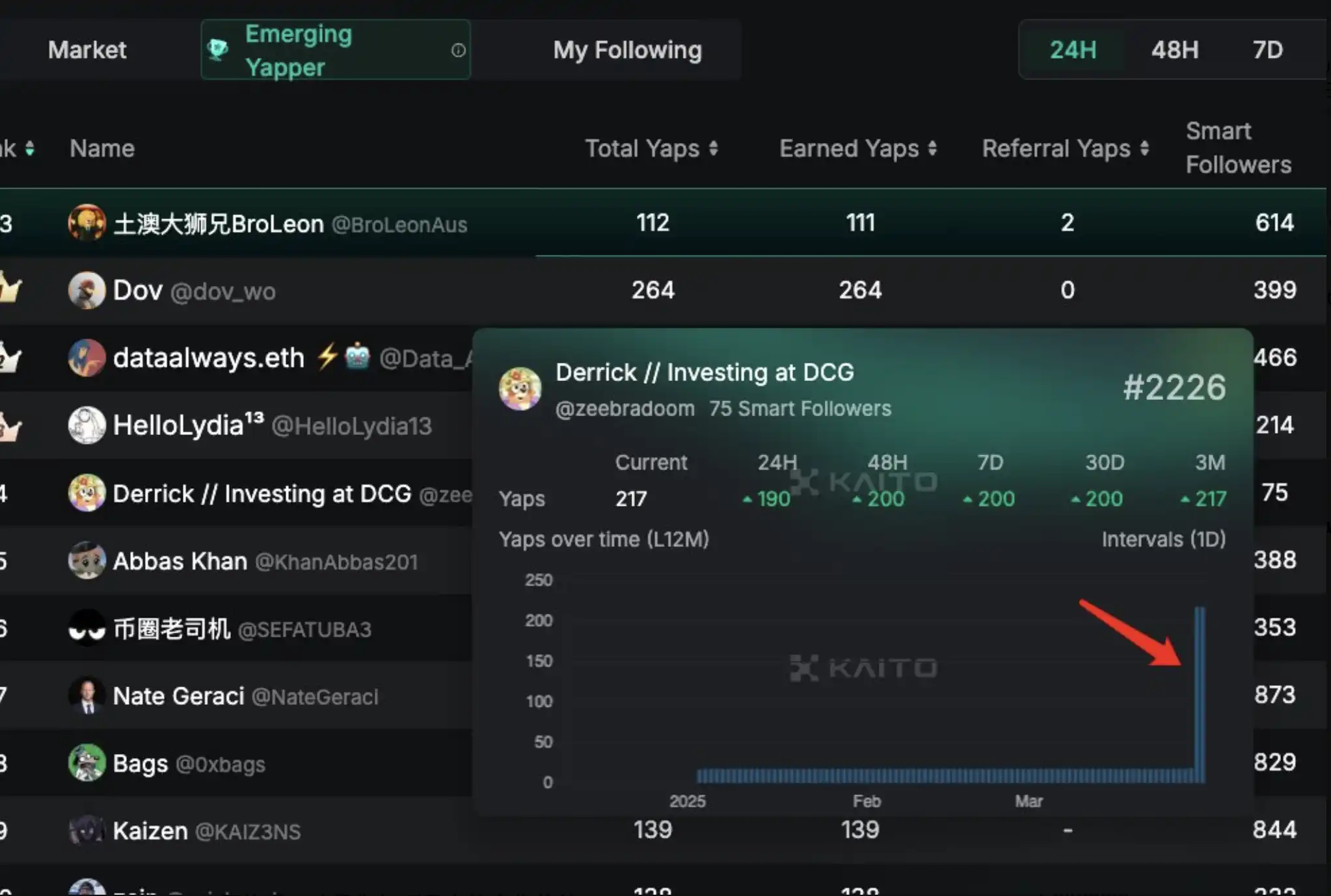
This is also why I have always appreciated @KaitoAI, as some small bloggers are genuinely discovered by emerging platforms and receive more exposure and recognition.
By filtering out the noise and helping many individuals discover valuable content from KOLs, platforms like this assist in highlighting the hidden gems. For instance, when a post with hardly any interactions suddenly skyrockets in engagement one day, it unquestionably contains valuable insights worth exploring.
Furthermore, the Value of Your Cooperation with the Project Team
A truly valuable KOL is someone who can help the project team achieve strategic goals at a certain stage.
For example, for some time, project teams have needed to boost engagement and do data-driven work to secure a slot on a top-tier CEX or to further fundraising. In such cases, you should be able to help them ignite attention and attract the spotlight of wool-pulling studios.
If what the project team needs is a post-listing price surge, then you should be able to maintain confidence, guide the narrative, and stimulate market buying interest.
KOL and the project team are fundamentally in a "symbiotic relationship of stages."
You need to understand what the project needs most at the moment and then ask yourself if you can truly deliver on that. If you can't, then don't take it. If you can, then you deserve the payment. Otherwise, most likely, you will be in a situation where you can't stomach it and ultimately damage your personal credibility.
Personal Brand Cultivation
There is something more crucial: is your personal brand clear? Is it trustworthy?
When others think of you, what comes to mind? Are you a deep researcher? An independent thinker? A comedian? A master of cryptocurrency biographies? An Alpha Hunter? Or are you full of copy-paste ad copies?
Your worth is determined by how trusted you are in others' minds, how many people trust you.
Proactively Choose Projects for Mutual Benefits
I have seen too many people whose timelines are filled with indiscriminate advertising posts without filtering or adjusting their messaging, and in the end, they don't even know who they are anymore. You are not an advertising platform; you are an information filter. You should choose projects, not let projects choose you.
I also receive many collaboration invitations every day. However, I turn down most of them. If a project cannot convince me to invest my own money, time, and confidence, I dare not advocate for it.
I cannot guarantee that every recommendation will be profitable, but I can guarantee - I have also invested. If it loses, my followers and I lose together; if it wins, we win together. This is my minimum commitment to mutual success.
I always believe that a good collaboration can allow me to:
• Receive fair compensation
• Enable the project team to achieve market exposure
• Provide my readers with real information and participation opportunities
This is the true win-win-win situation, and it is the sole meaning of why I do this. If we can't achieve a win-win-win, then it's better not to do it at all. Don't sacrifice your trust or damage your reputation for a small gain. Genuine personal influence is built through a series of choices, not by seeking exposure.
In conclusion:
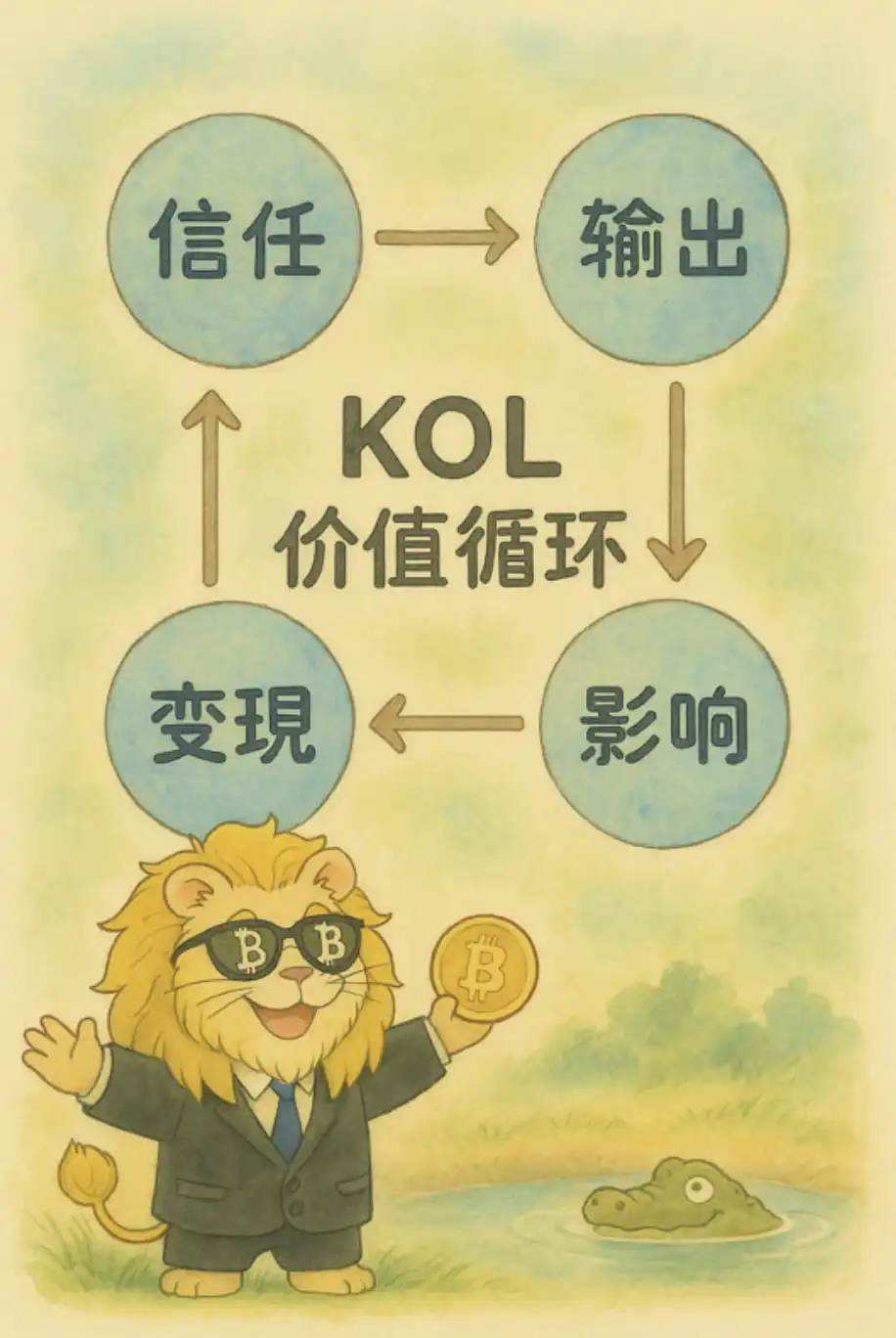
Influence is compound interest; trust is the moat.
The amount of money you ultimately earn does not depend on how many ads you post, but on how likely your ads are to help others make money and how many people are willing to trust you.
Trust's compound interest is what a KOL should embody.
This article is a contribution and does not represent the views of BlockBeats.
You may also like

Consumer-grade Crypto Global Survey: Users, Revenue, and Track Distribution

Prediction Markets Under Bias

Stolen: $290 million, Three Parties Refusing to Acknowledge, Who Should Foot the Bill for the KelpDAO Incident Resolution?

ASTEROID Pumped 10,000x in Three Days, Is Meme Season Back on Ethereum?

ChainCatcher Hong Kong Themed Forum Highlights: Decoding the Growth Engine Under the Integration of Crypto Assets and Smart Economy

Why can this institution still grow by 150% when the scale of leading crypto VCs has shrunk significantly?

Anthropic's $1 trillion, compared to DeepSeek's $100 billion

Geopolitical Risk Persists, Is Bitcoin Becoming a Key Barometer?

Annualized 11.5%, Wall Street Buzzing: Is MicroStrategy's STRC Bitcoin's Savior or Destroyer?

An Obscure Open Source AI Tool Alerted on Kelp DAO's $292 million Bug 12 Days Ago

Mixin has launched USTD-margined perpetual contracts, bringing derivative trading into the chat scene.
The privacy-focused crypto wallet Mixin announced today the launch of its U-based perpetual contract (a derivative priced in USDT). Unlike traditional exchanges, Mixin has taken a new approach by "liberating" derivative trading from isolated matching engines and embedding it into the instant messaging environment.
Users can directly open positions within the app with leverage of up to 200x, while sharing positions, discussing strategies, and copy trading within private communities. Trading, social interaction, and asset management are integrated into the same interface.
Based on its non-custodial architecture, Mixin has eliminated friction from the traditional onboarding process, allowing users to participate in perpetual contract trading without identity verification.
The trading process has been streamlined into five steps:
· Choose the trading asset
· Select long or short
· Input position size and leverage
· Confirm order details
· Confirm and open the position
The interface provides real-time visualization of price, position, and profit and loss (PnL), allowing users to complete trades without switching between multiple modules.
Mixin has directly integrated social features into the derivative trading environment. Users can create private trading communities and interact around real-time positions:
· End-to-end encrypted private groups supporting up to 1024 members
· End-to-end encrypted voice communication
· One-click position sharing
· One-click trade copying
On the execution side, Mixin aggregates liquidity from multiple sources and accesses decentralized protocol and external market liquidity through a unified trading interface.
By combining social interaction with trade execution, Mixin enables users to collaborate, share, and execute trading strategies instantly within the same environment.
Mixin has also introduced a referral incentive system based on trading behavior:
· Users can join with an invite code
· Up to 60% of trading fees as referral rewards
· Incentive mechanism designed for long-term, sustainable earnings
This model aims to drive user-driven network expansion and organic growth.
Mixin's derivative transactions are built on top of its existing self-custody wallet infrastructure, with core features including:
· Separation of transaction account and asset storage
· User full control over assets
· Platform does not custody user funds
· Built-in privacy mechanisms to reduce data exposure
The system aims to strike a balance between transaction efficiency, asset security, and privacy protection.
Against the background of perpetual contracts becoming a mainstream trading tool, Mixin is exploring a different development direction by lowering barriers, enhancing social and privacy attributes.
The platform does not only view transactions as execution actions but positions them as a networked activity: transactions have social attributes, strategies can be shared, and relationships between individuals also become part of the financial system.
Mixin's design is based on a user-initiated, user-controlled model. The platform neither custodies assets nor executes transactions on behalf of users.
This model aligns with a statement issued by the U.S. Securities and Exchange Commission (SEC) on April 13, 2026, titled "Staff Statement on Whether Partial User Interface Used in Preparing Cryptocurrency Securities Transactions May Require Broker-Dealer Registration."
The statement indicates that, under the premise where transactions are entirely initiated and controlled by users, non-custodial service providers that offer neutral interfaces may not need to register as broker-dealers or exchanges.
Mixin is a decentralized, self-custodial privacy wallet designed to provide secure and efficient digital asset management services.
Its core capabilities include:
· Aggregation: integrating multi-chain assets and routing between different transaction paths to simplify user operations
· High liquidity access: connecting to various liquidity sources, including decentralized protocols and external markets
· Decentralization: achieving full user control over assets without relying on custodial intermediaries
· Privacy protection: safeguarding assets and data through MPC, CryptoNote, and end-to-end encrypted communication
Mixin has been in operation for over 8 years, supporting over 40 blockchains and more than 10,000 assets, with a global user base exceeding 10 million and an on-chain self-custodied asset scale of over $1 billion.

$600 million stolen in 20 days, ushering in the era of AI hackers in the crypto world
Vitalik's 2026 Hong Kong Web3 Summit Speech: Ethereum's Ultimate Vision as the "World Computer" and Future Roadmap
On the same day Aave introduced rsETH, why did Spark decide to exit?
Full Post-Mortem of the KelpDAO Incident: Why Did Aave, Which Was Not Compromised, End Up in Crisis Situation?

After a $290 million DeFi liquidation, is the security promise still there?
ZachXBT's post ignites RAVE nearing zero, what is the truth behind the insider control?




 App
App