
 Buy Crypto
- Markets
 Futures
- Spot
- Copy Trade
- Earn
- More
When SEC Official Receives Bullet: Who Is Controlling $7.44 Billion Fund to Long Bitcoin?


Original Article Title: "When SEC Official Receives Bullet: Who is Manipulating $7.44 Billion to Long Bitcoin?"
Original Article Author: Lawrence, Mars Finance
On March 21, 2025, the atmosphere at the first Cryptocurrency Roundtable hosted by the U.S. Securities and Exchange Commission (SEC) was tense. When former SEC enforcement official John Reed Stark bluntly stated "Cryptocurrency investors have received death threats," the debate about "security characteristics" had evolved from a legal framework dispute to the ultimate game of survival in the cryptocurrency industry.
Simultaneously, a Bitcoin ETF with a single-week $7.44 billion inflow brought an end to a five-week bloodletting period, while Ethereum on-chain activity hit a historic low. This dual upheaval of regulation and the market is reshaping the power dynamics of the crypto world.
SEC's "War of Definition": Regulatory Schism Behind the Death Threat
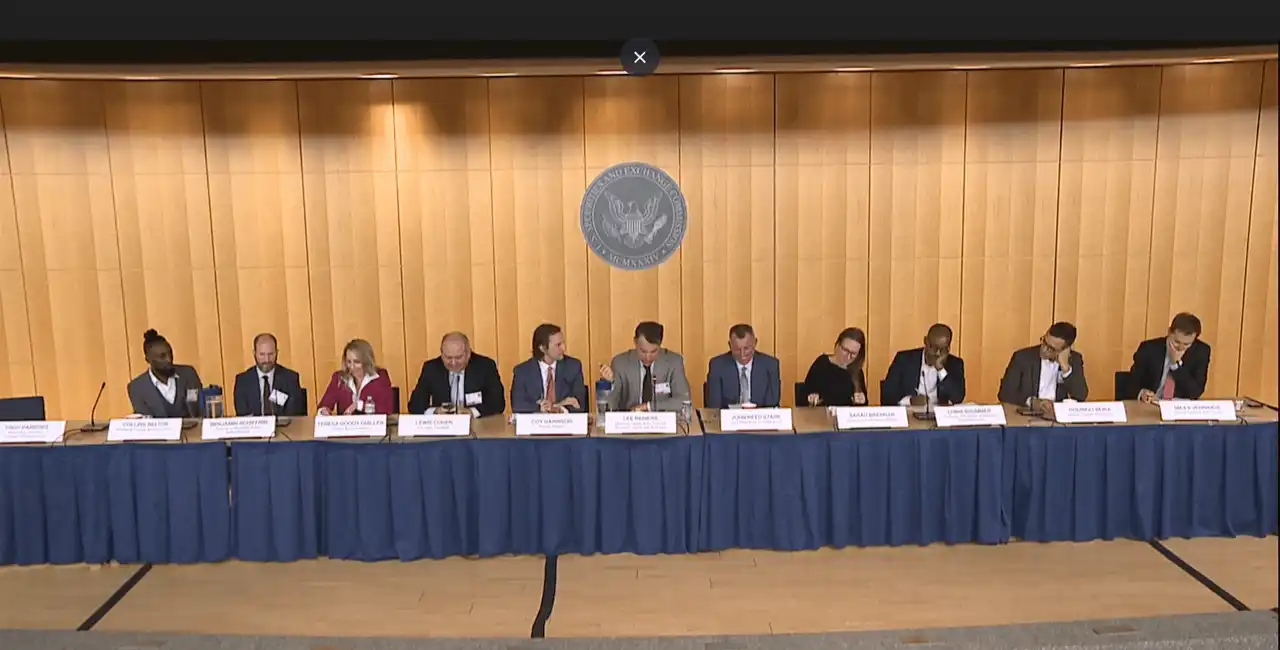
First SEC Cryptocurrency Roundtable Panel Members
On March 21, 2025, during the first Cryptocurrency Roundtable hosted by the U.S. Securities and Exchange Commission (SEC), former enforcement official John Reed Stark's speech was like a depth charge, detonating a decade-long regulatory guerrilla warfare in the crypto world – "Every time I publicly advocate for enhanced regulation, I receive death threats from cryptocurrency investors." This stark accusation not only exposed the bloody confrontation between regulators and the crypto community but also pushed a game of ultimate brinkmanship about "security characteristics" to a critical juncture.
The catalyst for this war had long been planted. Since the SEC's series of lawsuits against Coinbase and Binance in 2022, the confrontation between regulators and crypto companies escalated from the courtroom to the streets. Records from SEC Chairman Gary Gensler's office show that he personally received over 200 death threat emails from around the world between 2023 and 2024, with one anonymous letter from Australia even including a photo of a bullet and the words "Cryptocurrency freedom must not be tarnished."
Behind these extreme actions is the desperate resistance of crypto purists against the SEC's "comprehensive securitization" strategy – if 90% of tokens are brought under the securities regulatory framework, the survival space of decentralized finance (DeFi) will be entirely strangled.
However, the SEC's regulatory crackdown is not an isolated action. The Republican-led new SEC commission is attempting to reshape the power dynamics of the crypto world: the resignation of former Chairman Gary Gensler and the establishment of the Crypto Task Force signal that the Trump administration is dismantling the policy legacy of the Democratic era through "regulatory power redistribution."
New Acting Chairman Mark Uyeda revealed in a closed-door meeting that the SEC may open an exemption channel for NFTs and utility tokens through a "de-securitization statement," a policy shift that could disrupt the compliance cost structure of exchanges like Coinbase and Kraken.
The Howey Test is a legal test used to determine whether certain crypto assets are securities.
The essence of this definitional power struggle is the collision between the 1930s Howey Test and the Fourth Industrial Revolution. Teresa Goody Guillen, a partner at BakerHostetler, sharply pointed out at a roundtable meeting: "As distributed ledger technology (DLT) reconstructs the global business landscape, the SEC is trying to use an 'investment contract' as a rusty key to unlock the regulatory blockchain of the digital age." This contradiction is particularly evident in the NFT field—while the SEC tacitly acknowledges the non-securities nature of top projects like BAYC and CryptoPunks, it has launched a series of lawsuits against social tokens and fan economy NFTs, exposing the fragmentation and opportunism of regulatory logic.
The "Ice and Fire Reversal" of Bitcoin ETF: $744 Million Weekly Inflow Holds Hidden Secrets
While regulators are mired in a quagmire of definitional power, capital is rewriting the market narrative in cold hard cash.
March 17-21, the U.S. Bitcoin ETF ended five consecutive weeks of outflows with a $744 million weekly net inflow, with BNY Mellon IBIT attracting $105 million in a single day, surpassing a total net inflow of $36 billion.
Behind this round of "institutional buying the dip," a secretive arbitrage game is unfolding: the Chicago Mercantile Exchange (CME) Bitcoin futures premium has continued to narrow to below 2%, erasing the arbitrage space between spot ETFs and futures contracts, with nearly 40% of inflows confirmed to be unrelated to "real demand."
Of particular concern is the divergence in market consensus. While the Bitcoin price has been ranging between $83,000 and $85,500, on-chain data tells a completely different story: Glassnode has detected that Long-Term Holders (LTH) have accumulated an additional 250,000 BTC over the past 45 days, amounting to around $21 billion, while the Bitcoin reserves on centralized exchanges have dropped to the lowest level since 2021. This "institutional accumulation" versus "retail exodus" deviation implies that the market is gearing up for a new round of volatility.
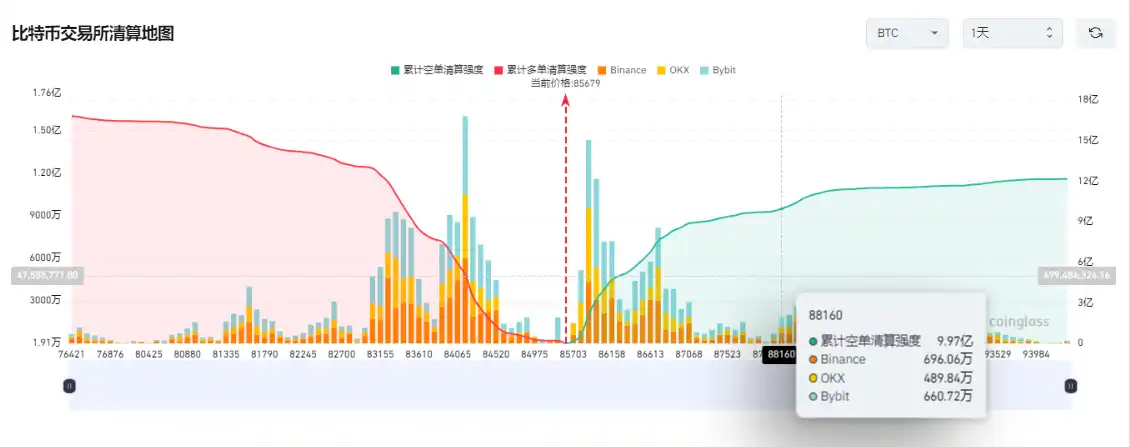
According to Coinglass liquidation data, if the Bitcoin price breaks above $88,000, it is estimated that short positions worth $1 billion will be liquidated.
The "Darkest Hour" of Ethereum: Ecosystem Collapse Behind Layer2 Boom
While Bitcoin ETFs regain favor with capital, the Ethereum ecosystem is undergoing an unprecedented winter.
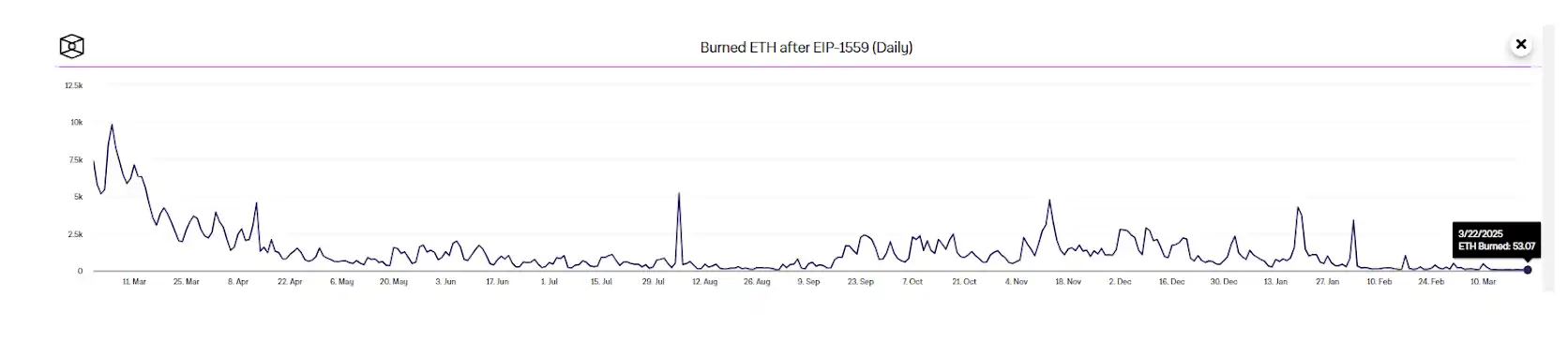
The Block data shows that on March 22, Ethereum's daily burn rate plummeted to 53.07 ETH (about $10.6 thousand), a 99% drop from the 2024 peak, with on-chain transaction volume, active addresses, and Gas fees simultaneously hitting historic lows.
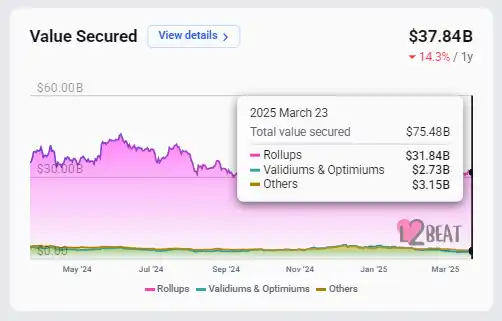
Meanwhile, the total value locked (TVL) on Layer2 has surged to $37.8 billion, yet leading networks like Base, Arbitrum account for 80% of DEX trading volume—this "hollowing out of the mainnet" juxtaposed with "Layer2 hegemony" exposes a fundamental flaw in the Ethereum economic model.
Standard Chartered Bank's forecast has deepened market concerns. The institution halved its Ethereum price target for 2025 from $10,000 to $4,000, pointing directly to the "siphoning effect" of Layer2 on the mainnet's value: "Base and other Layer2 solutions capture 80% of the ecosystem's value appreciation but only contribute less than 20% of the mainnet's fee revenue back." This unsustainable revenue-sharing mechanism has driven the ETH/BTC exchange rate to a historic low of 0.023, even below the performance of competitive public chains like Solana.
A more far-reaching impact comes from regulatory pressure. The SEC, in its "Meme Coin Statement," established a safe harbor for assets like Dogecoin but remained silent on Ethereum and Layer2 tokens.
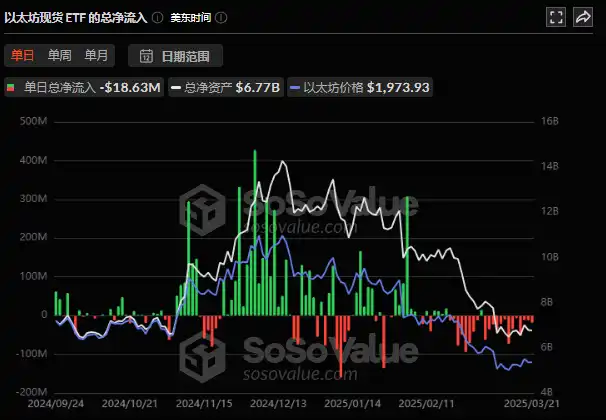
This uncertainty has forced Grayscale's ETHE and other funds to experience weekly outflows of $102 million, totaling over $730 million in outflows over 4 weeks, shaking the foundation of Ethereum as an "institutional asset."
The Road to Disruption: Regulatory Arbitrage, Technological Revolution, and Sovereignty Games
Amid this multi-layered crisis, three variables will determine the ultimate trajectory of the crypto market:
1. The End and Reconstruction of Regulatory Arbitrage
The SEC's crackdown on "security tokenization" has expanded from exchanges to Layer 2 protocols. In March 2025, Coinbase announced the acquisition of the Deribit exchange and its takeover of a Dubai license, signaling that U.S. firms are circumventing regulatory risks through offshore structures. However, the simultaneous push by the Trump administration of the "Stablecoin Act" shows that sovereign nations will not tolerate regulatory vacuums. The bill requires stablecoin issuers to hold a 1:1 cash reserve and prohibits tech companies from entering this field. This "precision strike" could reshape the $120 billion stablecoin market.
2. The Paradox and Breakthrough of Technological Revolution
The 153rd delay of the Prague upgrade by Ethereum developers exposed the weakness of technical iterations. In contrast, the Bitcoin ecosystem saw an explosion: the Ordinals protocol propelled on-chain NFT transactions to exceed $1 billion, and the Rune protocol led to a 300% monthly growth in BTCFi locked-up volume. As "Bitcoin programmability" moves from concept to reality, this "ancient blockchain's" self-revolution may disrupt the survival logic of the "Ethereum killers."
3. The Rise and Game of Sovereign Digital Assets
Putin's declaration that "no one can ban Bitcoin" resonates with Trump's crypto-friendly policies. Russia plans to build a compliant Bitcoin trading system on the Moscow Exchange (MOEX), and India's pilot of the Digital Rupee has attracted 15% of offshore crypto funds back — this "sovereign digitization race" is eroding the dominance of the US dollar stablecoins and may give rise to a new geopolitical financial order.
Conclusion: Seeking Certainty in Order Restructuring
In the crypto world of 2025, we stand at the fault line of the collision between traditional finance and decentralized ideals. The SEC's regulatory games, the institutional narrative of Bitcoin ETFs, and Ethereum's ecological dilemma together outline an industry landscape filled with tension. As the threat of death collides with trillions in capital on the same battlefield, as the 89-year-old Howey test encounters the Fourth Industrial Revolution, this transformation has long surpassed the technological realm and become an epic experiment in reshaping the human value exchange system.
You may also like

Morning News | The Hong Kong Securities and Futures Commission announced the regulatory framework for secondary market trading of tokenized investment products; Strategy increased its holdings by 34,164 bitcoins last week; KAIO completed a strategic fi...

What Is an XRP Wallet? The Best Wallets to Store XRP (2026 Updated)
An XRP wallet lets you safely store, send, and receive XRP on the XRP Ledger. Learn what wallets support XRP and discover the best XRP wallets for beginners and long-term holders in 2026.

What are the Top AI Crypto Coins? Render vs. Akash: 5 Gems Solving the 2026 GPU Crisis
What are the best AI crypto coins for the 2026 cycle? Beyond the hype, we analyze top tokens like RNDR, AKT, and FET that provide real-world solutions to the global GPU shortage and the rise of autonomous agents.

What Is a Token in AI? What Is an AI Token + 3 Gems You Can't Miss in 2026
The era of AI hype has transitioned into an era of utility. As we move through Q2 2026, the market is no longer rewarding "narrative-only" projects. At WEEX Research, we are seeing a massive capital rotation into Decentralized Compute (DePIN) and Autonomous Agent coordination layers. This guide analyzes which AI tokens are capturing institutional liquidity and how to spot high-conviction setups in a maturing market.

Consumer-grade Crypto Global Survey: Users, Revenue, and Track Distribution

Prediction Markets Under Bias

Stolen: $290 million, Three Parties Refusing to Acknowledge, Who Should Foot the Bill for the KelpDAO Incident Resolution?

ASTEROID Pumped 10,000x in Three Days, Is Meme Season Back on Ethereum?

ChainCatcher Hong Kong Themed Forum Highlights: Decoding the Growth Engine Under the Integration of Crypto Assets and Smart Economy

Why can this institution still grow by 150% when the scale of leading crypto VCs has shrunk significantly?

Anthropic's $1 trillion, compared to DeepSeek's $100 billion

Geopolitical Risk Persists, Is Bitcoin Becoming a Key Barometer?

Annualized 11.5%, Wall Street Buzzing: Is MicroStrategy's STRC Bitcoin's Savior or Destroyer?
An Obscure Open Source AI Tool Alerted on Kelp DAO's $292 million Bug 12 Days Ago

Mixin has launched USTD-margined perpetual contracts, bringing derivative trading into the chat scene.
The privacy-focused crypto wallet Mixin announced today the launch of its U-based perpetual contract (a derivative priced in USDT). Unlike traditional exchanges, Mixin has taken a new approach by "liberating" derivative trading from isolated matching engines and embedding it into the instant messaging environment.
Users can directly open positions within the app with leverage of up to 200x, while sharing positions, discussing strategies, and copy trading within private communities. Trading, social interaction, and asset management are integrated into the same interface.
Based on its non-custodial architecture, Mixin has eliminated friction from the traditional onboarding process, allowing users to participate in perpetual contract trading without identity verification.
The trading process has been streamlined into five steps:
· Choose the trading asset
· Select long or short
· Input position size and leverage
· Confirm order details
· Confirm and open the position
The interface provides real-time visualization of price, position, and profit and loss (PnL), allowing users to complete trades without switching between multiple modules.
Mixin has directly integrated social features into the derivative trading environment. Users can create private trading communities and interact around real-time positions:
· End-to-end encrypted private groups supporting up to 1024 members
· End-to-end encrypted voice communication
· One-click position sharing
· One-click trade copying
On the execution side, Mixin aggregates liquidity from multiple sources and accesses decentralized protocol and external market liquidity through a unified trading interface.
By combining social interaction with trade execution, Mixin enables users to collaborate, share, and execute trading strategies instantly within the same environment.
Mixin has also introduced a referral incentive system based on trading behavior:
· Users can join with an invite code
· Up to 60% of trading fees as referral rewards
· Incentive mechanism designed for long-term, sustainable earnings
This model aims to drive user-driven network expansion and organic growth.
Mixin's derivative transactions are built on top of its existing self-custody wallet infrastructure, with core features including:
· Separation of transaction account and asset storage
· User full control over assets
· Platform does not custody user funds
· Built-in privacy mechanisms to reduce data exposure
The system aims to strike a balance between transaction efficiency, asset security, and privacy protection.
Against the background of perpetual contracts becoming a mainstream trading tool, Mixin is exploring a different development direction by lowering barriers, enhancing social and privacy attributes.
The platform does not only view transactions as execution actions but positions them as a networked activity: transactions have social attributes, strategies can be shared, and relationships between individuals also become part of the financial system.
Mixin's design is based on a user-initiated, user-controlled model. The platform neither custodies assets nor executes transactions on behalf of users.
This model aligns with a statement issued by the U.S. Securities and Exchange Commission (SEC) on April 13, 2026, titled "Staff Statement on Whether Partial User Interface Used in Preparing Cryptocurrency Securities Transactions May Require Broker-Dealer Registration."
The statement indicates that, under the premise where transactions are entirely initiated and controlled by users, non-custodial service providers that offer neutral interfaces may not need to register as broker-dealers or exchanges.
Mixin is a decentralized, self-custodial privacy wallet designed to provide secure and efficient digital asset management services.
Its core capabilities include:
· Aggregation: integrating multi-chain assets and routing between different transaction paths to simplify user operations
· High liquidity access: connecting to various liquidity sources, including decentralized protocols and external markets
· Decentralization: achieving full user control over assets without relying on custodial intermediaries
· Privacy protection: safeguarding assets and data through MPC, CryptoNote, and end-to-end encrypted communication
Mixin has been in operation for over 8 years, supporting over 40 blockchains and more than 10,000 assets, with a global user base exceeding 10 million and an on-chain self-custodied asset scale of over $1 billion.

$600 million stolen in 20 days, ushering in the era of AI hackers in the crypto world
Vitalik's 2026 Hong Kong Web3 Summit Speech: Ethereum's Ultimate Vision as the "World Computer" and Future Roadmap
On the same day Aave introduced rsETH, why did Spark decide to exit?
Morning News | The Hong Kong Securities and Futures Commission announced the regulatory framework for secondary market trading of tokenized investment products; Strategy increased its holdings by 34,164 bitcoins last week; KAIO completed a strategic fi...
What Is an XRP Wallet? The Best Wallets to Store XRP (2026 Updated)
An XRP wallet lets you safely store, send, and receive XRP on the XRP Ledger. Learn what wallets support XRP and discover the best XRP wallets for beginners and long-term holders in 2026.
What are the Top AI Crypto Coins? Render vs. Akash: 5 Gems Solving the 2026 GPU Crisis
What are the best AI crypto coins for the 2026 cycle? Beyond the hype, we analyze top tokens like RNDR, AKT, and FET that provide real-world solutions to the global GPU shortage and the rise of autonomous agents.
What Is a Token in AI? What Is an AI Token + 3 Gems You Can't Miss in 2026
The era of AI hype has transitioned into an era of utility. As we move through Q2 2026, the market is no longer rewarding "narrative-only" projects. At WEEX Research, we are seeing a massive capital rotation into Decentralized Compute (DePIN) and Autonomous Agent coordination layers. This guide analyzes which AI tokens are capturing institutional liquidity and how to spot high-conviction setups in a maturing market.



 App
App