
 Buy Crypto
- Markets
 Futures
- Spot
- Copy Trade
- Earn
- More
Who Ate Hyperliquid's Cake: The Perp DEX Hunted by CEX

Original Article Title: The perverse incentives of building in crypto: Hyperliquid and CEXs
Original Article Author: VannaCharmer, Crypto Researcher
Original Article Translation: DysonTide Deep
Editor's Note: The article analyzes the challenges faced by DeFi, especially perp DEX, in its development, pointing out that CEXs, driven by economic incentives, suppress successful on-chain products like Hyperliquid through market manipulation, blackboxing, and public opinion warfare. The article dissects the economic ambush case faced by Hyperliquid and discusses its response strategies, such as decentralized validator nodes and risk parameter optimization. Finally, the author expresses approval of the Hyperliquid team's future vision of achieving full financial on-chainization, believing that founder Jeff's perseverance and ability will drive industry progress.
The following is the original article content (slightly reorganized for better readability and comprehension):
Entrepreneurship in the crypto field is fraught with difficulties. This is not only due to the numerous technical challenges but also because when you create a successful product, various interest groups are economically incentivized to become your adversaries. This article aims to expose the systemic flaws of the public development model and how CEXs disrupt DeFi through economic motivations, especially the development of perpetual contract decentralized exchanges (perp DEX).
Industry Background Insight
Over the years, CEXs, along with law firms, market makers, and AWS cloud services, have collectively formed the most powerful "money-printing machine" in the crypto world—raking in billions of dollars through high fees, off-book transactions (token listings), and other gray-area operations. They have too many vested interests to maintain: some directly exploit retail funds flow, and all CEXs have ambiguous cooperation with market makers. Why else would each of them have a "market maker program"? Just look at how FTX engages in self-trading through Alameda or how Coinbase suppresses Solana to promote its Layer2 network, Base. Economic interests dictate that CEXs cannot act in goodwill.
In fact, CEXs have engaged in even more nefarious off-chain blackboxing, but the public is unaware of it. The allure of the crypto world lies precisely in the fact that all games are played openly and transparently. However, public development is a double-edged sword: others may exploit product vulnerabilities for profit. As long as you are not completely destroyed, you will become stronger—think of Solana's multiple downtime events.
Do you think the process of full financial on-chainization will be smooth sailing?

Core Contradiction Analysis
Now, let's put ourselves in the shoes of a CEX. When you see a team like Hyperliquid:
· Iterating to develop excellent on-chain products based on user feedback
· Building the most outstanding on-chain trading venue
· Completing last year's most significant wealth creation event and having a large amount of organic KOL-driven promotion
Undeniably, Hyperliquid has built an extremely successful product, with its market share severely encroaching on the territory of top CEXs.
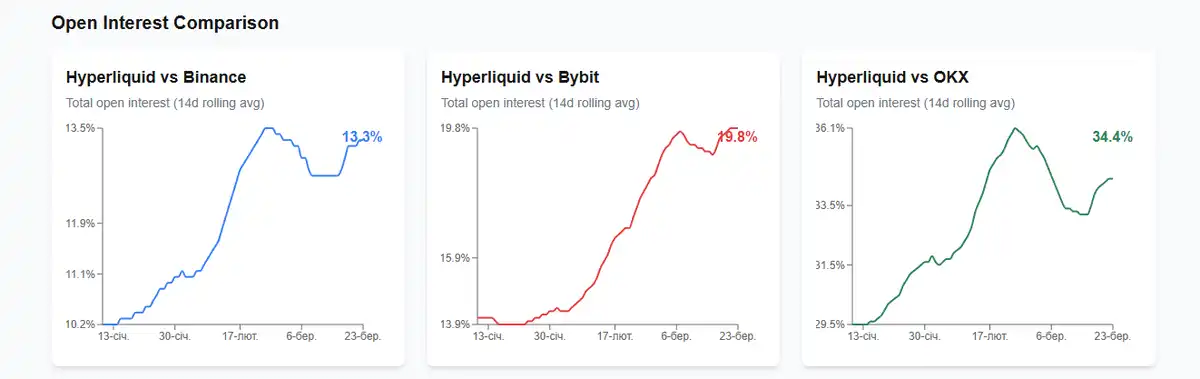
CEX Motivation Breakdown
Profit Incentive
As a CEX, you are completely excluded from Hyperliquid's profit ecosystem — not only are they eating away at your market share, but they also refuse to pay listing fees. Faced with this unconventional and continuously customer-poaching competitor, would you just sit back and do nothing? Clearly not. Thus, we see the current situation: the CEX has launched a clever sniper attack that benefits itself (while harming ordinary investors). Event recap:
· Wallet 0xde9 funded by Binance/OKEx established a massive short position equivalent to 40% of HL's circulating supply
This intentional liquidation transferred JELLY shorts to wallet 0xde9 of HLP while receiving dual funding support from Binance and OKEx
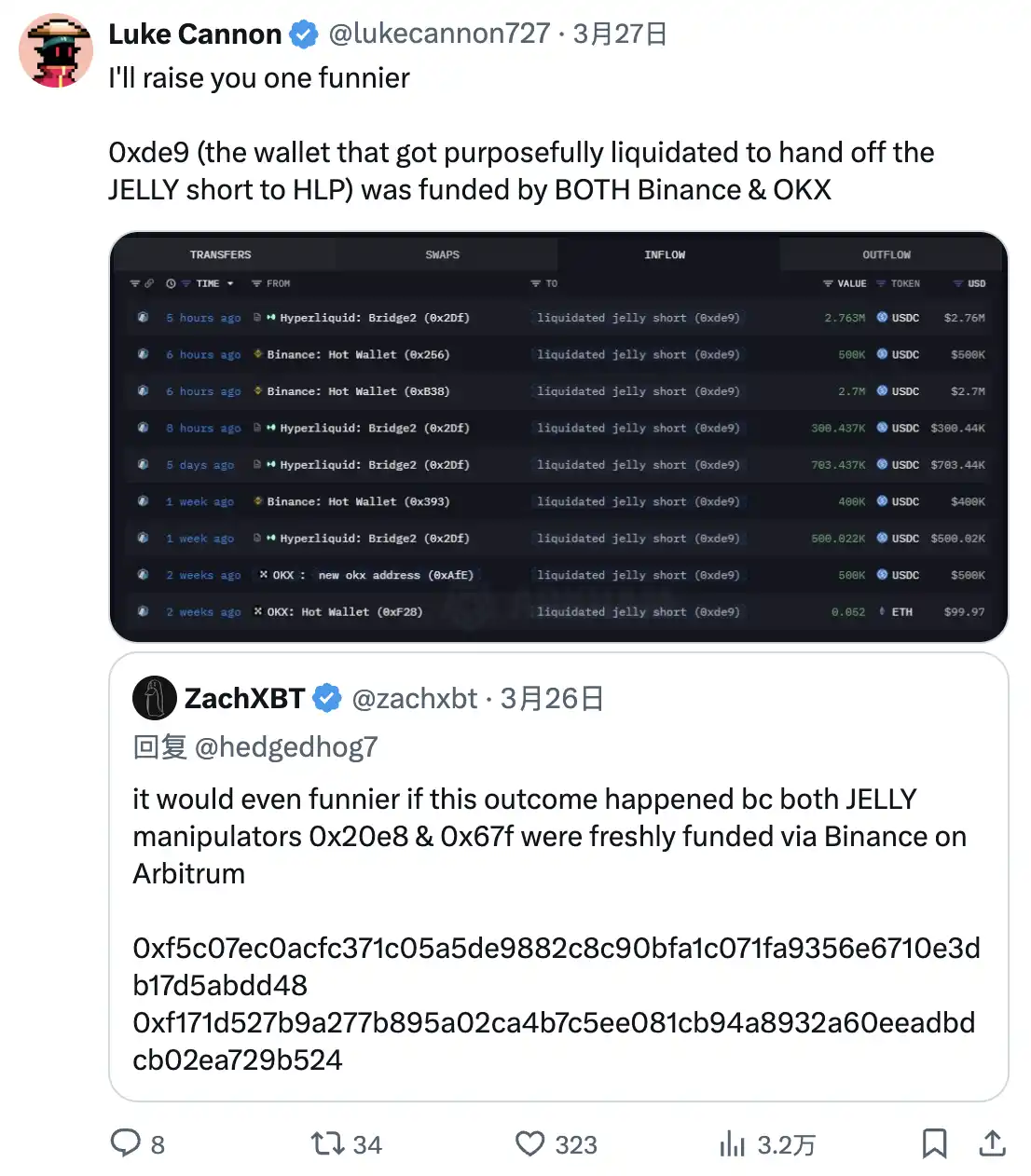
· JELLY token experiences a sudden on-chain surge
· CEX conveniently launches JELLY perpetual contracts
· After HL's short position is liquidated, the funds are transferred to HLP's insurance fund
· Hyperliquid's Validator Council (still in a centralized phase) urgently delists the JELLY contract, liquidates through an oracle manipulation to profit, and pledges full user reimbursement
· CEX simultaneously initiates a FUD propaganda war
This move can be seen as strategic: the CEX forces Hyperliquid founder Jeff to face the dilemma of "liquidation or delisting."
While protecting user choice is understandable, the consequence has been to provide CEX with regulatory leverage—government-friendly exchanges like Binance/Coinbase can easily use the "offshore CEX with no KYC/AML" label to launch legal attacks against HL.
What Should HL Do
With the launch of HyperEVM and the progression towards a decentralized validator set, Hyperliquid may still turn the tide. At the current stage, the team has chosen a centralized approach to deliver a high-performance product, a strategy that has proven successful. I firmly believe the team can gradually achieve decentralization—after all, in the current architecture, centralization vulnerabilities and economic attacks are indeed HL's only fatal weaknesses.
Areas for HL Improvement:
· Token Supply: Implement strict position limits relative to circulation and liquidity
· Dynamic Risk Parameters: Adjust collateral ratios based on market volatility, increase margin requirements for low-liquidity assets
· Delist obscure meme coins—these are the most easily manipulated low-liquidity, low-market-cap assets
The HL team must have learned lessons from this. Looking back at their past performance, they should be capable of handling and building a more robust system. The primary risks still lie in potential attacks from North Korean hackers and similar economic sniper attacks as seen recently.
Source: Original Article Link
You may also like

Consumer-grade Crypto Global Survey: Users, Revenue, and Track Distribution

Prediction Markets Under Bias

Stolen: $290 million, Three Parties Refusing to Acknowledge, Who Should Foot the Bill for the KelpDAO Incident Resolution?

ASTEROID Pumped 10,000x in Three Days, Is Meme Season Back on Ethereum?

ChainCatcher Hong Kong Themed Forum Highlights: Decoding the Growth Engine Under the Integration of Crypto Assets and Smart Economy

Why can this institution still grow by 150% when the scale of leading crypto VCs has shrunk significantly?

Anthropic's $1 trillion, compared to DeepSeek's $100 billion

Geopolitical Risk Persists, Is Bitcoin Becoming a Key Barometer?

Annualized 11.5%, Wall Street Buzzing: Is MicroStrategy's STRC Bitcoin's Savior or Destroyer?

An Obscure Open Source AI Tool Alerted on Kelp DAO's $292 million Bug 12 Days Ago

Mixin has launched USTD-margined perpetual contracts, bringing derivative trading into the chat scene.
The privacy-focused crypto wallet Mixin announced today the launch of its U-based perpetual contract (a derivative priced in USDT). Unlike traditional exchanges, Mixin has taken a new approach by "liberating" derivative trading from isolated matching engines and embedding it into the instant messaging environment.
Users can directly open positions within the app with leverage of up to 200x, while sharing positions, discussing strategies, and copy trading within private communities. Trading, social interaction, and asset management are integrated into the same interface.
Based on its non-custodial architecture, Mixin has eliminated friction from the traditional onboarding process, allowing users to participate in perpetual contract trading without identity verification.
The trading process has been streamlined into five steps:
· Choose the trading asset
· Select long or short
· Input position size and leverage
· Confirm order details
· Confirm and open the position
The interface provides real-time visualization of price, position, and profit and loss (PnL), allowing users to complete trades without switching between multiple modules.
Mixin has directly integrated social features into the derivative trading environment. Users can create private trading communities and interact around real-time positions:
· End-to-end encrypted private groups supporting up to 1024 members
· End-to-end encrypted voice communication
· One-click position sharing
· One-click trade copying
On the execution side, Mixin aggregates liquidity from multiple sources and accesses decentralized protocol and external market liquidity through a unified trading interface.
By combining social interaction with trade execution, Mixin enables users to collaborate, share, and execute trading strategies instantly within the same environment.
Mixin has also introduced a referral incentive system based on trading behavior:
· Users can join with an invite code
· Up to 60% of trading fees as referral rewards
· Incentive mechanism designed for long-term, sustainable earnings
This model aims to drive user-driven network expansion and organic growth.
Mixin's derivative transactions are built on top of its existing self-custody wallet infrastructure, with core features including:
· Separation of transaction account and asset storage
· User full control over assets
· Platform does not custody user funds
· Built-in privacy mechanisms to reduce data exposure
The system aims to strike a balance between transaction efficiency, asset security, and privacy protection.
Against the background of perpetual contracts becoming a mainstream trading tool, Mixin is exploring a different development direction by lowering barriers, enhancing social and privacy attributes.
The platform does not only view transactions as execution actions but positions them as a networked activity: transactions have social attributes, strategies can be shared, and relationships between individuals also become part of the financial system.
Mixin's design is based on a user-initiated, user-controlled model. The platform neither custodies assets nor executes transactions on behalf of users.
This model aligns with a statement issued by the U.S. Securities and Exchange Commission (SEC) on April 13, 2026, titled "Staff Statement on Whether Partial User Interface Used in Preparing Cryptocurrency Securities Transactions May Require Broker-Dealer Registration."
The statement indicates that, under the premise where transactions are entirely initiated and controlled by users, non-custodial service providers that offer neutral interfaces may not need to register as broker-dealers or exchanges.
Mixin is a decentralized, self-custodial privacy wallet designed to provide secure and efficient digital asset management services.
Its core capabilities include:
· Aggregation: integrating multi-chain assets and routing between different transaction paths to simplify user operations
· High liquidity access: connecting to various liquidity sources, including decentralized protocols and external markets
· Decentralization: achieving full user control over assets without relying on custodial intermediaries
· Privacy protection: safeguarding assets and data through MPC, CryptoNote, and end-to-end encrypted communication
Mixin has been in operation for over 8 years, supporting over 40 blockchains and more than 10,000 assets, with a global user base exceeding 10 million and an on-chain self-custodied asset scale of over $1 billion.

$600 million stolen in 20 days, ushering in the era of AI hackers in the crypto world
Vitalik's 2026 Hong Kong Web3 Summit Speech: Ethereum's Ultimate Vision as the "World Computer" and Future Roadmap
On the same day Aave introduced rsETH, why did Spark decide to exit?
Full Post-Mortem of the KelpDAO Incident: Why Did Aave, Which Was Not Compromised, End Up in Crisis Situation?

After a $290 million DeFi liquidation, is the security promise still there?
ZachXBT's post ignites RAVE nearing zero, what is the truth behind the insider control?




 App
App