
 Buy Crypto
- Markets
 Futures
- Spot
- Copy Trade
- Earn
- More
Canary Capital keeps submitting ETF applications frequently. Has submitting ETF applications become a disguised marketing business?







Original Article Title: "Canary Capital Frequently Submits ETF Applications, Is Shanzhai ETF Application Becoming Covert Advertising Business?"
Original Article Author: Weilin, PANews
On March 20, the U.S. financial institution Canary Capital filed the Canary PENGU ETF application with the U.S. Securities and Exchange Commission (SEC), planning to launch an ETF that holds both the Chunky Penguin NFT and the $PENGU token. According to the proposed scheme, the ETF fund plans to hold 80-95% of the $PENGU token and 5-15% of Pudgy Penguins NFT. This news has sparked widespread discussion within the Chunky Penguin community and the broader crypto market, with even Canary's avatar on social media being the Pudgy Penguin NFT.
Canary Capital, founded just 6 months ago, has already intensively submitted multiple meme coin ETF applications. However, this practice has also raised many doubts: how significant is the real demand for these meme coin ETFs? Or is this more like a gimmick and a marketing tactic?
PENGU ETF News Drives Coin Price Up and Then Down, Will Traditional Investors Enter?
After the PENGU ETF news was announced, the $PENGU price initially surged to $0.0075, up nearly 10%, reflecting the market's short-term optimism about the news. However, as of 7:30 p.m. on March 21, the price had fallen back to $0.0062, an overall 8.63% decline in 24 hours, showing that the market's enthusiasm for the news could not be sustained in the long term. Although there was a significant increase in capital inflow after the news announcement, with a 24-hour trading volume of $135 million, the price trend could not remain strong.
The submission of the PENGU ETF has sparked some controversial voices within the Chunky Penguin community. For example, Chunky Penguin community user @beast_ico stated, "The $PENGU ETF might be the most outrageous thing I've seen recently. We don't even need an ETF for a meme coin, let alone one that's not even 6 months old. If those 'Boomers' (traditional investors) aren't even interested in ETH (let alone SOL), why would they touch something called PENGU?"
However, digital artist @Tuteth_ expressed, "We're really screwed, guys. I've seen all the buzz about $PENGU and the Pudgy Penguin ETF, and it's just nonsense. Some of these people are still my friends. But you don't even realize you're fueling 'tall poppy syndrome' (jealousy of successful people, suppression of leaders). Bitcoin was mocked as the dumbest thing in the world back in the day. The reason we're in this community is to enjoy these seemingly absurd but ultimately real possibilities because we've seen them happen. We've come this far, only to hear that this ETF is going too far? Think about it, you have an animal as your avatar and talk about cryptocurrency with online friends every day. It's all absurd to the extreme—yet you insist on drawing a line here, it cracks me up."
Clearly, the Chonky Penguin community has differing opinions on this ETF application, with some detractors seeing it as a ridiculous hype and supporters viewing it as a natural progression of NFT culture.
Is the S-1 Filing Threshold Low? Canary Capital Successively Applies for Shanzhai ETFs
PANews previously introduced Canary Capital, a crypto investment firm, in October 2024 when it had only been established for a month. Canary Capital's founder and CEO is Steven McClurg, who is also a co-founder of Valkyrie Funds. It is worth mentioning that Justin Sun is also an investor in Valkyrie. In October 2021, Valkyrie was approved to launch the first Bitcoin futures ETF in the United States. Steven McClurg left Valkyrie Funds in August 2024 and founded the crypto investment firm Canary Capital in September, announcing the launch of the first HBAR Trust in the U.S. on October 1. Subsequently, Canary also applied for the SUI ETF, an ETF tracking Axelar (AXL) price, Litecoin (LTC) ETF, AXL Trust, Solana ETF, and XRP ETF.
Some analysts have pointed out that the low cost of S-1 filing may be one of the reasons for the recent surge in Shanzhai Coin ETF applications. According to analyst Jason Chen on March 7, "S-1 is the first step in registering an ETF, and what is the threshold for submitting an ETF's S-1? There are two key thresholds. Firstly, the company must be U.S.-registered with asset management and financial operations, and secondly, it needs to spend around $100,000 to cover the cost of drafting the S-1 filing."
Earlier on March 6, Canary Capital applied to the U.S. SEC to launch an ETF tracking the cross-chain protocol Axelar. At the time, Jason Chen pointed out, "After Canary submitted the S-1 for the AXL ETF, AXL experienced a price surge. I am familiar with the AXL project and have even written two lengthy articles about it. Fundamentally, the project is decent but falls far short of meeting the ETF qualifications. On the other hand, Canary, the company that submitted the materials, was only established in September 2024, less than half a year ago. So, can you believe that there is nothing fishy going on when a newly established company submits an obviously unqualified coin for an ETF and is widely reported by major media outlets?"
Crypto KOL @qinbafrank recently expressed a viewpoint similar to Chen Jian's: "In addition to the three largest mutual funds by BlackRock, Franklin, and Fidelity, as well as fund companies like Bitwise, Grayscale, and Ark which were the first to receive approval for a BTC ETF, if we see some unknown fund companies announcing the submission of a mysterious altcoin ETF to the SEC, undoubtedly these fund companies have likely received advertising fees, and the main manipulators behind the scenes may take advantage of the opportunity to pump up the price and unload their holdings."
SOL Futures Listing Debut Sees Weak Demand, Small-Cap Coins May Struggle to Sustain High Demand
Meanwhile, Solana futures began trading on March 17 on the Chicago Mercantile Exchange (CME) Group's American derivatives exchange, seen as a key step towards applying for a SOL spot ETF and a test of market demand.
However, according to preliminary data from the CME website, on March 17, the first day of trading, approximately 98,250 SOL (equivalent to around $12 million) in SOL futures changed hands on the trading platform. This performance, compared to major cryptocurrencies like Bitcoin and Ethereum, showed a lackluster early trading performance.
According to a report by research firm K33, the total trading volume for Solana futures on the first day was $12.3 million with $7.8 million in open interest. This is starkly contrasting to Bitcoin futures, which attracted a trading volume of $102.7 million and $20.9 million in open interest when they first appeared on the CME in December 2017. Ethereum also had a better performance with its futures launching in February 2021 with a trading volume of $31 million and $20 million in open interest.
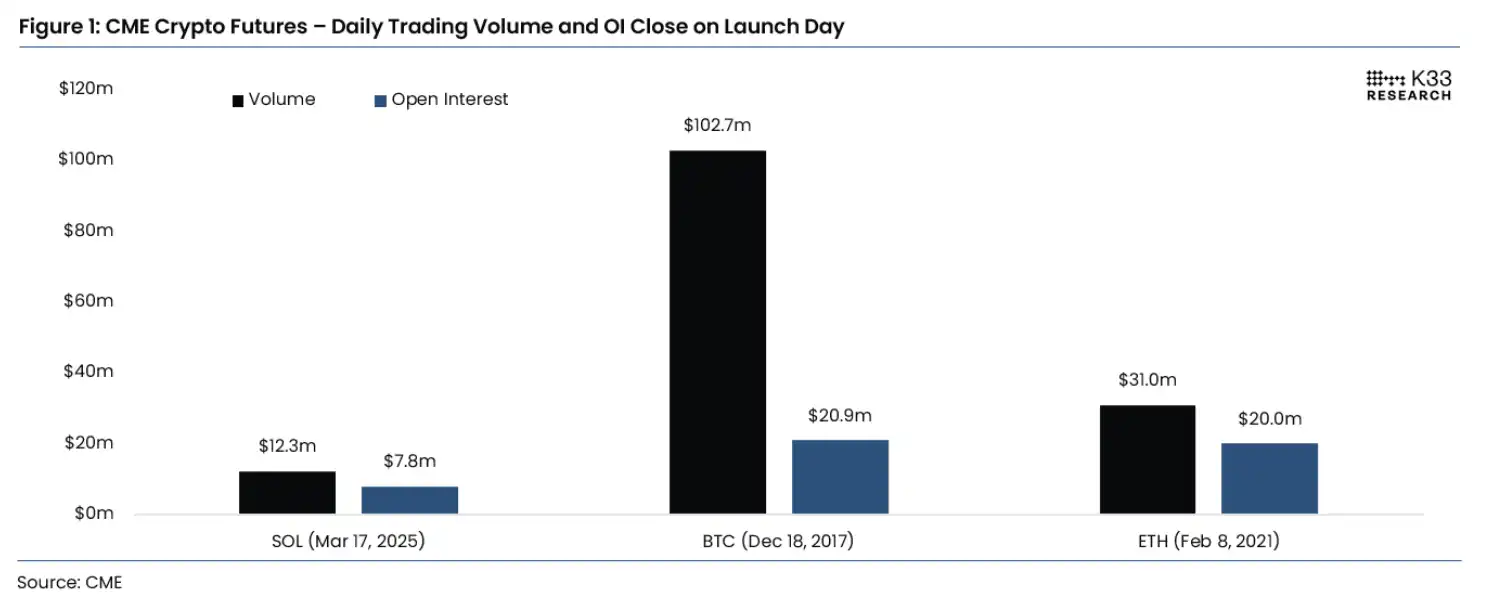
K33 analysts Vetle Lunde and David Zimmerman attributed the lukewarm performance to the broader market conditions, noting that Solana's launch occurred during a period of low risk appetite without a strong bull market or favorable period for altcoin rebounds. The K33 report stated: "Despite a more reasonable performance post-market cap adjustment, Solana's figures are a far cry from previous futures listings."
The analysts added that despite the underwhelming start, the listing does align with the pattern typically associated with ultimate approval of a spot ETF. However, they cautioned that the lower trading activity for Solana compared to the surge triggered by Bitcoin's spot ETF approval in early 2024 suggests that any future ETFs tied to the token may have a more subdued impact on the price.
Overall, the discussion of the PENGU ETF reflects a collision between NFT and memecoin culture and traditional finance, with community users holding their own views. As for Canary Capital's frequent applications for meme ETFs, is it an innovative attempt or simply a marketing tactic? The future of meme coin ETFs awaits answers from the cryptocurrency market, users, and regulatory agencies.
You may also like

Morning News | The Hong Kong Securities and Futures Commission announced the regulatory framework for secondary market trading of tokenized investment products; Strategy increased its holdings by 34,164 bitcoins last week; KAIO completed a strategic fi...

What Is an XRP Wallet? The Best Wallets to Store XRP (2026 Updated)
An XRP wallet lets you safely store, send, and receive XRP on the XRP Ledger. Learn what wallets support XRP and discover the best XRP wallets for beginners and long-term holders in 2026.

What are the Top AI Crypto Coins? Render vs. Akash: 5 Gems Solving the 2026 GPU Crisis
What are the best AI crypto coins for the 2026 cycle? Beyond the hype, we analyze top tokens like RNDR, AKT, and FET that provide real-world solutions to the global GPU shortage and the rise of autonomous agents.

What Is a Token in AI? What Is an AI Token + 3 Gems You Can't Miss in 2026
The era of AI hype has transitioned into an era of utility. As we move through Q2 2026, the market is no longer rewarding "narrative-only" projects. At WEEX Research, we are seeing a massive capital rotation into Decentralized Compute (DePIN) and Autonomous Agent coordination layers. This guide analyzes which AI tokens are capturing institutional liquidity and how to spot high-conviction setups in a maturing market.

Consumer-grade Crypto Global Survey: Users, Revenue, and Track Distribution

Prediction Markets Under Bias

Stolen: $290 million, Three Parties Refusing to Acknowledge, Who Should Foot the Bill for the KelpDAO Incident Resolution?

ASTEROID Pumped 10,000x in Three Days, Is Meme Season Back on Ethereum?

ChainCatcher Hong Kong Themed Forum Highlights: Decoding the Growth Engine Under the Integration of Crypto Assets and Smart Economy

Why can this institution still grow by 150% when the scale of leading crypto VCs has shrunk significantly?

Anthropic's $1 trillion, compared to DeepSeek's $100 billion

Geopolitical Risk Persists, Is Bitcoin Becoming a Key Barometer?

Annualized 11.5%, Wall Street Buzzing: Is MicroStrategy's STRC Bitcoin's Savior or Destroyer?
An Obscure Open Source AI Tool Alerted on Kelp DAO's $292 million Bug 12 Days Ago

Mixin has launched USTD-margined perpetual contracts, bringing derivative trading into the chat scene.
The privacy-focused crypto wallet Mixin announced today the launch of its U-based perpetual contract (a derivative priced in USDT). Unlike traditional exchanges, Mixin has taken a new approach by "liberating" derivative trading from isolated matching engines and embedding it into the instant messaging environment.
Users can directly open positions within the app with leverage of up to 200x, while sharing positions, discussing strategies, and copy trading within private communities. Trading, social interaction, and asset management are integrated into the same interface.
Based on its non-custodial architecture, Mixin has eliminated friction from the traditional onboarding process, allowing users to participate in perpetual contract trading without identity verification.
The trading process has been streamlined into five steps:
· Choose the trading asset
· Select long or short
· Input position size and leverage
· Confirm order details
· Confirm and open the position
The interface provides real-time visualization of price, position, and profit and loss (PnL), allowing users to complete trades without switching between multiple modules.
Mixin has directly integrated social features into the derivative trading environment. Users can create private trading communities and interact around real-time positions:
· End-to-end encrypted private groups supporting up to 1024 members
· End-to-end encrypted voice communication
· One-click position sharing
· One-click trade copying
On the execution side, Mixin aggregates liquidity from multiple sources and accesses decentralized protocol and external market liquidity through a unified trading interface.
By combining social interaction with trade execution, Mixin enables users to collaborate, share, and execute trading strategies instantly within the same environment.
Mixin has also introduced a referral incentive system based on trading behavior:
· Users can join with an invite code
· Up to 60% of trading fees as referral rewards
· Incentive mechanism designed for long-term, sustainable earnings
This model aims to drive user-driven network expansion and organic growth.
Mixin's derivative transactions are built on top of its existing self-custody wallet infrastructure, with core features including:
· Separation of transaction account and asset storage
· User full control over assets
· Platform does not custody user funds
· Built-in privacy mechanisms to reduce data exposure
The system aims to strike a balance between transaction efficiency, asset security, and privacy protection.
Against the background of perpetual contracts becoming a mainstream trading tool, Mixin is exploring a different development direction by lowering barriers, enhancing social and privacy attributes.
The platform does not only view transactions as execution actions but positions them as a networked activity: transactions have social attributes, strategies can be shared, and relationships between individuals also become part of the financial system.
Mixin's design is based on a user-initiated, user-controlled model. The platform neither custodies assets nor executes transactions on behalf of users.
This model aligns with a statement issued by the U.S. Securities and Exchange Commission (SEC) on April 13, 2026, titled "Staff Statement on Whether Partial User Interface Used in Preparing Cryptocurrency Securities Transactions May Require Broker-Dealer Registration."
The statement indicates that, under the premise where transactions are entirely initiated and controlled by users, non-custodial service providers that offer neutral interfaces may not need to register as broker-dealers or exchanges.
Mixin is a decentralized, self-custodial privacy wallet designed to provide secure and efficient digital asset management services.
Its core capabilities include:
· Aggregation: integrating multi-chain assets and routing between different transaction paths to simplify user operations
· High liquidity access: connecting to various liquidity sources, including decentralized protocols and external markets
· Decentralization: achieving full user control over assets without relying on custodial intermediaries
· Privacy protection: safeguarding assets and data through MPC, CryptoNote, and end-to-end encrypted communication
Mixin has been in operation for over 8 years, supporting over 40 blockchains and more than 10,000 assets, with a global user base exceeding 10 million and an on-chain self-custodied asset scale of over $1 billion.

$600 million stolen in 20 days, ushering in the era of AI hackers in the crypto world
Vitalik's 2026 Hong Kong Web3 Summit Speech: Ethereum's Ultimate Vision as the "World Computer" and Future Roadmap
On the same day Aave introduced rsETH, why did Spark decide to exit?
Morning News | The Hong Kong Securities and Futures Commission announced the regulatory framework for secondary market trading of tokenized investment products; Strategy increased its holdings by 34,164 bitcoins last week; KAIO completed a strategic fi...
What Is an XRP Wallet? The Best Wallets to Store XRP (2026 Updated)
An XRP wallet lets you safely store, send, and receive XRP on the XRP Ledger. Learn what wallets support XRP and discover the best XRP wallets for beginners and long-term holders in 2026.
What are the Top AI Crypto Coins? Render vs. Akash: 5 Gems Solving the 2026 GPU Crisis
What are the best AI crypto coins for the 2026 cycle? Beyond the hype, we analyze top tokens like RNDR, AKT, and FET that provide real-world solutions to the global GPU shortage and the rise of autonomous agents.
What Is a Token in AI? What Is an AI Token + 3 Gems You Can't Miss in 2026
The era of AI hype has transitioned into an era of utility. As we move through Q2 2026, the market is no longer rewarding "narrative-only" projects. At WEEX Research, we are seeing a massive capital rotation into Decentralized Compute (DePIN) and Autonomous Agent coordination layers. This guide analyzes which AI tokens are capturing institutional liquidity and how to spot high-conviction setups in a maturing market.



 App
App