
Why Bending Spoons May Choose to Issue Convertible Bonds Next

 Prefer us on Google



On October 7, 2026, at the OGR large maintenance factory in Turin, Italy, CEO Luca Ferrari of Bending Spoons delivered a speech at the Wave 2026 conference hosted by Vento.
Since going public in July, Bending Spoons has raised funds through debt and equity markets, primarily to acquire more tech companies and to support its continuously expanding asset portfolio. One financing tool that the company has yet to utilize is convertible bonds, but this tool may soon come into play.
A source close to the company revealed that in the current environment of high interest rates, the company is considering issuing convertible bonds as a supplement to its existing financing channels. Compared to regular bonds of the same rating, convertible bonds typically have a lower coupon rate; the trade-off is that bondholders have the option to convert their bonds into shares, which dilutes the equity of existing shareholders.
The company's funding needs are likely to remain high. Bending Spoons has been acquiring a series of well-known tech brands that are entering maturity, including AOL, event ticketing platform Eventbrite, collaboration platform Airtable, and video platform Vimeo. The company bets that through significant restructuring, it can help these businesses regain growth. Its latest acquisition was the whiteboard collaboration software Miro, completed at the end of October, with a company valuation of approximately $1.36 billion, which is a 90% discount compared to Miro's valuation during its private equity financing in 2021.
Sources indicate that the company's past acquisition prices generally range from 1 to 7 times the target company's revenue. At this stage, its goal is to acquire targets with annual revenues of at least $500 million and transaction amounts in the billions. The company remains open to acquisition opportunities across various tech sectors, with a particular focus on healthcare technology.
Bending Spoons primarily relies on debt for acquisition funding, supplemented by its own free cash flow and equity financing. In the first six months of 2026, the company generated approximately $250 million in free cash flow, far below the total acquisition expenditure of $2.3 billion.
Bending Spoons aims to maintain a net leverage ratio (net debt ÷ EBITDA, where net debt = total debt - cash) of 2 to 3 times. As of the end of June, this metric was within the target range: net debt of $4.09 billion, corresponding to a leverage ratio of about 2.4 times. The company is set to release its third-quarter financial report this Friday.
Both Moody's and S&P have assigned Bending Spoons a non-investment grade credit rating, resulting in higher borrowing costs compared to blue-chip companies. In September, Bending Spoons secured approximately $1.7 billion in loans, part of which was used to acquire Miro; in October, it completed its first high-yield bond issuance, raising $1.8 billion.
Sources say that the current blended effective interest rate on all of Bending Spoons' debt is about 9%, which takes into account the overall financing costs of loans and bonds.
As the public company's operating record continues to accumulate, or if overall market interest rates decline, Bending Spoons' financing costs are expected to decrease slightly. Obtaining an investment-grade credit rating could further lower borrowing costs, but this would require the company to reduce its leverage levels or make other trade-offs. Sources indicate that the company currently has no such plans.
This background makes convertible bonds an attractive alternative. Sources say that Bending Spoons views convertible bonds as a supplementary financing method rather than a core funding source, as this tool cannot provide large-scale funding. This is partly due to the existing debt size and partly to minimize dilution of existing shareholders' equity as much as possible.
Meanwhile, Bending Spoons is raising equity to expand its existing business operations while also funding acquisition deals. Last month, it conducted a directed share issuance of $330 million to Berkshire Hathaway; previously, Berkshire had already invested $600 million during Bending Spoons' IPO phase. Issuing equity instead of taking on debt can help the company keep its leverage ratio within the target upper limit.
After completing acquisitions, Bending Spoons will lay off employees at the acquired companies and assign 50 to 60 of its own employees to take over management positions. Additionally, it has raised product prices for several acquired companies; however, sources indicate that there are currently no plans to raise prices for the efficiency software Airtable acquired in September.
-- Price
This content is provided for general informational purposes only and doesn't constitute financial, investment, legal, or tax advice. Any events, rewards, online promotions, or related information mentioned herein should not be considered a recommendation, solicitation, or invitation to purchase, sell, trade, or otherwise deal in any crypto assets. Crypto assets are highly volatile and may result in loss. The availability of WEEX services, products, and related events may vary by region. You are responsible for ensuring that your participation is in accordance with applicable local laws and regulations.
You may also like

2 Financial Stocks to Buy Near Their 52-Week Lows

Airbnb’s New $12 Billion Buyback Is Backed by a 35% Free Cash Flow Margin. Here’s What It Means for Shareholders.
Not Anthropic. Not SpaceX. This Is the AI Stock to Buy for the Long Term

Opinion: The $6 trillion evaporation of the US stock market in 45 days is not the burst of the AI bubble; a bottom-fishing rebound in April 2025 may reoccur
CITIC Construction Investment Releases Food and Beverage Investment Strategy for 2027

VIX Soars to Highest Level Since Last Year’s Tariff Turmoil, Goldman Sachs Fear Index Nears Maximum, US Stocks May Face Over $80 Billion Sell-off Next Week

Prediction: Rocket Lab Will Triple Its Revenue by 2028. Here's What That Would Mean for the Stock.
Oracle Completes Funding for Collaboration with OpenAI
Forget SpaceX: This Stock Could Be the Real Winner of the Space Race

Where Will Bloom Energy Stock Be in 5 Years After More Than Doubling Its Revenue in 2026?

Ripple Is Rapidly Expanding the Potential Use Cases for Its Stablecoin. Here's Why That's Bearish for XRP.
Kimberly-Clark Completes Kenvue Acquisition, Expects 2.1 Billion USD in Savings

Lagarde: EU funds should bear initial losses for chip factories and data center projects
Robotaxis: 4 Stocks Positioned to Win
Would Warren Buffett Buy Anthropic? This Is the One Question He'd Have

Société Générale Predicts S&P 500 Will Rise to 8500 Points by End of 2027
Will the Market Rebound After Thanksgiving? Bank of America: Likely Short-Term, Major Trends Require Three Conditions
XRPL Credit Updates Approaching 29 Vote Threshold
NVIDIA Stock Price Falls 40% from Highs, Still Hope Remains
Barclays Strategist Says Stock Sell-off Driven by AI Concerns Has Overshot
Lagarde Calls for Advancing Capital Markets Union, Warns of Intensifying Savings Outflow
World Bank Considers Utilizing USDC Payments, Collaborates with Citi and Circle to Enhance Development Fund Transfer Efficiency

What is Suppressing Gold and Bitcoin?

UBS Raises Palo Alto Networks Price Target to $400, Maintains Neutral Rating

TD Cowen Lists Navan as Top Software Stock for 2027, Target Price Raised to $32
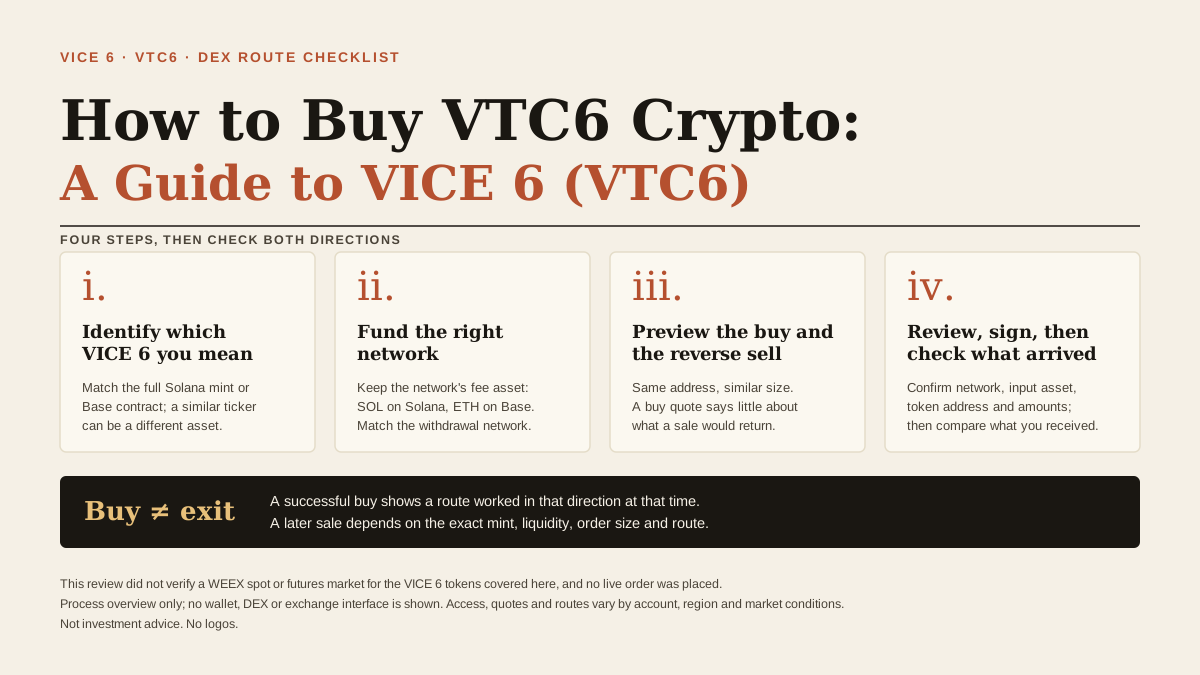
How to Buy VTC6 Crypto: A Guide to VICE 6 (VTC6)
Learn how to buy VTC6 crypto through a supported DEX route, verify the exact VICE 6 token address, and review buy and sell quotes before you swap.
UBS Downgrades Deutsche Börse Rating to 'Sell', Citing Overvaluation After 49% Surge This Year
Where is Nvidia Investing Its Money?
ZRO Unlock on November 20: Why Are Supply Estimates Different?

OSL Group CEO Emphasizes the Need for a Stablecoin Strategy
2 Financial Stocks to Buy Near Their 52-Week Lows
Airbnb’s New $12 Billion Buyback Is Backed by a 35% Free Cash Flow Margin. Here’s What It Means for Shareholders.
Not Anthropic. Not SpaceX. This Is the AI Stock to Buy for the Long Term
Opinion: The $6 trillion evaporation of the US stock market in 45 days is not the burst of the AI bubble; a bottom-fishing rebound in April 2025 may reoccur
CITIC Construction Investment Releases Food and Beverage Investment Strategy for 2027
VIX Soars to Highest Level Since Last Year’s Tariff Turmoil, Goldman Sachs Fear Index Nears Maximum, US Stocks May Face Over $80 Billion Sell-off Next Week
Latest articles


Latest coin listings on WEEX


