
CoreWeave Q3 Earnings: Why $3.66B in Revenue Still Lost $709M

 Prefer us on Google

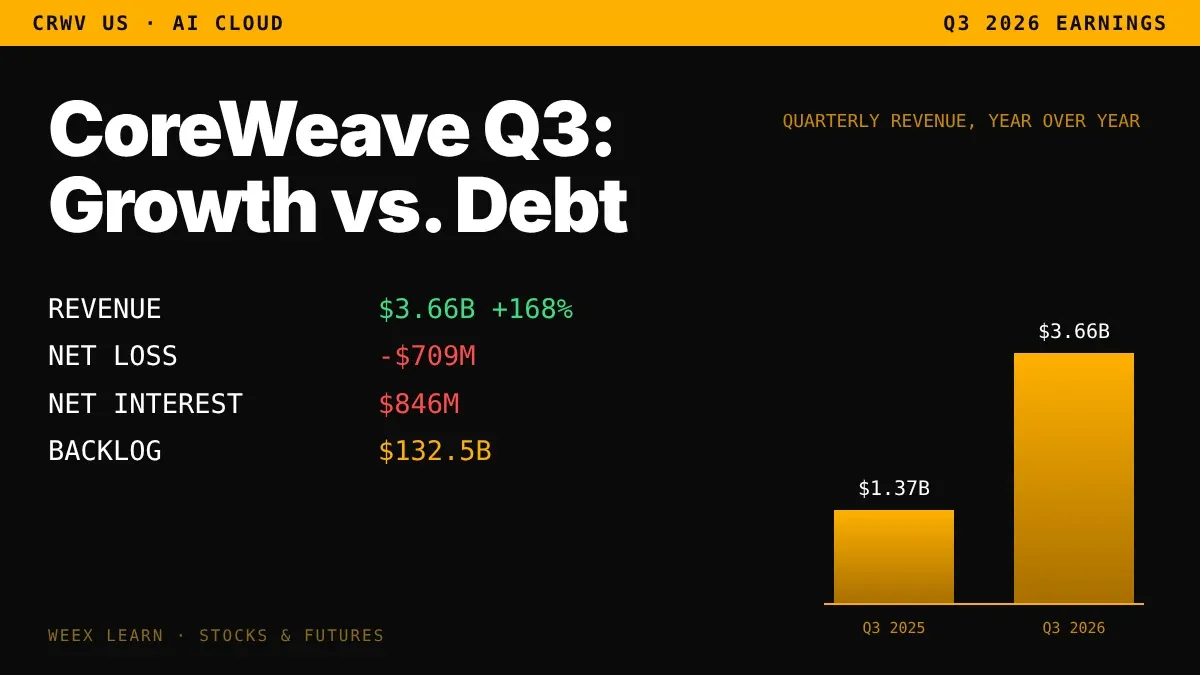
CoreWeave (CRWV) reported third-quarter revenue of $3.661 billion after the U.S. close on November 10, 2026, up about 168% from $1.365 billion a year earlier, and still posted a GAAP net loss of $709 million. The gap between those two numbers is the whole CoreWeave story: the AI cloud is growing faster than almost any listed company, but it is paying for that growth with borrowed money, and the interest bill now exceeds its operating profit. This article breaks down the CRWV Q3 earnings line by line, explains why revenue growth and net losses can rise together, what the $132.5 billion backlog does and does not promise, and how CRWV's stock and futures quotes on WEEX should be read after the report.
CoreWeave Q3 Earnings at a Glance
The headline figures for the quarter ended September 30, 2026, per CoreWeave's results and earnings call:
- Revenue: $3.661 billion, up about 168% year over year and above the top of company guidance.
- GAAP net loss: $709 million, versus $110 million a year earlier. Diluted loss per share was $1.27, narrower than the roughly $1.55 loss analysts expected, per Investing.com.
- Operating income: $207 million on a GAAP basis (6% margin). Adjusted operating income was $379 million, a 10% margin, down from 16% a year ago.
- Adjusted EBITDA: $2.256 billion, a 62% margin.
- Net interest expense: $846 million, up from $310 million.
- Revenue backlog: about $132.5 billion, up roughly 138% year over year.
The stock reacted to the beat, not the loss. CRWV closed the regular session at $48.73 on November 10 and traded about 5.7% higher, near $51.51, after hours.
Why CoreWeave Revenue Grew 168% but Net Loss Widened
The short answer is that CoreWeave's revenue comes after it builds data centers, while its interest costs start as soon as it borrows to build them.
Follow the quarter from top to bottom. CoreWeave turned $3.66 billion of revenue into $207 million of GAAP operating income. Depreciation on billions of dollars of GPUs and facilities takes most of the difference. Then $846 million of net interest expense pushed the company to a $626 million pretax loss, and an $83 million tax provision took the net loss to $709 million.
In other words, interest expense alone was about four times GAAP operating income. That is why the 62% adjusted EBITDA margin and the net loss can both be true. EBITDA excludes depreciation and interest, which are exactly the two costs that define this business model.
The trend matters more than the single quarter. Adjusted operating margin fell from 16% to 10% year over year, and CoreWeave guided Q4 interest expense to $1.05 billion to $1.15 billion, higher again. Management told investors it expects adjusted net income to turn positive in the first half of 2028. Until then, the income statement is likely to show growth and losses side by side.
AI Cloud Interest Expense and Capex: The Financing Pressure
The balance sheet explains the interest line. CoreWeave carried about $46.9 billion of recourse and non-recourse debt at the end of Q3, up from about $21.4 billion at the end of 2025. During the quarter it raised $10.3 billion in new debt and repaid $2.3 billion.
Spending is still accelerating:
- Q3 capital expenditure: $9.44 billion on property and equipment, against $1.98 billion of operating cash flow.
- 2026 capex guidance: $37 billion to $39 billion, with the low end raised from $35 billion.
- Cash: $4.12 billion of cash and equivalents, or $6.40 billion including restricted cash.
Management gave two details that change how to read this. First, the weighted average cost of its debt was 7.9%, and CoreWeave said it will not issue unsecured parent-level debt at current yields. Second, it expects most remaining capex to be funded through asset-level delayed-draw term loans, customer prepayments and vendor financing, with less than $5 billion raised at the parent level through 2027. It also expects about $9 billion of customer prepayments and deposits over the next three months.
The better reading is that CoreWeave is shifting financing risk toward specific projects and customers. That lowers the chance of a company-wide funding squeeze, but it ties each new data center more tightly to the customer contract behind it. If a large customer delays or renegotiates, the debt tied to that project does not go away.
-- Price
What the $132.5 Billion Backlog Does and Does Not Mean
CoreWeave's revenue backlog reached about $132.5 billion, up about 138% from a year earlier. It is the number bulls point to most, and it needs the most care.
Backlog is contracted future revenue, not revenue already earned. It turns into reported revenue only when CoreWeave delivers capacity: the power is connected, the GPUs are installed, and the customer starts using them. Three conditions decide how fast that happens:
- Power and construction. CoreWeave had more than 1.7 gigawatts of active power at the end of Q3 and is targeting more than 1.85 GW by year-end. Contracted power totals 4.6 GW, so most of the backlog depends on capacity that is not yet live.
- Concentration. Management said more than half of the backlog is tied to one contract, with delivery expected to begin by year-end. That makes the backlog large but lumpy.
- Customer health. A multiyear contract is only as strong as the buyer's ability and willingness to keep paying for AI compute.
Guidance should be read the same way. CoreWeave raised its 2026 revenue guidance to $13.0 billion to $13.3 billion and adjusted operating income guidance to $1.275 billion to $1.375 billion, and it expects an annualized revenue run-rate of $20 billion to $21 billion when it exits 2026. These are forecasts, not results already achieved.
CRWV Stock vs. CRWV Futures on WEEX: Reading the Quotes
WEEX lists CoreWeave exposure in two forms, and after earnings they showed different numbers for good reasons.
On November 11 at 10:14 Beijing time (02:14 UTC), the CRWV stock page on WEEX showed 52.58 USDT with the U.S. market marked Closed. That is a closed-market reference price, not a live Nasdaq quote. A minute later, the CRWV-USDT perpetual futures market on WEEX was at 54.47 USDT, up 10.13% on a rolling 24-hour basis.
Three points to keep in mind when comparing them:
- The 10.13% futures move is not CRWV's Nasdaq move. A rolling 24-hour change compares the price with the price exactly 24 hours earlier, before the report. The regular-session close and the about 5.7% after-hours move are measured against different starting points.
- Futures can run ahead of the stock. Perpetual futures trade around the clock, so they absorb earnings news while Nasdaq is closed. The gap usually narrows once regular trading reopens.
- The products give different rights. A perpetual contract gives price exposure with margin, funding payments and liquidation risk. It does not give shareholder rights such as voting. Using leverage on a stock that just moved on earnings magnifies both the upside and the risk of being liquidated on a reversal.
CRWV Earnings Outlook: What to Watch Next
CoreWeave's Q3 showed that demand for AI compute is not the bottleneck. The constraint is converting a $132.5 billion backlog into delivered capacity fast enough to outrun interest costs that are heading above $1 billion a quarter. For the next few months, the most useful checks are whether the expected $9 billion in customer prepayments arrives, whether active power reaches the 1.85 GW year-end target, and whether Q4 interest expense lands inside the $1.05 billion to $1.15 billion range. Those numbers will say more about CRWV than the next headline revenue figure.
FAQ
1. Did CoreWeave beat Q3 2026 earnings expectations?
Yes. CoreWeave reported a loss of $1.27 per share against an expected loss of about $1.55, and revenue of $3.661 billion came in above the top of its own guidance. Shares rose about 5.7% after hours on November 10.
2. Why is CoreWeave losing money if revenue is growing?
Most of the gap comes from depreciation and interest. In Q3, GAAP operating income was $207 million while net interest expense was $846 million, which led to a $709 million net loss.
3. Is CoreWeave's $132.5 billion backlog already revenue?
No. Backlog is contracted future revenue. It becomes reported revenue only as CoreWeave delivers powered, operating capacity to customers, and more than half of it is tied to a single contract.
4. What is the difference between CRWV stock and CRWV futures on WEEX?
The CRWV stock page tracks the share price and shows a closed-market reference when Nasdaq is shut. The CRWV-USDT perpetual offers leveraged price exposure 24/7, with funding and liquidation risk, and no shareholder rights.
This content is provided for general informational purposes only and doesn't constitute financial, investment, legal, or tax advice. Any events, rewards, online promotions, or related information mentioned herein should not be considered a recommendation, solicitation, or invitation to purchase, sell, trade, or otherwise deal in any crypto assets. Crypto assets are highly volatile and may result in loss. The availability of WEEX services, products, and related events may vary by region. You are responsible for ensuring that your participation is in accordance with applicable local laws and regulations.
You may also like

Why Is CoreWeave (CRWV) Stock Falling? Debt, Bond Yields and What Analysts Say

Telegram GRAM Wallet Hits 700K Sign-Ups: Are Users Really Active?
ALLO Token Unlock: 160M Tokens Hit Allora's First-Year Cliff
NYSE Picks Avalanche for Settlement: What It Means for AVAX
Bitcoin After Hot CPI: Why December Rate Hike Odds Hit 85%

WEEX P2P Now Supports ILS, BHD, OMR and QAR: How to Buy Crypto With Local Currencies
What Is GRAM? Price Rebounds After Falling Below $1, Telegram Wallet Data and What Is Confirmed
Why Is My WEEX Crypto Withdrawal Still Pending?
What Should I Do If I Forgot the Memo or Tag When Depositing to WEEX?

Which Futures Exchanges Have the Lowest Trading Fees? What to Compare

USDC Staking on WEEX: How to Stake USDC, Rates and Rules
Can I Recover Crypto Sent to WEEX Using the Wrong Blockchain Network?
Why Is My WEEX Deposit Confirmed but Not Credited?

NYSE Picks Avalanche for Tokenized Stocks: Will AVAX Benefit?
PROJECT CORTEX (XTX) Price: Why a 15.8M% Gain and a $6 Billion Market Cap Are Hard to Trust

USOE Price Drop: Why Did United States Oil Exchange Fall Over 90% in a Week?
NYSE-Linked Avalanche Settlement News: Why AVAX Is Up and What It Does Not Prove

Copy Trading Platforms With Verified Performance: Spot the Fakes
Top 10 Crypto Derivatives Exchanges Worldwide by Open Interest
Beginner Futures Exchanges With Low Entry: What $50 Really Buys
Tesla Cybertruck Refunds: What the Line Shutdown Means for TSLA
User-Friendly Crypto Copy Trading Platforms: 6 Picks Compared

WEEX Review: The Latest Fees, Features, Security and Trading Experience

What Does It Mean to Stake Crypto? Staking on WEEX Explained
Keplr Wallet Security Alert: Is Your ATOM Safe?

NVIDIA Board Opens Probe: What's Next for NVDA?

Midterm Elections Crypto Fallout: $170M Spent, Key Races Lost

Jensen Huang Affair Rumors: What the Alice Huang Report Says

USOR Token Price: Why the Oil Meme Coin Is Down 99% From Its Peak
XLM Token Price Today: Why Stellar's Nov. 23 Bell Vote Matters
Why Is CoreWeave (CRWV) Stock Falling? Debt, Bond Yields and What Analysts Say
Telegram GRAM Wallet Hits 700K Sign-Ups: Are Users Really Active?
ALLO Token Unlock: 160M Tokens Hit Allora's First-Year Cliff
NYSE Picks Avalanche for Settlement: What It Means for AVAX
Bitcoin After Hot CPI: Why December Rate Hike Odds Hit 85%
WEEX P2P Now Supports ILS, BHD, OMR and QAR: How to Buy Crypto With Local Currencies
Contents
Popular coins
Latest articles





