
Bitcoin Mining Difficulty Falls 9.13%, Giving Active Miners Some Breathing Room

 Prefer us on Google


TL;DR
- Bitcoin difficulty fell to approximately 134.82 trillion at block 975,744 on November 14.
- The 9.13% reduction improves the expected return from each hash, with other conditions unchanged.
- Power costs, fees and Bitcoin's dollar price still determine whether individual operations are profitable.
Bitcoin's automatic difficulty adjustment has made the next block easier for miners to find. At block 975,744 on November 14, the network reduced difficulty by approximately 9.13%, bringing the measure to 134.82 trillion.
That offers some relief to operators whose machines remain online. It also needs to be read correctly: the network has changed the amount of computational work expected for a successful block, not the electricity bill on a particular mining site or the price a miner receives when selling Bitcoin.
The adjustment responds to the previous mining period
Mempool's network data records the new difficulty at 134,823,837,323,272.7, compared with 148,364,561,003,867.4 previously. The adjustment block's recorded time was 05:02:50 UTC on November 14. October 29's adjustment had increased difficulty, so the latest move reverses part of that earlier tightening.
Bitcoin's developer documentation explains the mechanism: the network retargets every 2,016 blocks, using the elapsed time across the preceding period to steer block production back toward its intended pace. Slower production leads to an easier target; faster production leads to a harder one.
The setting is therefore backward-looking. It summarises block production over an interval rather than identifying a specific company, outage or price move responsible for a change in mining activity.
The benefit per hash is slightly larger than the headline cut
Difficulty and expected success per hash move inversely. Dividing the previous difficulty by the new one gives approximately 1.1004. In other words, the same amount of hashing now has roughly a 10% higher expected success rate than before, assuming the relevant reward and other conditions remain unchanged.
That is a calculation from the published difficulty values, not a promise that every miner will produce 10% more coins in its next reporting period. Mining outcomes vary, pool payout methods differ and individual machines experience downtime. The improvement describes expected work efficiency at the protocol level.
A fleet upgrade is another way to change the calculation. NewsBTC's earlier PowerCompute production report illustrates how operators also manage equipment, financing and power use alongside network conditions.
Dollar revenue can still fall as mining gets easier
Consider a simplified example with fees and uptime held constant. If difficulty falls about 9.13% while Bitcoin's dollar price also falls about 9.13%, the higher expected Bitcoin output per hash is broadly offset by the lower value of each coin. The percentage effects work through a ratio, rather than adding neatly together.
Real operations are more complicated. Electricity contracts, cooling, maintenance and financing can change the break-even point. Transaction fees also vary, affecting the reward available for the work performed. A miner with efficient equipment and cheap power can face very different economics from another running older machines.
That explains why an easier network does not automatically stop industry restructuring. As NewsBTC's coverage of Hut 8's AI-campus plans shows, companies may compare mining against other uses of their power and capital.
-- Price
The next period will test how miners respond
The Bitcoin Core implementation applies retargeting at defined block intervals. Between those points, the difficulty setting persists even while the amount of active mining equipment changes.
If improved economics encourage machines to return, blocks may arrive faster and put upward pressure on the following adjustment. If more capacity leaves, the opposite can happen. Estimates for that next change will shift as new blocks arrive; they should not be treated as completed adjustments.
The confirmed development is narrower and more useful: the November 14 cut reduces expected work per block for the current period. Whether that becomes lasting financial relief depends on the prices and costs miners face while using it.
Written by the News Desk and edited by Samuel Rae.
This content is provided for general informational purposes only and doesn't constitute financial, investment, legal, or tax advice. Any events, rewards, online promotions, or related information mentioned herein should not be considered a recommendation, solicitation, or invitation to purchase, sell, trade, or otherwise deal in any crypto assets. Crypto assets are highly volatile and may result in loss. The availability of WEEX services, products, and related events may vary by region. You are responsible for ensuring that your participation is in accordance with applicable local laws and regulations.
You may also like

Sam Price Reveals Bitcoin and Preferred Stock Investment Dynamics

Bitcoin developer verifies 164 million unspent coins in just 72 seconds

From ETH to BTC: What is THORChain and what can investigators track

Bitcoin Pulls Back 50%, Retail Traders Turn to Anthropic IPO

Tether’s Paolo Ardoino backs RGB for Bitcoin tokenization

Sam Price Says Bitcoin ETF Ends Consecutive Outflows

Gary Gensler: The AI Bubble May Burst Before Bitcoin's 2028 Halving

ZachXBT flags Lazarus use of Kruw’s CoinJoin: Should coordinators be held accountable?

US Supreme Court Turns Down Custodia Bank Appeal Over Federal Reserve Master Account

ZachXBT challenges $3m Gate freeze over alleged tracing error

Backpack BP Token Surges 44% on CFTC Approval Talk: What We Know

BPI Becomes The Finney Foundation For Open Technology

We Need To Change Our Management: Ricardo Salinas On Mexico's Future, Bukele And Bitcoin

Dragonfly partner predicts Bitcoin could reach 400000 by 2030

How Bitcoin still competes with a 2.92% Treasury yield after inflation
Hackers Attempted to Change Crypto Addresses of 176 Companies
Blockstream and Thales Launch Institutional-Grade Bitcoin Custody System

Hedge fund cuts Bitcoin mining stocks by up to 94% in Q3

CoinGecko Acquired: Two People Started with $200, Once Valued at $500 Million

Trump Media Creditors Can Claim $1 Billion on November 30
Hong Kong-listed firm sells 300 Bitcoin for $19.2M to fund AI deal

BlackRock IBIT Records $76.5 Million Inflows, BTC ETF Market Still Faces Limited Interest

Tether-backed Twenty One Capital buys $10M in Bitcoin as stock slides
Binance’s He Yi explains AI Pro transfers after hack-day withdrawal claims
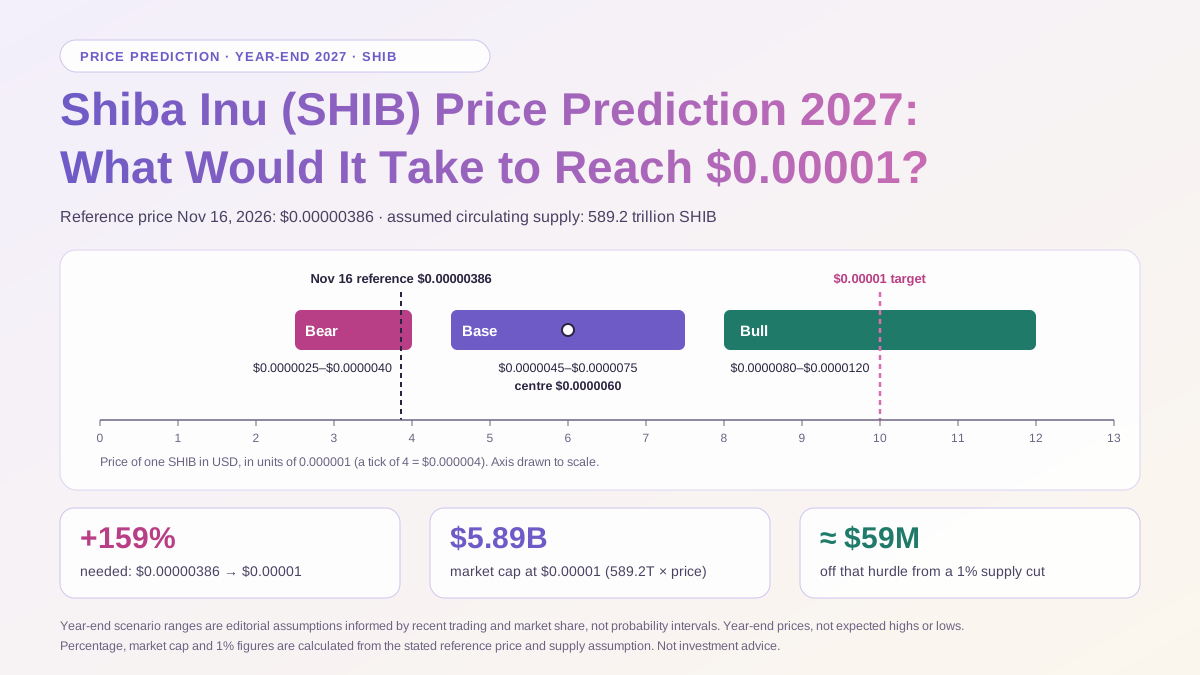
Shiba Inu (SHIB) Price Prediction 2027: What Would It Take to Reach $0.00001?
See our Shiba Inu price prediction for 2027, including the $0.000006 base estimate, the market cap needed for $0.00001, and how much burns could help.
Bitcoin Profit Supply Ratio Drops to 52%, Largest Decline in a Year
Former SEC Chair Predicts AI Bubble Revaluation Before 2028 Election

Mercado Bitcoin Withdrawal Update: Pix Restart and Crypto Suspension
Mercado Bitcoin set November 17 for Pix deposits and withdrawals in Brazilian reais. Read the withdrawal rules and the background to the crypto suspension.

Reasons Why Cryptocurrency Kiosks Face Increasing Regulation

Wells Fargo's Q3 Bitcoin ETF Holdings Increase to 30,553 BTC
Sam Price Reveals Bitcoin and Preferred Stock Investment Dynamics
Bitcoin developer verifies 164 million unspent coins in just 72 seconds
From ETH to BTC: What is THORChain and what can investigators track
Bitcoin Pulls Back 50%, Retail Traders Turn to Anthropic IPO
Tether’s Paolo Ardoino backs RGB for Bitcoin tokenization
Sam Price Says Bitcoin ETF Ends Consecutive Outflows
Latest articles





Latest coin listings on WEEX


