
US Supreme Court Turns Down Custodia Bank Appeal Over Federal Reserve Master Account

 Prefer us on Google


TL;DR
- The Supreme Court denied Custodia Bank's petition on November 16, leaving a lower ruling in place.
- The decision is a refusal to review the case, not a full Supreme Court opinion on crypto banking.
- Debate over limited master-account access remains a separate regulatory question.
Custodia Bank has reached the end of a significant route through the US federal courts in its effort to obtain direct access to Federal Reserve payment services. On November 16, the Supreme Court denied the Wyoming-chartered institution's petition to review the dispute. The decision leaves a lower-court ruling in place. It is not a fresh opinion deciding every question about crypto-focused banks or an announcement that all such institutions must be kept out of the payments system.
The docket states a narrow outcome
Supreme Court docket 26-62 records a straightforward entry: the petition was denied on November 16, 2026. The justices did not agree to hear oral arguments and issue a merits opinion on the dispute. In practical terms, the lower-court position remains operative, but the denial should not be presented as the Supreme Court affirmatively endorsing each part of the earlier reasoning. This procedural distinction is important. It marks the end of this review attempt while leaving future policy and account-design questions to regulators, lawmakers and separate legal processes.
Why Custodia sought the account
A Federal Reserve master account gives a qualified institution access to central-bank payment services without depending on another bank for the same connection. Custodia applied through the Kansas City Fed in 2020, arguing that its state bank charter supported its request. The application was denied in January 2023 following disputes over the institution's business model and the risks the Fed identified. Custodia challenged the outcome, contending that federal law limited the Fed's discretion. The appellate ruling instead recognised discretion to approve or deny applications in the relevant circumstances.
For related context, see our earlier report on Hong Kong's crypto licensing proposals.
The debate now moves toward policy design
The banking system is already debating whether some new financial firms should receive narrower forms of direct payments access. A proposed limited or "skinny" account would not necessarily provide the same services or rights as a full master account. That difference matters to institutions building business models around settlement speed, access costs and interest treatment. Even if a different account structure emerges, a future limited product should not be confused with the full access Custodia originally sought. The exact eligibility conditions and supervision requirements will determine whether such designs change the industry materially.
-- Price
What this means for digital-asset businesses
Crypto companies operating as banks or partnering with banks have a commercial interest in dependable dollar settlement, but charter status and payment-system access are not interchangeable. Firms may still use intermediary banking arrangements, with associated concentration and operational risks. The Custodia decision removes one possible path to overturn a prior denial; it does not prohibit new applications or resolve every question about emerging financial infrastructure. The next informative developments will be formal Fed rules, account approvals and the requirements attached to them.
The practical consequence for businesses is continuing uncertainty rather than an abrupt change to payment access. A firm can be licensed at the state level and still face a separate federal assessment of whether it may hold a Reserve Bank account. Policymakers who want to expand access must resolve supervision, settlement risk and eligibility in rules that Reserve Banks can actually apply. Meanwhile, fintech firms may keep using correspondent banks and other intermediaries, with the associated costs and dependencies those arrangements create.
For related context, see our earlier report on custody arrangements for a US bitcoin ETF.
The clearest fact is in the court record: review was denied. Whether the broader US payment system opens new pathways for digital-asset banks depends on future decisions, not on an expansive reading of this one-line order.
Reporting sources: US Supreme Court docket 26-62 · The Block chronology
Written by the News Desk and edited by Samuel Rae.
This content is provided for general informational purposes only and doesn't constitute financial, investment, legal, or tax advice. Any events, rewards, online promotions, or related information mentioned herein should not be considered a recommendation, solicitation, or invitation to purchase, sell, trade, or otherwise deal in any crypto assets. Crypto assets are highly volatile and may result in loss. The availability of WEEX services, products, and related events may vary by region. You are responsible for ensuring that your participation is in accordance with applicable local laws and regulations.
You may also like

Sam Price Reveals Bitcoin and Preferred Stock Investment Dynamics

Bitcoin developer verifies 164 million unspent coins in just 72 seconds

From ETH to BTC: What is THORChain and what can investigators track

Bitcoin Pulls Back 50%, Retail Traders Turn to Anthropic IPO

Tether’s Paolo Ardoino backs RGB for Bitcoin tokenization

Sam Price Says Bitcoin ETF Ends Consecutive Outflows

Gary Gensler: The AI Bubble May Burst Before Bitcoin's 2028 Halving

ZachXBT flags Lazarus use of Kruw’s CoinJoin: Should coordinators be held accountable?

ZachXBT challenges $3m Gate freeze over alleged tracing error

Backpack BP Token Surges 44% on CFTC Approval Talk: What We Know

BPI Becomes The Finney Foundation For Open Technology

We Need To Change Our Management: Ricardo Salinas On Mexico's Future, Bukele And Bitcoin

Dragonfly partner predicts Bitcoin could reach 400000 by 2030

How Bitcoin still competes with a 2.92% Treasury yield after inflation
Hackers Attempted to Change Crypto Addresses of 176 Companies
Blockstream and Thales Launch Institutional-Grade Bitcoin Custody System

Hedge fund cuts Bitcoin mining stocks by up to 94% in Q3

CoinGecko Acquired: Two People Started with $200, Once Valued at $500 Million

Trump Media Creditors Can Claim $1 Billion on November 30
Hong Kong-listed firm sells 300 Bitcoin for $19.2M to fund AI deal

BlackRock IBIT Records $76.5 Million Inflows, BTC ETF Market Still Faces Limited Interest

Tether-backed Twenty One Capital buys $10M in Bitcoin as stock slides
Binance’s He Yi explains AI Pro transfers after hack-day withdrawal claims
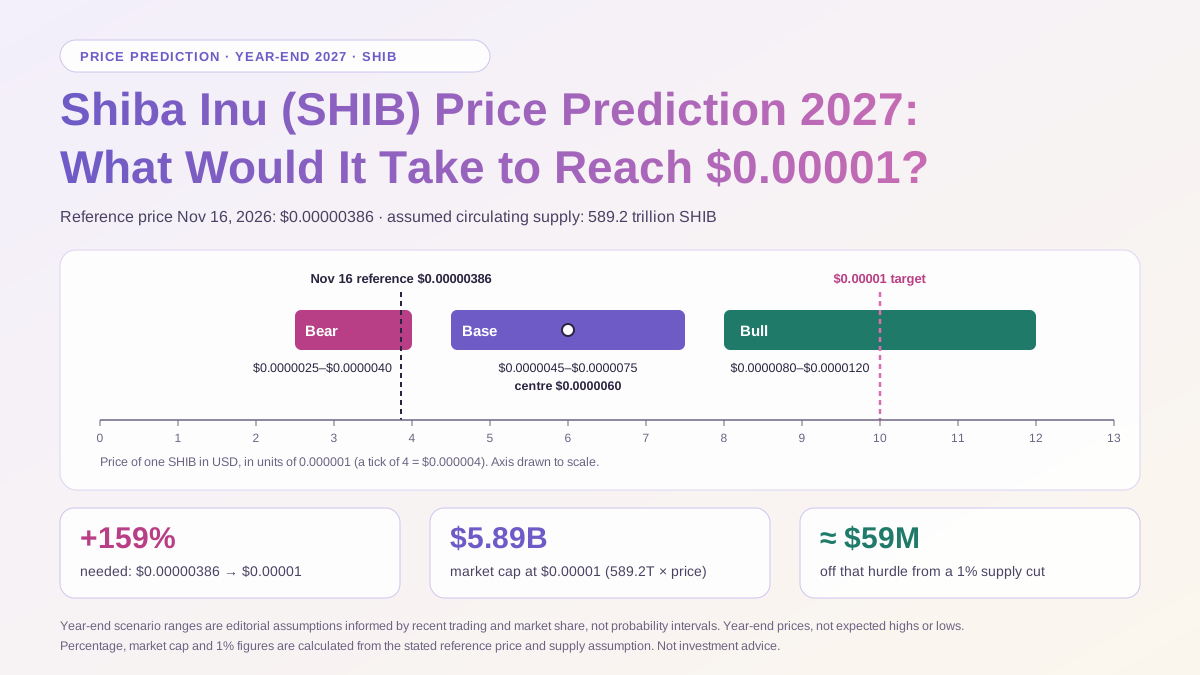
Shiba Inu (SHIB) Price Prediction 2027: What Would It Take to Reach $0.00001?
See our Shiba Inu price prediction for 2027, including the $0.000006 base estimate, the market cap needed for $0.00001, and how much burns could help.

Bitcoin Profit Supply Ratio Drops to 52%, Largest Decline in a Year
Former SEC Chair Predicts AI Bubble Revaluation Before 2028 Election

Mercado Bitcoin Withdrawal Update: Pix Restart and Crypto Suspension
Mercado Bitcoin set November 17 for Pix deposits and withdrawals in Brazilian reais. Read the withdrawal rules and the background to the crypto suspension.

Reasons Why Cryptocurrency Kiosks Face Increasing Regulation

Wells Fargo's Q3 Bitcoin ETF Holdings Increase to 30,553 BTC

A Decade of a Crypto Neutral Fund Manager: A High-Pressure Way of Life
Sam Price Reveals Bitcoin and Preferred Stock Investment Dynamics
Bitcoin developer verifies 164 million unspent coins in just 72 seconds
From ETH to BTC: What is THORChain and what can investigators track
Bitcoin Pulls Back 50%, Retail Traders Turn to Anthropic IPO
Tether’s Paolo Ardoino backs RGB for Bitcoin tokenization
Sam Price Says Bitcoin ETF Ends Consecutive Outflows
Latest articles




Latest coin listings on WEEX


