
Flop Labs Led by Arthur Hayes Launches FLOP Testnet, Initial Airdrop Scoring Not Yet Started

 Prefer us on Google



Coin Circle (120btc.CoM): Flop Labs, directly led by BitMEX co-founder Arthur Hayes, has taken a significant step forward. At 8:56 PM Beijing time on November 24, Flop Labs officially announced the launch of the FLOP testnet and previewed that various core functions would be gradually opened in the following hours. According to the initial operational parameters disclosed on the official test webpage, the entire network is currently supported by six founding validators who share the responsibilities of block production and transaction confirmation; it is important to note that scoring is not conducted during the testnet launch phase, and the testnet tokens themselves do not possess any monetary value, with related reward certificates currently unable to be earned or traded.
In an industry where it is common for well-known figures to serve as advisory names, Arthur Hayes's level of involvement with FLOP shows a significant difference—he has chosen to take full control of the development entity as a frontline operator. As early as August 18, Beijing time, Arthur Hayes publicly announced his return to the entrepreneurial front line, personally leading Flop Labs in advancing research and development, and highlighted the principle of no pre-sale, no venture capital allocation for fair distribution. Looking at his personal profile on the social platform X, the title of CEO of Flop Labs is now presented alongside that of Chief Investment Officer of Maelstrom. From the official announcement of leading the team, explaining the token distribution logic, to the formal launch of this testnet, all key external communications have been directly led by him, with actual participation depth far exceeding merely endorsing the external team.
Anchoring Decentralized AI Reasoning and Agent Settlement
From a business positioning perspective, FLOP precisely targets the decentralized AI computing power and agent payment niche. According to the official white paper structure, this project is not a parasitic smart contract application within an existing ecosystem, but an independent Layer 1 public chain built on the Substrate framework, with the core scenario being to support AI agents to directly use FLOP tokens to procure large model reasoning services from GPU suppliers across the network as needed.
Its on-chain collaboration and settlement linkages are clearly defined: the entire process begins with the AI agent submitting the required model specifications, response latency, and cost budget to the network; capable computing power miners are responsible for executing model reasoning calculations, while validators are responsible for verifying proof of work and completing account settlements. In terms of underlying mechanism design, the network has clearly decoupled "task verification" from "block consensus"—reasoning proofs are exclusively used to determine valid computing work and corresponding reward distribution, while the underlying block consensus adopts the AlephBFT algorithm, with each serving its purpose.
It is worth noting that FLOP's product landscape is not limited to the underlying public chain itself. As a front-end supporting facility, Technocore.chat is designed as a market interface for AI agents to conduct interactive communication, seek collaboration partners, publish task requirements, and preserve historical memories, operating independently of the underlying protocol. The FLOP public chain focuses on backend clearing functions, while the charging mechanism around agent memory read and write is planned to be introduced in the mainnet phase.
In terms of token utility, the white paper deliberately avoids the conventional practice of "additional packaged stablecoins," insisting that a single native token, FLOP, simultaneously covers three major functions: model reasoning payment, node operation staking, and inter-agent transaction settlement. Meanwhile, this public chain is highly focused on AI reasoning vertical scenarios and does not include any smart contract deployment or general EVM execution environment in its core product positioning.
85% of Reasoning Fees Go to Miners with Brokers Introduced
Breaking down the economic incentive model outlined in the white paper, revenue distribution is clearly tilted towards frontline computing power providers: for every reasoning fee paid by AI agents, 85% goes directly to the miners who actually execute the reasoning services, while the remaining 15% is allocated to the validators responsible for verification and settlement. In addition to the fee-sharing, miners can also receive block rewards based on the verified computation volume, and in the early stages of the network's cold start, miner income is expected to primarily rely on this block subsidy.
For traditional AI computing power buyers who are not familiar with cryptocurrency operating processes, the white paper has specifically designed a broker channel. Such buyers can directly settle fees in fiat or stablecoins through brokers, who will prepare FLOP tokens in advance to complete the underlying on-chain clearing, allowing end users to avoid direct contact with or management of crypto tokens throughout the process; as a commercial return, brokers can build their own profit models based on price differentials and network reward subsidies.
On the other hand, the implementation of a fair distribution without pre-sales or venture capital allocations does not mean that the development team lacks long-term funding sources. According to the existing draft plan, Flop Labs and the FLOP Foundation will receive an additional 8 FLOP per block as development support funds, and this issuance will be halved in sync with the network's block rewards and will cease entirely in the tenth year of network operation. The white paper also clearly defines the boundary of token rights—FLOP tokens do not carry company cash flow, buybacks, or revenue sharing.
Scoring Phase Closely Tied to Real Computing Power Distribution Airdrop
As the testnet takes its first step, market attention is gradually shifting to the upcoming scoring phase. According to the rules framework disclosed by the official, the airdrop quota for the scoring phase will be strictly linked to the network's real contribution, specifically based on the effective reasoning volume delivered by miners, the comprehensive performance of validators, and the scale of computing power consumption by AI agents completing settlements on-chain. The official clearly indicates that simply receiving and hoarding test tokens will not accumulate any airdrop quota, and all operational states on the current test chain will not be migrated in bulk to the future mainnet.
In terms of node expansion and engineering risk alerts, the testnet will initially accept the first batch of 50 validator seats for team registration, with subsequent orderly access to the network in batches. The project party also admits that some functional modules planned in the white paper are still in an unfinished state, parameter calibration, or security audit, and the testnet may experience downtime maintenance, protocol upgrades, or historical record resets at any time during the iteration process.
Stepping out of the technical framework and returning to the essence of business, whether the FLOP model can ultimately achieve a long-term closed loop still focuses on the supply and demand sides of the computing power market. On one hand, the current unit price of AI model reasoning is facing a continuous and fierce industry price war; on the other hand, the block subsidies supporting early miners are planned to be halved every two years. This means that in the future, the network must gradually bear the high hardware depreciation and daily operation and maintenance costs based on real agent reasoning usage demand to continue retaining GPU suppliers in the long term after the subsidies decline.
-- Price
This content is provided for general informational purposes only and doesn't constitute financial, investment, legal, or tax advice. Any events, rewards, online promotions, or related information mentioned herein should not be considered a recommendation, solicitation, or invitation to purchase, sell, trade, or otherwise deal in any crypto assets. Crypto assets are highly volatile and may result in loss. The availability of WEEX services, products, and related events may vary by region. You are responsible for ensuring that your participation is in accordance with applicable local laws and regulations.
You may also like

The Battle of Personal Agents: Ambition and Restraint

Payment Giant Stripe Negotiates Acquisition Offer Valued Over $200 Billion, Launches Stablecoin Spending Card with Deel

Ansem and Satoshi Nakamoto: Living Under the Same 'Stolen' Roof
Quickben22 Rechecks 2018 Bitcoin Dormant Address List: Nearly 10,000 Dormant Addresses Restart Transfers After Eight Years, Transferring a Total of 245,000 BTC

Bank of America Releases 2027 Investment Outlook: Global Stock Markets Could Rise 4%-8%! Improved Financial Environment Allows for Cryptocurrency Investments
Bitcoin developers propose fix for transaction verification gap affecting Lightning wallets

UBS Downgrades Aixtron to Sell, Expects AI Optical Communication Equipment Demand to Slow by 2028, Shares Plunge Over 10%

Unitree Stock Hits 20% Limit-Up: What Drove the November 23 Surge
Unitree Robotics (688836) hit its 20% limit-up at ¥708 on Nov 23, 2026. See the price data, the reported catalysts, the valuation context and what is unconfirmed.
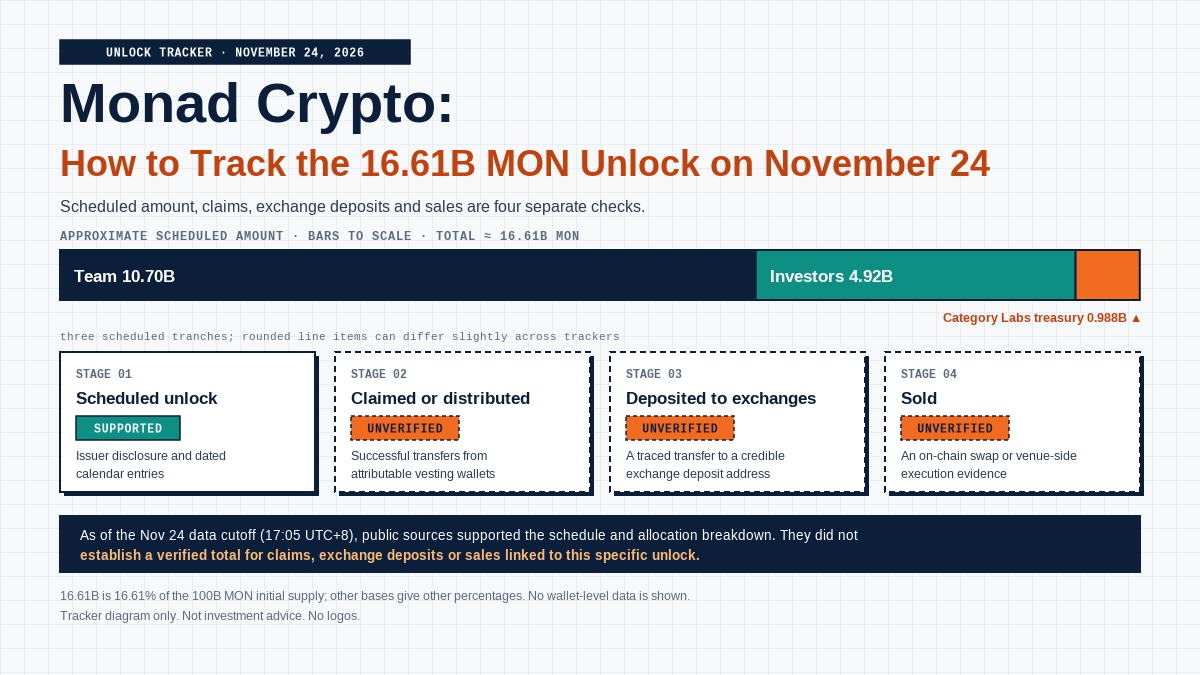
Monad Crypto: How to Track the 16.61B MON Unlock on November 24
Track Monad’s 16.61B MON unlock on November 24. See the team, investor, and treasury allocations, and learn how to verify claims and exchange deposits.

China Launches AI Standardization Pilot in Five Free Trade Zones
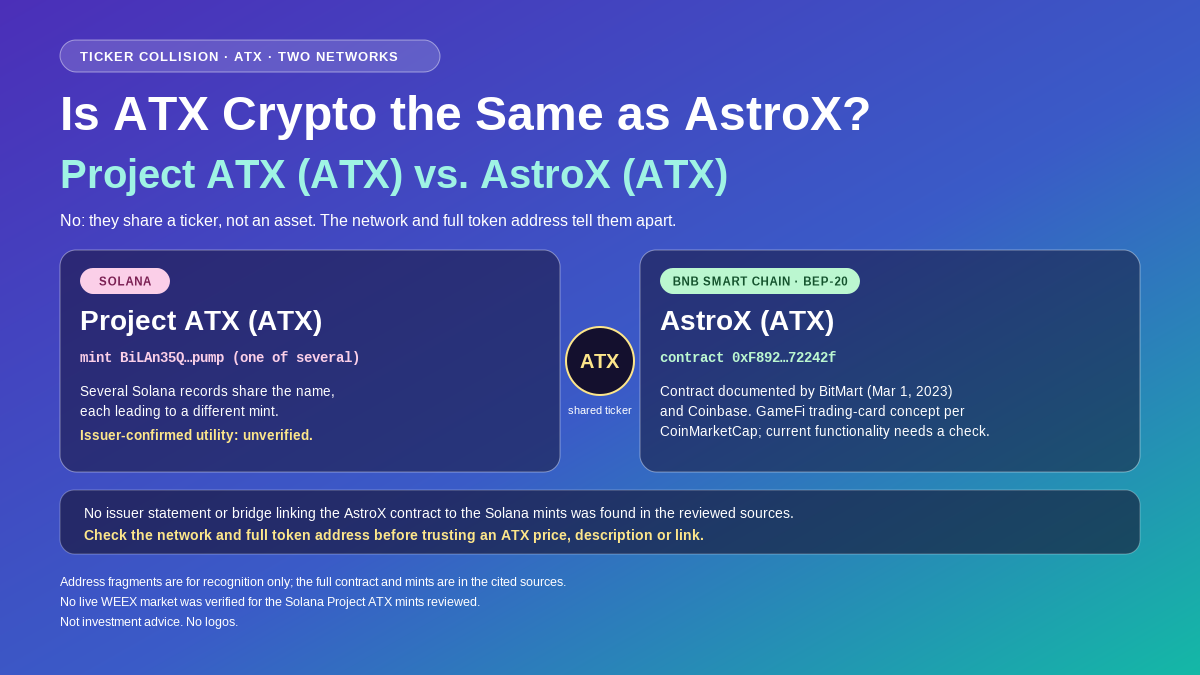
Is ATX Crypto the Same as AstroX? Project ATX (ATX) vs. AstroX (ATX)
Compare Project ATX on Solana with AstroX on BNB Smart Chain. Learn how to verify each token address before trusting an ATX price or buying guide.
Bayer Signals Future Pharmaceutical Deals May Target Mid-Stage Clinical Assets

Ethereum ETF: $96 million in net inflows stop the November bleeding
AI Agents in Payments: Cards Dominate, Yet Stablecoins Fill the 'Gap'|a16z Frontier
Grayscale Claims Bitcoin and Major Assets Are Oversold, Market Outlook Affected by AI Risks

Jensen Huang's "Miraculous Return" Forces Investment Banks to Rewrite Reports Overnight

Applied Digital Stock Surged 20% on a Hyperscaler Deal. What to Know About Its $41 Billion in Leases

Hewlett Packard Enterprise Q4 Earnings Exceed Market Expectations, Board Approves $5 Billion Stock Buyback Plan

Nvidia vs. SpaceX: The AI Revolution Is Big Enough for Both. Here's the Better Buy.

Bitcoin’s supply squeeze narrative faces scrutiny after 11,000 BTC moves to Kraken

Reactions Prove 167-Year-Old Riemann Hypothesis with Help from Claude; Are We Close to Superintelligence?
3 Unstoppable AI Stocks to Buy Hand Over Fist Before the End of 2026

Texas Pacific Land Company Acquires EagleRock Land in $3 Billion All-Stock Deal

Central Bank Anti-Money Laundering Bureau Emphasizes Need for Enhanced Cooperation Against Cross-Border Money Laundering Networks
Sandisk Just Split Its Stock 8-for-1. Is It Time to Buy?

XRP Ledger lending upgrade just 5 votes away from approval

Media: Jensen Huang and His Wife Have Accumulated Vast Wealth

The Scarce Dividend in the Autonomous Taxi Race: Supporting Service Stations

Hong Hao Believes US Stocks Have Peaked, Rebound Unlikely to Reach New Highs

dtcpay Supports Visa Stablecoin Fund Flow to Expand Cross-Border Payments
The Battle of Personal Agents: Ambition and Restraint
Payment Giant Stripe Negotiates Acquisition Offer Valued Over $200 Billion, Launches Stablecoin Spending Card with Deel
Ansem and Satoshi Nakamoto: Living Under the Same 'Stolen' Roof
Quickben22 Rechecks 2018 Bitcoin Dormant Address List: Nearly 10,000 Dormant Addresses Restart Transfers After Eight Years, Transferring a Total of 245,000 BTC
Bank of America Releases 2027 Investment Outlook: Global Stock Markets Could Rise 4%-8%! Improved Financial Environment Allows for Cryptocurrency Investments
Bitcoin developers propose fix for transaction verification gap affecting Lightning wallets
Latest articles


Latest coin listings on WEEX


