
Mathematicians Disheartened by OpenAI Are Now Building Their Own AI Models from Scratch

 Prefer us on Google


The conflict between the mathematics academic community and large AI companies is escalating. After OpenAI announced that it had used AI to tackle several mathematical problems, it not only failed to gain widespread recognition from the academic community but also sparked intense debates about the ownership of research results, data usage rights, and the value of AI in problem-solving. Some mathematicians believe that commercial companies are turning mathematical research results into products and marketing materials without adequately respecting the contributions and rights of the academic community.
In this context, an increasing number of mathematicians are attempting to bypass commercial AI companies by independently developing open-source models and research tools. Reports indicate that Professor Sergei Gukov from Caltech is leading a team to build AI models specifically for mathematical research; Fields Medal winner and UCLA professor Terence Tao is promoting the establishment of an AI collaboration platform controlled by mathematicians.
The focus of this debate has extended beyond whether AI can solve mathematical problems to who controls research data, how to evaluate AI-generated mathematical results, and whether the academic community can retain autonomy amid the rapid expansion of commercial AI.
Academics Question OpenAI: Controversy Over Problem-Solving Results and Data Usage
Mathematicians' dissatisfaction with OpenAI has a long history, and this controversy centers on two main issues: whether AI-generated mathematical answers have genuine research value and whether commercial companies have the right to use academic data and research results.
In October of this year, OpenAI announced that its model had solved several long-standing mathematical problems, but this news did not receive universal acclaim in the mathematics community. Some researchers believe that the answers released by OpenAI lack sufficient academic value and that human mathematicians may need to spend weeks determining whether the derivation process is rigorous and whether it truly solves the problem.
Caltech mathematics PhD student and outspoken anti-AI Substack blogger Tasmin Chu referred to these answers as "garbage." She believes that OpenAI's actions resemble leveraging research results in the mathematics field to create momentum for itself rather than genuinely advancing mathematical research.
The issue of data usage has further exacerbated tensions between the two sides. Previously, two mathematicians accused OpenAI of using their chat records without authorization to assist in solving the famous Navier-Stokes problem. This incident has heightened mathematicians' concerns that their interactions with AI systems may be used for commercial model training or research without permission.
Chu views the initiative of mathematicians to develop their own AI systems as part of the struggle for "ownership of the means of production." However, she also acknowledges that it remains to be seen how this trend will ultimately develop.
Bypassing Commercial Companies: Mathematicians Begin Building Specialized Models
In the face of the dominance of commercial AI companies, Gukov has chosen to start with model development. In a Caltech laboratory, he leads a small group of students in designing and training open-source AI models aimed at mathematical research. According to him, these models have already solved some of the mathematical problems that OpenAI has tackled.
However, the academic community's self-built models still face significant capability limitations. Gukov likened them to a Ferrari: excellent performance on specific tasks but difficult to meet the needs of a broad user base.
Currently, these models are mostly optimized for a specific type of mathematical problem, and their capabilities become significantly limited when asked to perform cross-domain reasoning. In contrast, models from commercial AI companies like Anthropic possess greater versatility and can handle mathematical problems across different disciplines. Gukov stated that the team is working on developing models with stronger general capabilities, but they are not yet ready.
Despite this, he remains optimistic about AI's involvement in mathematical research, believing that this field is full of exploratory potential. He described current AI research as akin to Columbus exploring new lands, which is exciting.
Mathematicians Have Not Reached Consensus: Terence Tao Promotes the Establishment of an Autonomous Platform
The initiative to build self-developed models does not imply that the mathematics community has formed a unified stance. There are still significant differences among scholars regarding whether AI should enter mathematical research.
Anti-AI scholars like Chu hope to maintain traditional research methods as much as possible. She stated that she still wishes to conduct mathematical research without relying on AI and believes that this path remains viable. Another group of younger mathematicians is more positive about AI, believing that new technologies may bring breakthroughs to mathematical research, while some see it as an opportunity to change existing research models.
Terence Tao is attempting to find a balance between the two. Recently, he showcased Open Math OS, a platform launched by his nonprofit organization at Caltech. This platform integrates cutting-edge open-source AI models, cloud computing resources, and collaboration tools, focusing on allowing mathematicians to decide how research data is used rather than completely handing over data control to commercial AI companies.
From specialized models to autonomous collaboration platforms, mathematicians are trying to establish a technological system different from that of commercial AI companies. Their core demands include not only enabling AI to better solve mathematical problems but also retaining control over research data, knowledge results, and their usage.
As AI's involvement in mathematical research continues to increase, the contradiction between the technological advantages of commercial models and the academic community's data autonomy will persist. Whether mathematicians can establish an independent research ecosystem capable of competing with large AI companies remains a key issue in this debate.
-- Price
This content is provided for general informational purposes only and doesn't constitute financial, investment, legal, or tax advice. Any events, rewards, online promotions, or related information mentioned herein should not be considered a recommendation, solicitation, or invitation to purchase, sell, trade, or otherwise deal in any crypto assets. Crypto assets are highly volatile and may result in loss. The availability of WEEX services, products, and related events may vary by region. You are responsible for ensuring that your participation is in accordance with applicable local laws and regulations.
You may also like

White House Plans to Reduce Use of Special Government Employee Status, Involving Musk and David Sacks
Port Security Personnel at Los Angeles Reach Temporary Agreement to Avert Strike Threat

Follow the Money: Variational Raises $110 Million, Tether Activity and M&A Deals

US Data Center Construction Costs Surge 13% in 2026

South Korean lawmaker says blockchain could be the answer to ‘AI totalitarianism’

Where is Nvidia Investing Its Money?
Ethereum Glamsterdam Upgrade May Be Delayed Until May 2027
UK Grid Reform Leads to Extended Project Connection Times
SpaceX's Two Major Business Growth Prospects Favorably Viewed by Wall Street! Starship Launch Economic Benefits Are Impressive, AI Data Center Investment Expected to Break Even in One Year
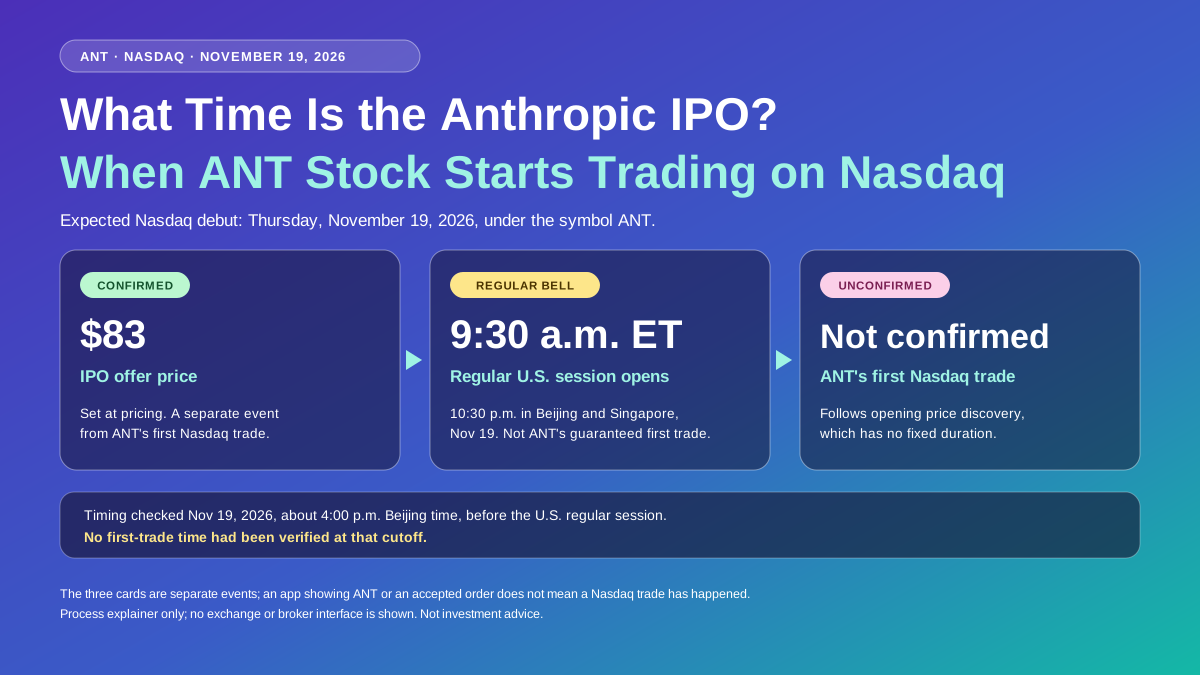
What Time Is the Anthropic IPO? When ANT Stock Starts Trading on Nasdaq
What time is the Anthropic IPO? Check ANT’s November 19 Nasdaq debut, global opening-bell times, the $83 offer price, and why orders may stay pending.
Solana co-founder pitches onchain basket to track global economy

Japan’s yen stablecoin issuer JPYC extends app outage with no recovery date

China Passenger Car Association: Negative Growth in Domestic Retail in November

Axe Compute Reports Q3 Revenue of $7.24 Million, Up 125% Quarter-over-Quarter, Cash Reaches $148 Million
Technical Failures Disrupt Key Systems in the U.S., from Flight Cancellations to Banking Delays
Further Arrests in the Zondacrypto Scandal. Prosecutor Talks About Three Individuals
Service Disruptions at Major U.S. Banks Affecting Customer Accounts and Payments

Shenzhen PCB Leaders Have Orders for High-End Products Until 2028
Orders for Diesel Generators Extended to October 2027
Trezor found implants in reseller wallets. What protects the buyer?
Why is the only spot Bitcoin ETF in continental Europe acquired by an Asian group, BIT?
Samsung Partners with Google to Challenge Meta's Monopoly in the AI Glasses Market
What Licenses Are Needed for Crypto Payments in Hong Kong?

Nakamoto Q3 Financial Report: Holds 4,283 BTC, Net Profit of $85.5 Million
CFTC, DOJ sue Arkansas to stop Kalshi gambling lawsuit
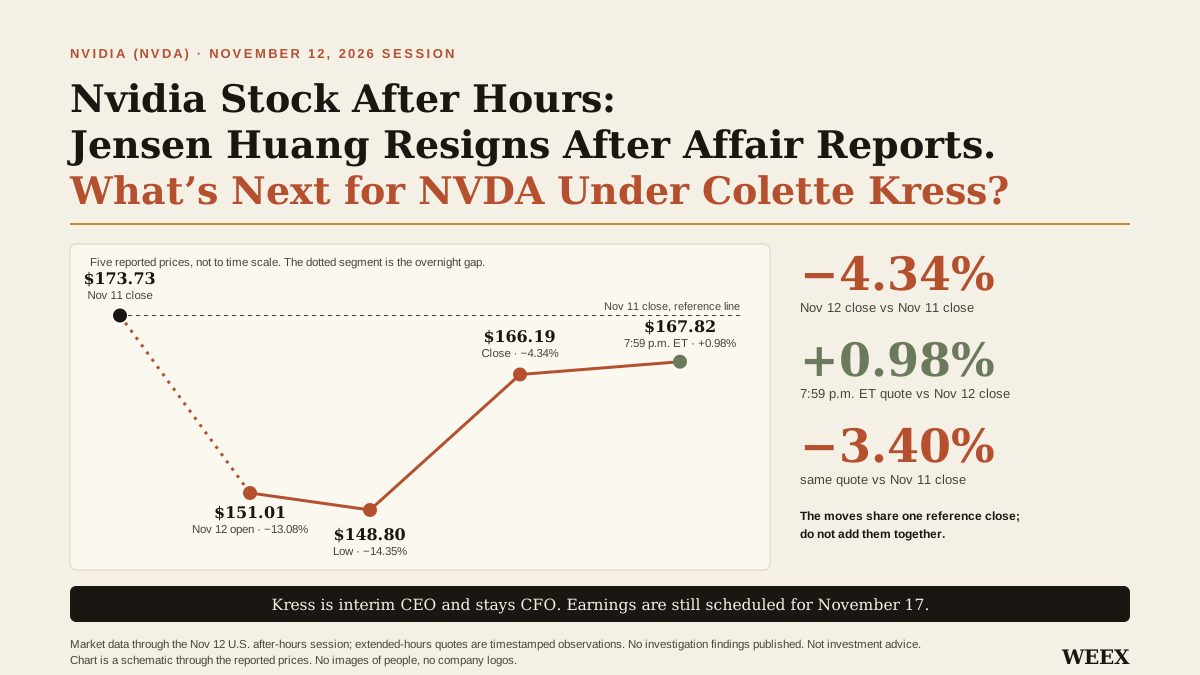
Nvidia Stock After Hours: Jensen Huang Resigns After Affair Reports. What’s Next for NVDA Under Colette Kress?
Nvidia fell 4.34% after Jensen Huang resigned, then rose 0.98% after hours. See what Colette Kress’s appointment means for NVDA and November 17 earnings.

The market demanded liquidity and the Economy granted it: what to expect for interest rates after the Treasury auction

FTX's Fourth Anniversary: When Bankruptcy Becomes a Business
South Carolina's $2 Billion Factory Nears Completion, Scott Motors Secures 212,000 Vehicle Reservations

Ethlabs Proposes Post-Quantum and AI Security for Ethereum by 2027
White House Plans to Reduce Use of Special Government Employee Status, Involving Musk and David Sacks
Port Security Personnel at Los Angeles Reach Temporary Agreement to Avert Strike Threat
Follow the Money: Variational Raises $110 Million, Tether Activity and M&A Deals
US Data Center Construction Costs Surge 13% in 2026
South Korean lawmaker says blockchain could be the answer to ‘AI totalitarianism’
Where is Nvidia Investing Its Money?
Latest articles



Latest coin listings on WEEX


