
Stanford’s encryption breakthrough could unlock a new era for Bitcoin

 Prefer us on Google


Researchers from Stanford University and Byzantine Research have developed a new cryptographic scheme that could make Bitcoin bridges, scaling solutions, and smart contracts less reliant on trusted intermediaries and continuous fraud monitoring.
Summary
- Stanford University and Byzantine Research researchers have introduced Praxis, a general purpose witness encryption scheme with potential applications across the Bitcoin ecosystem.
- The technology could help developers build Bitcoin bridges and scaling solutions with less reliance on custodians and participants responsible for monitoring fraudulent activity.
- Praxis reduces ciphertext storage requirements from over 110 billion GiB in an earlier construction to 7.88 GiB at the same security level.
- The proposed construction supports existing zero knowledge proof frameworks, although its Groth16 implementation requires an honest trusted setup.
According to a research paper titled "Praxis: Practical Witness Encryption for NP," researchers David Tse, Nikhil Vanjani, and Psi Vesely have devised a method to substantially reduce the computational costs associated with witness encryption, a cryptographic technique first introduced in 2013.
Witness encryption allows information to be encrypted against a mathematical statement instead of a conventional key, meaning anyone who can produce valid proof that a predetermined condition has been satisfied can decrypt the information.
While several constructions have been proposed over the past decade, the researchers noted that previous attempts at general-purpose witness encryption have either been computationally impractical or relied on cryptographic assumptions that were subsequently challenged or broken.
Praxis, according to its authors, is the first construction to combine general-purpose functionality, mathematically established security guarantees under specified assumptions, and computational costs considered practical by the researchers.
How could Praxis expand Bitcoin's capabilities?
Bitcoin's limited scripting language makes it difficult for developers to directly verify complex mathematical proofs on the network, particularly when building applications that involve computations performed on other blockchains.
Existing solutions such as BitVM work around this limitation by allowing computations to take place outside Bitcoin, with participants able to challenge fraudulent claims through transactions submitted to the main network.
In January, Bitcoin zero-knowledge rollup Citrea launched its mainnet with a BitVM-based verification mechanism that requires at least one honest participant to challenge fraudulent activity.
Witness encryption could offer developers an alternative by making access to the information needed to spend Bitcoin conditional on the production of a valid cryptographic proof.
The researchers explained:
"A ciphertext carries its own release condition, with no key to distribute and no party trusted to release the message."
In a Bitcoin bridge, for instance, the secret needed to unlock BTC held on the original blockchain could be encrypted against a statement confirming that a corresponding withdrawal has been processed correctly on another network.
Such a construction could reduce dependence on custodians and participants tasked with monitoring bridge activity, provided the underlying protocol securely defines and enforces its withdrawal conditions.
The paper identifies Bitcoin covenants, which place restrictions on how coins can subsequently be spent, as another potential application.
How does Praxis work?
At the core of Praxis is a mechanism that allows developers to encrypt a secret against the outcome of a computer program. The person attempting to decrypt the information does not need to know the original encryption key but must possess a valid proof that the program has produced the required result.
Praxis uses a cryptographic technique known as a witness key encapsulation mechanism, which generates a secret key that can subsequently be used to encrypt messages of any length through conventional symmetric encryption.
During decryption, a person who possesses a valid witness needs to recover only one unknown mathematical value through a computational search. Someone attempting to access the same information without a valid witness faces a substantially more difficult problem involving four unknown values.
The construction relies on a mathematical security assumption known as Module-SIS, which forms part of the foundation of lattice-based cryptography.
Unlike earlier witness encryption schemes designed around specific mathematical problems, Praxis allows developers to work with general computational statements, meaning the same underlying encryption mechanism can accommodate different applications without requiring a separate cryptographic construction for each one.
Praxis reduces witness encryption costs by several orders of magnitude
For its construction, Praxis builds upon earlier research by cryptographers Hair and Sahai, whose witness encryption scheme required enormous amounts of storage and computational resources.
At a 100-bit security level, the researchers calculated that the earlier construction would require more than 110 billion GiB of ciphertext to encrypt a 100-bit key under the same mathematical statement.
Praxis brings that figure down to 7.88 GiB, with ciphertext size and encryption costs falling by more than ten orders of magnitude and decryption costs by more than six.
The scheme uses Groth16, a cryptographic proof system that allows developers to verify complex computations through compact proofs, with a single fixed verification key capable of serving different computational programs.
As such, developers could define encryption conditions using programs written in conventional programming languages such as Rust, provided their execution can be verified through a compatible proof system.
According to the paper, encryption and decryption can take seconds on a laptop, although the operations require approximately 12 GB and 5 GB of memory, respectively.
The proposed Groth16 implementation requires an honest trusted setup, since anyone who retains its secret randomness could decrypt ciphertexts generated using the corresponding verification key.
-- Price
Bitcoin developers have already explored witness encryption
Separate efforts to bring advanced transaction functionality to Bitcoin have previously encountered the computational limitations that Praxis seeks to address.
In September, researchers at Alloc Init introduced Shielded Bitcoin, a proposed privacy-focused system designed to conceal transaction participants and amounts without modifying Bitcoin's existing consensus rules.
The project intends to use a witness encryption construction known as PIPEs to facilitate Bitcoin deposits and withdrawals.
Earlier in February, Alloc Init founder Misha Komarov disclosed that the second iteration of PIPEs required roughly 330 TB of ciphertext storage, with researchers identifying a possible route toward reducing that requirement to approximately 100 GB.
This content is provided for general informational purposes only and doesn't constitute financial, investment, legal, or tax advice. Any events, rewards, online promotions, or related information mentioned herein should not be considered a recommendation, solicitation, or invitation to purchase, sell, trade, or otherwise deal in any crypto assets. Crypto assets are highly volatile and may result in loss. The availability of WEEX services, products, and related events may vary by region. You are responsible for ensuring that your participation is in accordance with applicable local laws and regulations.
You may also like
Citrea Acquires Bitcoin Privacy Mobile Wallet Crest

Bitcoin Layer Citrea Acquires Privacy Wallet Crest

Citrea Suspends Cross-Chain Transfers of ctUSD and Other Assets Due to Zentra Finance Security Incident
Impact of Bitcoin Contract Analysis on BitVM Bridge by 唐华斑竹

What is Bitlayer (BTR)? What Happened with Bitcoin Bridge?

UPBIT will list Citrea (CTR) and support BTC and USDT markets

Bitcoin: Five-Year Returns Hover Near Zero as Fed Takes Control
Bank of America Releases 2027 Investment Outlook: Global Stock Markets Could Rise 4%-8%! Improved Financial Environment Allows for Cryptocurrency Investments

The Future Prosperity of AI Rests in NVIDIA's Hands, for Better or Worse

Bitcoin developers propose fix for transaction verification gap affecting Lightning wallets

Cardano introduces on-chain surveys that anyone can independently verify

Weekend Dividends: How Franklin Templeton's Tokenized Money Fund Breaks Traditional Barriers?

Crypto: ECB Opens Credit Operations to Tokenized Assets

UBS Downgrades Aixtron to Sell, Expects AI Optical Communication Equipment Demand to Slow by 2028, Shares Plunge Over 10%
Stock Market Sell-Off: 5 Magnificent Stocks I'd Love to Buy at the Right Price

New Crypto Banks Struggle to Retain Customers with Cash Back Offers

For Wintermute, Bitcoin's rebound since July was a false signal

The Ethereum Foundation prioritizes post-quantum migration

Borrowing to Buy Food: The Reality of American Life
Where can Bitcoin count toward a US exchange’s operating reserves?

Japan Tightens Cryptocurrency Tax Audits, Tokyo Tax Bureau Pursues 3.9 Billion Yen in Undeclared Income
Unitree Stock Hits 20% Limit-Up: What Drove the November 23 Surge
Unitree Robotics (688836) hit its 20% limit-up at ¥708 on Nov 23, 2026. See the price data, the reported catalysts, the valuation context and what is unconfirmed.
Compass Group Plans to Relocate Main Listing to the U.S.

SBI Chairman Kitao Proposes Separate Taxation and Acceleration of Cryptocurrency ETFs

The Perpetual Futures Market Is Booming. That Might Not Be as Bullish for Hyperliquid as Some Investors Think.

Anthropic's IPO Sparks ETF Issuance Surge: 16 US ETFs Offer Leveraged Long, Inverse Short, and Options Income Strategies

Xiaomi Reports Q3 Revenue of 107.2 Billion Yuan, Adjusted Net Profit Plummets 56.8%, Automotive and AI Business Operates at a Loss of 3.4 Billion Yuan
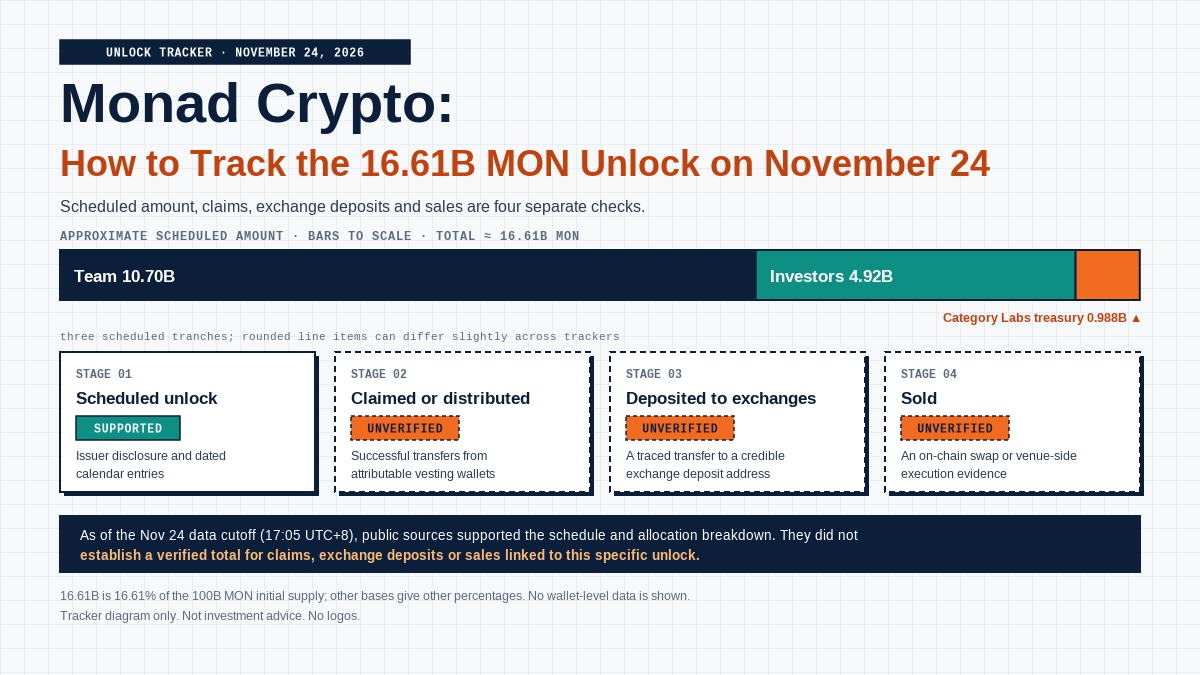
Monad Crypto: How to Track the 16.61B MON Unlock on November 24
Track Monad’s 16.61B MON unlock on November 24. See the team, investor, and treasury allocations, and learn how to verify claims and exchange deposits.
Nvidia Stock Soars 31% as Jensen Huang Returns: What Happened on November 23
Nvidia stock closed up 31.48% at $165.05 on Nov 23, 2026 after Jensen Huang was reinstated as CEO. See the numbers, the market context and what investors still watch.

CFTC Allows Bitcoin and Ethereum as Operating Reserves: Will It Boost Crypto Markets?
Citrea Acquires Bitcoin Privacy Mobile Wallet Crest
Bitcoin Layer Citrea Acquires Privacy Wallet Crest
Citrea Suspends Cross-Chain Transfers of ctUSD and Other Assets Due to Zentra Finance Security Incident
Impact of Bitcoin Contract Analysis on BitVM Bridge by 唐华斑竹
What is Bitlayer (BTR)? What Happened with Bitcoin Bridge?
UPBIT will list Citrea (CTR) and support BTC and USDT markets
Latest articles


Latest coin listings on WEEX


