
Why Can VTC6 Crypto Show High Volume but Almost No Liquidity?

 Prefer us on Google


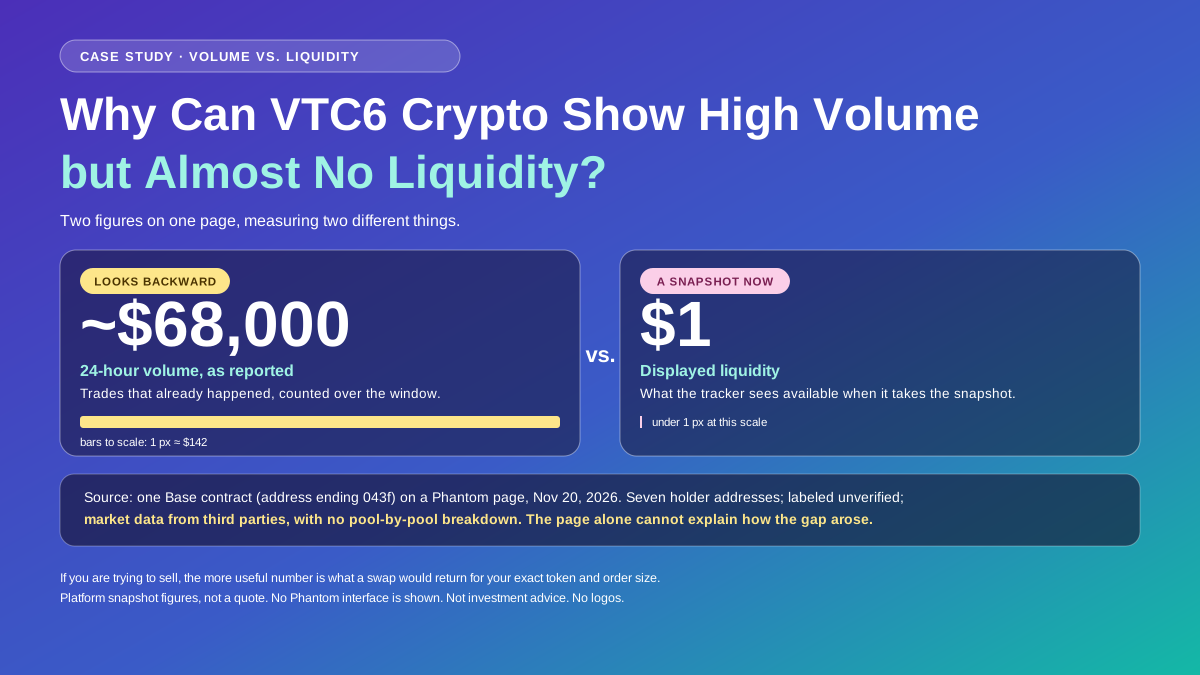
VTC6 crypto can show high trading volume and almost no liquidity because the two figures measure different things. Volume adds up trades that already happened. Liquidity reflects the assets available in the markets a tracker covers when it takes a snapshot. On November 20, 2026, a Phantom page for one Base token labeled VTC6⚡️ displayed about $68,000 in 24-hour volume and just $1 in liquidity. That combination is possible, but the page alone cannot explain how it arose.
If you are trying to sell, the more useful number is how much the swap would return for your exact token and order size. A chart price may reflect a past trade. A current quote shows what an available route estimates you could receive. The difference can be especially large for VICE 6 listings, where similar names can lead to different contracts and pools.
Recommended Reading
- VTC6 Crypto: Is It the Official GTA 6 Coin? What Take-Two Actually Proposed
- What Is VTC6 Crypto? A Beginner’s Guide to VICE 6 (VTC6)
- Is VTC Coin the Same as VTC6? Vertcoin and VICE 6 Explained
- Why Did Some VTC6 Crypto Tokens Crash After the GTA 6 Launch?
- How to Buy VTC6 Crypto: A Guide to VICE 6 (VTC6)
Author — WEEX SEO Team
Published — November 20, 2026
Updated — November 20, 2026
Quick Answer
- A busy trading window can leave behind a thin pool. Trades made earlier still count toward 24-hour volume.
- The VTC6⚡️ page showing $68,000 in volume and $1 in liquidity referred to one Base contract. Other VICE 6 listings have their own data.
- To understand a sell quote, check the exact token address, route, estimated output, minimum received and price impact.
- An unusually large gap between volume and liquidity warrants a closer look. Establishing wash trading or a liquidity withdrawal requires transaction evidence.
What Did the $68,000 Volume and $1 Liquidity Snapshot Actually Show?
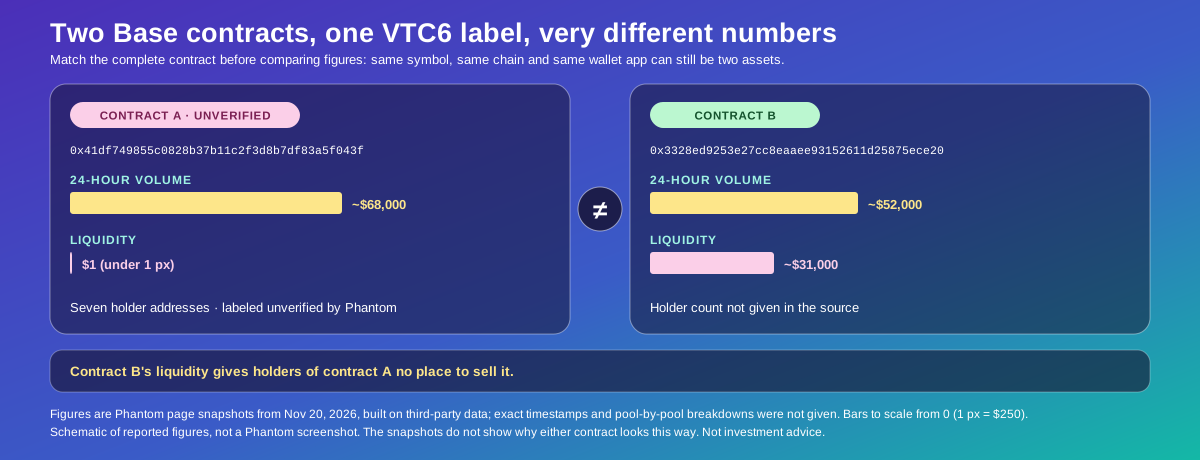
Phantom’s November 20 page identified a token displayed as VTC6⚡️ on Base, at contract 0x41df749855c0828b37b11c2f3d8b7df83a5f043f. The page showed approximately $68,000 in 24-hour volume, $1 in liquidity and seven holder addresses. Phantom labeled the token unverified and said its market data came from third parties. The source did not provide an exact timestamp for each metric or a pool-by-pool breakdown showing where the reported volume came from.
| Field on the Phantom page | What it tells you | What to check next |
|---|---|---|
| ~$68,000 in 24-hour volume | The provider’s reported trading activity over the preceding window | Which pools contributed and how recent the trades were |
| $1 in displayed liquidity | The provider’s liquidity reading for this token page | Which quote assets are available and whether a route can use them |
| Seven holder addresses | The reported number of addresses holding the token | How balances are distributed and whether any addresses are pools or service accounts |
| Unverified label | How Phantom classifies the listing | The exact contract, its source and whether there is independent evidence for any issuer claim |
Another Phantom page on Base displayed the same VTC6⚡️ label for contract 0x3328ed9253e27cc8eaaee93152611d25875ece20, with about $52,000 in volume and $31,000 in liquidity in its captured view. That is a different token contract. The second page’s liquidity does not give holders of the first token a place to sell it. Even the same wallet app, symbol and blockchain can lead to two different assets.
Why Can High Volume and Low Liquidity Exist at the Same Time?
Volume measures turnover. The same liquidity can support many transactions as traders exchange assets back and forth. More importantly, trades that took place when a pool was deeper can stay in the 24-hour total after current reserves have dropped. A tracker may also show a token-level volume figure spanning more than one market, while a quote depends on the markets a particular router can access. The Phantom page does not establish which of these explanations applies to its Base snapshot.
A separate Solana VICE 6 (VTC6) pool makes the timing difference easier to see. DEX Screener displayed about $86,000 in 24-hour volume for the PumpSwap pool ending in imG8, alongside roughly $1,300 in liquidity. The same snapshot showed just 0.1899 SOL in the pool, marked at about $14. Most of the displayed liquidity value came from the pool’s VTC6 side. This is a separate mint and market from the Base token on Phantom, but it shows how a large backward-looking volume number can sit beside a tiny quote-asset reserve.
There is another detail to watch for when a token trades in a concentrated-liquidity market. Providers can set price ranges in which their liquidity is active. The total value assigned to a pool and the depth available near the current price can therefore differ. A sell quote is useful because it reflects the route and order size the app can evaluate at that moment.
-- Price
Why Might a VTC6 Sell Quote Be Lower Than the Wallet Balance?
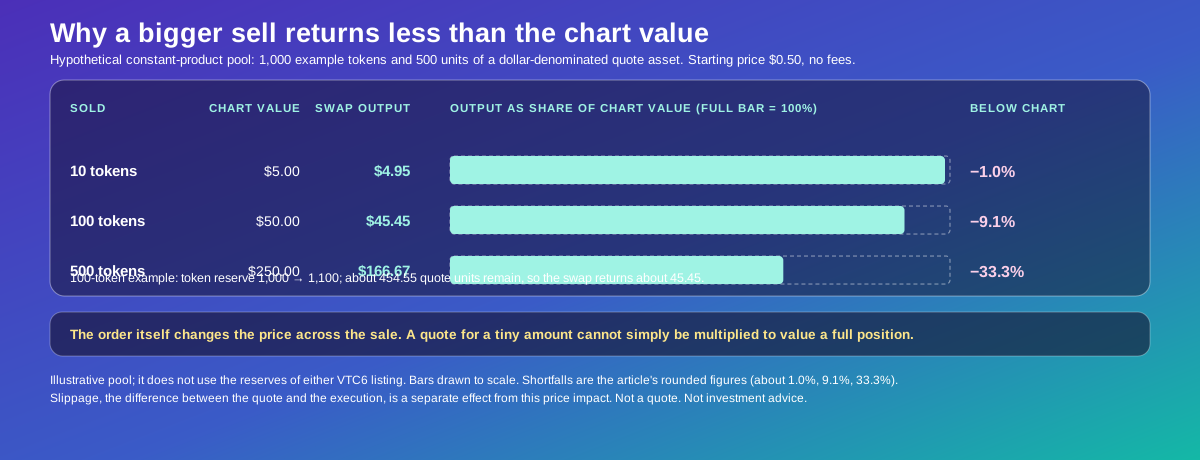
A wallet balance can be valued by multiplying the token quantity by a displayed unit price. A swap quote follows the pricing rules of the pools in the proposed route. In a shallow pool, selling pushes more of the token into the pool and takes out some of the asset on the other side. The average price you receive across the order can fall as the sale gets larger. This effect is called price impact. Slippage is the difference between what you expected from the quote and what you actually received at execution.
Consider a simplified constant-product pool with 1,000 example tokens and 500 units of a dollar-denominated quote asset. The starting marginal price is $0.50 per token. The table starts each example from the same reserves and excludes fees. It illustrates how a pool prices different order sizes. It does not use the reserves of either VTC6 listing.
| Example tokens sold | Value at the starting chart price | Illustrative swap output | Below the starting chart value |
|---|---|---|---|
| 10 | $5.00 | $4.95 | ~1.0% |
| 100 | $50.00 | $45.45 | ~9.1% |
| 500 | $250.00 | $166.67 | ~33.3% |
In the 100-token example, the sale increases the token reserve from 1,000 to 1,100. The pool’s constant-product formula leaves about 454.55 units on the quote side, so the swap returns about 45.45. No intervening trade is needed to explain the shortfall from the displayed $50 value. The order itself changes the price across the sale. This is why a quote for a tiny amount cannot simply be multiplied to estimate what a full position would return.
What Should You Check if a VTC6 Swap Shows No Quote?
Start by confirming what the app is trying to swap. A Base contract and a Solana mint are different assets even when their names match. Once you have the exact address, identify the network, the asset you want to receive, and the size of the order. Phantom’s support documentation says a quote can be unavailable when it cannot find a supported route for the pair or amount. An app can also report other issues, such as an insufficient network-fee balance, so the wording of the message matters.
- Match the complete contract or mint in your wallet with the market page.
- Review the quote for the actual amount you are analyzing. If there is a quote, check the expected output, price impact and any minimum-received value shown.
- If the app shows no quote, compare available markets for that exact asset on the same network. Different apps can have access to different pools.
- Read the failure message before changing settings. A fresh quote may address a stale one. A wider slippage tolerance cannot create liquidity or make an unsupported route available.
A small quote can help you diagnose whether a route exists at all. A substantially worse quote at a larger size points to limited depth along that route. Compare both at roughly the same time, since pool balances and price impact can change between requests. See the WEEX guide to DEX swaps for more on reading price impact and slippage.
Does This Prove Fake Volume or a Rug Pull?
The Phantom figures alone leave that question open. To investigate whether the reported volume reflects repeated activity by related wallets, you would need the trades behind the figure, including timestamps, amounts and wallet addresses. Repeated swaps can justify a closer look, but timing alone does not establish common ownership. Seven displayed holders also tells you little about how many addresses traded during the earlier 24-hour window. The two metrics represent different populations and periods.
A claim that someone removed liquidity calls for different evidence. A swap can reduce the quote-asset reserve because the pool pays sellers. A liquidity withdrawal can also reduce reserves, but it appears as a different operation in protocols such as PumpSwap. That distinction explains what to check in the Solana comparison. For the Base contract in the Phantom case, first identify its actual pool and protocol, then interpret the instructions recorded there. The snapshot supplies no verified withdrawal transaction for that Base listing.
Our View & Suggestion
The VTC6 example is useful because the largest number on the page answers the least immediate question for someone trying to sell. The $68,000 figure describes reported past activity. An executable estimate depends on the exact contract, the route, the size of the order and the reserves available now. When reporting on a token with several lookalikes, publish the address and observation time alongside the volume figure. When trying to interpret a wallet balance, start with the quote for that position size.
FAQ
1. Can a Token Have $68,000 in Volume and Only $1 in Liquidity?
Yes. The first number describes reported trades over a period. The second describes available liquidity at a point in time or within the data provider’s coverage. Phantom displayed both on its November 20 page for a specific Base VTC6⚡️ contract.
2. Why Can I See a Price but Get No Quote for My Order?
The app may display market data even when it cannot find a supported route for your asset pair or order size. If a quote exists, its expected output can still be substantially below the wallet’s displayed valuation in a shallow market.
3. Does Locked Liquidity Guarantee a Good Sell Price?
A lock, where present, applies to the liquidity covered by its terms. Your sell quote still depends on pool depth, asset reserves and order size. Trading can alter the reserve balance even while a liquidity position remains locked.
4. Can I Use a Different VTC6 Pool When One Has No Liquidity?
A different pool may provide a route if it trades the exact same token on the same network. Confirm the complete mint or contract first. A pool for a similarly named asset with a different address cannot serve as a direct exit for the token you hold.
Sources
- Phantom, November 20, 2026. Base VTC6⚡️ listing ending in
043fand separate Base listing ending ince20. - DEX Screener, reviewed November 20, 2026. Solana VTC6/SOL PumpSwap pool.
- Phantom Support, accessed November 20, 2026. Unable to swap a token due to low liquidity and Swap tokens in Phantom.
- Uniswap Labs, accessed November 20, 2026. Pool token pricing and Price impact vs. price slippage.
- PumpSwap public documentation, accessed November 20, 2026. Swap and liquidity instructions.
This content is provided for general informational purposes only and doesn't constitute financial, investment, legal, or tax advice. Any events, rewards, online promotions, or related information mentioned herein should not be considered a recommendation, solicitation, or invitation to purchase, sell, trade, or otherwise deal in any crypto assets. Crypto assets are highly volatile and may result in loss. The availability of WEEX services, products, and related events may vary by region. You are responsible for ensuring that your participation is in accordance with applicable local laws and regulations.
You may also like
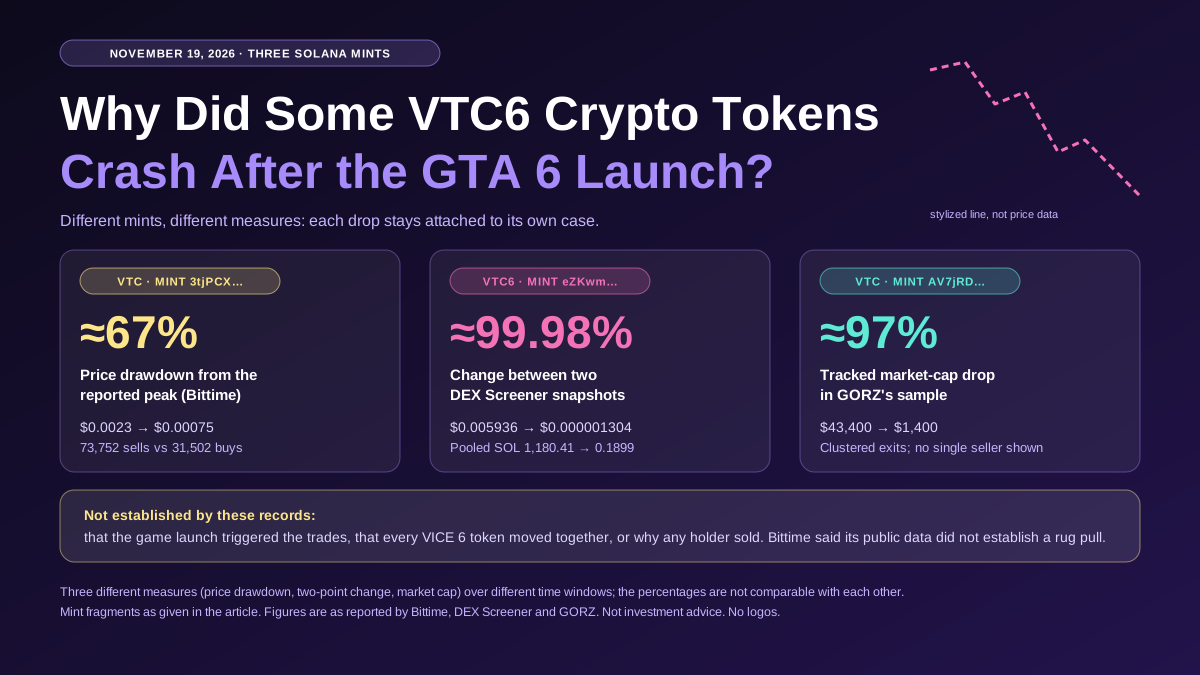
Why Did Some VTC6 Crypto Tokens Crash After the GTA 6 Launch?
See why some VTC6 crypto tokens fell around the GTA 6 launch. Compare three Solana mints, sell activity, pool reserves and the evidence for a rug pull.
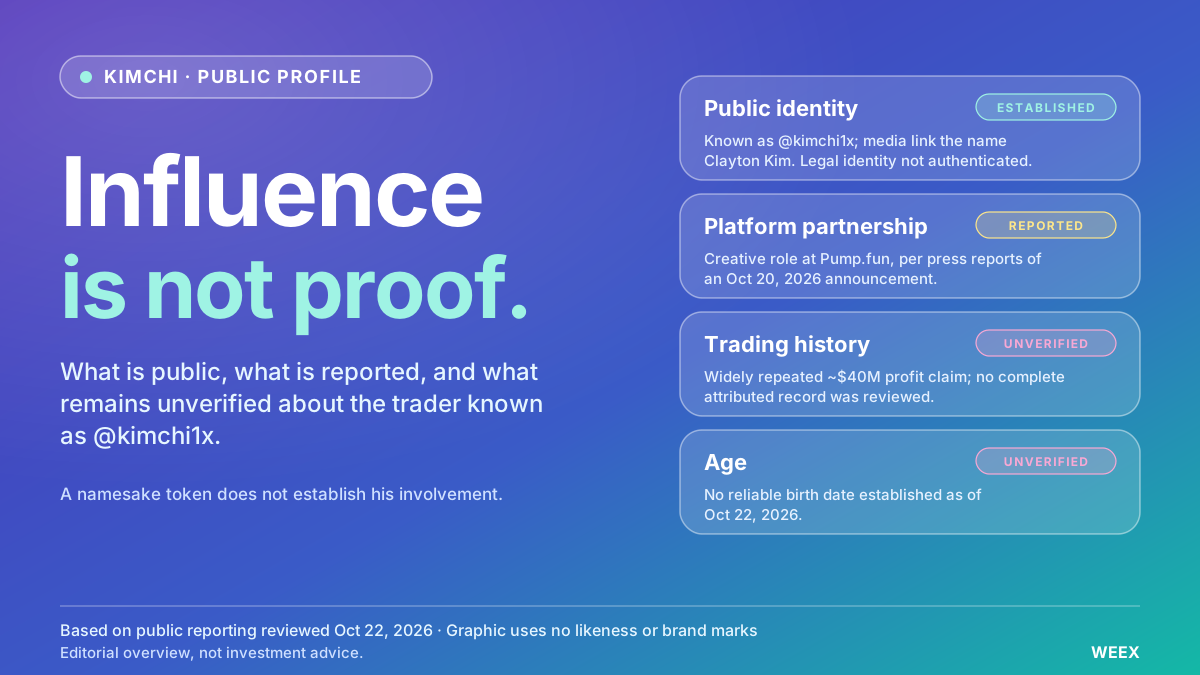
Who Is Kimchi Crypto Trader? Age, Real Name, and Trading Background
Who is Kimchi crypto trader? Check what is known about his age, the name Clayton Kim, trading background, profit claims, and Pump.fun partnership.
PUMP Price Hit a New Post-October High as Pump.fun Out-Earned Hyperliquid: What the Revenue Gap Really Shows
PUMP rose to roughly $0.0064, its highest level since the October 2025 "1011" selloff, after Pump.fun edged past Hyperliquid in 30-day protocol revenue. The headline is real, but the revenue gap is only a couple of percent, and the token is still well below its record high.

Pump.fun Reports Weekly Revenue of $10.74 Million, Highest Since Late January

Curve Founder Criticizes Pump.fun, Sparking Solana Controversy
$3,800 for 6.6 million: ai16z Accused of Insider Trading

web3: Solana, BNB, and Sui Push Upgrades as Altcoin Divergence Intensifies
Top Four Market Makers Suffer Collective Losses of $23.5 Million in the Past 30 Days, Two May Have Suspended Liquidity Provision

DEX Spot Volume Reaches 24% of CEX Volume in July
Why the Billion-Dollar Revenues of Crypto Projects Did Not Lead to Token Growth

Pump.fun Fires Employees Two Months Before They Receive Their PUMP Tokens

Pump.fun Employees Miss Out on Seven-Figure PUMP Tokens Before Layoffs
Castle Labs: $726 Million Revenue from 6 Protocols in the First Half of the Year, Negative Net Value Inflow for Token Holders

ARK Invest researcher predicts more crypto shutdowns
Hyperliquid and Two Other Platforms Account for Nearly 80% of Total Application Revenue
Experts Warn Against Projects Impersonating XRP

Pump.fun Developer Company Hiring Head of Growth Marketing with Salary Up to $1 Million
Pump.fun Launches BOOST Mode to Enhance Liquidity of New Migrated Tokens by Approximately 20%
LAB Token Unlock Day: Team-Related Entities Continue Selling, Allocation Value Drops to $4 Million
Pump.fun Repurchases and Destroys Nearly 15% of PUMP Supply, Protocol Revenue Reaches $5.9 Million

NOXA.Fun Protocol Fees Reach $2.33 Million, Four Times That of Pump.fun
Pump.fun Hiring Legal Director in New York with Salary Up to $5 Million
Pump.fun App Launches Robinhood Chain Token Trading Feature
Cash Flow Showdown in a Bear Market: Spotlight on 8 Crypto Projects with Buybacks

Data: Pump Fun deposited 68,600 SOL to Kraken in the early morning, worth 5.65 million USD
Pump Sells 4.73 Million SOL, Generating $805 Million in Fees
Pump Fun Deposits 68,596 SOL to Kraken, Worth $5.65 Million

ANSEM Updates Ecosystem, Bitcoin ETF Sees Net Inflow of $266 Million
pump.fun Weekly Report: Weekly Revenue of $7.2 Million, Cumulative Burn of 41.8% of Circulating Supply

ANSEM Ecosystem Update: Creator Fees Supplement LP, Airdrop SOL to Community Contributors
Why Did Some VTC6 Crypto Tokens Crash After the GTA 6 Launch?
See why some VTC6 crypto tokens fell around the GTA 6 launch. Compare three Solana mints, sell activity, pool reserves and the evidence for a rug pull.
Who Is Kimchi Crypto Trader? Age, Real Name, and Trading Background
Who is Kimchi crypto trader? Check what is known about his age, the name Clayton Kim, trading background, profit claims, and Pump.fun partnership.
PUMP Price Hit a New Post-October High as Pump.fun Out-Earned Hyperliquid: What the Revenue Gap Really Shows
PUMP rose to roughly $0.0064, its highest level since the October 2025 "1011" selloff, after Pump.fun edged past Hyperliquid in 30-day protocol revenue. The headline is real, but the revenue gap is only a couple of percent, and the token is still well below its record high.
Pump.fun Reports Weekly Revenue of $10.74 Million, Highest Since Late January
Curve Founder Criticizes Pump.fun, Sparking Solana Controversy
$3,800 for 6.6 million: ai16z Accused of Insider Trading
Latest articles


Latest coin listings on WEEX


