
NEAR Inflation Cut to 1.6%: Why the Price Fell Anyway This Week

 Prefer us on Google

NEAR Protocol's governance body, the House of Stake, has approved a proposal to lower NEAR's maximum annual inflation from 2.5% to 1.6%, phased in over 24 months. On paper that is good news for holders: fewer new tokens each year means less dilution. The market did not treat it that way. NEAR fell about 18% in the two weeks to Nov. 2, 2026, roughly three times bitcoin's 5.6% drop over the same period, and traded around $3.80 early on Nov. 3.
The two facts do not contradict each other. A supply change that starts after a 90-day grace period and takes two years to complete does very little for this month's price. What moved NEAR this week was profit-taking after a 165% gain this year, a market-wide pullback, and fear that stolen NEAR from the Binance hack could be sold.
This piece separates the slow story from the fast one: what the inflation cut actually changes, why the price fell anyway, and the levels and events traders are watching next.
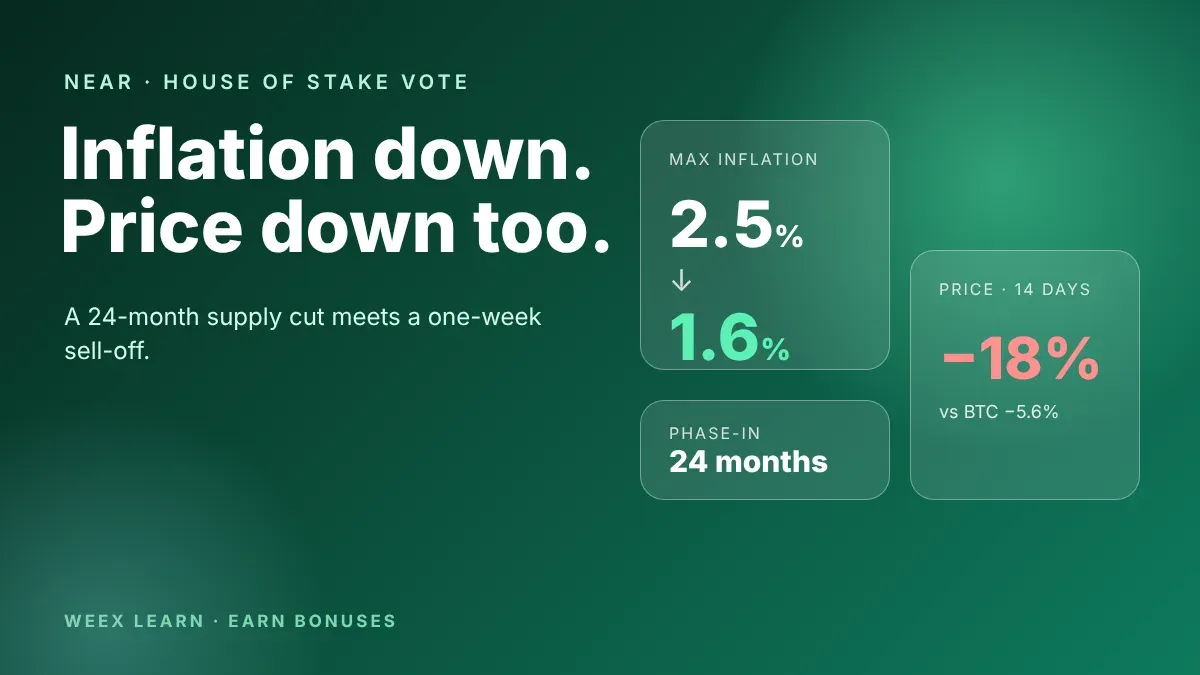
What the NEAR Inflation Cut Changes
The approved proposal changes NEAR's issuance in three steps:
- Review: The House of Stake Security Committee reviews and approves the change.
- Grace period: A 90-day window follows, giving validators and node operators time to prepare.
- Rollout: Validators adopt the change through a protocol upgrade, and the maximum issuance rate steps down each epoch until it reaches 1.6% at month 24.
Quarterly reports will compare actual issuance with the planned schedule. No calendar dates for the start or finish have been published yet.
The size of the change is easy to estimate. Cutting the cap by 0.9 percentage points means about 9 fewer new NEAR per 1,000 in supply each year once the cut is complete. That supports holders over years, not weeks. For stakers, who receive most new issuance as rewards, it also likely means lower staking yields over time, since rewards come from the same newly minted tokens.
Why NEAR Fell 18% in Two Weeks
Daily data from 24/7 Wall St. shows where the damage came from:
- Oct. 22-23: NEAR closed at $4.88, then $4.68, as bitcoin's pullback began.
- Oct. 29: NEAR opened at $4.73 and closed at $4.05, with volume jumping from 4.9 million to 12.3 million, the day the Binance hack hit markets.
- Oct. 30: an intraday low of $3.90, then a bounce to $4.29.
- Nov. 1: volume fell to 2.9 million as selling thinned out.
Three forces stacked up. First, NEAR had risen about 165% year to date and hit a one-year high of $5.89 on Oct. 11, so profit-taking was likely. Second, smaller-cap tokens fall harder than bitcoin in sell-offs because their order books are thinner. Third, the Binance hacker held NEAR among the stolen assets, and reports said stolen NEAR began moving on Nov. 1, raising fear of a dump.
In practice, a governance win announced in the middle of a hack-driven sell-off rarely gets noticed by price. Our breakdown of the $1.57 billion liquidation cascade on Oct. 30 shows how leverage magnified the same move across the market.
NEAR Price Levels Traders Are Watching
Based on the Nov. 2 data, the levels most traders watch are:
- Support: about $4.00 and the Oct. 30 low near $3.90. A daily close below $3.90 opens the way toward $3.42, the Sept. 20 low, and then $3.07.
- Resistance: the 50-day moving average around $4.55 and the 20-day near $4.74. A close above $4.55 on rising volume would be the first sign of a reversal.
- Longer-term trend: the 200-day average sits near $2.53. NEAR remains above it, which keeps the year's uptrend intact on that measure.
NEAR traded below $3.90 early on Nov. 3, so the first support has already been tested. Treat these levels as reference points, not predictions.
-- Price
How to Trade NEAR Through the Noise
For anyone holding or trading NEAR in the next few weeks, a few practical points:
- Separate the two clocks. The inflation cut is a 24-month story. The hack overhang and leverage are this-week stories.
- Watch the hacker's wallets. Large transfers of stolen NEAR to exchanges would be the clearest near-term risk.
- Size for volatility. NEAR fell three times as fast as bitcoin in this pullback. Use smaller positions or lower leverage on NEAR futures, or hold spot on the WEEX NEAR/USDT market.
- Check the vote follow-through. The Security Committee review and the start of the 90-day grace period are the next governance dates to confirm.
The better reading is that NEAR's long-term supply picture just improved while its short-term risk did not. Price will follow the second until the first has time to matter.
FAQ
1. What did NEAR governance approve?
The House of Stake approved cutting NEAR's maximum annual inflation from 2.5% to 1.6%, phased in over 24 months after a security review and a 90-day grace period.
2. When does the NEAR inflation cut take effect?
After the Security Committee review, a 90-day grace period follows, then validators adopt the change through a protocol upgrade. The rate falls gradually each epoch and reaches 1.6% at month 24. No calendar dates have been published.
3. Why did NEAR's price fall after the vote?
The cut works over two years, while the drop was driven by short-term factors: profit-taking after a 165% yearly gain, a market-wide pullback, and fear that stolen NEAR from the Binance hack could be sold.
4. Will lower inflation reduce NEAR staking rewards?
Likely, over time. Staking rewards are paid mainly from new issuance, so a lower inflation cap generally means lower yields once the cut is phased in.
This content is provided for general informational purposes only and doesn't constitute financial, investment, legal, or tax advice. Any events, rewards, online promotions, or related information mentioned herein should not be considered a recommendation, solicitation, or invitation to purchase, sell, trade, or otherwise deal in any crypto assets. Crypto assets are highly volatile and may result in loss. The availability of WEEX services, products, and related events may vary by region. You are responsible for ensuring that your participation is in accordance with applicable local laws and regulations.
You may also like
NEAR Protocol HSP-029: Max Issuance Falls From 2.5% to 1.6%, but When Does the Change Take Effect?
NEAR Up 4.8% After HSP-029 Issuance Vote Passes

Top 7 AI Crypto to Buy in October 2025
Telegram GRAM Wallet Hits 700K Sign-Ups: Are Users Really Active?
ALLO Token Unlock: 160M Tokens Hit Allora's First-Year Cliff
NYSE Picks Avalanche for Settlement: What It Means for AVAX
Bitcoin After Hot CPI: Why December Rate Hike Odds Hit 85%
CoreWeave Q3 Earnings: Why $3.66B in Revenue Still Lost $709M

WEEX P2P Now Supports ILS, BHD, OMR and QAR: How to Buy Crypto With Local Currencies
What Is GRAM? Price Rebounds After Falling Below $1, Telegram Wallet Data and What Is Confirmed
Why Is My WEEX Crypto Withdrawal Still Pending?
What Should I Do If I Forgot the Memo or Tag When Depositing to WEEX?

Which Futures Exchanges Have the Lowest Trading Fees? What to Compare

USDC Staking on WEEX: How to Stake USDC, Rates and Rules

Can I Recover Crypto Sent to WEEX Using the Wrong Blockchain Network?
Why Is My WEEX Deposit Confirmed but Not Credited?

NYSE Picks Avalanche for Tokenized Stocks: Will AVAX Benefit?
PROJECT CORTEX (XTX) Price: Why a 15.8M% Gain and a $6 Billion Market Cap Are Hard to Trust
USOE Price Drop: Why Did United States Oil Exchange Fall Over 90% in a Week?
NYSE-Linked Avalanche Settlement News: Why AVAX Is Up and What It Does Not Prove
Copy Trading Platforms With Verified Performance: Spot the Fakes
Top 10 Crypto Derivatives Exchanges Worldwide by Open Interest
Beginner Futures Exchanges With Low Entry: What $50 Really Buys
Tesla Cybertruck Refunds: What the Line Shutdown Means for TSLA
User-Friendly Crypto Copy Trading Platforms: 6 Picks Compared

WEEX Review: The Latest Fees, Features, Security and Trading Experience

What Does It Mean to Stake Crypto? Staking on WEEX Explained
Keplr Wallet Security Alert: Is Your ATOM Safe?

NVIDIA Board Opens Probe: What's Next for NVDA?
Midterm Elections Crypto Fallout: $170M Spent, Key Races Lost
NEAR Protocol HSP-029: Max Issuance Falls From 2.5% to 1.6%, but When Does the Change Take Effect?
NEAR Up 4.8% After HSP-029 Issuance Vote Passes
Top 7 AI Crypto to Buy in October 2025
Telegram GRAM Wallet Hits 700K Sign-Ups: Are Users Really Active?
ALLO Token Unlock: 160M Tokens Hit Allora's First-Year Cliff
NYSE Picks Avalanche for Settlement: What It Means for AVAX





