
AI Agent Battle Begins: Amazon Blocks Meta's AI Agent, E-commerce Entry War Escalates

 Prefer us on Google


TL;DR
Meta's newly launched AI Agent Muse has quickly gone viral, with over 900,000 downloads in just six days, topping the free charts in two major app stores in the U.S.
Amazon has blocked Muse from accessing its retail website and has demanded that Meta remove Amazon from Muse's shopping features; previously, Amazon had also restricted external shopping agents like Perplexity.
The core conflict behind this is the battle for e-commerce entry: as AI starts to search, compare, and even place orders for users, agents could become a new intermediary layer between consumers and e-commerce platforms, impacting Amazon's sales and advertising revenue.
Unlike Amazon, Shopify has chosen to collaborate with Meta to advance Agentic Checkout.
Meta's newly launched AI Agent Muse is rapidly becoming the new focal point in the tech industry. According to Sensor Tower data, Muse surpassed 902,000 downloads within six days of its launch on September 8, exceeding the 773,000 downloads of the previous Meta AI App during the same period. As of this Monday, Muse has topped the free app charts in both the Apple App Store and Google Play in the U.S.
However, with the rapid growth of Muse's user base, a new question has emerged: when AI not only helps users search for products but also starts shopping directly on their behalf, who decides where it can buy things?
Why is Amazon Blocking Muse?
According to Bloomberg, Amazon has blocked Muse from accessing its retail website. Users shopping on Amazon using Muse will see a pop-up indicating that such actions violate Amazon's terms of use. Amazon states that third-party applications that can purchase goods on behalf of consumers should operate transparently and respect whether service providers wish to participate; currently, Amazon has requested that Meta remove it from Muse's shopping experience.
This is not the first time Amazon has restricted external AI agents. Amazon itself is also developing automated shopping tools and has consistently tried to prevent competitors' bots from browsing product catalogs and making purchases. Last year, Amazon even sued Perplexity, claiming that the latter attempted to hide these automated tools after Amazon requested its removal of the shopping agent.
The underlying business logic is not complicated. Currently, consumers use AI primarily for searching, comparing, and recommending products, and they usually still complete purchases on e-commerce platforms like Amazon. However, if users become increasingly accustomed to directly telling AI, "Help me buy a pair of noise-canceling headphones under $200," the agent may decide which platforms to search, which products to compare, and ultimately where to place the order.
This means that AI agents could gradually become a new intermediary layer between consumers and e-commerce platforms. The original text also points out that if agents start completing purchases for consumers, they could very well direct orders to other platforms, thereby affecting Amazon's product sales and advertising revenue.
Amazon Closes Its Doors, Shopify Chooses to Integrate
In contrast to Amazon's stance, Shopify is actively embracing this change. Mark Zuckerberg announced that Meta is collaborating with Shopify to make it easier for Muse users to shop and check out; Shopify CEO Tobi Lütke also stated that the two parties will promote Agentic Checkout through Shop Pay.
This means that in the future, users may discover products, select items, and complete payments directly within Muse, without needing to navigate to different merchants' websites. Thus, Amazon and Shopify present two different strategies: the former aims to control which agents can enter its commercial ecosystem, while the latter hopes to make it easier for Shopify merchants to become part of the product and transaction network that AI agents can access.
If agents ultimately become the new entry point for consumption, this difference will become significant. In the past, e-commerce platforms competed for users to actively open apps, search for products, and click on ads; in the future, some search, comparison, and even ordering behaviors may be completed by AI in the background. The platforms will need to compete not only over "who the consumer opens first" but also over a new question—"who the AI agent calls first."
AI Agents Are Transitioning from Chat Tools to Transaction Entry
The rapid growth of Muse has drawn attention partly due to this shift in product form. Goldman Sachs believes that one important feature of Muse is that it makes previously complex agent capabilities accessible to ordinary consumers. Users do not need to program; they simply need to make requests through chat, and Muse can assist with shopping, travel, and restaurant bookings, as well as follow up on emails, monitor tasks, and continue working in the background when users are offline.
This is also one of the core differences between agents and traditional chatbots: past AIs were more responsible for providing answers, while today's agents are beginning to attempt to complete actions on behalf of users.
Therefore, the significance of Amazon blocking Muse may not just be a minor friction between platforms. As agents move from searching for information to entering shopping, payment, and booking transactions, competition among tech companies may extend from models and user scales to products, payments, and transaction infrastructures.
When AI starts making decisions for users and completing transactions, who can become the default platform for agents to call may become a new question in the next stage of internet entry competition.
-- Price
This content is provided for general informational purposes only and doesn't constitute financial, investment, legal, or tax advice. Any events, rewards, online promotions, or related information mentioned herein should not be considered a recommendation, solicitation, or invitation to purchase, sell, trade, or otherwise deal in any crypto assets. Crypto assets are highly volatile and may result in loss. The availability of WEEX services, products, and related events may vary by region. You are responsible for ensuring that your participation is in accordance with applicable local laws and regulations.
You may also like

Bitcoin's AI-driven rally faces a hidden danger if the machines get richer but workers don't

ICO, VC Tokens, and Alpha Models: Why They Can't Save the Current Crypto Market?

Developers Slam Lightning Network: 80% of Payments Depend on Custodians, Is the Community Weaving a Dream?

Ransom of $1,011 in Bitcoin: The Leak Shaking Israel Twelve Days Before Elections

"Japan's Barrier is Not Culture but Local Investment" - Huobi Co-founder Du Jun Discusses Regulations, Stablecoins, and Expansion in Asia

Cyberattack on the ports of Marseille and La Rochelle? Hackers paid 1 dollar in crypto

Goldman Sachs Analysis: Interest Rate Cuts Expected in Second Half of 2027, How Long Will High Rates Last?

Analyst Who First Predicted September Rate Hike: Fed to Hold Steady in October, May Hike 50 Basis Points in December
Slash Card Now Available for Payment with USDC, Open to the Public
AI Agents Pay for Services in Crypto via x402 Protocol

Crypto: BlackRock's ETFs Bounce Back 63%, Far from 2025 Peak

Moderna's INTerpath-001 ESMO 2026 Presentation Date and Q3 Call
Moderna presents its late-breaking INTerpath-001 data at ESMO 2026 on 24 October 2026 at 16:30 CEST.

唐华斑竹 Analyzes BTC Support Test, Suggests Watching for Stabilization Signals

Podcast Notes | Conversation with Justin Sun: Extreme Loneliness is Also a Kind of Freedom
JANUSZ KRYPTO: Is My Ledger Safe? Spyware in Wallets and Stolen Millions

X-Agent Builds Onchain Personal AI Assistant

Dialogue with Haotian: Don't Just Chase Memes in the Early Bull Market! Robinhood's Next Moves are Hooks, Agents, and Tokenized Stock DeFi

Bitwise Predicts Bitcoin Will Rise Long-Term Regardless of AI and Interest Rate Movements

OpenAI Report Reveals Significant Gap in AI Tool Usage Among EU Businesses
Crypto Long and Short: Why Gold and Bitcoin Can Be in the Same Portfolio

No One Endorses a CEO or Founder They Don't Trust

Stricter Regulation May Lead Brazilian Crypto Market to a New Concentration Cycle
Russian Stablecoin A7A5 Sees Sharp Decline in Trading Activity Following Drone Attacks
Strive’s new $500 million Bitcoin financing plan comes with a $257 million annual dividend problem

Gemini 4 Argon AI Enhances Security: Resolves 12 Simulated Attacks, Compared to 5
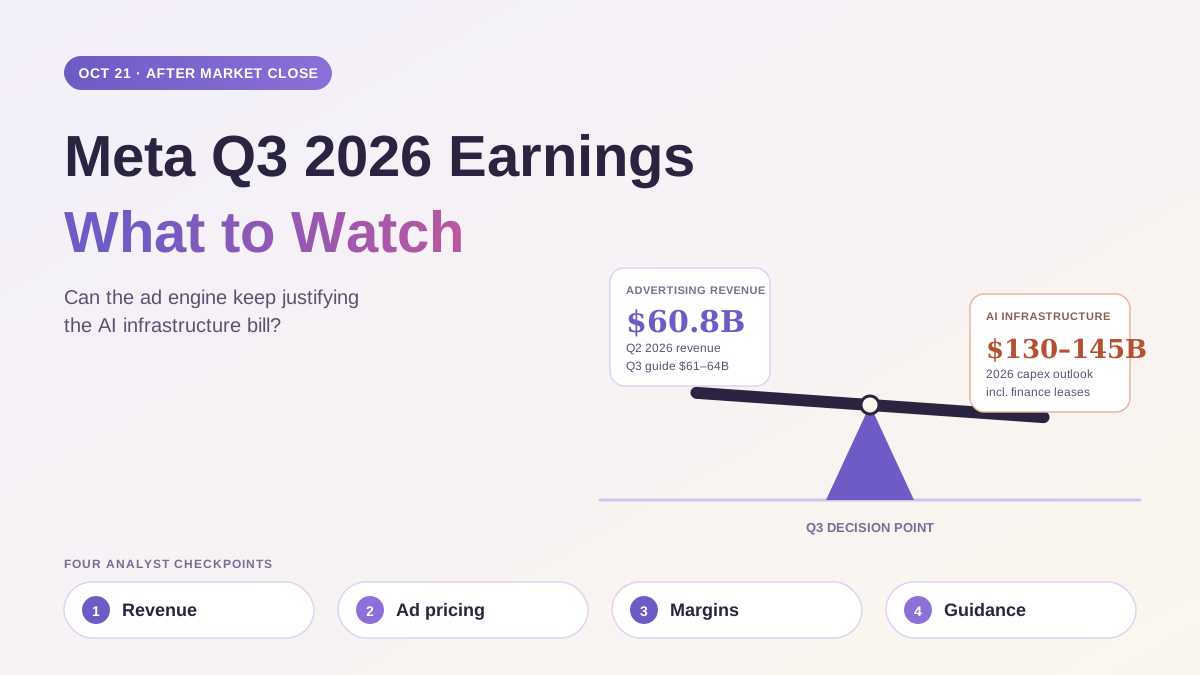
Meta Stock Earnings: What to Watch in Meta Platforms’ Q3 2026 Results
Meta reports Q3 2026 results on October 21. See the advertising, AI spending, margin, and guidance signals that could move META stock.
"The Scene from 1999 is Replaying"

DeepSigma: Former Goldman Sachs and Citadel Executives Launch Perpetuals on Stocks and Commodities

Fidelity Warns of Financial Tightening as Investment Clock Strikes Midnight

Why Only 2% of $10 Billion in US Treasury Bonds Enter DeFi?
Bitcoin's AI-driven rally faces a hidden danger if the machines get richer but workers don't
ICO, VC Tokens, and Alpha Models: Why They Can't Save the Current Crypto Market?
Developers Slam Lightning Network: 80% of Payments Depend on Custodians, Is the Community Weaving a Dream?
Ransom of $1,011 in Bitcoin: The Leak Shaking Israel Twelve Days Before Elections
"Japan's Barrier is Not Culture but Local Investment" - Huobi Co-founder Du Jun Discusses Regulations, Stablecoins, and Expansion in Asia
Cyberattack on the ports of Marseille and La Rochelle? Hackers paid 1 dollar in crypto
Contents
Latest articles





Latest coin listings on WEEX


