
AI Agents Do More Than Just Place Orders: The Next Entrepreneurial Opportunity Lies in Matching and Trust

 Prefer us on Google



Breaking down how AI agents can expand Uber-like matching to complex transactions, highlighting that bilateral networks and trustworthy transaction mechanisms are the real moat.
Written by: Guy Wuollet
Compiled by: AididiaoJP, Foresight News
Uber simplifies demand into one thing: calling a car from A to B. The network is responsible for finding drivers who are willing to take the order at a suitable price. The more drivers there are, the easier it is for passengers to get a ride; the more passengers there are, the more drivers are willing to join.
The author believes that AI agents can expand this matching network to more goods and services. Agents can articulate complex preferences on behalf of individuals and then find suppliers willing to take the order. Some transactions exist today but are too expensive or convoluted for the average person to participate; some transactions are too troublesome for anyone to organize; and there are some demands that people haven't thought to raise yet. For entrepreneurs, these are all opportunities.
Can Uber-like Networks Be Used to Arrange a Meal?
Organizing a dinner with friends is a familiar challenge. Everyone has different schedules, budgets, and tastes. Often, one person is responsible for collecting preferences in a group chat and searching for restaurants; if the options are unsuitable, they have to communicate again in the group. On the restaurant side, there may be empty tables available on Tuesday nights, but it's hard to reach a group that hasn't finalized their plans.
An agent can take over this task. Your agent coordinates with friends or their agents to form a request: six people, in the city, with a budget of no more than $60 per person, available between 5:30 and 8:00 PM, and willing to eat anything except sushi. The restaurant agent quotes based on the availability of tables. One restaurant might say that the price is better for a 5:30 PM seating; another might offer a family-style menu for the group. Your agent matches the quotes with everyone's preferences and places the order within the agreed range.
If a restaurant has an available table at six o'clock, it can directly quote the group willing to eat earlier, even before they have chosen a restaurant. The group has preferences and budgets; the restaurant has capacity and acceptable prices. What’s missing is a network that allows both parties’ agents to find each other and agree on a purchase.
Uber has proven that a network can bring buyers and sellers together around relatively simple demands. Agents can extend this model to more complex purchases, such as a group dinner. Most networks are built for people; now, they need to be built for machines. Entrepreneurs can create such markets: agents bringing in requests while suppliers compete to fulfill them.
A 'Machine-Use' Market is Needed Between Agents
The crypto space already has models for organizing such requests: intents, or intention orders. Users simply state the desired outcome, and suppliers compete to deliver. For example, with UniswapX, users sign an order specifying what token they want to swap and what conditions they can accept; suppliers compete to match from different sources of liquidity.
Agents can extend the intent model to everyday commerce. Large language models can turn a conversation into requests that suppliers can execute, and agents can then search for quotes and negotiate details. Arranging a small purchase, like a dinner for six, could be cost-effective enough to justify doing so.
Uber’s usefulness relies on network effects. More complex purchases can also create similar network effects. The more restaurants that join, the more matching opportunities for diners, especially when the group has specific requirements. The more groups there are, the more opportunities restaurants have to fill empty tables, making it worthwhile to integrate a reservation system and provide more tailored quotes. The more participants in a city, the more types of requests the network can accommodate.
Entrepreneurs can start with dining in a city and then expand outward. The initial product must save users enough time or money for them to invite friends to use it; restaurants need to see reservations they couldn't originally get. Only when both sides achieve results will they return and invite others.
Ensuring Both Sides Benefit
The author believes that consumer-facing agents can be used for free, charging through a model similar to order flow commissions. Users specify what they want and how much they are willing to pay, while suppliers compete for orders. If an agent agrees to arrange a dinner for $300 and finds a restaurant that can do it for $270, the network can keep the difference; it can also charge the restaurant a referral fee. These transaction revenues can be used to cover the reasoning costs for users.
However, users should know how agents charge and how they make choices between quotes. Whether they are willing to entrust purchases to agents depends on whether they trust these choices.
-- Price
Software Can Be Copied, But Networks and Trust Are Hard to Replicate
AI makes it increasingly easy to copy software, while the willingness of people and businesses to transact through a particular network becomes a more important source of advantage. Some of the best companies in the internet era, such as Facebook, eBay, and Uber, become better the more people use them.
Agent business networks can also form this advantage. Competitors can create similar software, but they still need to bring buyers and sellers together and ensure reliable transactions. Returning to the restaurant example, this means there must be enough local restaurants willing to quote and enough groups ready to place orders.
Ensuring reliable transactions is part of building the network itself. Restaurants need to know that agents have the authority to use the group’s money; diners need to know that accepting a quote will lock in a table at the agreed price. The network must be able to verify agent authority, record reservation terms, and arrange payments. Both sides should also know what happens if the group cancels or if the restaurant fails to fulfill the order.
Entrepreneurs can build these services while building the market. As buyers and sellers transact, the network can accumulate records of who fulfills agreements and who does not, forming a dispute resolution process. A network that helps participants find good quotes and reliably complete purchases will bring them back for the next transaction.
Beyond Dining: Travel, Procurement, Computing Power, and Arbitration
Dining is just a toy example. Agents can help build many networks.
In travel, personal agents can coordinate a group’s schedules and budgets, then negotiate a suitable plan with hotels and other suppliers. The more flexible the dates or destinations, the better the quotes they can obtain that fixed searches cannot find.
In corporate procurement, corporate agents can be online all day, negotiating future supply and price commitments with suppliers. They not only compare prices but also delivery schedules and payment terms, helping buyers lock in costs while providing sellers with more predictable demand.
In computing power markets, agents match workloads and available capacity based on hardware requirements, location, and time. Companies can also purchase future computing power to hedge against computing costs.
In arbitration, parties agree to use a shared arbitration platform to resolve disputes, which is faster than existing legal systems. The more buyers and suppliers that adopt the same set of rules, the more attractive the platform becomes for the next participant.
In physical device networks, agents can buy services from drone networks or data from connected devices. The more providers there are, the larger the network coverage or the more types of services needed by other participants.
In collaborative health research, people aggregate health data to participate in crowdsourced studies. The more contributors there are, the larger the scale of research that can be supported, answering questions that small groups cannot.
Human-centered networks also have opportunities. As intelligence becomes cheaper, people still need to establish identities, endorse others' qualifications, and build trust relationships. More work is happening outside traditional institutions, making credential networks and membership clubs potentially more valuable.
This content is provided for general informational purposes only and doesn't constitute financial, investment, legal, or tax advice. Any events, rewards, online promotions, or related information mentioned herein should not be considered a recommendation, solicitation, or invitation to purchase, sell, trade, or otherwise deal in any crypto assets. Crypto assets are highly volatile and may result in loss. The availability of WEEX services, products, and related events may vary by region. You are responsible for ensuring that your participation is in accordance with applicable local laws and regulations.
You may also like
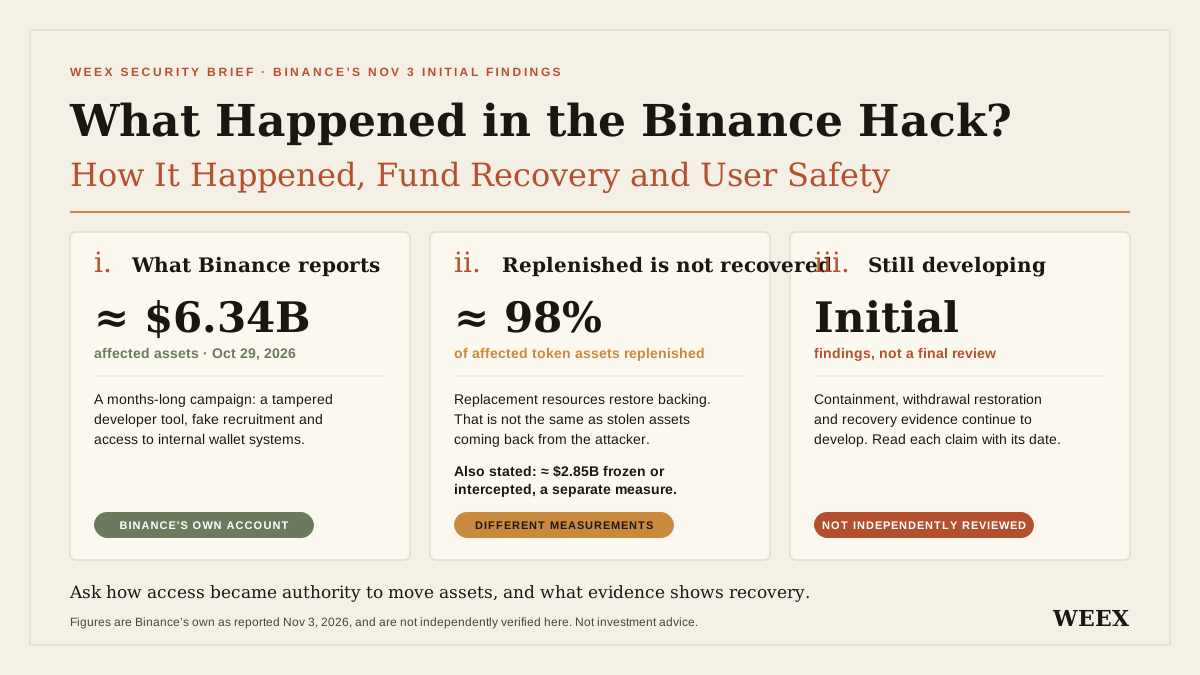
What Happened in the Binance Hack? How It Happened, Fund Recovery and User Safety
What happened in the Binance hack? Review the attack timeline, latest fund replenishment, recovery limits and practical steps to protect your account.

Tata Power Plans to Sign Agreement with Four States Allowing Power Prices to Be Linked to Coal Costs

NVIDIA Scandal Shakes the Internet! How Should Cryptocurrency Be Divided After a Divorce with a Tech Tycoon?

Bundesbank President Says Economic Recovery Faster Than Expected, Structural Reforms Needed

Immutable Chain's Transition to OP Stack: What Changes for Users

Ledger CEO faces backlash after saying everybody will be hacked at some point
WEEX 11.11 Shopping Fest: Buy BTC and Unlock Up to 888 USDT in Rewards

NEAR AI Discloses SGLang Security Incident and Revokes Exposed API Keys

The Art of Trading: How They Profit from Arbitraging USDE Stocks

VARA Is Not a Panacea: Dubai's Crypto Payments Still Depend on the Central Bank

a16z Frontier Partner: Agents Should Rebuild Uber-like Transaction Networks

Poland's Parliament Votes 240-202 To Let Officials Freeze Crypto Before Court Review

WEEX P2P now supports ILS, BHD, OMR & QAR —Merchant Recruitment Now Open

Cryptocurrency Security Checklist: Four Lessons from Phemex Safety Hub Vol. 05–08

Ondo Claims $4B in Tokenized Assets as RWA Market Gains Institutional Depth

DTCC Launches Tokenization Service: What Can Investors Actually Do?

The catch in recovering a hacked crypto wallet: the thief may still have a key

Bitcoin Remains Strong: Why $76,000 is the Level That Matters Now
Peter Schiff Criticizes Strategy's Bitcoin Purchases

iPhone Attack Kit 'DarkSword' Suspected of Being Misused for Cryptocurrency Theft, Bitquery Identifies Approximately $4.06 Million in Stolen Funds

Financial and Political Crisis in Paraguay: How the Ueno Bank Explosion Triggered the President's Resignation

OpenAI Releases National Community Covenant and Computing Park Policy Blueprint

GitBook Security Incident Review, Attack Targeting Trade.xyz

Post-Quantum Era Consensus Layer Divergence: Ethereum Maintains Decentralization, Monad Prioritizes Speed

The Ghost Behind the Screen: Unveiling the Secret World of North Korean Hackers Lazarus

Bitcoin Miners Turn to AI: Escaping the Crypto Cycle, but Entering New Turbulence
Decoding Variational: How a No-Order-Book Exchange Became the Dragon Behind Hyperliquid?

Creators Speak | The Biggest Risk in the Crypto Industry is Thinking It's Safe

Who really controls a crypto project? Inside the SEC’s new guidance

Reflections After the Binance Heist: Who Should We Trust with Our Crypto Assets?
What Happened in the Binance Hack? How It Happened, Fund Recovery and User Safety
What happened in the Binance hack? Review the attack timeline, latest fund replenishment, recovery limits and practical steps to protect your account.
Tata Power Plans to Sign Agreement with Four States Allowing Power Prices to Be Linked to Coal Costs
NVIDIA Scandal Shakes the Internet! How Should Cryptocurrency Be Divided After a Divorce with a Tech Tycoon?
Bundesbank President Says Economic Recovery Faster Than Expected, Structural Reforms Needed
Immutable Chain's Transition to OP Stack: What Changes for Users
Ledger CEO faces backlash after saying everybody will be hacked at some point
Latest articles


Latest coin listings on WEEX


