
Ledger CEO faces backlash after saying everybody will be hacked at some point

 Prefer us on Google


Ledger CEO Pascal Gauthier has faced criticism from the cryptocurrency community after warning that everyone will eventually be hacked, a statement that has raised questions about the security assurances offered by hardware wallet manufacturers.
Summary
- Ledger CEO Pascal Gauthier has faced criticism after saying everyone will eventually be hacked and acknowledging that perfect security does not exist, including at Ledger.
- Crypto users on X questioned the remarks, arguing that they appeared at odds with Ledger's business of selling hardware wallets designed to protect digital assets.
- Gauthier defended hardware wallets during a Bloomberg interview, arguing that decentralized asset protection has resulted in considerably smaller losses than centralized platforms.
- The backlash follows recent security incidents involving compromised Ledger devices, while Sui hardware wallet project Suiball has announced its closure amid industry security concerns.
During a Bloomberg Crypto interview on November 10, Gauthier said that perfect security does not exist and acknowledged that Ledger itself was not immune to potential attacks.
"Everybody will be hacked at some point. Perfect security doesn't exist. And so that rule applies to Ledger as well as others," he said.
His comments quickly attracted attention on X after crypto news account Watcher.Guru shared a clip of the interview, prompting criticism from users who questioned why the head of a company specializing in cryptocurrency security would make such a statement.
Ledger CEO's hack comments draw criticism from crypto community
Several X users questioned Gauthier's remarks, particularly because Ledger markets hardware wallets designed to help cryptocurrency holders protect their private keys and digital assets.
Crypto commentator Jeremy (@Jeremybtc) criticized the statement and said he would take a large short position against Ledger if the company were publicly traded.
"The CEO of a company who secures over 20% of ALL crypto assets is saying everybody will be hacked at some point???" he wrote, referring to Ledger's claimed position in the cryptocurrency custody market.
Another X user, StarPlatinum (@StarPlatinum_), questioned the company's central selling proposition.
"My brother in Christ your entire business is selling a device so we don't get hacked," the user wrote while sharing the Bloomberg interview.
Bert (@bertocinto) offered a shorter reaction, describing it as a "Weird thing for a hardware wallet CEO to say."
Other responses went further, with X user BRUH (@MarcTheMesenger) interpreting the warning as a sign that cryptocurrency itself was becoming increasingly vulnerable to security threats.
THEY'RE TELLING YOU IN YOUR FACE
CRYPTO IS DEAD https://t.co/pVDjGrXUeD
--- BRUH 👑 (@MarcTheMesenger) November 10, 2026
The criticism largely centered on whether Gauthier's assessment of unavoidable security breaches was consistent with the protection customers expect when purchasing a hardware wallet.
Gauthier defends hardware wallets despite growing security threats
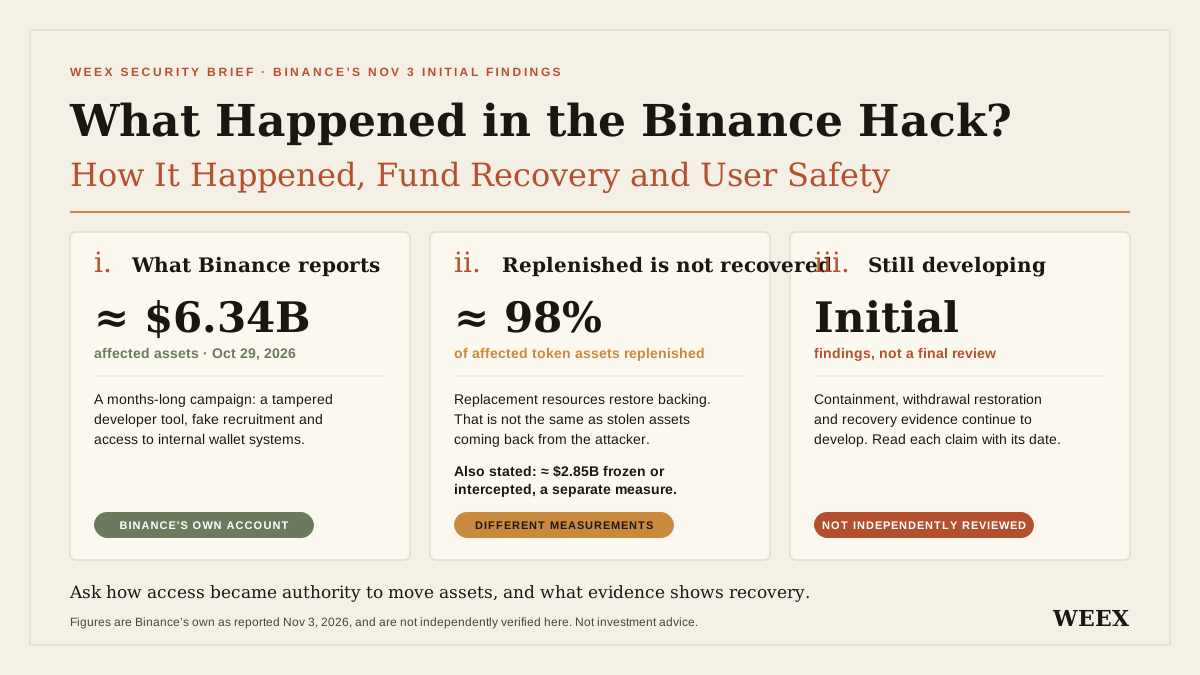
Gauthier made the remarks while discussing the recent $6.3 billion Binance hack and the security risks facing centralized cryptocurrency platforms.
The October 29 Binance breach affected approximately $6.3 billion in digital assets, with investigators tracing unauthorized transfers across multiple blockchain networks.
During the interview, Gauthier argued that centralized institutions remain particularly vulnerable because they concentrate large amounts of cryptocurrency under a single organization.
He pointed to previous incidents involving FTX, Bybit and other major cryptocurrency businesses while explaining why he believes decentralized asset protection remains preferable.
When questioned about roughly $90 million in losses associated with compromised Ledger devices, Gauthier acknowledged the figure but compared it with the much larger amounts stolen from centralized platforms.
He said the losses represented approximately 0.01% of the assets Ledger protects, arguing that the decentralized nature of hardware wallet security makes large-scale attacks more difficult.
The executive maintained that hardware wallets had suffered considerably smaller losses than centralized institutions when measured by both value and percentage.
Gauthier warned that cryptocurrency thefts were becoming more frequent, citing approximately $9 billion stolen last year and $12 billion so far this year. He identified artificial intelligence and quantum computing among the threats facing the industry.
Recent Ledger wallet attacks have raised security concerns
The interview followed an October investigation involving compromised Ledger hardware wallets distributed through a third-party reseller in Southeast Asia.
Ledger confirmed that an unauthorized hardware implant discovered inside an affected device could capture a user's 24-word recovery phrase and transmit the information through a cellular connection.
The malicious component operated separately from the wallet's Secure Element, allowing attackers to obtain recovery credentials without directly compromising the device's underlying cryptographic security.
Following the discovery, Ledger began reviewing its distribution practices and anti-tampering protections. The company subsequently suspended retail sales in Germany through MediaMarkt Saturn after another reported device implant.
Security concerns have affected other hardware wallet developers as well.
On November 10, Sui-native hardware wallet project Suiball announced its closure, citing recent attacks across the industry and a decision by the Sui Foundation that continuing to support the project carried excessive risks.
Suiball said its device had already entered manufacturing, but customers would receive refunds instead of their preordered wallets.
Approximately 80% of preorders were placed on-chain, with the company planning to distribute USDC refunds directly to wallets holding the corresponding preorder NFTs within a week.
-- Price
This content is provided for general informational purposes only and doesn't constitute financial, investment, legal, or tax advice. Any events, rewards, online promotions, or related information mentioned herein should not be considered a recommendation, solicitation, or invitation to purchase, sell, trade, or otherwise deal in any crypto assets. Crypto assets are highly volatile and may result in loss. The availability of WEEX services, products, and related events may vary by region. You are responsible for ensuring that your participation is in accordance with applicable local laws and regulations.
You may also like

Tata Power Plans to Sign Agreement with Four States Allowing Power Prices to Be Linked to Coal Costs
AI Agents Do More Than Just Place Orders: The Next Entrepreneurial Opportunity Lies in Matching and Trust
NVIDIA Scandal Shakes the Internet! How Should Cryptocurrency Be Divided After a Divorce with a Tech Tycoon?

Bundesbank President Says Economic Recovery Faster Than Expected, Structural Reforms Needed

Immutable Chain's Transition to OP Stack: What Changes for Users

WEEX 11.11 Shopping Fest: Buy BTC and Unlock Up to 888 USDT in Rewards

NEAR AI Discloses SGLang Security Incident and Revokes Exposed API Keys

The Art of Trading: How They Profit from Arbitraging USDE Stocks

VARA Is Not a Panacea: Dubai's Crypto Payments Still Depend on the Central Bank

a16z Frontier Partner: Agents Should Rebuild Uber-like Transaction Networks

Poland's Parliament Votes 240-202 To Let Officials Freeze Crypto Before Court Review

WEEX P2P now supports ILS, BHD, OMR & QAR —Merchant Recruitment Now Open

Cryptocurrency Security Checklist: Four Lessons from Phemex Safety Hub Vol. 05–08
Ondo Claims $4B in Tokenized Assets as RWA Market Gains Institutional Depth

DTCC Launches Tokenization Service: What Can Investors Actually Do?

The catch in recovering a hacked crypto wallet: the thief may still have a key

Bitcoin Remains Strong: Why $76,000 is the Level That Matters Now
Peter Schiff Criticizes Strategy's Bitcoin Purchases
iPhone Attack Kit 'DarkSword' Suspected of Being Misused for Cryptocurrency Theft, Bitquery Identifies Approximately $4.06 Million in Stolen Funds

Financial and Political Crisis in Paraguay: How the Ueno Bank Explosion Triggered the President's Resignation
OpenAI Releases National Community Covenant and Computing Park Policy Blueprint

GitBook Security Incident Review, Attack Targeting Trade.xyz

Post-Quantum Era Consensus Layer Divergence: Ethereum Maintains Decentralization, Monad Prioritizes Speed

The Ghost Behind the Screen: Unveiling the Secret World of North Korean Hackers Lazarus

Bitcoin Miners Turn to AI: Escaping the Crypto Cycle, but Entering New Turbulence
Decoding Variational: How a No-Order-Book Exchange Became the Dragon Behind Hyperliquid?
Creators Speak | The Biggest Risk in the Crypto Industry is Thinking It's Safe
What Happened in the Binance Hack? How It Happened, Fund Recovery and User Safety
What happened in the Binance hack? Review the attack timeline, latest fund replenishment, recovery limits and practical steps to protect your account.
Who really controls a crypto project? Inside the SEC’s new guidance

Reflections After the Binance Heist: Who Should We Trust with Our Crypto Assets?
Tata Power Plans to Sign Agreement with Four States Allowing Power Prices to Be Linked to Coal Costs
AI Agents Do More Than Just Place Orders: The Next Entrepreneurial Opportunity Lies in Matching and Trust
NVIDIA Scandal Shakes the Internet! How Should Cryptocurrency Be Divided After a Divorce with a Tech Tycoon?
Bundesbank President Says Economic Recovery Faster Than Expected, Structural Reforms Needed
Immutable Chain's Transition to OP Stack: What Changes for Users
WEEX 11.11 Shopping Fest: Buy BTC and Unlock Up to 888 USDT in Rewards
Latest articles




Latest coin listings on WEEX


