Apple Reclaims Top Market Cap as Silver Nears $50: WEEX TradFi Market Brief

 Prefer us on Google


Apple has reclaimed its position as the world's most valuable publicly traded company, overtaking Nvidia at the end of October as investors reassess the outlook for artificial intelligence spending. At the same time, silver prices have returned to the closely watched $50-per-ounce region, highlighting the impact of changing inflation and interest-rate expectations on precious metals.
The latest shift in Apple market cap reflects a broader change in market sentiment. While AI infrastructure companies face renewed scrutiny over capital expenditure, Apple's established consumer business and cash-generation profile have attracted attention.
Meanwhile, the silver price remains sensitive to monetary policy expectations, industrial demand and investor risk appetite. Together, these developments show how equity valuations and commodity markets can respond differently to changing financial conditions.
In this November 2, 2026 edition of the WEEX TradFi Daily Market Brief, we examine why Apple market cap has moved ahead of Nvidia, what silver's return toward $50 means, and which upcoming events could shape market sentiment.
Why Did Apple Overtake Nvidia in Market Capitalization?
Apple regained the title of the world's most valuable publicly traded company on October 30, 2026, as major technology stocks came under selling pressure.
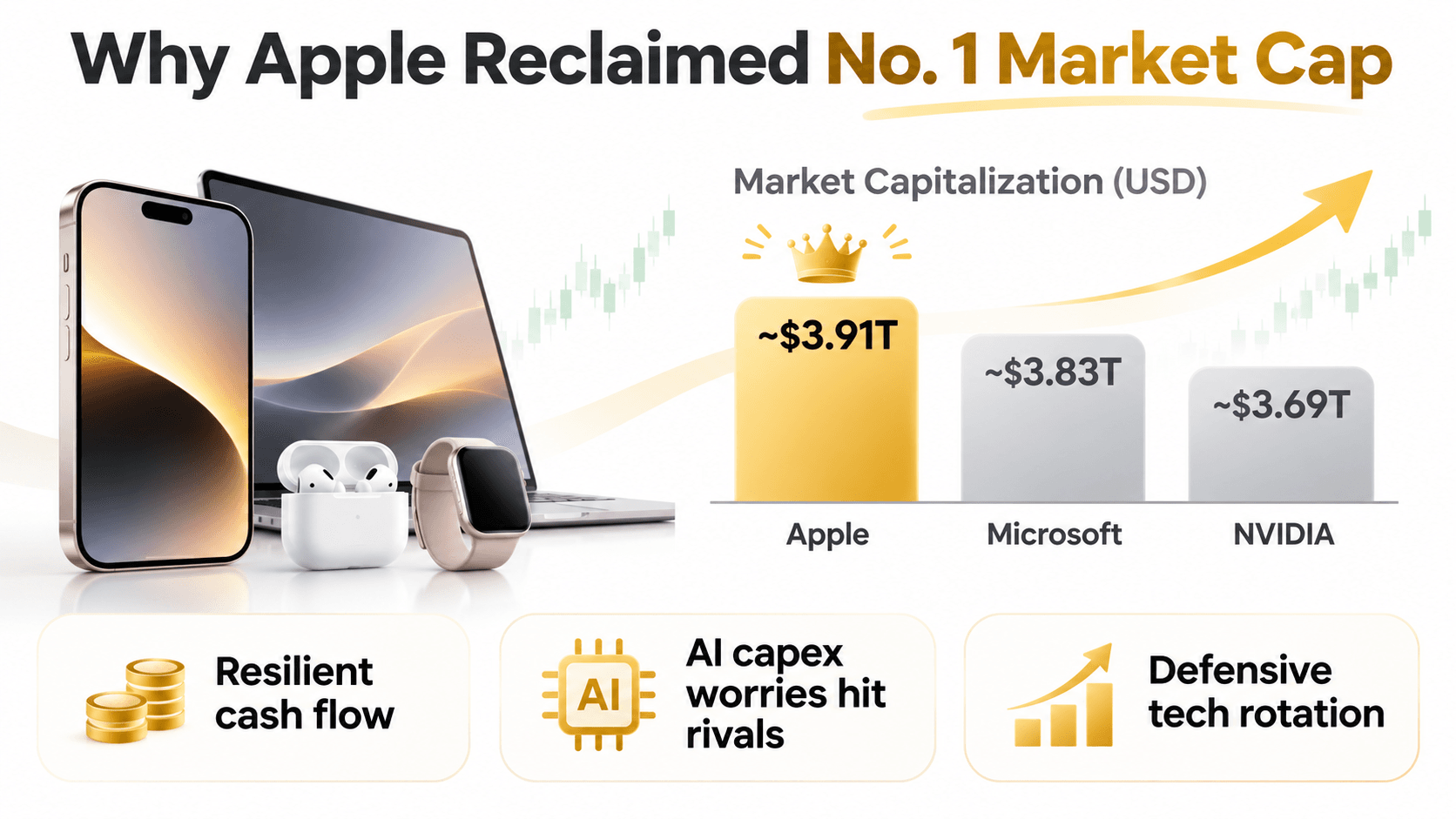
According to Bloomberg's market report, Apple finished the session with an estimated market capitalization of $5.03 trillion, compared with approximately $4.93 trillion for Nvidia.
Interestingly, Apple did not need a strong share-price rally to regain first place. Its shares declined less sharply than Nvidia's during the session, allowing its relative valuation to move ahead.
Market capitalization represents the total equity value of a listed company, calculated using its share price and outstanding shares. When the valuations of two companies are close, even a relatively short period of uneven stock performance can change their ranking.
Why Are Investors Reassessing AI Spending?
One of the main concerns affecting technology valuations is the substantial capital expenditure required to develop artificial intelligence infrastructure.
Major technology companies are investing in data centers, computing capacity and AI-related services. Although these projects may generate future revenue, investors increasingly want to understand their financial returns, operating costs and long-term profitability.
Nvidia remains closely associated with AI computing infrastructure. Changes in expectations for data-center investment can therefore influence sentiment toward the company and the wider semiconductor sector.
Apple offers a different investment profile, supported by its consumer hardware ecosystem, services business and established customer base. These characteristics may attract attention during periods when investors reassess companies with significant AI infrastructure exposure.
However, Apple's stronger relative performance does not mean it is immune to market volatility. Its valuation still depends on earnings growth, product demand, margins and investor expectations.
What Does Apple's Market-Cap Lead Mean?
Apple's return to first place highlights a shift in relative market valuations rather than a definitive change in the long-term outlook for artificial intelligence.
The ranking could change again as investors respond to corporate earnings, technology spending forecasts and broader economic conditions.
For readers following Apple and Nvidia, comparing the two businesses offers a useful perspective on how different technology investment themes are being valued.
Their price movements can also be monitored through supported stock-linked instruments on WEEX, although these products have their own trading rules and do not represent ownership of the underlying shares.
Why Is Silver Trading Near $50 an Ounce?
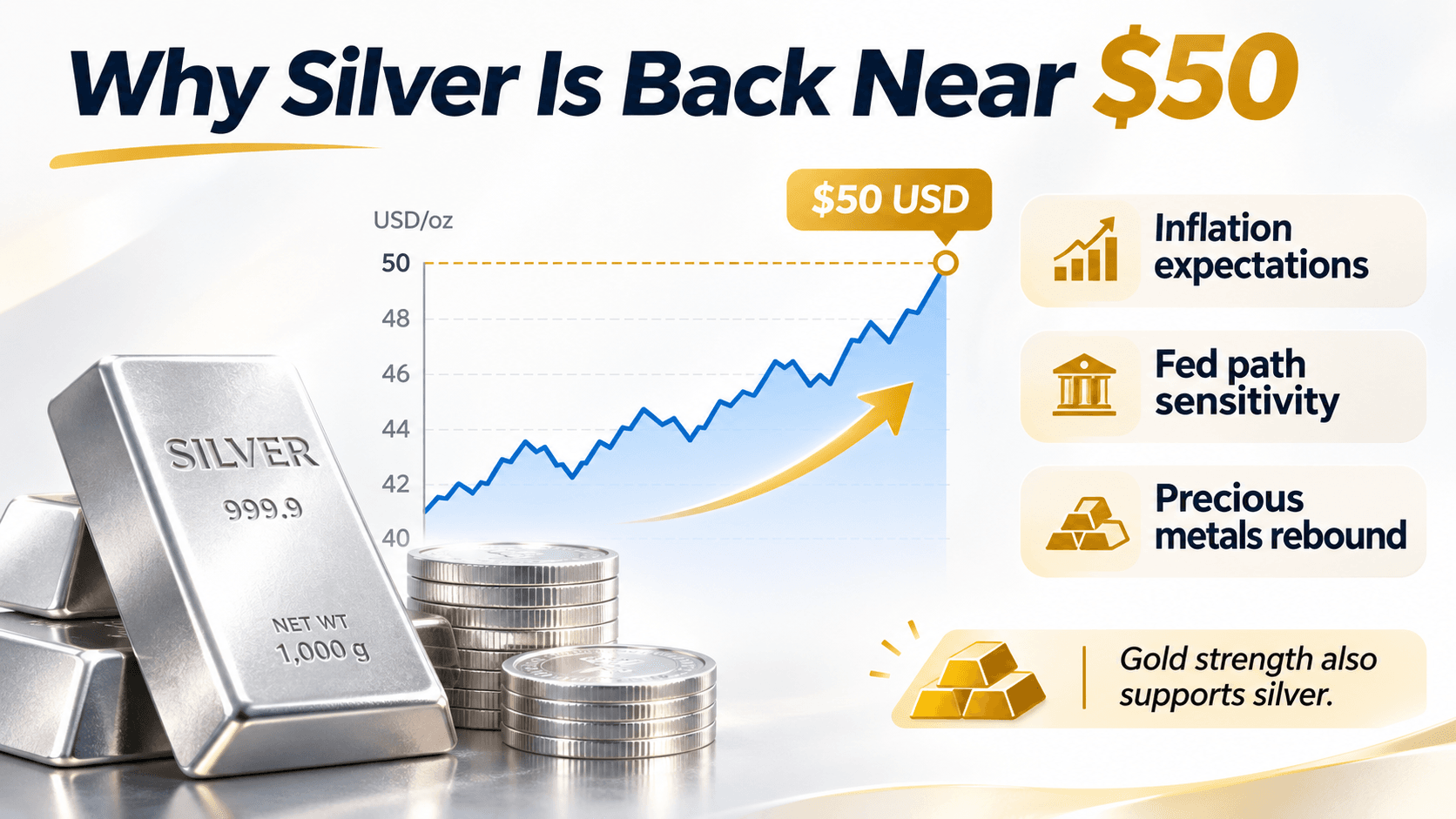
Silver has moved back toward the $50-per-ounce region following a period of volatility in precious metals.
According to Fortune's October 30 silver market update, spot silver was quoted at approximately $50.04 per troy ounceduring the morning U.S. session.
That figure represents a historical market snapshot rather than a live quotation. Prices can differ between spot markets, futures contracts and other silver-linked instruments.
The $50 level attracts attention because it is an easily recognizable psychological reference point. However, a move toward this level does not automatically confirm a sustained recovery.
How Do Inflation and Interest Rates Affect Silver?
Silver prices respond to several macroeconomic variables, including inflation expectations, U.S. dollar movements and the direction of real interest rates.
When interest rates remain elevated, interest-bearing investments may become relatively more attractive than non-yielding assets such as precious metals.
Conversely, expectations for lower real interest rates or a weaker dollar can sometimes support demand for precious metals.
These relationships are not guaranteed. Silver also has substantial industrial applications, making its price sensitive to manufacturing activity, electronics demand and economic growth expectations.
Why Can Silver Move Differently From Gold?
Gold is widely followed as a monetary asset and potential store of value, while silver combines investment demand with industrial consumption.
This means silver can respond to both financial market uncertainty and expectations for economic activity.
When industrial demand expectations weaken, silver may face pressure even if gold remains relatively strong. Conversely, improving manufacturing conditions can support silver independently of movements in gold.
For traders analyzing precious metals, these differences help explain why the two assets do not always move in the same direction.
What Do Apple and Silver Tell Us About Global Market Sentiment?
Apple's market-cap leadership and silver's return toward $50 reflect separate market developments, but both illustrate how investors are reassessing risk across asset classes.
Within equities, attention has turned toward the financial returns generated by AI investment and the relative resilience of established technology businesses.
Within commodities, inflation expectations, monetary policy and industrial demand continue to shape price movements.
These forces can create uneven performance across technology stocks, precious metals and cryptocurrencies.
Why Cross-Market Analysis Matters
A decline in technology shares does not automatically produce a rise in precious metals. Similarly, strength in silver does not guarantee weakness in Bitcoin or other digital assets.
Each asset class has distinct liquidity conditions, market participants and price drivers.
However, certain economic events can influence several markets simultaneously. Federal Reserve decisions, inflation reports and employment data can affect interest-rate expectations, currency movements and overall risk appetite.
For users following multiple markets, understanding these relationships provides context for price changes without assuming that one asset's performance will predict another's.
-- Price
What Market Events Should Traders Watch on November 2?
The beginning of November brings several earnings announcements that could influence market sentiment across U.S. equities.
According to the November 2 earnings calendar, Apple and Palantir are scheduled to report after the U.S. market closes, while Marriott International is among the companies reporting before the opening bell.
Apple (AAPL): iPhone Demand and Earnings Guidance
Apple's fiscal fourth-quarter 2026 results are scheduled for November 2, after the U.S. market closes.
Investors will likely focus on iPhone demand, services performance, operating margins and management's outlook for the upcoming quarter.
The results may also influence expectations for Apple's valuation relative to Nvidia and other major technology companies.
Actual earnings and management guidance can produce significant price movements when they differ from market expectations.
Palantir (PLTR): Enterprise AI Demand
Palantir is also scheduled to publish quarterly results after the market close.
Investors may examine its commercial customer growth, government-related business and AI software revenue to assess the financial performance of enterprise AI adoption.
The company's results could provide additional context for the broader AI investment narrative.
Marriott International (MAR): Consumer and Travel Demand
Marriott's earnings provide a different view of economic activity.
Hotel demand, occupancy trends and revenue performance can offer insights into consumer spending and business travel conditions.
Although Marriott operates outside the technology sector, its results may help investors assess the broader economic environment.
These events should be monitored alongside upcoming economic releases and changing monetary policy expectations.
About WEEX TradFi: Stock and Precious Metal Markets
WEEX TradFi provides access to selected traditional-market price exposures through a USDT-margined derivatives environment.
Supported market categories include stock-linked instruments, precious metals and other traditional financial assets, subject to the platform's current product availability.
For users following the two major themes in today's market brief, WEEX has separate perpetual futures market pages for Apple AAPL/USDT, Nvidia NVDA/USDT and silver XAG/USDT.
These links lead to derivative markets rather than ordinary stock purchases or physical silver transactions. The contracts provide price exposure, but do not confer ownership of Apple or Nvidia shares or rights to physical silver delivery.
WEEX also offers a separate Stock Spot 2.0 product category featuring synthetic tokens linked to selected equities and ETFs. These price-tracking tokens are distinct from leveraged futures contracts and do not provide the shareholder rights associated with owning actual shares.
Users interested in stock tokens can explore the available instruments through the WEEX Stocks market section.
Before accessing any market, users should confirm the instrument name, contract specifications, current trading status and regional availability. Leverage, margin requirements, funding fees and liquidation mechanisms may apply to derivative products.
How to Trade Apple, Nvidia and Silver on WEEX
Readers following Apple's market-cap performance or movements in silver can use WEEX's market interfaces to review supported stock-linked and commodity-linked products.
The following steps describe the general process for exploring these instruments while distinguishing between synthetic stock tokens and perpetual futures.
Step 1: Log In and Confirm Account Eligibility
Access your WEEX account and complete any applicable registration or identity verification requirements.
Confirm that the relevant trading product is supported in your region before proceeding. Product availability and market access may differ across jurisdictions.
Step 2: Prepare Your USDT Balance
Review the available USDT balance in the account used for the selected product.
Stock-token trades and USDT-margined futures may require different account balances or transfers, so users should check the interface instructions before moving funds.
Step 3: Select the Relevant Trading Market
Choose the product that matches the asset you wish to follow.
For Apple's market-cap developments, locate the AAPL-linked instrument. For the AI semiconductor theme, review the NVDA-linked market. For movements in precious metals, examine the XAG-linked contract.
Confirm the precise instrument symbol and whether it is a synthetic stock token or a perpetual futures contract. Do not assume that similarly named products offer identical rights, execution mechanisms or risk exposure.
Step 4: Review the Order Details and Risks
Check the displayed quotation, available order types, trading fees and market liquidity.
For futures contracts, pay particular attention to margin requirements, leverage settings, funding fees and liquidation conditions. Greater leverage increases exposure to price movements and can amplify losses.
For stock tokens, review the order book, bid-ask spread and market trading schedule. A stock token's execution price may differ from the referenced company's share price.
Step 5: Submit and Monitor an Order
If the product is available and you decide to proceed, select the order type and review the position size or order amount before submitting.
After execution, monitor the relevant position or asset balance through your account interface.
Risk-management orders may help define an exit plan, but they do not guarantee execution at a particular price and cannot eliminate market risk.
Conclusion
Apple's return to the top of the global market-cap rankings and silver's movement back toward $50 illustrate how market leadership can change as investors reassess economic conditions.
Apple's relative strength reflects changing sentiment toward technology earnings and AI infrastructure spending, while silver remains sensitive to monetary policy expectations, industrial demand and broader commodity-market conditions.
Neither development should be interpreted as a reliable prediction of future returns.
For the coming sessions, Apple's earnings, other major corporate reports and economic data will provide further context for both equity and commodity markets.
Through WEEX, eligible users can explore selected stock-linked and precious-metal-linked markets using supported USDT-based products. Understanding the differences between stock tokens and derivatives remains essential when evaluating these instruments.
FAQ
1. Why Did Apple Overtake Nvidia in Market Capitalization?
Apple regained the top market-cap ranking on October 30, 2026, because its shares declined less sharply than Nvidia's during the session. Apple's estimated valuation was approximately $5.03 trillion, compared with Nvidia's $4.93 trillion.
2. What Was the Silver Price on October 30, 2026?
Spot silver traded around $50 per troy ounce during the October 30 morning U.S. session, according to the cited market snapshot. This was a historical quotation rather than the current live price.
3. Why Is the $50 Silver Price Level Important?
The $50 level is a prominent psychological reference point for market participants. However, its significance depends on subsequent price movements, trading activity and broader market conditions. A move toward $50 does not guarantee a sustained recovery.
4. When Is Apple's Next Earnings Report?
Apple's fiscal fourth-quarter 2026 results are scheduled for November 2, 2026, after the U.S. market closes. The schedule should be checked against official investor relations announcements if this article is updated later.
5. Can Users Trade Apple, Nvidia and Silver on WEEX?
WEEX provides selected stock-linked and silver-linked trading products, subject to availability and eligibility requirements. Apple and Nvidia can be accessed through supported stock-token or derivative markets, while silver exposure is available through supported derivative instruments. These products do not represent ownership of the underlying company shares or physical metal.
This content is provided for general informational purposes only and doesn't constitute financial, investment, legal, or tax advice. Any events, rewards, online promotions, or related information mentioned herein should not be considered a recommendation, solicitation, or invitation to purchase, sell, trade, or otherwise deal in any crypto assets. Crypto assets are highly volatile and may result in loss. The availability of WEEX services, products, and related events may vary by region. You are responsible for ensuring that your participation is in accordance with applicable local laws and regulations.
You may also like

Crypto: Gate Freezes Two Accounts Linked to Binance Hack
BlackRock’s Ethereum fund sheds 580K ETH as monthly exits mount

How T7X Is Building the Infrastructure for a New Era of Capital Markets

The End of the Seasonality Myth. Why September and October Surprised Investors?

Hong Kong plans stablecoin trials for tokenized government debt
Ownership of Bitcoin in the Qian Zhimin Case and Victim Compensation

Polygon expands US banking access to Solana's 15 billion stablecoin market

Sui Puts Enforced Spending Limits at the Center of Its AI-Agent Design

Vitalik's Latest Thoughts: We Need a Digital Minimalism Movement
RLUSD supply fell 29% on XRPL. One XRP trading pool barely changed

Mercado Bitcoin Plans Sui Asset Access in Brazil With Lending and Tokenization Links
Bitcoin Volatility Calendar: Which Events Really Shake the Market?

The decline of gold could signal further tensions, according to Peter Schiff

Bitcoin Turns 18; Will Satoshi's Legacy Stand the Test of Time?

Polygon Completes Coinme Acquisition to Expand Regulated Fiat Payment Rails
The Need for Institutionalization of Market Makers Between Liquidity Provision and Price Manipulation

Chainlink Launches CustodySync With Anchorage to Link Custody and DeFi Loans

CDI was the only refuge in October: what this reveals

Lagarde to leave ECB with Europe’s tokenized-finance blueprint still undecided
Polkadot OpenGov #1961: dotUSD Supply Bug and $1.3M Treasury Loss Explained
Cryptocurrency Market Makers: Distinguishing the Real from the Fake – Tiger Research

Hanwha Investment & Securities Partners with Chainlink to Build Global RWA Tokenization Platform
Controversy over Gold: BCRA Revealed How the Operation with the Metal Was Questioned by AGN
Silicon Valley shifts AI funding to crypto using an Ethereum ICO blueprint
Circle and ACI Bring USDC Settlement Into Latin American Payment Operations

DBS Survey Finds 88% of Businesses Testing or Using Tokenized Money
"Bitcoin is in an early bull market," according to Willy Woo's new model

ECB keeps rate at 2.5% as energy inflation raises concerns

Polygon Labs brings Open Money Stack to Solana for payments
Mosaic: The Art Hidden In Bitcoin
Crypto: Gate Freezes Two Accounts Linked to Binance Hack
BlackRock’s Ethereum fund sheds 580K ETH as monthly exits mount
How T7X Is Building the Infrastructure for a New Era of Capital Markets
The End of the Seasonality Myth. Why September and October Surprised Investors?
Hong Kong plans stablecoin trials for tokenized government debt
Ownership of Bitcoin in the Qian Zhimin Case and Victim Compensation