
High Salaries with a Catch: How Agencies in Poland Deceive Labor Migrants

 Prefer us on Google

About 70% of foreign workers in Poland who were employed through employment agencies have personally encountered opaque salary calculation or payment schemes. Moreover, 57.8% of respondents have already experienced several such practices.
According to Dilo.ua, this is evidenced by the results of a new study by the Gremi Personal Analytical Center.
Labor migrants are most often deceived by promises of high net salaries, while the actual amount of taxes and contributions to ZUS is hidden. Employers artificially lower the official salary and list all the rest as "conditional" bonuses, confuse worked hours or change the rate, and during employment, they deduct money for unforeseen expenses.
Experience with intermediaries directly affects the risk of falling into a trap: among those who worked through only one agency, 44% encountered schemes. If a worker changed from 2 to 4 agencies, this share rises to 74.5%, and among those who had experience working with five or more companies, 88.9% faced manipulations.
Although a high rate remains a key factor when choosing a job — 64.3% of respondents rate its influence at 4-5 out of 5. At the same time, 74.5% of respondents admit that over time they have become more cautious about offers with overly attractive pay.
Especially cautious are "foreigners with experience" who have worked in Poland for more than three years: 95.2% of them either choose completely transparent vacancies or are willing to consider a higher rate only after a written explanation and the opportunity to verify its formation. 63.8% of this group always check the agency and conditions before signing an agreement, while among newcomers, only 28.9% do.
The reason for such caution is the fear of legal and financial consequences. Respondents are most concerned about:
- problems with ZUS and social insurance (79.5%);
- loss of legality of work and residence documents (77.0%);
- problems with tax authorities (70.0%);
- inspections by controlling services (PIP, ZUS, KAS, or Border Guard) (69.8%).
Additionally, 44.5% of respondents have heard in their surroundings about cases of forced return, re-entry bans, or deportation due to employment violations.
Besides gray schemes, a significant factor of dissatisfaction is the level of income. According to WNP.pl, Ukrainian refugees in Poland earn an average of 973 euros per month, which is significantly less than in other European countries (for comparison, Poles earn about 1,227 euros). Therefore, Poland is witnessing a gradual decrease in the number of Ukrainians: some are returning home, while others are moving to Western European countries in search of higher salaries and better conditions.
Despite this outflow, Ukrainians still make up the largest share among foreigners — as of September 2024, there were about 779,000 officially employed citizens of Ukraine. However, their share in the market is gradually decreasing.
Overall, the number of foreign workers in Poland has already exceeded 1.17 million people. Currently, around 30,000 citizens from Colombia and the Philippines are working in the country, and the number of workers from Nepal and India is rapidly increasing.
"For employment agencies, this means a fairly confident trend of changing competition rules. The attempt to lure workers with just a higher rate is gradually losing effectiveness. If the pay difference does not have a clear written explanation, the high rate itself begins to be perceived as a possible risk signal and prompts more experienced candidates to check the agency more carefully. Therefore, it is not the maximum figure in the advertisement that matters, but the agency's ability to prove that this figure is real, transparent, and will not create problems for the worker in a few months," emphasize analysts from Gremi Personal.
Research note: The sociological study "Rates, Schemes of Employment, and Fear of Consequences" was conducted by the Gremi Personal Analytical Center from August 5 to 18, 2026, using the CAWI method. It involved 600 foreign workers aged 18 and older (citizens of Ukraine, Belarus, Georgia, Moldova, Colombia, India, the Philippines, Nepal, and Uzbekistan) who are currently working or have worked in Poland over the past three years through employment agencies.
-- Price
This content is provided for general informational purposes only and doesn't constitute financial, investment, legal, or tax advice. Any events, rewards, online promotions, or related information mentioned herein should not be considered a recommendation, solicitation, or invitation to purchase, sell, trade, or otherwise deal in any crypto assets. Crypto assets are highly volatile and may result in loss. The availability of WEEX services, products, and related events may vary by region. You are responsible for ensuring that your participation is in accordance with applicable local laws and regulations.
You may also like

Zcash Q3 Report: Zakura Launched, Privacy Pool Supply Returns to 29%

Fractional Reserve: Reserve Requirement Abolished. Where is the Value?

Taiwan Blocks Coinbase and Kalshi Websites Over Alleged Election Betting

bStocks' Tokenized Shares Surpass $1 Billion in Assets Under Management in Four Months

Bitcoin's AI-driven rally faces a hidden danger if the machines get richer but workers don't

ICO, VC Tokens, and Alpha Models: Why They Can't Save the Current Crypto Market?

Developers Slam Lightning Network: 80% of Payments Depend on Custodians, Is the Community Weaving a Dream?

Ransom of $1,011 in Bitcoin: The Leak Shaking Israel Twelve Days Before Elections

"Japan's Barrier is Not Culture but Local Investment" - Huobi Co-founder Du Jun Discusses Regulations, Stablecoins, and Expansion in Asia

Cyberattack on the ports of Marseille and La Rochelle? Hackers paid 1 dollar in crypto

Goldman Sachs Analysis: Interest Rate Cuts Expected in Second Half of 2027, How Long Will High Rates Last?

Analyst Who First Predicted September Rate Hike: Fed to Hold Steady in October, May Hike 50 Basis Points in December
Slash Card Now Available for Payment with USDC, Open to the Public
AI Agents Pay for Services in Crypto via x402 Protocol

Crypto: BlackRock's ETFs Bounce Back 63%, Far from 2025 Peak

Moderna's INTerpath-001 ESMO 2026 Presentation Date and Q3 Call
Moderna presents its late-breaking INTerpath-001 data at ESMO 2026 on 24 October 2026 at 16:30 CEST.

唐华斑竹 Analyzes BTC Support Test, Suggests Watching for Stabilization Signals

Podcast Notes | Conversation with Justin Sun: Extreme Loneliness is Also a Kind of Freedom
JANUSZ KRYPTO: Is My Ledger Safe? Spyware in Wallets and Stolen Millions
X-Agent Builds Onchain Personal AI Assistant

Dialogue with Haotian: Don't Just Chase Memes in the Early Bull Market! Robinhood's Next Moves are Hooks, Agents, and Tokenized Stock DeFi

Bitwise Predicts Bitcoin Will Rise Long-Term Regardless of AI and Interest Rate Movements

OpenAI Report Reveals Significant Gap in AI Tool Usage Among EU Businesses
Crypto Long and Short: Why Gold and Bitcoin Can Be in the Same Portfolio

No One Endorses a CEO or Founder They Don't Trust

Stricter Regulation May Lead Brazilian Crypto Market to a New Concentration Cycle
Russian Stablecoin A7A5 Sees Sharp Decline in Trading Activity Following Drone Attacks
Strive’s new $500 million Bitcoin financing plan comes with a $257 million annual dividend problem

Gemini 4 Argon AI Enhances Security: Resolves 12 Simulated Attacks, Compared to 5
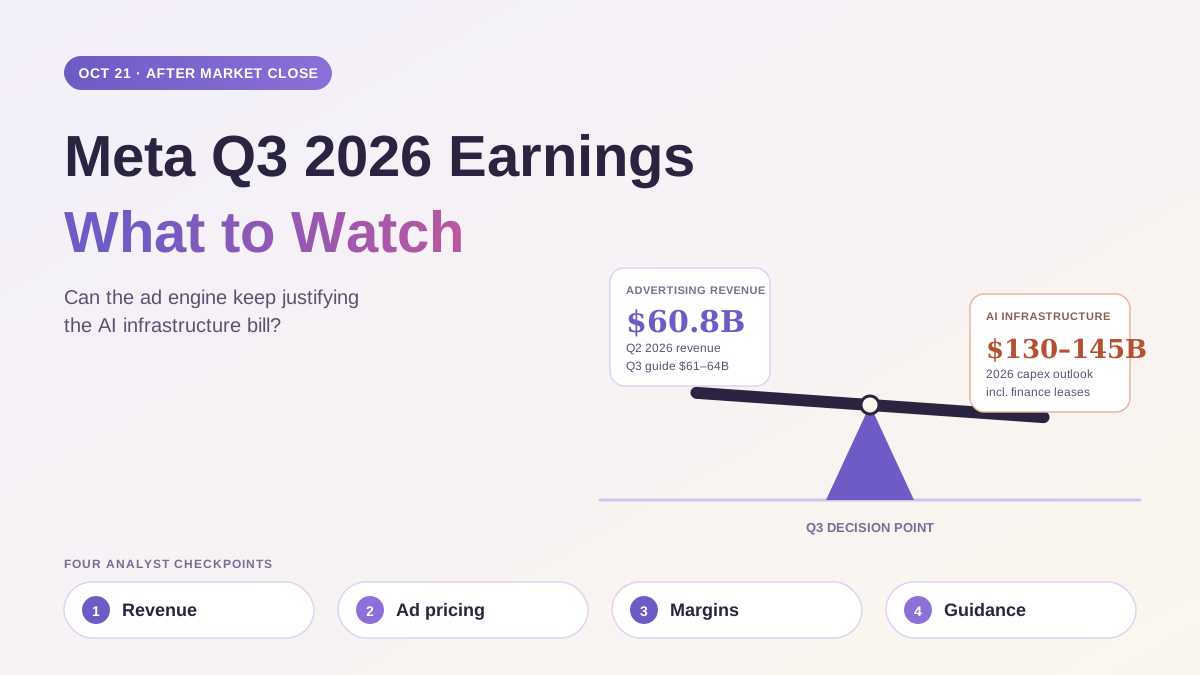
Meta Stock Earnings: What to Watch in Meta Platforms’ Q3 2026 Results
Meta reports Q3 2026 results on October 21. See the advertising, AI spending, margin, and guidance signals that could move META stock.
Zcash Q3 Report: Zakura Launched, Privacy Pool Supply Returns to 29%
Fractional Reserve: Reserve Requirement Abolished. Where is the Value?
Taiwan Blocks Coinbase and Kalshi Websites Over Alleged Election Betting
bStocks' Tokenized Shares Surpass $1 Billion in Assets Under Management in Four Months
Bitcoin's AI-driven rally faces a hidden danger if the machines get richer but workers don't
ICO, VC Tokens, and Alpha Models: Why They Can't Save the Current Crypto Market?





