In China, digital identity will rely on blockchain starting March 2027

 Prefer us on Google


China is preparing a new generation of digital identity services based on blockchain technology. On November 27, 2026, eleven Chinese administrations, including the central bank, published a regulation consisting of 44 articles that will come into effect on March 1, 2027. This regulation aims to allow individuals and businesses to use digital credentials recognized by various platforms. Beijing intends to develop the use of blockchain while maintaining control over its national infrastructure.
In brief
- China adopts a 44-article regulation on distributed digital identity.
- The system will come into effect on March 1, 2027, with voluntary registration.
- Authorities encourage its integration into financial, tax, and administrative services.
China gives a new dimension to blockchain
Blockchain is increasingly occupying a place in Chinese public infrastructures. Last April, tax authorities were already encouraging banks to adopt this technology to modernize their lending services and improve data sharing.
Beijing is now interested in the recognition of digital identities among different institutions. The new regulation, which will be subject to public consultation starting June 18, 2026, defines the responsibilities of network operators, certification bodies, and users.
Individuals and businesses will be able to voluntarily obtain a distributed digital identity after verification by an authorized organization. The system will notably allow the conversion of official documents, diplomas, or professional qualifications into verifiable digital credentials.
An administration will thus be able to recognize a document issued by another institution without necessarily reproducing the entire verification process. The regulation also encourages cross-border recognition of digital identities, provided that Chinese security requirements are met. The project therefore goes far beyond the mere dematerialization of identity cards.
Users will have better control over their data
One interesting aspect of the system concerns the amount of personal information collected by platforms. Article 17 of the regulation stipulates that users will be able to request, hold, use, and deactivate their digital identities and associated credentials.
Article 40 also limits data collection to the needs of the service provided, unless otherwise stipulated by legal, regulatory, or contractual provisions. For example, an institution wishing to verify a candidate's diploma could use an authenticable digital credential instead of asking for multiple documents containing additional personal information.
Blockchain and cryptographic mechanisms allow for the verification of the authenticity of a credential without necessarily exposing all the data of its holder. China has been exploring these technologies for several years. As early as 2023, Conflux and China Telecom presented a SIM card integrating blockchain, capable of generating and storing cryptographic keys.
Identity management could now join that of financial services. Article 29 specifically encourages mutual recognition between identities associated with the digital yuan and the new distributed identities. Authorities are also considering applications in transportation, customs, taxation, and public procurement.
-- Price
A distributed blockchain under institutional control
China pursues a particular approach to blockchain. While authorities have further tightened restrictions on cryptocurrency-related activities in February 2026, they are multiplying institutional applications of the same technology.
The new digital identity system illustrates this distinction. Article 8 requires different participants to use public services authorized by the Chinese cyberspace administration. Organizations wishing to integrate into the network must also meet applicable security standards and registration obligations.
Users will thus have a certain autonomy in managing their credentials, without necessarily controlling the governance of the infrastructure. This approach differs from some Web3 initiatives. In 2024, World ID notably integrated the Solana blockchain to allow crypto applications to verify the authenticity of their users.
This distinction deserves to be highlighted. Distributing a computing infrastructure does not necessarily mean distributing decision-making power. The Chinese project could reduce the duplication of personal data and simplify many administrative procedures. However, its effectiveness in terms of privacy will depend on the actual conditions of access to information and the application of the exceptions provided for by the regulation. China thus offers a new example of large-scale blockchain adoption, without adhering to the open governance model advocated by major cryptocurrencies.
This content is provided for general informational purposes only and doesn't constitute financial, investment, legal, or tax advice. Any events, rewards, online promotions, or related information mentioned herein should not be considered a recommendation, solicitation, or invitation to purchase, sell, trade, or otherwise deal in any crypto assets. Crypto assets are highly volatile and may result in loss. The availability of WEEX services, products, and related events may vary by region. You are responsible for ensuring that your participation is in accordance with applicable local laws and regulations.
You may also like
Solana Founder States AI Cannot Imitate Public Keys
DTCC's Blueprint for Tokenized Securities

XRP Ledger Records $1 Billion Increase in Tokenized Funds in 24 Hours

Pump.fun Charges for First Block Snipers, Will Meme Coin Launches Be Fairer?

Bullish Expands Stock Tokenization Services to Aptos and Ethereum

Bullish Expands Stock Tokenization Services to Aptos and Ethereum

Anza Urges Solana Mainnet Validators to Upgrade to Agave v4.4.2

Bank of England to test how UK finance would recover from an AI disruption

Aon Completes Three Stablecoin Premium Settlements, Two Using Solana

RWA Enters the Era of 'Big Infrastructure': The Competition Just Begins After Asset Tokenization

Midnight Foundation partners with WEA Japan and Netstars to explore private stablecoin payments
Jeff Park: This is the toughest Bitcoin cycle I've ever experienced

Solana introduces AI-powered Playground for blockchain developers
Sequent Completes $2.2 Million Pre-seed Financing, Curve Becomes First Paying Customer

Polygon Launches Open Money Stack on Coinbase Base for Cross-Border Payments

3 Crypto Companies Achieve $203 Million in Sales

Zcash urged to retire Sapling faster as AI cryptography concerns grow

Pump.fun to introduce Block0 fees to curb memecoin sniping from Dec. 4

Amid the Plunge, Small and Medium-Sized Crypto Treasuries Are Quietly Selling Coins

Google's AI Paper Has No Impact on RSA or Bitcoin Cryptography, Experts Say

SBI Holdings, SMFG, and Solana Foundation Launch SBI Solana Global
AI Self-Custody Wallet Ulys Raises $4 Million in Funding Led by Streamlined Ventures

SBI Solana Global Launches: Joint Venture with Sumitomo Mitsui FG and Solana Foundation for Stablecoin Payments and RWA Projects

Solana Developers Propose Allowing Validators to Stop Processing Unadopted Blocks

Brale lets businesses launch USD stablecoins on Cardano

Ansem and Satoshi Nakamoto: Living Under the Same 'Stolen' Roof

Cyber Loses 5.213 Million CYBER in Theft, Equivalent Tokens Destroyed
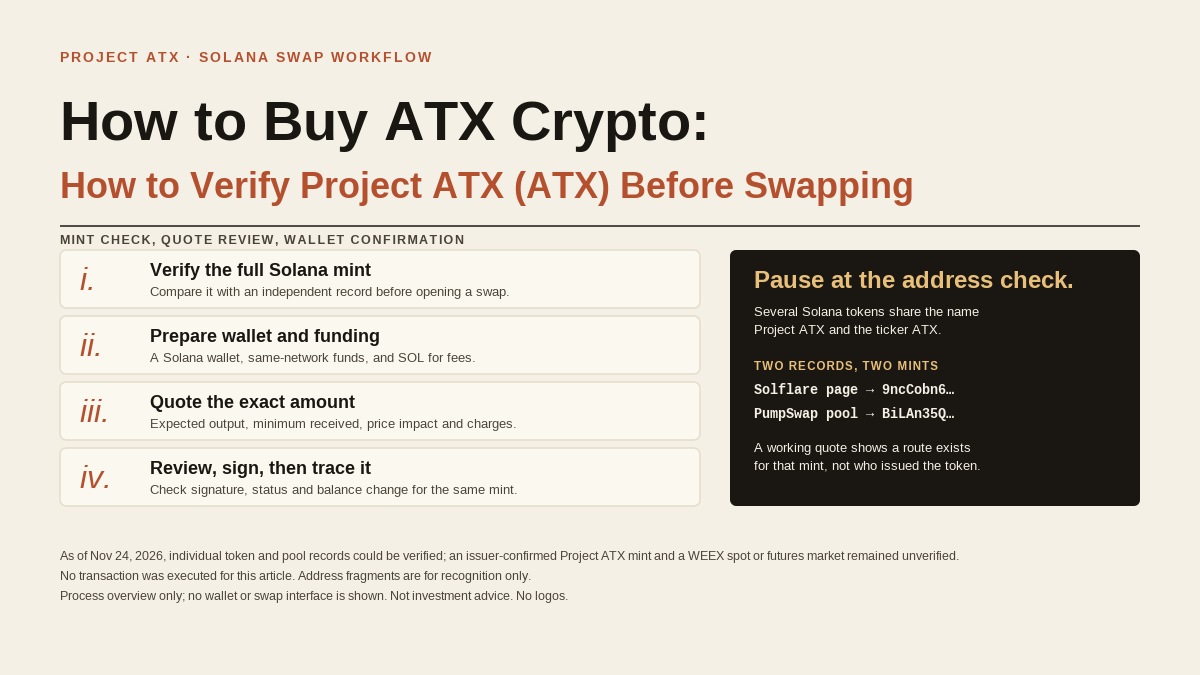
How to Buy ATX Crypto: How to Verify Project ATX (ATX) Before Swapping
Learn how to buy ATX crypto on Solana. Verify the Project ATX mint, review swap quotes and fees, and confirm the exact token you receive on-chain.

Why Is the ATX Crypto Price Different Across Platforms? Project ATX (ATX) Explained
See why the ATX crypto price varies across platforms. Compare Project ATX mint addresses, PumpSwap pools, and swap quotes for the same trade size.
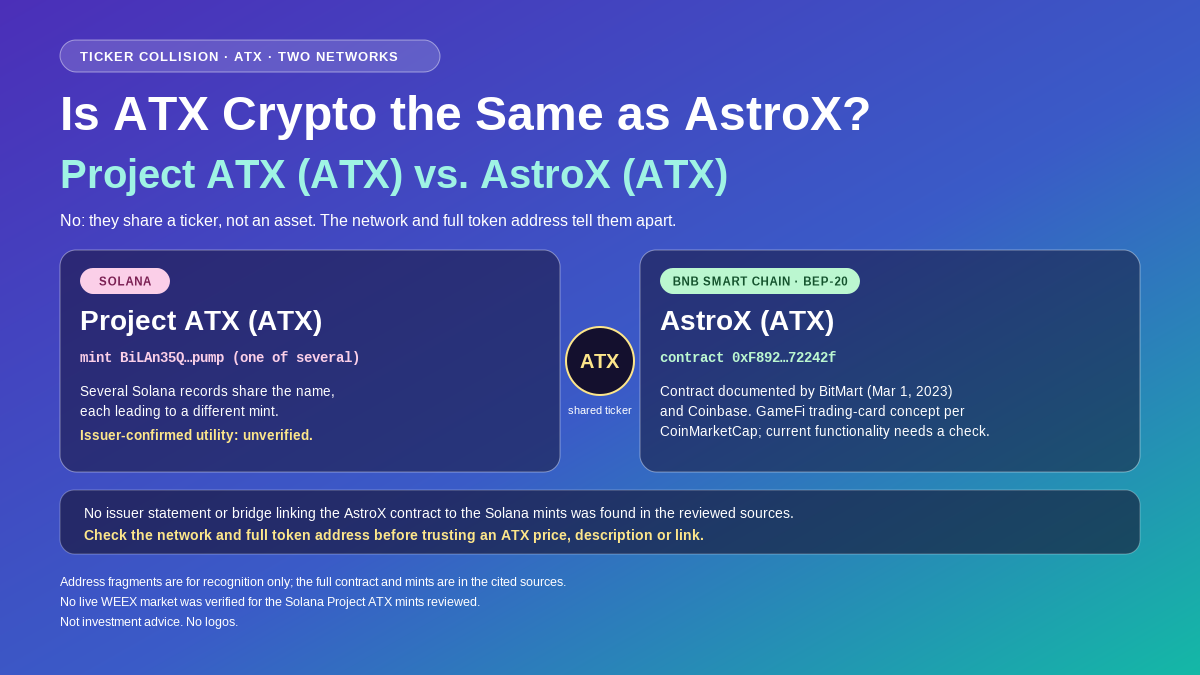
Is ATX Crypto the Same as AstroX? Project ATX (ATX) vs. AstroX (ATX)
Compare Project ATX on Solana with AstroX on BNB Smart Chain. Learn how to verify each token address before trusting an ATX price or buying guide.
Solana Founder States AI Cannot Imitate Public Keys
DTCC's Blueprint for Tokenized Securities
XRP Ledger Records $1 Billion Increase in Tokenized Funds in 24 Hours
Pump.fun Charges for First Block Snipers, Will Meme Coin Launches Be Fairer?
Bullish Expands Stock Tokenization Services to Aptos and Ethereum
Bullish Expands Stock Tokenization Services to Aptos and Ethereum
Latest articles


Latest coin listings on WEEX