
「Money Printer」 PUMP.FUN Establishes Investment Arm, Can $3 Million Keep a Good Project?

 Prefer us on Google

Original Article Title: "Making 9 Billion with Only 3 Million Invested, How Does Pump.fun's Math Work?"
Original Article Author: angelilu, Foresight News
On January 20, Pump.fun, the most profitable Meme coin platform in the Solana ecosystem, announced the establishment of an investment department, Pump Fund, and kicked off its first hackathon with an initial investment of $3 million to fund 12 projects. This figure, compared to its total revenue of nearly $9 billion, presents a subtle contrast: for every approximately $300 earned by the platform, only $1 is allocated to invest in the ecosystem, representing about 0.33%.
A New Attempt Under Competitive Pressure
The timing of Pump Fund's launch is intriguing. According to Solana Launchpads' transaction volume data, while Pump.fun still maintains its dominance, the recent upstart platform Bags has quickly captured over 10% market share, directly causing a decline in Pump.fun's market share.
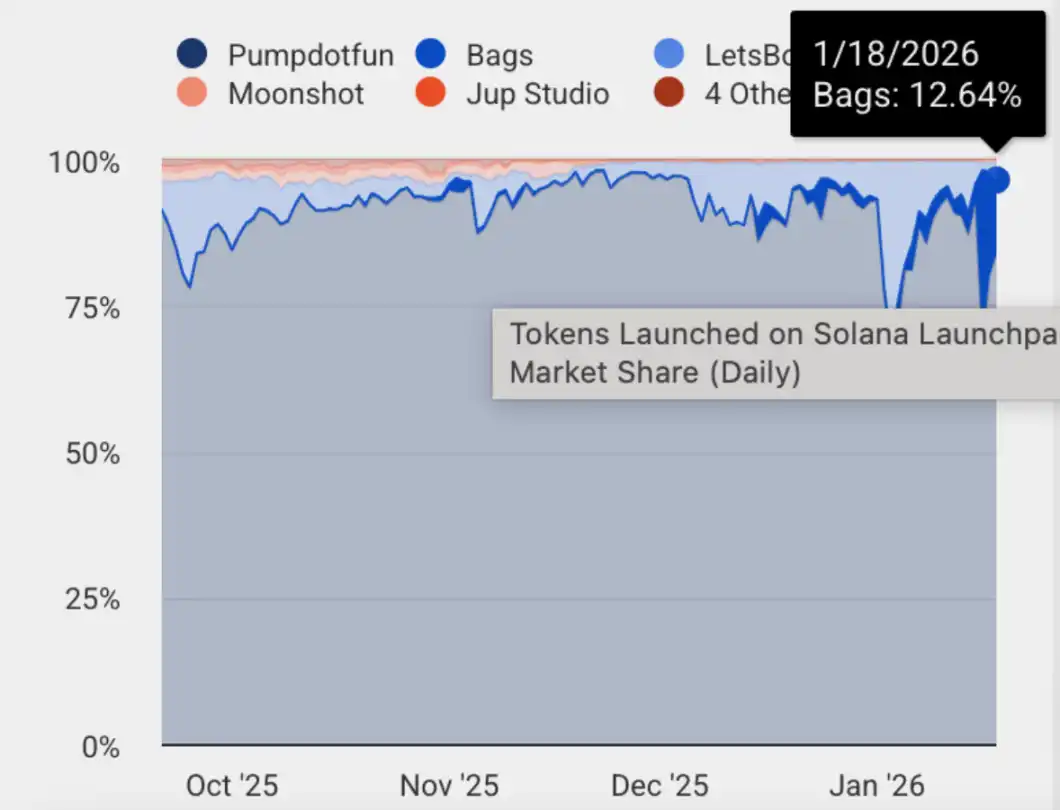
In this context, the $3 million ecosystem investment can be seen as an attempt at differentiation in competition. When the technical barrier between platforms is extremely low, and user loyalty is also extremely limited, Pump.fun chooses to establish new brand awareness through ecosystem investments—not just as a trading platform but also as a project incubator.
However, the question remains: is a 0.33% investment ratio sufficient to support this positioning? In comparison, even in relatively conservative technology companies, the investment ratio is many times higher than this number. From a business logic perspective, this is closer to an exploratory market experiment rather than a comprehensive strategic transformation.
Let the Market Be the Judge
The question that Pump Fund's experiment seeks to answer is: in the Web3 world, who should define what a "good project" is?
This global hackathon, called "Build in Public," adopts a set of rules that are completely different from traditional start-up competitions: no expert judges to score, no Demo Day pitches; instead, the market decides directly.

Specifically, participating teams must issue tokens on Pump.fun, publicly share their development progress daily, and showcase the building process through social media. The ultimate criterion is one—market response. If a project garners attention, trust, and trading volume, it proves worthy of investment; otherwise, it naturally gets eliminated. From the opening of applications on January 19 to the announcement of the first batch of winners on February 18, during these four weeks, all projects will undergo a real-time assessment in the open market. On February 18, at least one project will be selected and funded.
In the hackathon rules, the platform explicitly states that "in addition to the project's social media appeal, the long-term sustainability of the project will also be evaluated." However, it is currently unclear how to find a balance between market hype and long-term value, and what specific criteria will be used to judge.
As Pump.fun co-founder Alon puts it, "this framework creates a new path for founders who cannot access traditional capital." In a sense, this is a challenge to traditional VC investment logic—since Web3 emphasizes decentralization, why should the success of a project still be determined by a few investors.
A Deeper Business Dilemma
Aside from the mechanism design, Pump Fund also faces a more fundamental problem: even if high-quality projects are successfully incubated, will these projects stay on Pump.fun?
This is the structural dilemma of Meme coin platforms. The Nasdaq invests in tech companies going public, and companies like Microsoft and Apple continue to trade on the Nasdaq after listing, contributing long-term value to the platform. But Meme coin projects operate under different logic. If a project achieves initial success on Pump.fun, builds a user base and market recognition, what will be the next step? It is likely to migrate to a platform with greater liquidity, such as Binance or Coinbase, or even establish its own independent community.
Pump.fun is essentially a "launchpad," and projects will naturally seek a broader market as they mature. More fatally, the platform's revenue model makes it difficult to truly retain high-quality projects. Pump.fun relies on early high-frequency trading to earn fees, but as a project matures, the trading frequency tends to decrease, long-term hodlers increase, and speculative trading diminishes. From a revenue perspective, the platform always makes the most money from those "fast-moving consumer goods" that are short-term pumps, rather than the "value projects" built for the long term.
This may explain why the investment ratio is only 0.33%. In the current business model, large-scale investment ecosystems not only have uncertain returns but may even be making a wedding dress for others. This is not simply "stinginess" but a manifestation of business rationality.
Four weeks later, when the first batch of award-winning projects is announced, we may get a preliminary answer. However, the longer-term question remains: in the Meme coin field with low technical barriers and weak user loyalty, can ecosystem investment truly become a moat? As competitors like Bags continue to eat away at market share, can this $3 million experiment help Pump.fun maintain its position?
-- Price
This content is provided for general informational purposes only and doesn't constitute financial, investment, legal, or tax advice. Any events, rewards, online promotions, or related information mentioned herein should not be considered a recommendation, solicitation, or invitation to purchase, sell, trade, or otherwise deal in any crypto assets. Crypto assets are highly volatile and may result in loss. The availability of WEEX services, products, and related events may vary by region. You are responsible for ensuring that your participation is in accordance with applicable local laws and regulations.
You may also like

Pump.fun Updates Callout Rewards Algorithm, Introduces Follower Profit and Loss Metrics
Pump.fun Adjusts Reward Algorithm to Reduce Incentives for Low-Quality Recommendations

Pump.fun Adjusts Callout Rewards Mechanism, Weakens Trading Volume Assessment

Pump.fun Adjusts 'Signal' Reward Mechanism, Emphasizing Quality Over Quantity

OpenAI Publishes Proof Refuting Erdős's Conjecture

Pumpfun announces that 50% of its revenue will be used to buy back and burn PUMP tokens
The Most Profitable App in the Crypto World Starts to Decline
JANUSZ KRYPTO: Is My Ledger Safe? Spyware in Wallets and Stolen Millions
For the First Time, a Crypto Company Acquires a Bank in Europe

US Public Company Led by FTX Europe Head to Trade Tokenized Stocks Under SEC Exception

Morgan Stanley: Gold Has Strong Support at $4,000, Rising Yields May Not Be Bearish for Gold

Creators Speak | In the New Cycle, How Should Investors Find 'Value Coins'?
Hot CPI Lifts Hike Bets; Risk Assets Pull Back | WEEX TradFi Daily(October 15, 2026)
Major indexes closed lower on October 14, with the Nasdaq leading the decline. September unadjusted CPI rose to 3.7% year on year, above forecasts, and core CPI also beat expectations. Traders sharply raised this month’s hike probability to about 43.7% and fully priced two more hikes by the end of January. Chip stocks were sold again. Bitcoin broke below $83,000 and last traded near $81,700, while spot gold and silver fell. Crypto-related stocks were under pressure, but PYTH rose against the tape. October 15 brings PPI, retail sales and key

Dialogue with Haotian: Don't Just Chase Memes in the Early Bull Market! Robinhood's Next Moves are Hooks, Agents, and Tokenized Stock DeFi
Bitcoin Could Be "Less Volatile" Than Gold and Surpass Its Market Value
Firelight forces XRP-linked tokens lockup as withdrawal delay queue grows

Analysts Turn Bullish on Market Predictions, Similar to Late 2022 = CryptoQuant

Bitwise Predicts Bitcoin Will Rise Long-Term Regardless of AI and Interest Rate Movements

Large Companies Aim to Advance Quantum Defense of Bitcoin

Crypto Long and Short: Why Gold and Bitcoin Can Be in the Same Portfolio

No One Endorses a CEO or Founder They Don't Trust

Stricter Regulation May Lead Brazilian Crypto Market to a New Concentration Cycle

Ecuador Government Promotes Bitcoin Mining Amid Power Outages

Solana Sets a Date for Its Next Major Upgrade
Aurora Intents connects Solana wallets to Elara’s Ethereum yield
Stablecoin cards win users on FX savings, not rewards: Wirex CEO

MemeToro, Pump.fun, and Four.meme: Which token launch platform better protects buyers?
Ethereum's quantum race takes a new turn as zkSync courts banks and Starknet weighs exit
How AI Memecoins Differ from Classic Memecoins: A Look at MemeToro, DOGE, and PEPE
Ripple partners with DriveWealth for RLUSD settlement and global payments
Pump.fun Updates Callout Rewards Algorithm, Introduces Follower Profit and Loss Metrics
Pump.fun Adjusts Reward Algorithm to Reduce Incentives for Low-Quality Recommendations
Pump.fun Adjusts Callout Rewards Mechanism, Weakens Trading Volume Assessment
Pump.fun Adjusts 'Signal' Reward Mechanism, Emphasizing Quality Over Quantity
OpenAI Publishes Proof Refuting Erdős's Conjecture
Pumpfun announces that 50% of its revenue will be used to buy back and burn PUMP tokens
Contents
Latest articles


Latest coin listings on WEEX


