
Morpho Loans Double in a Year: How Much Did Collaborative Channels Contribute?

 Prefer us on Google


Analyzing the sources of Morpho's loan growth and treasury structure in Q3.
Written by: Alea Research
Compiled by: AididiaoJP, Foresight News
Morpho positions itself as the lending engine behind other brand applications. The official statement is "Robinhood in front, Morpho behind." Q3 data confirms this distribution model: chains and collateral related to Robinhood, Coinbase, Circle, and Kraken contributed 62% of the $1.85 billion increase in Morpho loans.
Among the nine major lending protocols, Morpho's loan share has more than doubled within a year, reaching 20.3% by the end of Q3. The annualized interest paid by borrowers reached $235 million in September. MORPHO holders have a switch that can add protocol fees to these interests, but they currently choose to keep it off.
How Credit is Transferred in Morpho
Morpho was designed from the beginning as a lending infrastructure, rather than a lending application directly aimed at users. The market is responsible for holding loans, the treasury gathers lender funds, Midnight provides fixed terms, and partner applications manage customer relationships. Each layer charges different participants.
A market locks in loan assets, collateral, oracles, and liquidation thresholds when it opens. Most lenders do not choose the market directly but deposit money into the treasury. Managers write risk policies into contracts, deciding which markets the treasury can lend to and how much each market can receive.
This is closest to the traditional financial model of "banking as a service": a licensed balance sheet supports fintech brands in the background. The difference is that here, the balance sheet belongs to the depositors. Coinbase and Robinhood compete for the same batch of customers, yet both connect to Morpho. This is the most direct evidence of network neutrality. Another explanation is price: zero protocol fees make Morpho the lowest-cost credit engine currently available.
Collaborative Channels Dominated Growth This Quarter
At the end of the quarter, chains and collateral related to Robinhood, Coinbase, Circle, and Kraken accounted for 47.1% of Morpho loans, up from 39.6% three months ago. Robinhood Chain contributed the most, growing from zero to $456 million in the first quarter.
The share increase occurred in two steps. Over the nine months leading to the end of June, primarily due to competitors' loan contractions, Morpho's share rose to 17.2%; entering Q3, Morpho's own loans grew by 51%, outpacing the recovery speed of the other eight protocols.
Managers Decide Risk Preferences
The treasury reached $6.24 billion at the end of the quarter, growing 52% in a single quarter. Four curators manage 82% of the funds, each with different collateral preferences. Gauntlet and Spark mainly operate Bitcoin-related markets, while Steakhouse saw the largest increase, reaching $764 million, managing both Robinhood and Coinbase application treasuries. Sentora is responsible for the dollar treasury for PayPal and Ripple, with assets nearly doubling to $1.27 billion.
-- Price
Circular Trading and USDe Oracles
The circular market reached $1.63 billion at the end of the quarter, nearly doubling since June. A typical operation is: stake USDe for a 5% collateral reward, borrow dollars at about 4% interest, and then buy more USDe. With a loan-to-value ratio of 89.4%, $1 of own funds can leverage about $9.4 of USDe, yielding an annualized return of about 13%. USDe itself does not pay returns in these markets; returns rely entirely on rewards, which are distributed weekly.
Steakhouse's oracle fixes USDe at a price of $1, switching only when the backup feed deviates from parity by more than 0.5% for 16 consecutive hours. Depositors of Robinhood Earn and Coinbase High Yield provide funds for this transaction. The core risk they bear is that the USDe discount lasts longer than this window.
From September 2025 to November 9, the hourly closing price of USDe against USDT never fell below parity by 0.5% for 16 consecutive hours. The longest instance lasted only two hours, occurring on October 10, 2025, when a certain hourly closing price fell below parity by 6.35%. Under the current oracle rules, such a brief discount would not trigger a price adjustment.
Rewards Mainly Paid by Token Issuers
The Q3 reward program distributed a total of $19.9 million, mostly paid by the issuers of the promoted dollars. Ethena contributed $7.59 million, and PayPal contributed $3.99 million. DAO's own activities accounted for only $730,000. The Morpho rewards committee additionally supplemented $2.49 million for the Robinhood treasury.
Excluding the USDe market and the seven largest reward treasuries, Morpho loans still grew by 31.3% in Q3; further excluding Circle's Arc chain, the growth rate was 24.6%, roughly on par with the 24% increase of the other eight protocols.
Midnight Market Expansion Accelerated in October
Midnight is Morpho's fixed-rate market, launched on Base in July. In October, loans grew more than 20 times, reaching $70 million, with $48 million concentrated on October 22 and 23. A treasury adapter will be launched in Q4, allowing existing V2 treasuries to lend to Midnight once the DAO registers it. These treasuries held a total of $3.77 billion on Ethereum and Base at the end of the quarter.
Fees Switch and Valuation
Lenders and treasury depositors took 90.3% of the fees this quarter. Currently, all markets have zero protocol fees, but the DAO can vote to raise the maximum rate to 25% of interest.
Based on Aave's quarter-end 35x annualized revenue valuation multiple, Morpho's $1.75 billion market cap on September 30 implies about $50 million in annual revenue, equivalent to 24.6% of the quarterly interest pace, just within the 25% cap.
Aave's revenue has already been used for buybacks, while Morpho, even if it activates fees, cannot temporarily flow to holders until a voting path for distribution is established.
After the Quarter
From September 30 to November 9, MORPHO fell by 17.8%, roughly in line with AAVE. During the same period, Morpho loans rose to $5.73 billion, with its share among the nine protocols further increasing to 22.7%.
This content is provided for general informational purposes only and doesn't constitute financial, investment, legal, or tax advice. Any events, rewards, online promotions, or related information mentioned herein should not be considered a recommendation, solicitation, or invitation to purchase, sell, trade, or otherwise deal in any crypto assets. Crypto assets are highly volatile and may result in loss. The availability of WEEX services, products, and related events may vary by region. You are responsible for ensuring that your participation is in accordance with applicable local laws and regulations.
You may also like

As traditional giants rush into digital dollars, USDD’s Yvonne Chia explains why 24/7 access, self-custody, and transparent yield give decentralized stablecoins an edge banks can’t replicate.

Sky Founder Suspected of Draining Own USDS Lending Pool

Self-Rescue and Breakthrough in the Cold Winter: How Can Crypto Lending Find New Growth?

Animoca Co-Founder Criticizes Traditional Bank Checking Accounts, AI Agents and DeFi May Reshape Financial Services

The Arrogance and Prejudice of a16z

WBTC Expands Into Confidential DeFi, STRK Rewards and Institutional Lending

Lido’s lending plan could block loan repayments without stopping interest
XRP loans trigger 883 liquidations, and $53M remains at risk

RWA Weekly: NYSE to Use Avalanche for Settling Tokenized Stocks; Goldman Sachs, Citigroup Commit Approximately $270 Million to Joint Stablecoin Project

Analyst: HYPE Buyback Outperforms PUMP, AAVE, and JUP
Alta raises $47.5M for blockchain backed by crypto skeptic Jack Zhang

US card debt hits $1.29 trillion as Bitcoin loans expose a collateral divide

Valour Lists Eight New Crypto ETPs Including Canton, Morpho and Raydium
Chainalysis Report: Why Did Western Europe Withstand the Global Crypto Market Chill?
Tokenized gold can now back a Coinbase loan. The price feed takes weekends off

Raycash Launches on Ethereum Mainnet, Offering Privacy Stablecoin Payments and Yield Features
Groma Launches Permissioned Asset GRO on Uniswap v4, Supporting On-Chain Trading

OAK Research: Stablecoin Revenue Not Flowing to Public Chains

What Makes Erebor, Dubbed the 'Next Silicon Valley Bank', Attractive to SBI and Robinhood?

Total Deposits of reUSD and reUSDe Exceed $400 Million, reUSD Launches on Monad

Onlend Unveils No-Code Infrastructure to Launch Custom Onchain Lending Apps
Morpho Loans Exceed $5.8 Billion: Growth Driven by Application Traffic or Reward Subsidies?
The Same Bad Debt: Five Points of Loss Recognition in DeFi Treasuries
Spark's Q3 Lending Market Share Rises to 13.2%, Net Income Drops 30%
1kx Blockchain Industry In-Depth Report: Who is Really Making Money?

USDD Reports Strong Treasury Performance, Growth in Key Metrics, and Ecosystem Expansion

Morpho RWA deposits pass $2B as loans approach $900 million

Birch Hill Completes $4 Million Seed Round Financing Led by Multicoin Capital

A New Wave of TGE? 19 Projects Expected to Launch Intensively in Q4
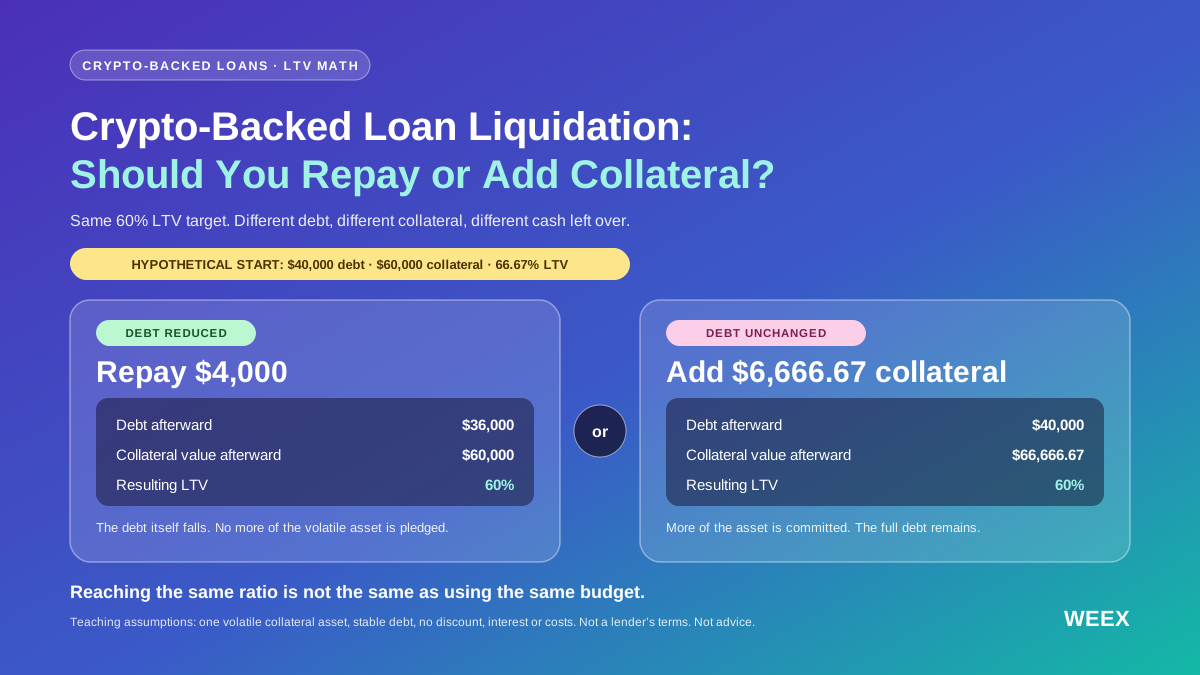
Crypto-Backed Loan Liquidation: Should You Repay or Add Collateral?
Facing crypto-backed loan liquidation? Compare repayment and collateral top-ups using equal budgets, LTV calculations, stress tests and protection limits.
As traditional giants rush into digital dollars, USDD’s Yvonne Chia explains why 24/7 access, self-custody, and transparent yield give decentralized stablecoins an edge banks can’t replicate.
Sky Founder Suspected of Draining Own USDS Lending Pool
Self-Rescue and Breakthrough in the Cold Winter: How Can Crypto Lending Find New Growth?
Animoca Co-Founder Criticizes Traditional Bank Checking Accounts, AI Agents and DeFi May Reshape Financial Services
The Arrogance and Prejudice of a16z
WBTC Expands Into Confidential DeFi, STRK Rewards and Institutional Lending
Latest articles


Latest coin listings on WEEX


