
Stablecoins: The $6.6 Trillion Gap That Is Frightening Banks

 Prefer us on Google
All the stakes in a single adverb. The Office of the Comptroller of the Currency published its final rule implementing the GENIUS Act on stablecoins on Wednesday. However, it removed the provision that banks were most eagerly awaiting. The text will come into effect on January 18, 2027.
The American Bankers Association reacted during the day. Its president, Rob Nichols, contests this reversal by the OCC regarding yields.
Key points of this article:
- The Office of the Comptroller of the Currency published the final rule of the GENIUS Act, omitting a crucial provision for banks.
- Banks fear a massive outflow of deposits due to the OCC's decision, estimated at $6.6 trillion.
Stablecoins: the law prohibits, the adverb allows
Section 4(a)(11) of the GENIUS Act prohibits a payment stablecoin issuer from paying interest or yield to the holder. The prohibition applies to cash, tokens, or any other form, but only in relation to the holding of the token. Everything is in this adverb. Thus, a payment motivated, even in part, by something other than mere holding falls outside the scope of the prohibition. Similarly, a payment made by a third party rather than by the issuer escapes the letter of the text.
In March, the OCC wanted to close the loophole. Its proposed rule then added a rebuttable presumption of violation. It applied whenever an issuer made an agreement with an affiliate or a related third party to compensate holders. However, the definition of the related third party was broad enough to catch exchanges and wallet providers. It targeted anyone offering to pay yields to holders as a service.
The presumption has been dropped. The regulator deemed it unsuitable at this stage of the market. It will therefore examine arrangements on a case-by-case basis, without publishing any examples. Future regulation will come when it has accumulated supervisory experience, with no announced deadline. It also refuses to presume compliance for reward programs prior to the law, according to its bulletin. In the meantime, programs continue to operate. PayPal pays 4% on its PYUSD, Coinbase One 3.75% on USDC, and Kraken+ offers up to 4.5% on USDG.
| Program | Stablecoin | Announced Reward |
|---|---|---|
| Kraken+ | USDG | up to 4.5% |
| PayPal | PYUSD | 4% |
| Coinbase One | USDC | 3.75% |
Rates effective as of October 21, 2026. Source: CoinDesk.
Banks Estimate Deposit Outflow at $6.6 Trillion
Rob Nichols, president of the American Bankers Association, did not mince his words on Wednesday. According to him, the final rule abandons the safeguards that the OCC itself had proposed against indirect arrangements. These go through affiliates, platforms, or distribution partners. These gaps "risk undermining the distinction that Congress has drawn between payment stablecoins and traditional bank deposits." His harshest statement targets the promise of future regulation. For him, "wanting to address deposit outflows and economic damage after they have occurred is the wrong approach." The ABA thus promises to return to regulators and legislators.
The Bank Policy Institute echoed the same message through Paige Pidano Paridon. For her, the removal of the presumption "replaces clarity with ambiguity." Banking lobbies also cite an estimate from the Treasury Advisory Committee on borrowing. It estimates that $6.6 trillion in deposits could leave the banking system. The Community Bank Association adds its own projection. According to it, its members would lend at least $850 billion less in the coming years.
On the regulator's side, Jonathan Gould promises "a clear and workable framework for innovation in payment stablecoins." Scott Bessent, Secretary of the Treasury, sees the GENIUS Act as "a turning point in American finance." According to him, the law further establishes the United States as the "global capital of crypto."
Only the Courts Remain for American Banks
The crypto industry, however, has not shied away from its pleasure. Dante Disparte at Circle "welcomes the final rules from the OCC implementing the GENIUS Act." Faryar Shirzad, head of public policy at Coinbase, summarized it on X: "there's a lot to like." For the Blockchain Association, removing the presumption brings regulation closer to the letter voted by Congress. On the stock market on Wednesday, Circle rose about 6% and Coinbase more than 4%.
Banks have lost twice in two months. First, the amendments that were supposed to close the loophole sank with the Clarity Act. The Senate rejected it in September by a vote of 49 to 50, with Republicans remaining divided on yields. Then the OCC's presumption disappeared from the final version. At TD Cowen, Jaret Seiberg sees this as a negative point and raises the real timeline. According to him, "until the courts decide, there will be ambiguity about what is permitted and what is prohibited." The Community Bank Association had already sued the OCC in early October. It contests the national trust bank charters granted to crypto players.
January 18, 2027, is also the effective date of the GENIUS Act itself. However, several implementing texts are still missing. The OCC has left aside the money laundering and sanctions aspect. It will be subject to separate regulation, coordinated with the Treasury. The FDIC and the Fed have not finished either. Finally, the battle over yields will be played out in front of a judge rather than in Congress.
This content is provided for general informational purposes only and doesn't constitute financial, investment, legal, or tax advice. Any events, rewards, online promotions, or related information mentioned herein should not be considered a recommendation, solicitation, or invitation to purchase, sell, trade, or otherwise deal in any crypto assets. Crypto assets are highly volatile and may result in loss. The availability of WEEX services, products, and related events may vary by region. You are responsible for ensuring that your participation is in accordance with applicable local laws and regulations.
You may also like

Solana targets faster finality, while Wall Street cuts the cash that must move

TUM Blockchain Conference: Information and Speakers

Beyond Prediction Markets: How to Determine Whether Bitcoin Will Rise or Fall?

NEAR Co-Founder Discusses New AI Economic Strategy: From Cross-Chain Transactions to Privacy AI, Is the Next Step for AI Agents to Take Over the Market?

CICC: How to Hedge AI Risks?

Zcash NU7 Upgrade: 3 Things ZEC Holders Must Know Before November 5
USDC Listed as the EU's First 'Significant E-Money Token'
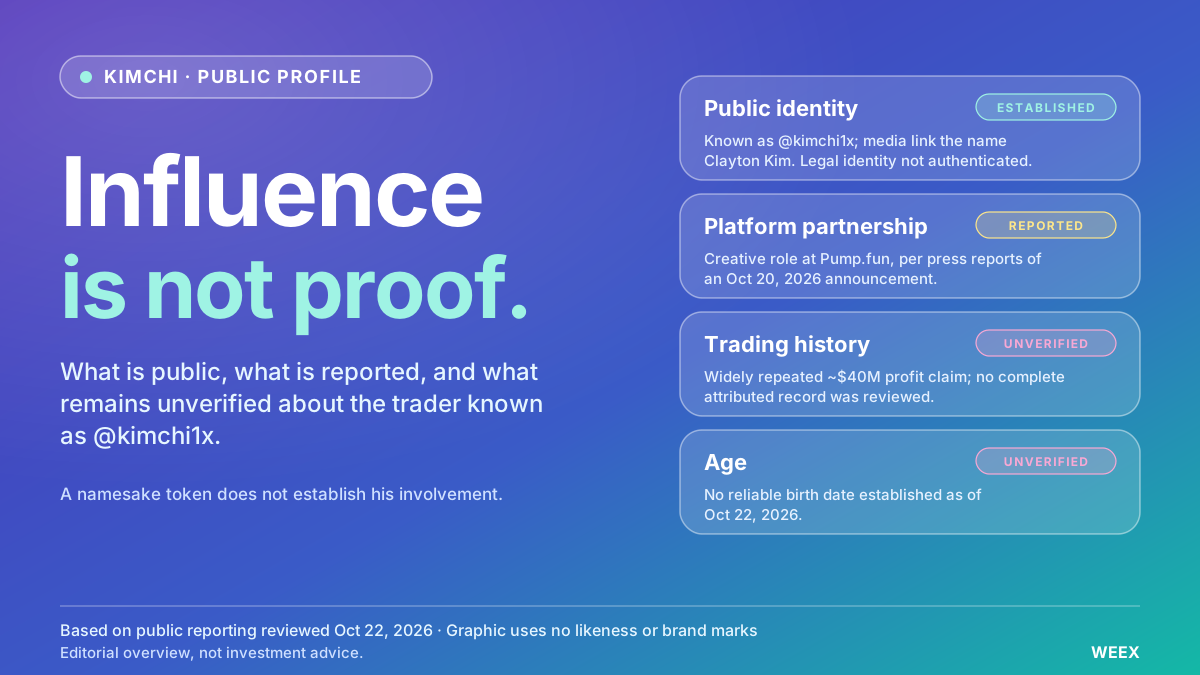
Who Is Kimchi Crypto Trader? Age, Real Name, and Trading Background
Who is Kimchi crypto trader? Check what is known about his age, the name Clayton Kim, trading background, profit claims, and Pump.fun partnership.

Gold, USDC, Uniswap: How Matrixdock and Arc Expand On-Chain Applications of Tokenized Gold?

From AWS Dream to Liquidity Harvesting Machine: The Zero-Sum Truth Behind Hyperliquid's Profits

Robinhood Chain Surpasses Ethereum in Revenue: $51 Million vs $41 Million in Q3

Countdown to the GENIUS Act: What Changes Did the OCC Final Rule Make?

Crises Have Driven the Evolution of Crypto Perpetual Futures

Blockchain Prepares for the Era of Quantum Computers: Ethereum, Stellar, and Tron Adopt Different Survival Strategies

October 28: The Fed, Big Tech Earnings and What to Watch in Bitcoin, Stocks and Gold

GRVT Burns 1.1 Million Tokens as Countdown to Grvt 2.0 Begins

Earning Millions Monthly: How Crypto Frontends Make So Much Money?
Are Meme Stock Tokens a Passing Fad or a New Gateway to Traditional Securities Markets?

One billion dollars in three days is not enough. Bitcoin faces a significant challenge

Crypto Company Backed by Robinhood Founder Aims to Create Data Layer for the AI Era

Railway security breach linked to $371,000 crypto theft across 19 chains
Folius Ventures Founder: Crypto VCs Will Disappear! Don't Look for 100x New Stories in the Next Round, Just Buy the Winners

AI Capital Expenditure Increases Financing Pressure, Global Assets Reassess Interest Rates and Safe-Haven Demand

Big Tech Opposes Stock Tokenization: What’s Next for Institutional Entry?

Binance founder CZ warns crypto users over critical PHP security flaws

Crypto-kidnappings: 6 out of 10 French people want to protect themselves, crypto holders already do

Is Leverage in U.S. Stocks Stalling? Wall Street 'Has Exhausted Its Balance Sheet'
Countdown Two Weeks: Zcash NU7 Upgrade Approaches, 22,000 ZEC Facing Soft Freeze

Grupo Caldeira OTC and Urban Announce Merger and Create Institutional Platform for Virtual Assets

DeFi Gold Mining Guide: 5 Potential Projects to Watch
Solana targets faster finality, while Wall Street cuts the cash that must move
TUM Blockchain Conference: Information and Speakers
Beyond Prediction Markets: How to Determine Whether Bitcoin Will Rise or Fall?
NEAR Co-Founder Discusses New AI Economic Strategy: From Cross-Chain Transactions to Privacy AI, Is the Next Step for AI Agents to Take Over the Market?
CICC: How to Hedge AI Risks?
Zcash NU7 Upgrade: 3 Things ZEC Holders Must Know Before November 5




