
Tether wants its gold token to rival ETFs

 Prefer us on Google


Anchorage Digital's support for Tether Gold gives eligible institutional clients routes to sell or borrow against XAUT as Paolo Ardoino promotes it as a gold-ETF challenger. The competitive test is how readily those routes deliver funds at the size and price a holder needs.
In Tether's November 12 announcement, its CEO said he believes XAUT is on track to become "the first true competitor to the gold ETF market." A day earlier, Anchorage announced custody, principal-desk trading and collateral support for the gold-backed token. Like gold-trust shareholders, token holders still depend on counterparties to turn that exposure into funds.
Tether said KPMG U.S. audited issuer TG Commodities S.A. de C.V.'s financial statements for the year ended December 31, 2025, issuing an unqualified opinion. The announced audit concerns that entity and year, rather than all current Tether reserves or today's trading and financing terms.
For eligible clients, desk-sale proceeds come from the trading counterparty. Anchorage advertises USD or USDT borrowing against bank-custodied XAUT through arrangements with other clients. Borrowing preserves gold exposure but creates debt; the announcement does not establish bank-funded lending. It also specifies neither a universal sale settlement currency nor a fiat-withdrawal timetable.
Anchorage says it holds XAUT at Anchorage Digital Bank in the US or Anchorage Digital Singapore. The group's footer names Anchorage Hold LLC as digital-asset trading provider, Anchorage Digital NY LLC for New York agency trading and A1 Ltd. as a principal-trading business. It does not identify one universal trade-contract entity.
Access is institutional, with limited high-net-worth availability and further requirements for certain trading. Custodied tokens lack Anchorage guarantees and FDIC or SIPC protection. Custody therefore provides neither an insured gold deposit nor assured liquidity.
Anchorage's notice says US persons cannot purchase or redeem XAUT with TG Commodities. The issuer's terms contain a qualification: US counterparties qualifying as eligible contract participants, a regulatory category, may be accepted at Tether Gold's sole discretion. Direct purchases and redemptions also require verified issuer-customer status.
Platform eligibility, issuer eligibility and issuer acceptance are separate gates. Neither institutional access at Anchorage nor eligible-contract-participant status alone establishes the issuer's acceptance. Anchorage's notice addresses issuer transactions, rather than a blanket ban on permitted secondary trading or custody.
Even an eligible, verified issuer customer does not have an unconditional cash buyback. The terms describe whole-bar redemption for delivery in Switzerland. Instead of taking delivery, a customer can request that Tether Gold attempt a sale to a gold dealer or broker. Only a successful sale produces fiat proceeds, less fees; Tether Gold has no obligation to repurchase the tokens or bullion. That route also needs a buyer.
IAU holders use intermediaries too
The iShares Gold Trust product page describes IAU shares trading on NYSE Arca through brokerage accounts. For an ordinary share sale, a market buyer supplies the money through the brokerage transaction. The trust is not paying the retail holder cash for redeeming a share.
Its currently linked prospectus, dated December 22, 2022, reserves creation and redemption of baskets to authorized participants, with gold exchanged for shares. Retail sale access and direct redemption access are different rights in this structure as well.
Borrowing without selling is also available within conventional brokerage arrangements, subject to approval. Fidelity's margin FAQ lists ETFs held for at least 30 days as eligible collateral, with special security and account requirements, and says checkwriting, bank cards and bill payments can create or increase margin debt. That general policy establishes neither IAU-specific approval nor a particular borrowing limit.
Who supplies the funds?
Both structures need a counterparty. Switch between selling and borrowing to follow the funds.
GOLDEXPOSURESELLSale proceedsBORROWLoan funds + debt
GOLDEXPOSURESELLSale proceedsBORROWLoan funds + debt
Follow the funds
Follow the fundsSellBorrow
The trading counterparty or market buyer supplies sale proceeds. The desk or broker provides the route.
XAUT / ANCHORAGESELLERBUYERSale proceedsXAUT sold through deskXAUT holderTrading counterpartyEligibility and agreed execution terms apply IAU / BROKERAGE SELLER BUYER Cash via brokerage sale IAU shares sold IAU holder Market buyer Retail share sale; separate from trust redemption
XAUT / ANCHORAGETrading counterpartySale proceedsXAUT holderXAUT sold through the deskEligibility and execution terms applyIAU / BROKERAGEMarket buyerCash via brokerIAU holderIAU shares soldTrust redemption is a separate route
Another bank client supplies XAUT financing; a brokerage lender may supply approved margin credit. Both create debt.
XAUT / ANCHORAGEHOLDERLENDERUSD or USDT loanXAUT stays in bank custodyXAUT borrowerAnother bank clientClient financing; no bank-funded loan established IAU / BROKERAGE HOLDER LENDER Margin credit, if approved Eligible securities collateral Shareholder Brokerage lender General Fidelity route; IAU-specific approval not established
XAUT / ANCHORAGEAnother bank clientUSD or USDT loanXAUT borrowerXAUT remains in bank custodyNo bank-funded loan establishedIAU / BROKERAGEBrokerage lenderMargin credit, if approvedShareholderEligible securities collateralIAU-specific approval not established
A sale needs a buyer; a loan needs a lender. Custody alone guarantees neither.
Anchorage notice excludes US direct issuer transactions; issuer terms allow discretionarily accepted US ECPs after verification. Neither custody nor ECP status establishes issuer acceptance. IAU trust redemption is AP-only for gold. Fidelity policy does not establish IAU-specific credit. Sale currencies, fiat withdrawal timing and loan terms remain client-specific.
Sources and evidence
Sources
- Anchorage support and client arrangements
- IAU secondary-market access
- IAU authorized-participant redemption
- Fidelity general margin rules
- Issuer eligibility and redemption terms
Supporting facts
- Reported statement Anchorage's November 11 announcement says institutions can hold XAUT at Anchorage Digital Bank, N.A., buy and sell through its principal desk, and pledge bank-custodied XAUT in arrangements with other Anchorage Digital Bank clients. [1]
- Reported statement Anchorage advertises borrowing USD or USDT against XAUT while retaining gold-price exposure; the announcement describes collateral arrangements between clients, not a bank-funded loan program. [1]
- Anchorage's notice says US persons cannot purchase or redeem XAUT with TG Commodities, while the issuer's terms exclude US persons from issuer services except eligible contract participants accepted at its sole discretion. [1] [5]
- For an eligible XAUT sale through Anchorage's principal desk, the trading counterparty supplies sale proceeds; for a collateral arrangement with another client, that financing counterparty supplies funds and the borrower incurs a repayment obligation. [1]
- IAU shares trade on NYSE Arca and can be bought or sold through brokerage accounts; the trust permits creation and redemption only by authorized participants in baskets, in exchange for gold. [2] [3]
- For a retail IAU secondary-market sale, cash comes from a market buyer through the brokerage trade rather than direct trust redemption. [2] [3]
- TG Commodities' terms require verified issuer-customer status for direct purchases/redemptions and reserve a discretionary exception for US eligible contract participants; custody or trading eligibility at Anchorage does not by itself establish that status. [5] [1]
- Under the issuer's terms, an eligible verified customer redeems at whole-bar scale for Swiss delivery or may request an attempted sale to a gold dealer/broker; fiat proceeds follow only if that sale succeeds, less fees, and Tether Gold has no obligation to repurchase tokens or bullion. [5]
- Fidelity lists ETFs held at least 30 days as eligible margin collateral, subject to special security/account requirements, and says checkwriting, bank cards and bill payments can create or increase a margin loan; the FAQ does not establish IAU-specific eligibility or terms. [4]
Method
Qualitative cash-direction diagram from the reported service mechanisms. Arrows show direction, not volume, speed or guaranteed availability. The borrowing panel compares client financing with a general brokerage margin route.
Scope
Anchorage notice excludes US direct issuer transactions; issuer terms allow discretionarily accepted US ECPs after verification. Neither custody nor ECP status establishes issuer acceptance. IAU trust redemption is AP-only for gold. Fidelity policy does not establish IAU-specific credit. Sale currencies, fiat withdrawal timing and loan terms remain client-specific.
Infographic by CryptoSlate
CryptoSlate's July analysis of XAUT lending already examined the comparison with brokerage margin and restricted gold-trust redemption. Anchorage's offering extends the institutional service set; collateral utility alone does not make tokenized gold unique.
The measurable comparison remains uneven. iShares reported 9,023,902 IAU shares traded on November 13 and a 0.01% 30-day median bid/ask spread as of that date. Anchorage calls XAUT its most active tokenized-gold product, but its announcement supplies no comparable depth series, quoted spreads or executed lending totals.
Ardoino's ETF challenge ultimately turns on usable access: a client who qualifies, a counterparty willing to transact and terms that deliver the funds required. Custody and collateral support create routes. Their availability at the needed size and price is the next test.
-- Price
This content is provided for general informational purposes only and doesn't constitute financial, investment, legal, or tax advice. Any events, rewards, online promotions, or related information mentioned herein should not be considered a recommendation, solicitation, or invitation to purchase, sell, trade, or otherwise deal in any crypto assets. Crypto assets are highly volatile and may result in loss. The availability of WEEX services, products, and related events may vary by region. You are responsible for ensuring that your participation is in accordance with applicable local laws and regulations.
You may also like

$LIBRA: One of the defendants seeks to remove Judge Ledesma and halt the review that could reactivate the case

OpenAI Partners with Four Organizations for AI Safety Assessment
U.S. Supreme Court rejects Custodia appeal on Fed master account
Trezor found implants in reseller wallets. What protects the buyer?

UK convicts two Iranians for spying on Tehran's critical journalists

Banks Push Hard on Artificial Intelligence, But Profits May Not Follow
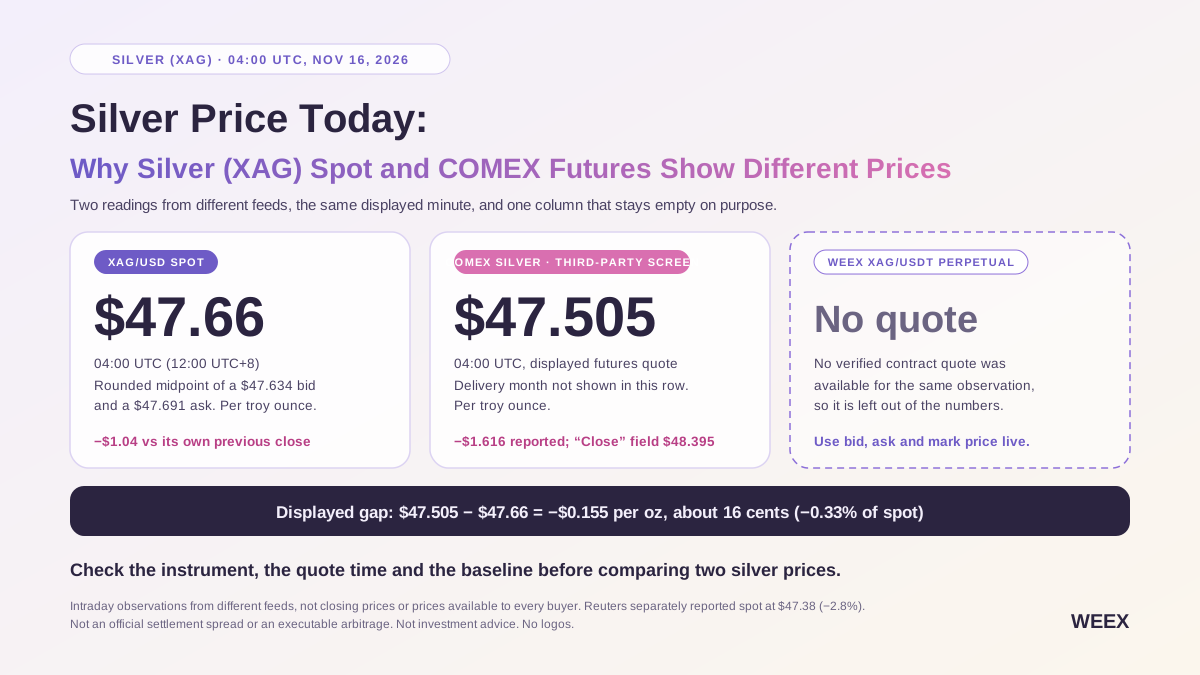
Silver Price Today: Why Silver (XAG) Spot and COMEX Futures Show Different Prices
Silver traded near $47–$48 on November 16. Compare XAG/USD spot, COMEX silver futures, and XAG/USDT perpetuals, and learn why their prices differ.

Proposal for Freezing Virtual Assets to Strengthen Response to Multi-Victim Fraud Crimes

Perpetuals on Stocks: SEC Comes to CFTC's Aid Against Cboe and Citadel
German Customs to Administer Seizures of Suspiciously Sourced Cryptocurrencies Starting in 2027

*ST Wentai Appeals Dutch Court Ruling, Withdraws Part of Litigation Claims
A forced Bitcoin Lightning exit can be cheap and still leave you waiting days

Solana Confidential Compute Enters Beta, Mainnet Launch Date Undetermined

Crypto: The UK Assessed by FATF Before Its Rules Come Into Effect
Elizabeth Warren could reopen crypto’s banking fight without changing a single law

AI Agent Payments Reach 15 Million... Expanding XRP Ledger Ecosystem

Solana launches private AI tools with on-chain hardware checks
Trump Administration Sued Over Restoration of Arctic Offshore Drilling Leases
Amazon says no human wrote or reviewed the code for its new cloud testing tool

Bitcoin Core reveals Tor flaw that trusted thousands of nodes

Polymarket's New Matching Engine Nex Set to Launch in Mid-December, Delays Reduced by 412 Times

CFTC, DOJ sue Arkansas to stop Kalshi gambling lawsuit

OpenAI GPT-6 Astra Error Termination Alignment Evaluation

Unocoin Submits Investigation into BitGo Ethereum Address Withdrawals

Trump-linked stablecoin replaced by USDC on FIFA partner's site

The Next Battle in Crypto Security: How to Rebuild the Authorization System Beyond Smart Contracts?

Intel and SK Hynix Launch Solution to Break AI Inference Bottleneck

Judge Rejects Novig's Injunction Request, Criticizes CFTC Order for Implying Collusion
Dutch Court Rejects Jaguar Land Rover's Evidence Preservation Request, BYD Achieves Interim Victory in Overseas Intellectual Property Defense

Novig loses court shield, and New York gambling laws strike back
$LIBRA: One of the defendants seeks to remove Judge Ledesma and halt the review that could reactivate the case
OpenAI Partners with Four Organizations for AI Safety Assessment
U.S. Supreme Court rejects Custodia appeal on Fed master account
Trezor found implants in reseller wallets. What protects the buyer?
UK convicts two Iranians for spying on Tehran's critical journalists
Banks Push Hard on Artificial Intelligence, But Profits May Not Follow
Latest articles




Latest coin listings on WEEX


