
Banks Push Hard on Artificial Intelligence, But Profits May Not Follow

 Prefer us on Google


The banking sector's third-quarter earnings reports have brought more attention to its applications of artificial intelligence (AI). Major banks are leveraging AI to automate daily tasks, adjust hiring strategies, and explore whether productivity gains can translate into revenue growth.
During this earnings season, Barclays announced layoffs in some business units deploying AI technology; meanwhile, UniCredit and Santander reported that technology is helping employees free up time for higher-value work and improve business processes. Major U.S. banks like JPMorgan Chase and Goldman Sachs are also making similar adjustments to staffing and workflows.
However, as banks seek to improve efficiency and cut costs, strategists point out that it remains difficult to find sufficient evidence proving that AI has led to significant and quantifiable revenue growth.
Banks Accelerate AI Adoption
UniCredit's CEO Andrea Orcel referred to AI as an "opportunity to accelerate development," stating that the technology is helping banks shift their focus to more commercially valuable and higher-value-added businesses while enhancing customer interactions.
Orcel noted that the Italian bank is using AI to "move into a new phase of development." The bank previously reported quarterly profits of €3.3 billion, a record high.
On November 9, Orcel stated in an interview that AI is "a lever we never anticipated having, and it works remarkably well."
Santander reported that its AI projects generated €194 million in commercial value in the first nine months of 2026.
The bank's CFO José García Cantera stated that AI is currently being integrated into "all business processes" the bank undertakes.
Cantera mentioned in an interview on October 28: "At least for now, AI primarily helps reduce low-value workflows, allowing company employees to focus on higher-value work. This impacts both revenue and costs."
He added, "It is difficult to accurately distinguish how much of the benefit comes from AI, but there is no doubt that AI is improving the quality of service we provide to customers, helping us enhance asset quality, strengthen cost management, and have a very positive impact."
ABN AMRO is using AI to assist in anti-money laundering reviews while expanding its collaboration with Infosys to modernize its technology systems, retaining human judgment in business decision-making.
The bank's CEO Marguerite Bérard stated in the third-quarter earnings report released on November 11: "These improvements make it easier for the bank to operate and scale its business, helping employees invest more time in activities that create value for customers."
Reduction in Workforce
Andrew Stimpson, managing director and head of European bank research at KBW, noted that some banks announced large-scale layoffs in the third quarter, which are "partly driven by AI but not entirely attributable to it."
Stimpson stated via email: "Layoffs tend to be concentrated in back-office and support functions rather than in front-office customer-facing business units."
Barclays plans to cut 5,000 jobs by 2026, approximately 5% of its total workforce.
The British bank stated in its third-quarter earnings report that about 60% of the layoffs will involve support functions, including developer positions. However, Barclays emphasized that not all layoffs are caused by AI.
On October 7, reports indicated that as AI changes how HSBC serves customers, the bank may cut about half of the management and professional positions in its UK wealth management business, as well as up to 70% of financial advisor roles.
Goldman Sachs stated it plans to "limit employee growth" and reduce a small number of positions.
JPMorgan's CFO Jeremy Barnum told analysts during the bank's third-quarter earnings call that as banks deploy AI across various businesses, management has been asked to avoid hiring new employees whenever possible.
Revenue Growth Remains a Greater Challenge
KBW released a study in September examining the application of AI in European banks.
The study found that customer service is the most frequently mentioned AI application scenario in banks, including chatbots and customer request classification. The second area is back-office operations, such as operations, identity verification, and financial crime prevention.
Cost savings remain the most frequently cited goal by banks. Among the AI application cases tracked by KBW, just under half aim to reduce costs or improve efficiency.
The report found that banks are increasingly exploring ways to use AI to increase revenue, but AI is not yet seen as a primary driver of profit growth.
Analysts stated that wealth management and advisory services are becoming key areas to test whether AI can increase bank revenues, rather than just reduce costs.
Stimpson noted that banks seem to "fairly consistently believe" that AI can achieve this goal in wealth management.
He explained that AI can significantly improve the efficiency of customer onboarding and access processes, report generation, etc., allowing financial advisors to "serve more clients."
Analyst Sophia Whitbread from asset management firm Ninety One stated that the strongest evidence currently focuses on AI improving customer service, enhancing customer interactions, and increasing employee productivity, rather than AI directly generating quantifiable revenue.
However, initiatives that enable financial advisors to use AI to serve more clients are expected to expand the reach of personalized financial advice without necessarily increasing the number of client managers.
She stated that wealth management may be "the most important revenue growth testing ground, as AI can enhance the capabilities of financial advisors rather than replace them."
Whitbread pointed out: "For European banks, the more likely model is 'human advisors + AI' rather than fully automated customer relationship management. This is especially true for private banking businesses at UBS, Standard Chartered, as well as Deutsche Bank, ABN AMRO, and major French banks."
She also noted that JPMorgan's launch of advisor-assisted tools and wealth planning tools is an example of the U.S. banking industry adopting this model.
Shift in Hiring Demand Towards Technical Skills
Mark Astbury, director at recruitment consultancy Morgan McKinley, stated that AI is also reducing "employment opportunities in traditional project management and back-office roles."
Astbury stated via email that the demand for "professionals in AI, software engineering, and data fields" is growing.
He said: "The London financial services industry is increasingly transforming into a technology-oriented employer. The demand for talent has not disappeared, but the skills banks are willing to invest in are changing."
Astbury noted that as AI takes on more daily tasks that were typically handled by junior staff, "banks need to rethink how to cultivate the next generation of talent."
He added: "We are already seeing senior positions beginning to require candidates to have specialized AI skills, far beyond simply using tools like Copilot or Gemini. I expect entry-level positions will increasingly emphasize technical capabilities in the future.
-- Price
This content is provided for general informational purposes only and doesn't constitute financial, investment, legal, or tax advice. Any events, rewards, online promotions, or related information mentioned herein should not be considered a recommendation, solicitation, or invitation to purchase, sell, trade, or otherwise deal in any crypto assets. Crypto assets are highly volatile and may result in loss. The availability of WEEX services, products, and related events may vary by region. You are responsible for ensuring that your participation is in accordance with applicable local laws and regulations.
You may also like

'Tokenization Is Not the Finish Line': Jupiter to Let Users Borrow Against Bullish Shares

Anthropic's Wall Street Operator: CFO Krišna Rao

'Nobody Knows Who's in Charge': Boris Johnson Stands by Bitcoin Skepticism at Breakpoint

Mazama Energy Finds New Solution to the Biggest Challenge in Geothermal Drilling

Have Semiconductors Bottomed? Here's How the Current Chip Stock Plunge Compares With Past Bear Markets.

Is Apple Losing Its Memory?

Rising Transportation Costs Make Large Holiday Purchases More Difficult

Zhao Changpeng Lists Six Possible Reasons for Bitcoin's Decline: Anthropic IPO and ETF Redemptions, Security Incidents, Regulatory Uncertainty, and More

J.P. Morgan's Forecast for 2027: Inflation Around 2% and Increased Pressure on the Dollar

The Amber Controversy: Diverging Paths with Wintermute
First Financial Report After Jensen Huang's Departure: Colette Kress Faces Core Questions

Dreamteam Completes $53 Million Financing to Expand AI CRM Business

Stellar Bell Vote on November 23: What It Means for XLM Holders

Solana Breakpoint attendees warned of robberies after reported wallet theft

Federal Reserve Governor Barr Warns AI Agents May Exacerbate Bank Runs
Trezor found implants in reseller wallets. What protects the buyer?

The Vast Used Car Market: CarMax and Carvana Clash Over Americans' Car Buying Methods
Trump and Xi Jinping to Meet in Shenzhen, Focusing on Chip Regulation and AI Security

Why is the only spot Bitcoin ETF in continental Europe acquired by an Asian group, BIT?

The Application is Landing, Wealth is Evaporating: Analyzing the Painful Roots of the Crypto Industry through Three Financial Statements

A Look at Traditional Banks Entering Web3: Who Made Money and Who Lost?

IMF President Warns Global Economy is 'Standing on One Leg': AI Circular Financing Reaches $1 Trillion

Tesla Autopilot Team Veterans Found Simulation Startup Valued at $1 Billion

Ministry of Industry and Information Technology to Interview Automotive Companies with Large Accounts Payable
Twenty One Capital’s $1.09 Billion Profit Is Mostly a Bitcoin Accounting Story
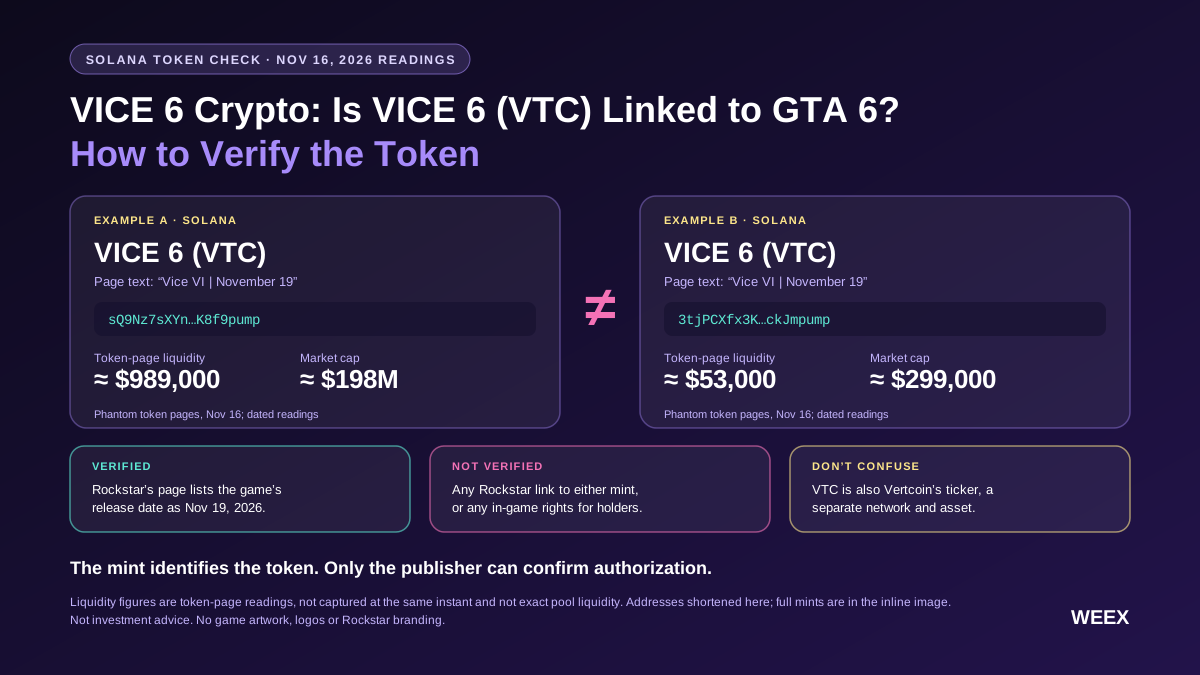
VICE 6 Crypto: Is VICE 6 (VTC) Linked to GTA 6? How to Verify the Token
Is VICE 6 crypto linked to GTA 6? Compare two Solana tokens using VTC, verify their mint and pool addresses, and see what Rockstar has confirmed.

Enterprise Blockchain: Why It's Time to Return?

DTCC Plans to Introduce Tokenized Securities and Bonds on Solana by 2027—Expanding Under Wallet Restrictions

Cardano holders reject 22M ADA treasury bid to buy physical copper

What Licenses Are Needed for Crypto Payments in Hong Kong?
'Tokenization Is Not the Finish Line': Jupiter to Let Users Borrow Against Bullish Shares
Anthropic's Wall Street Operator: CFO Krišna Rao
'Nobody Knows Who's in Charge': Boris Johnson Stands by Bitcoin Skepticism at Breakpoint
Mazama Energy Finds New Solution to the Biggest Challenge in Geothermal Drilling
Have Semiconductors Bottomed? Here's How the Current Chip Stock Plunge Compares With Past Bear Markets.
Is Apple Losing Its Memory?
Latest articles



Latest coin listings on WEEX


