
Silver Price Today: Why Silver (XAG) Spot and COMEX Futures Show Different Prices

 Prefer us on Google


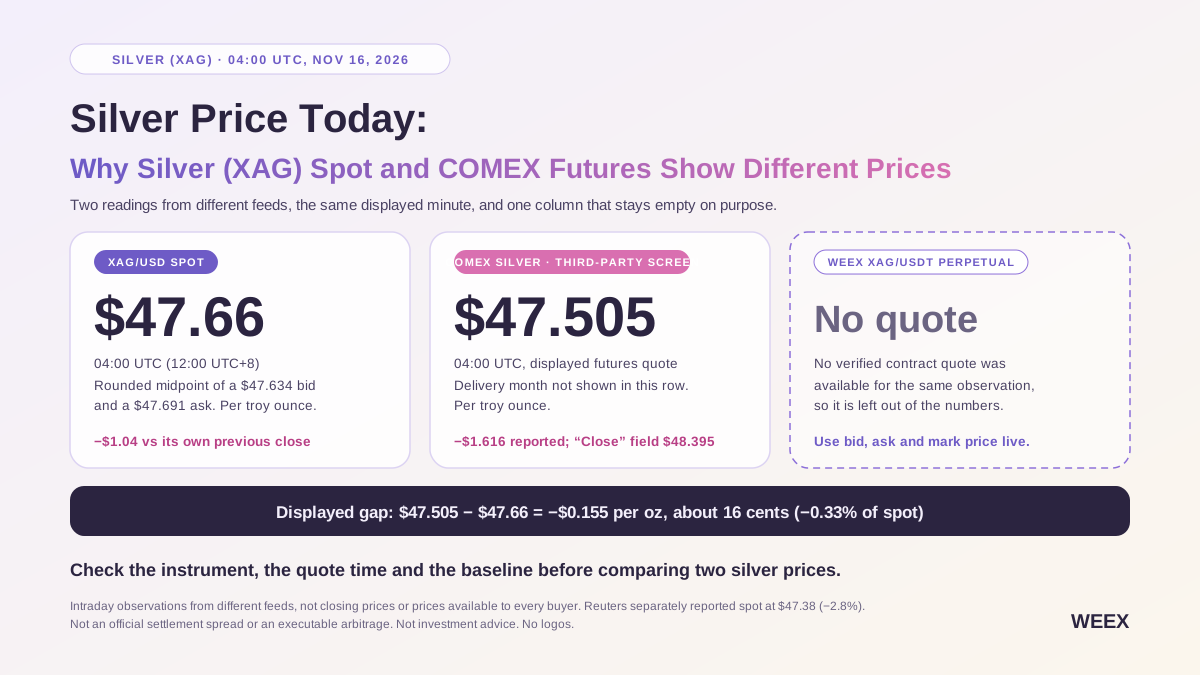
Silver traded near $47–$48 per troy ounce in the early hours of November 16, 2026. At 04:00 UTC, a spot feed showed $47.66, while a third-party COMEX futures feed displayed $47.505. The displayed futures price was about $0.16 per ounce lower. Reuters separately reported spot silver at $47.38, down 2.8%, in its morning metals coverage. These are intraday observations from different feeds, not a closing price or a single price available to every buyer.
The most useful detail is hidden in the COMEX quote row. Its reported dollar change does not reconcile with the field labeled “Close.” And the row does not identify the delivery month. The $0.16 gap is observable, but that one row cannot establish an official settlement spread, the shape of the silver futures curve, or an executable arbitrage. Before drawing a conclusion from two silver prices, check the instrument, quote time, and comparison baseline.
Key Takeaways
- Silver spot, COMEX futures, and XAG/USDT perpetuals are three different instruments. XAG/USD is a cash-market reference; a COMEX contract has a delivery month; a perpetual has no scheduled expiry and uses funding.
- The November 16 comparison starts with two readings at 04:00 UTC: about $47.66 for spot and $47.505 on a third-party COMEX screen. The latter screen did not identify the contract month for that observation.
- A dollar price gap and a percentage-return gap answer different questions. The two screens can show prices only 16 cents apart and still report materially different daily declines because they use different reference prices.
- A silver deficit forecast can coexist with a selloff. The Silver Institute forecasts a 35-million-ounce deficit for 2026 alongside a 5% decline in annual demand. Neither figure explains a specific intraday move on its own.
- On WEEX, use the XAG/USDT order book for executable quotes and the mark price for position-risk checks. The Nasdaq-style ticker conventions of traditional markets do not carry over to a USDT-settled perpetual.
Cover image ALT: November 16 silver price comparison showing $47.66 XAG/USD spot and $47.505 on a COMEX futures screen at 04:00 UTC, with a separate column for the WEEX XAG/USDT perpetual.
What Is the Silver Price Today?
The November 16 spot snapshot attributed to Swissquote displayed about $47.66 per troy ounce at 04:00 UTC, or 12:00 UTC+8. The feed showed a $47.634 bid and a $47.691 ask. Their midpoint was $47.6625, which rounds to the page’s headline price. Those three figures describe the same market observation, but only two are actual sides of the displayed quote. A midpoint is useful for tracking the market; it is not a promise that a buy or sell order can fill there.
Reuters’ morning metals report later cited $47.38 per ounce for spot silver, down 2.8%. The report gave a timestamp for its gold observation but did not specify a separate exact timestamp for the silver quote. The $47.38 reading supports the broader picture of silver trading in the high-$47 range during the morning. It should not replace the 04:00 UTC spot quote in a synchronized comparison with futures.
For readers comparing unit prices, one troy ounce is about 31.1035 grams. At $47.66 per troy ounce, the implied raw-metal value is about $1.53 per gram or $1,532 per kilogram, before dealer premiums, fabrication, taxes where applicable, shipping, or other charges. A one-ounce retail coin can be priced above the raw-metal reference because the dealer is selling a particular item. The relevant comparison is the dealer’s total price and buyback quote, not the spot midpoint alone.
A search for “silver price today” can therefore return several correct answers. One may be a spot midpoint, another a dealer’s cash bid, another an intraday futures trade. The number to use depends on whether you want to track the metal, value a physical purchase, or monitor a specific position.
Why Did Silver (XAG) Spot and COMEX Futures Differ at 04:00 UTC?
The third-party COMEX snapshot captured at 04:00 UTC displayed $47.505 for COMEX silver, a change of −$1.616, and a separate $48.395 field labeled “Close.” The spot source displayed $47.66 and a −$1.04 change. The simple comparison is:
Displayed futures minus displayed spot = $47.505 − $47.66 = −$0.155 per troy ounce, or approximately −0.33% of the spot quote.
That calculation uses the rounded spot headline, so about 16 cents is more useful than treating the third decimal place as exact. Both sources showed the same displayed minute, but they did not provide enough information to verify matching update seconds, feed latency, or executable prices for the same trade size.
| 04:00 UTC observation | Displayed price | Quote type | What is known about the baseline? |
|---|---|---|---|
| XAG/USD spot | $47.66 | Rounded midpoint of a $47.634 bid and $47.691 ask | The provider reported −$1.04 versus its own previous close. |
| Third-party COMEX silver | $47.505 | Displayed futures quote; delivery month not shown in this row | The row reported −$1.616 and separately labeled $48.395 as “Close.” |
| WEEX XAG/USDT perpetual | Not included in the numerical comparison | USDT-settled perpetual referencing silver | No independently verified contract quote was available for the same observation. |
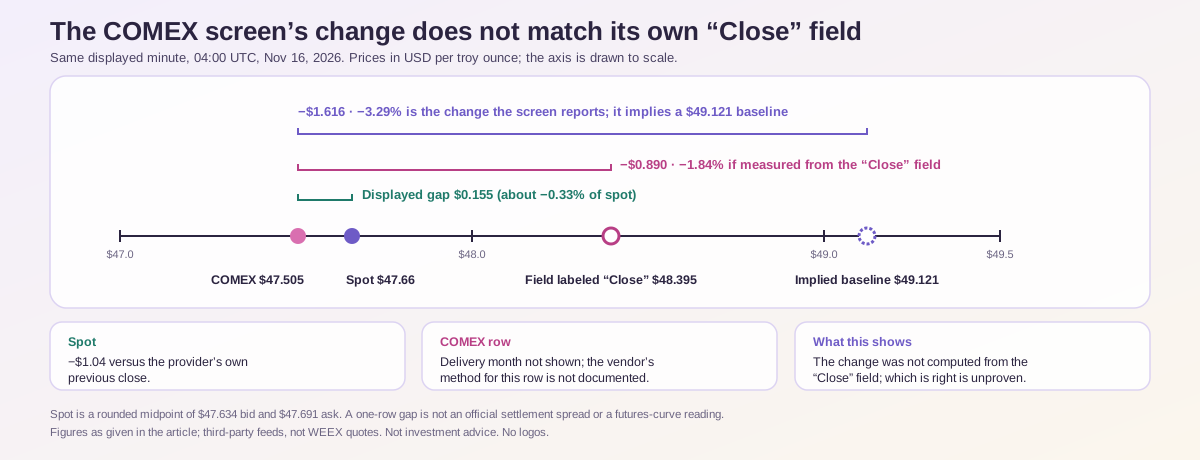
Here is the check that matters. If $47.505 is down $1.616, the implied baseline is $49.121. If the baseline were instead the separately displayed $48.395, the move would be −$0.890, or about −1.84%, rather than the reported −3.29%. This establishes that the displayed change was not calculated from the field labeled “Close.” Without the vendor’s methodology for that historical row, it does not establish what either reference represents or which one should be used.
A separate December 2026 silver futures series identifies its contract as SIZ6. That helps readers find and track a named delivery month. It does not establish that the unlabeled 04:00 UTC snapshot was for SIZ6, and its daily observations should not be treated as synchronized intraday quotes. To reproduce a contract-specific comparison, capture the named futures contract and a spot quote during the same session, record what each quote represents, and compare the results in the same units.
-- Price
What Is the Difference Between Silver (XAG) Spot and COMEX Futures?
Spot silver is a cash-market reference
XAG/USD expresses silver in U.S. dollars per troy ounce. Spot pricing reflects the cash market for metal rather than a contract with a named future delivery month. What retail readers see depends on the provider. It may be an indicative quote, a bid, an ask, or a midpoint calculated from both sides. Two spot pages can disagree briefly if they use different data sources or update times.
Spot is usually the most useful starting point for answering “What is silver worth per ounce?” It is also the right reference for calculating the premium on physical silver. For example, if a dealer offers a one-troy-ounce coin at $51.00 against a $47.66 spot reference, the displayed premium is $3.34, or about 7.0%, before any separately charged costs. If the objective is to estimate what you could recover by selling, request the dealer’s bid as well. The purchase premium does not automatically come back at resale.
A COMEX silver futures price belongs to a particular contract
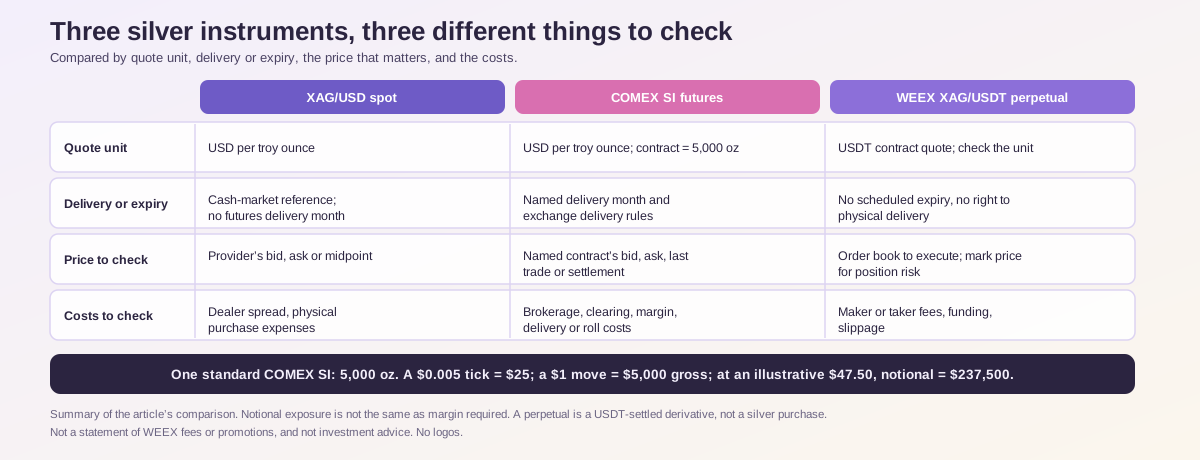
A standard COMEX silver futures contract, SI, represents 5,000 troy ounces, according to the CME Group contract specifications. The quoted number is per ounce, while the financial exposure is based on the entire contract. An outright tick of $0.005 per ounce is $25 on one standard contract. A $1 move per ounce represents $5,000 of gross price movement on that contract before costs. At an illustrative quote of $47.50, its notional value is $237,500. Notional exposure and the margin required to maintain the position are different amounts.
The month matters because December silver and a later delivery contract are separate markets. Their prices can move together without moving by the same amount. A continuous chart usually switches from one contract to another according to the provider’s roll rules. If the new contract trades at a different price, the chart can show a jump that partly reflects the switch. An adjusted chart may smooth that transition, but historical prices then may not match individual trade prints. When comparing daily moves, verify the full symbol and whether the chart is continuous or contract-specific.
Timing matters even when the contract is identical. The last trade is the latest transaction on the displayed feed. The daily settlement is an exchange-determined reference used in clearing and marking positions. It does not have to equal the last trade shown when you open the page. CME’s public silver futures page also labels its public market data as delayed by at least 10 minutes. A screen refreshed at 04:00 does not necessarily contain a trade that took place at 04:00.
Does a Lower COMEX Quote Mean Silver (XAG) Is in Backwardation?
A futures contract can trade above or below comparable spot silver. CME’s explanation of the futures curve describes how financing, storage, insurance, and the value of having metal on hand can influence the relationship. When later delivery prices are above nearer prices, the curve is typically described as being in contango. When nearer prices are higher than later prices, the curve is typically described as being in backwardation.
A negative gap between the two screenshots is not enough to classify the market. A more useful test would align a spot midpoint and two or more named COMEX delivery months, record the bid and ask or use the same quote convention throughout, and then repeat the comparison using fresh observations. If December trades below spot but later contracts are progressively more expensive than December, the curve can look different depending on which segment you examine. One spread never tells you what every delivery month is doing.
The costs of moving or holding physical metal also matter. An industrial buyer may pay more for metal that arrives in time to keep production running. A trader without access to qualifying inventory, financing, storage, or delivery facilities cannot assume they can capture the difference between a spot screen and a futures screen. Even two prices visible at the same instant can be separated by dealing spreads, commissions, and delivery conditions. The usable comparison is the price at which each side can actually execute after costs.
Why Was Silver (XAG) Down on November 16?
Reuters’ morning coverage described a firmer U.S. dollar and attention on U.S. interest-rate expectations. Those are relevant conditions for metals priced in dollars. A stronger dollar can make the metal more expensive in other currencies even when the dollar quote stays unchanged. Higher yields can also increase the opportunity cost of holding bullion that does not pay interest. These mechanisms help explain why traders watch the dollar and yields, but a morning market report cannot establish how much of silver’s decline came from either one.
Silver also has an industrial demand story. The Silver Institute’s November 12 update projects 2026 demand of about 1.08 billion ounces, down 5% year over year, while still forecasting a 35-million-ounce supply deficit. It expects reduced silver consumption in solar cells as manufacturers cut silver use per unit or substitute other materials. At the same time, it forecasts 4.5% growth in industrial silver demand outside photovoltaics. Those forecasts describe a changing demand mix, not a uniform collapse in industrial use.
Lower demand and an annual deficit are compatible: demand can decline and still exceed supply. They also operate on a different time scale from an intraday quote. The annual forecast is an estimate of how much metal will be supplied and consumed over the year. Monday’s price reflects what buyers and sellers were willing to pay during a particular trading window. A forecast deficit does not mean that every buyer is unable to source metal today, and a single price decline does not invalidate the forecast.
To follow the move after the initial headlines, compare spot silver and a named futures contract during the next common trading window. If both weaken while the spread barely changes, the main development is the decline in silver itself. If the spread changes materially while spot holds steady, check the contract month, quote delay, and trading activity before attributing the move to a shortage or a new demand shock.
How Does the WEEX Silver (XAG) Perpetual Fit In?
The WEEX XAG/USDT perpetual is a digital derivative tied to an international spot silver reference. It is quoted and settled in USDT and has no scheduled expiry. Opening a position does not buy a silver bar or create a right to take COMEX delivery. The relevant comparison is to a silver-linked contract price, not a physical purchase price.
| Feature | XAG/USD spot quote | Standard COMEX silver futures | WEEX XAG/USDT perpetual |
|---|---|---|---|
| What the screen tracks | Cash-market silver reference | Market for a named delivery month | A venue-specific silver-linked contract |
| Quote convention | USD per troy ounce | USD per troy ounce | USDT contract quote; check the venue’s contract unit |
| Expiry or delivery | The quote itself does not specify a futures delivery month | A named delivery month and exchange delivery rules | No scheduled expiry or right to physical delivery |
| Price to check | Provider’s bid, ask, or midpoint | Named contract’s bid, ask, last trade, or settlement | Order book for execution; mark price for position risk |
| Costs to check | Dealer spread and any physical purchase expenses | Brokerage, clearing, margin, and applicable delivery or roll costs | Maker or taker fees, funding, and potential slippage |
The perpetual screen can show several prices at once. The last price is the most recent transaction. The index price is the reference used in the contract’s pricing framework. The mark price is used for position calculations, including unrealized profit and loss and liquidation monitoring, under WEEX’s futures pricing rules. A mark price is not an executable order. The best bid and ask, plus the depth available at each level, are more useful for estimating where an order could fill.
Funding is a separate consideration. Under the WEEX funding rules, funding payments are exchanged between eligible long and short positions at the applicable settlement times. The funding rate and settlement schedule should be checked for the specific contract. Funding is not included in the market’s last price and is separate from the maker or taker fee. A small difference between a perpetual quote and an external silver quote can be outweighed by spread, funding, or execution costs.
To use the market page, open the XAG/USDT perpetual and check its order status, contract unit, best bid and ask, mark price, funding countdown, and applicable fees. If placing an order, review the position’s notional size, margin mode, leverage, and estimated liquidation price before confirming. A limit order controls the worst acceptable price but may not fill; a market order can fill across multiple prices if the book is thin. Check the fee shown for the order and the terms that apply to your account. An older fee promotion is not evidence of a discount on this trade.
How to Compare Silver Prices Without Mixing the Numbers
Imagine two tabs: one shows a $47.66 spot midpoint, and the other shows a $47.51 futures last trade. First record each quote’s timestamp, including the time zone and any stated delay. Then check the instrument name and the field you captured. A current spot midpoint and a futures last trade from several minutes earlier can produce a visible gap even if both markets have already moved. If the futures page only displays a continuous symbol, open the named contract before comparing delivery months.
Next, normalize the quote. Use USD per troy ounce for the spot-to-COMEX comparison. If adding a USDT perpetual, keep the currency label visible and check the applicable USD-to-USDT conversion before calculating a precise difference. Confirm that you understand the contract unit as well. A quote of about 47 on two screens says nothing about whether one order creates exposure to one ounce, 5,000 ounces, or a different contract size.
Finally, separate the level, return, and cost. The level is the quoted price at an observation time. The return is its move from a specified baseline. The cost is what an order or purchase would actually require after spread, fees, and any holding expenses. For a physical purchase, the all-in dealer quote is what matters. For a futures position, it is the named contract, fill price, and exposure. For a perpetual, it is the order book price, position size, mark price, and funding. That is how to turn a search result into a comparison you can check.
WEEX Editorial View
The key story on November 16 is that silver was weaker in the morning, while the exact size of the move depended on the instrument and reference price. The matched-minute quotes are useful because their difference can be calculated. Their limitations are equally useful: the delivery month was not established for one snapshot, the vendor’s percentage-change baseline was unclear, and there was no matching WEEX quote to complete a numerical three-way comparison.
For the next update, the most informative addition would be a fresh spot quote, a named COMEX contract quote, and the WEEX perpetual’s bid and ask, all recorded at the same time. Keep the raw inputs with the comparison. That lets a reader tell whether silver itself moved, the spot-to-futures spread moved, or one platform simply changed which quote it displayed.
FAQ
1. What Was the Silver Price Today, November 16, 2026?
One spot feed showed $47.66 per troy ounce at 04:00 UTC. Reuters separately reported spot silver at $47.38 in its morning metals coverage. These were intraday observations, so a later quote or a dealer’s price can differ.
2. Why Is the COMEX Silver Price Different From Spot Silver?
COMEX futures refer to a contract with a specified delivery month, while spot silver refers to the cash market. Financing, storage, and demand for immediate metal can affect the difference. A mismatch in timestamps, quote types, or data delays can also create or widen an apparent gap.
3. Does a Lower Futures Quote Predict a Lower Silver Price Later?
No. A futures quote reflects the price of a particular delivery contract now. A lower reading can reflect the relationship between immediate and future delivery, and it is not a guarantee of where spot silver will trade when the contract expires.
4. Is the WEEX XAG/USDT Perpetual the Same as Buying Silver?
No. It is a silver-linked perpetual derivative settled in USDT. It carries contract, funding, margin, and execution considerations, and does not give the holder physical silver or a COMEX delivery claim.
5. Which Silver Price Should I Follow?
Use XAG/USD spot for the cash-market benchmark, a named COMEX futures contract for a specific delivery month, and the XAG/USDT order book and mark price when monitoring a WEEX perpetual. For coins or bars, compare the dealer’s actual buy and sell quotes with spot.
This content is provided for general informational purposes only and doesn't constitute financial, investment, legal, or tax advice. Any events, rewards, online promotions, or related information mentioned herein should not be considered a recommendation, solicitation, or invitation to purchase, sell, trade, or otherwise deal in any crypto assets. Crypto assets are highly volatile and may result in loss. The availability of WEEX services, products, and related events may vary by region. You are responsible for ensuring that your participation is in accordance with applicable local laws and regulations.
You may also like

Gnosis Safe wallet reportedly drained of $6.45M in suspected exploit

Thailand Stablecoin Transfer Limit: What the SEC Draft Proposes

Tesla Autopilot Team Veterans Found Simulation Startup Valued at $1 Billion
TAO Crypto Price Near $190: Is Bittensor (TAO) Recovering or Just Bouncing?
TAO bounced near $190. Compare spot volume, futures positioning, and Bittensor subnet flows to see what would confirm a more durable recovery.
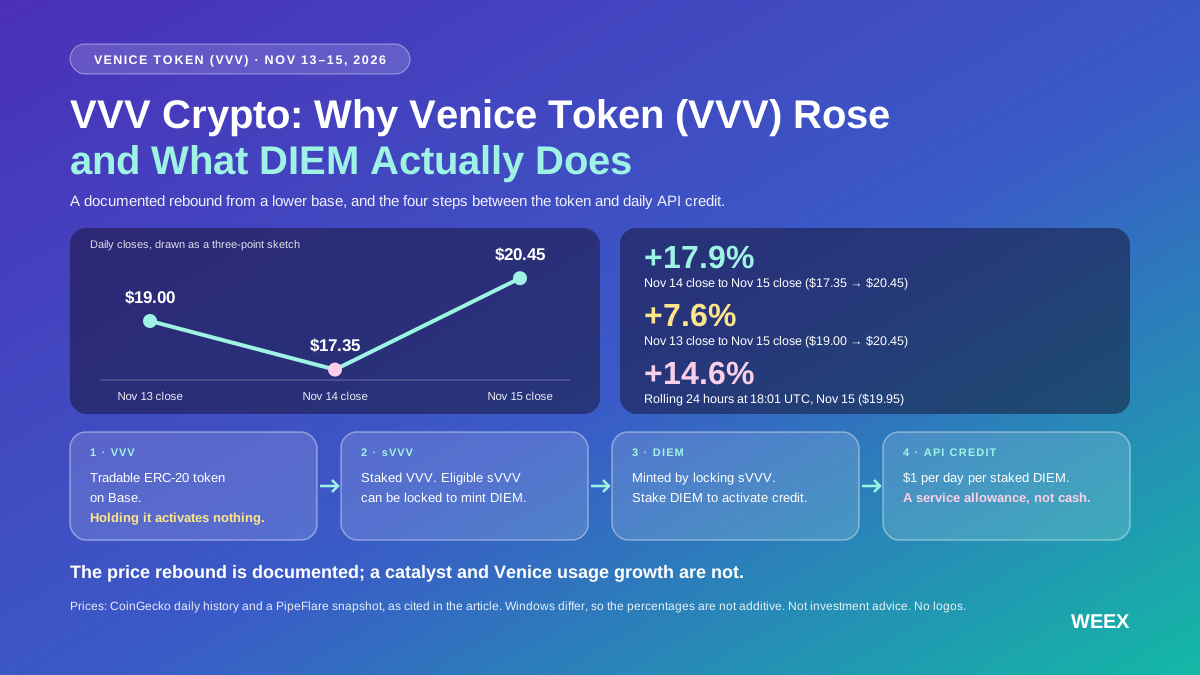
VVV Crypto: What Is Venice Token, Why Venice Token (VVV) Rose and What DIEM Actually Does
Venice Token rose about 14.6% in one November 15 snapshot. Learn what the data shows, how VVV staking works, and what DIEM’s daily API credit buys.

Options Big Bets | Nvidia's $118 Million Cross-Period CALL Spread Bets on Mid to Long-Term Upside; AMD's Bearish Spread Combined with Long-Term Bullish Spread, Underlying Tensions Between Bulls and Bears

Galaxy Securities: A-shares Market's Downward Risk Converges, Focus on Sector Rotation Opportunities

How $10,000 in stablecoins would have gained €420 without earning interest

Bitcoin now looks cheap by one measure after $1 billion in ETF outflows

These Bitcoin miners have halved their hashrate, while their AI revenues have doubled

Bitcoin: Should We Fear the Worst or Bet on Hopes for a Rebound?

This Under-the-Radar Stock Is Behind Steak 'n Shake's MAHA-Driven Growth. Should You Buy?

XDC vs XRP: Which Payment-Focused Blockchain is Superior?

The Privacy Paradox of Bitcoin: Satoshi Acknowledged It Long Ago, Have the Successors Solved It?

[Analysis] Two Barriers Preventing Bitcoin from Rising

No New Money Inflows in Dogecoin ETFs for a Month

XRP loans trigger 883 liquidations, and $53M remains at risk

CoreWeave and Nebius Group: 1 Soars, the Other 1 Plunges. A Tale of 2 Neoclouds

Research Reveals 3D Spatial Navigation Map of Hand in the Brain to Aid Brain-Machine Interface Development

Yen Fluctuations Highlight Current Trading Difficulties, Investors Have Huge Divergence on Long-term Outlook

BNY Mellon Adds to Invesco Galaxy Bitcoin ETF: What Changes with the Custody Filing?
South Korea Proposes Withdrawal Suspension for Cryptocurrency: What Happens When Exchanges Suspect a Hack

Exclusive: Canton Strategic CEO warns MEV could raise costs for tokenized stock traders

CARF Customer Transaction Information Report: What Data Processing is Required from On-Chain Transactions to Tax Reporting?

Bottomline Completes First USDC Transfers Inside Its Enterprise Payments Platform

Bitcoin: Glassnode warns of liquidity shortage and capital flight

9-Minute Attack Window, 7.1 Million BTC Exposed: How Bitcoin Can Save Itself from Quantum Threats
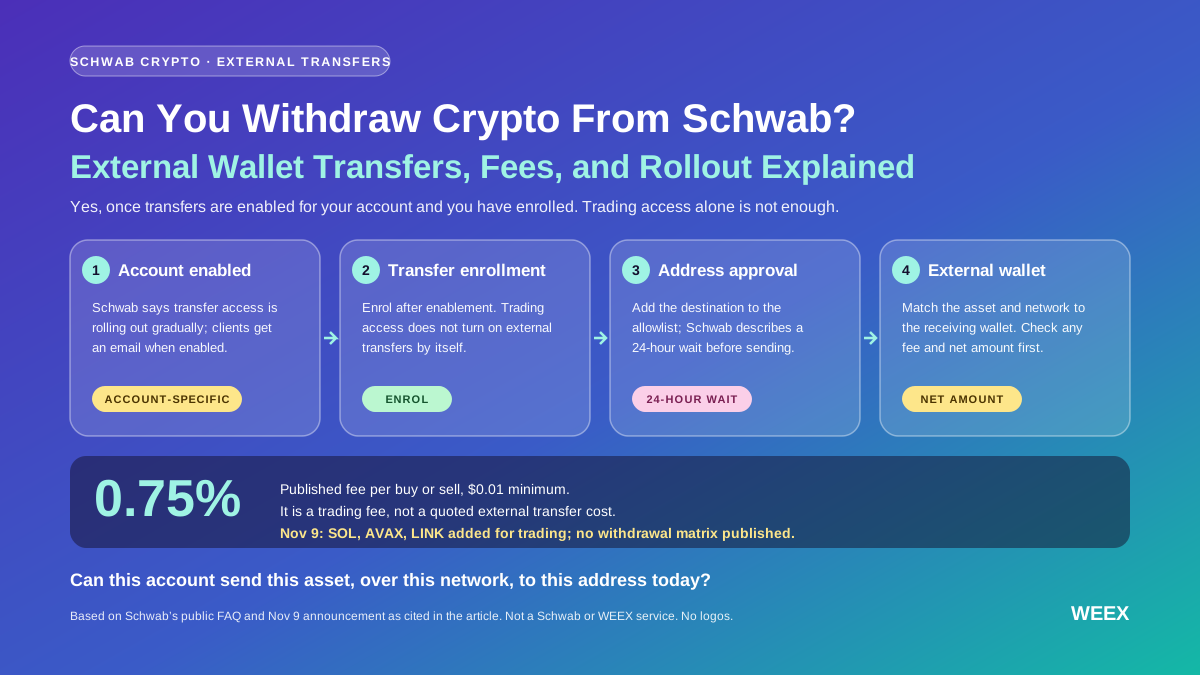
Can You Withdraw Crypto From Schwab? External Wallet Transfers, Fees, and Rollout Explained
Find out when Schwab Crypto allows external wallet withdrawals, how the 24-hour address wait works, and why the 0.75% trading fee is separate.

Adam Back Predicts Bitcoin Will Reach $1 Million by 2028

Bull Market Gains, Bear Market Losses: How to Calculate Taxes on Cryptocurrency Investments?
Gnosis Safe wallet reportedly drained of $6.45M in suspected exploit
Thailand Stablecoin Transfer Limit: What the SEC Draft Proposes
Tesla Autopilot Team Veterans Found Simulation Startup Valued at $1 Billion
TAO Crypto Price Near $190: Is Bittensor (TAO) Recovering or Just Bouncing?
TAO bounced near $190. Compare spot volume, futures positioning, and Bittensor subnet flows to see what would confirm a more durable recovery.
VVV Crypto: What Is Venice Token, Why Venice Token (VVV) Rose and What DIEM Actually Does
Venice Token rose about 14.6% in one November 15 snapshot. Learn what the data shows, how VVV staking works, and what DIEM’s daily API credit buys.
Options Big Bets | Nvidia's $118 Million Cross-Period CALL Spread Bets on Mid to Long-Term Upside; AMD's Bearish Spread Combined with Long-Term Bullish Spread, Underlying Tensions Between Bulls and Bears
Latest articles


Latest coin listings on WEEX


