
Wall Street Sees 'Gazumping' Phenomenon as Hedge Funds Compete for Top Talent

 Prefer us on Google


In recent months, several traders have switched to competing banks and hedge funds, and Citigroup's global head of equity trading, Fattah Belbashir, is facing another team member's departure.
Rob Smolen, who was then the global head of exotic derivatives trading at Citigroup, was originally set to join Barclays' expanding equity trading division, but Citigroup quickly offered better terms to retain him. The retention plan worked, and Smolen returned to Citigroup as the head of equity trading for Europe, the Middle East, and Africa.
This is known as gazumping, a term originally used in the UK property market: after receiving a job offer, a trader may back out if a better opportunity arises, sometimes opting to return to their former employer. This practice is particularly common in the hedge fund industry, where hedge funds often offer multi-million dollar salaries to poach key personnel, highlighting the fierce competition for scarce top talent and the last-minute tug-of-war to retain traders.
Matthias Schwartz, a former senior credit trader at Bank of America and founder of consulting firm Career Capital One, stated that traders who can be retained with a counteroffer from their original employer are either highly productive or crucial to the stable operation of the trading desk. "This is very tricky for the hiring side, as it can't simply be brushed aside."
Spokespeople for Citigroup and Barclays both declined to comment.
A Significant Victory
Sources say that at the end of October, Barclays executives were caught off guard when they received an email informing them that Smolen would not be joining. On November 4, just before his scheduled start date, Citigroup announced Smolen's return.
For Belbashir, retaining Smolen is considered a significant victory. His equity derivatives team has recently lost several members: Jeffroy Le Roux-Magan moved to BNP Paribas, Guillaume Galissier joined Qube Quant, and Lorenzo Pizzoni Ferrarese went to Barclays. In October, Millennium Management poached Luca Valitutti, Citigroup's global head of exotic derivatives and index forwards.
Belbashir had previously served as global head of equities at Barclays for about a year before joining Citigroup.
Adil Khan, Barclays' global markets head, is also often involved in counteroffers. He sometimes flies to New York overnight in an attempt to retain talent. Smolen's original joining would have bolstered the performance of Scott McDavis's strong equity team, which saw a 47% year-on-year revenue increase in the third quarter, marking its best performance since at least 2009.
Sources revealed that JPMorgan and Bank of America have also successfully retained several core traders who were preparing to switch jobs this year. Spokespeople for both banks declined to comment.
Borrowing Tactics from Hedge Funds
Some banks are looking to raise the bar for candidates to back out and strengthen their talent protection by adopting hedge fund operational models: non-compete agreements, termination penalties, and clawback clauses are standard arrangements in hedge funds.
Sources say that some senior traders at Jefferies have contracts that include "penalty" clauses, stipulating that if they ultimately do not join, they must compensate Jefferies, with the amount being a significant portion of the first year's salary to cover the company's losses. One insider indicated that this compensation is typically borne by the candidate's current employer rather than the trader personally.
A spokesperson for Jefferies declined to comment.
Headhunters also have their own methods to stabilize traders: some prepare scripts to teach candidates how to decline their original employer's counteroffers; others maintain ongoing contact with candidates to remind them of their commitments and the growth prospects of the new position.
Schwartz mentioned that after the loss of core traders, banks sometimes have to raise salaries for the remaining team members to prevent them from leaving as well.
Traders who choose to stay also face risks. "The raises they negotiate may significantly shrink the following year.",
-- Price
This content is provided for general informational purposes only and doesn't constitute financial, investment, legal, or tax advice. Any events, rewards, online promotions, or related information mentioned herein should not be considered a recommendation, solicitation, or invitation to purchase, sell, trade, or otherwise deal in any crypto assets. Crypto assets are highly volatile and may result in loss. The availability of WEEX services, products, and related events may vary by region. You are responsible for ensuring that your participation is in accordance with applicable local laws and regulations.
You may also like

Bitcoin developer verifies 164 million unspent coins in just 72 seconds

Druckenmiller Turns Bearish on Copper Prices, Zeroes Out Stock Positions, Says Current Market Visibility is Lowest in Memory

Prediction: These Will Be Nvidia’s and AMD’s Stock Prices by the End of 2027 (Hint: Only 1 Is a Buy).

Where Will Nvidia Stock Be in 3 Years?
U.S. 10-Year Treasury Yield Stays Above 5% for Days Close to 2007 Record

Backpack BP Token Surges 44% on CFTC Approval Talk: What We Know
Prediction: This Will Be Broadcom’s Stock Price by the End of 2028

BPI Becomes The Finney Foundation For Open Technology

We Need To Change Our Management: Ricardo Salinas On Mexico's Future, Bukele And Bitcoin
FinCEN Withdraws Crypto Travel Rule Proposal: What Still Applies

Dec. 9 Expected to Impact S&P 500 as Rate Hike Looms

This Magnificent Growth Stock Just Entered the Artificial Intelligence (AI) Cloud Race, and It Looks Dirt Cheap

Former New York Fed President Dudley: The Fed's 'Painless Disinflation' Strategy Is Doomed to Fail

Solana Foundation AI Agents Account for 76% of OpenRouter Token Usage
FTX 'Old Team' Secures US Futures License, 24/7 Trading on the Horizon

Where Will AMD Stock Be in 5 Years?

Stablecoin holders lose 12000 million USD annually in Treasury interest
CoinGecko Acquired: Two People Started with $200, Once Valued at $500 Million
Micron Has Plunged 36% From Its Peak. Here’s the Price at Which I’d Buy.

Controversial AI Explainability Research Draws Attention from Sam Altman

The Next Hyperliquid Will Emerge from These 6 Companies
A Super Empire on a Fragile Foundation: How Jensen Huang Has Controlled NVIDIA for 33 Years

Microsoft Ignite Conference Kicks Off Today! Focus on Copilot Monetization and AI Computing Returns, Can the Enterprise AI Flywheel Deliver?

IOSG: Bitcoin Needs to Reach $250,000 to Compete with AI in Mining

Aave Labs Reports: A 97-Person Team Supporting What Kind of DeFi Business?

唐华斑竹 Suggests Optimizing WEEX Platform Token Functionality
Intesa Sanpaolo raises XRP and Solana ETF holdings, cuts Bitcoin and Ethereum
Why Are Tokenized Stocks Seeing Strong Buying Pressure While Prices Keep Falling?

WEEX P2P now supports CAD —Merchant Recruitment Now Open
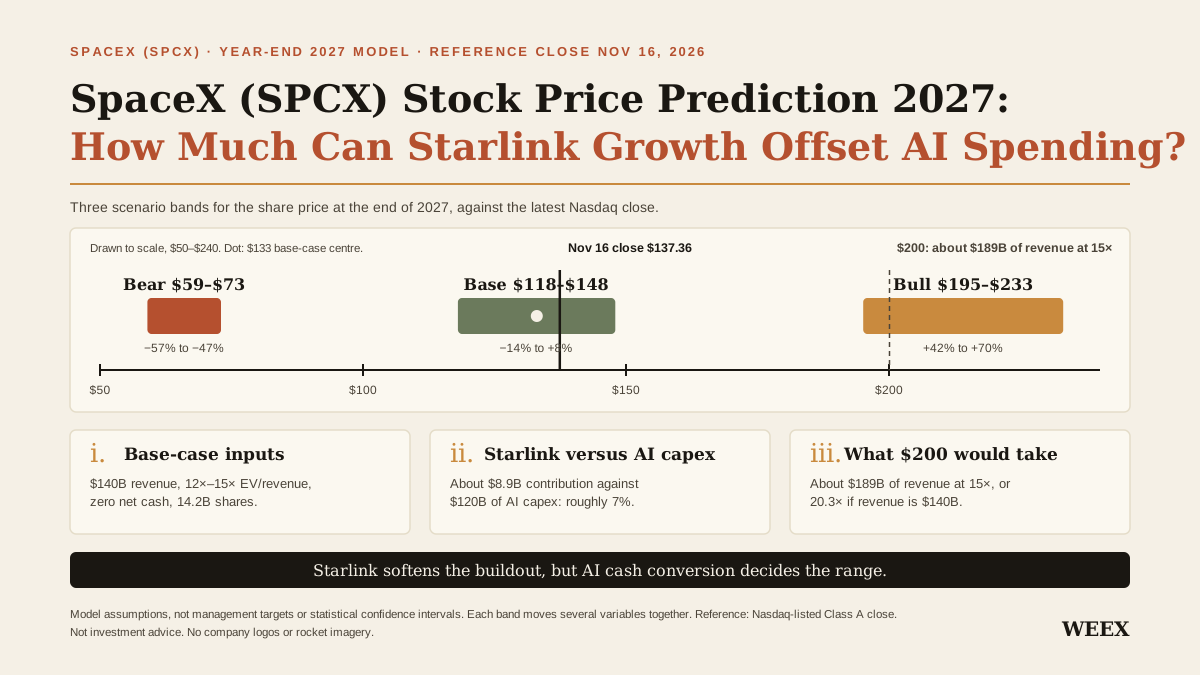
SpaceX (SPCX) Stock Price Prediction 2027: How Much Can Starlink Growth Offset AI Spending?
SpaceX stock price prediction for 2027: See the $118–$148 base case, how much Starlink could offset AI spending, and what it would take to reach $200.
Bitcoin developer verifies 164 million unspent coins in just 72 seconds
Druckenmiller Turns Bearish on Copper Prices, Zeroes Out Stock Positions, Says Current Market Visibility is Lowest in Memory
Prediction: These Will Be Nvidia’s and AMD’s Stock Prices by the End of 2027 (Hint: Only 1 Is a Buy).
Where Will Nvidia Stock Be in 3 Years?
U.S. 10-Year Treasury Yield Stays Above 5% for Days Close to 2007 Record
Backpack BP Token Surges 44% on CFTC Approval Talk: What We Know
Latest articles


Latest coin listings on WEEX


