
IOSG: Bitcoin Needs to Reach $250,000 to Compete with AI in Mining

 Prefer us on Google



Miners are shifting to AI computing power leasing, as the scarcity of electricity reshapes the pricing logic for mining companies, Bitcoin, and AI infrastructure.
Written by: Mario Chow
Stock prices are based on the closing price on November 13, 2026; Bitcoin price is $64,400 on November 16. MW refers to key IT loads, which is the actual power delivered to servers. Gross MW refers to the total power consumption of the entire facility, including cooling, which is usually 20% to 40% higher than IT loads.
TL;DR
- Why the shift. CoinShares values established and leased AI data centers at about $27 million per MW, while the power capacity of unleased miners is valued at less than $3 million per MW. This 9-fold difference is not solely due to grid connection prices, as the former includes construction investments of $8 million to $15 million per MW; even after deducting construction costs, the gap remains 4 to 6 times. Based on operating profits per MW, mining currently nets about $230,000 a year at the current hashprice, while AI leases are about $1.9 million, meaning Bitcoin needs to rise to about $250,000 to bridge this gap. The underlying issue is the power shortage for AI: it takes three to four years to connect a new grid in the hottest markets in the U.S., while miners already have connected interfaces. The midterm elections on November 3 made these interfaces scarcer, as Texas elected a governor who promised to pause approvals for data centers.
- How the shift occurs. Grid connections, substations, land, and permits can be reused, while almost everything else needs to be demolished and rebuilt, costing about $8 million to $15 million per MW, similar to new construction. Miners are not selling properties, but rather the two to four years of waiting time that tenants can skip.
- Who is shifting. Eight publicly listed mining companies have signed contracts for about 6.3 GW of IT capacity, and the morning after the election, Riot leased out the entire 910 MW Corsicana facility; Cipher also has 700 MW of gross power. About 1 GW is actually online. CoreWeave occupies 24% of this, and there are no guarantees behind the rent. Riot's AI lab tenant (reportedly Anthropic) now occupies 18%, nearly as large as CoreWeave.
- Revenue and costs. After deducting operating costs, disclosed NOI leases range from $1.85 million to $2.15 million per MW per year; Galaxy Helios Phase II's NOI is estimated at about $2.3 million based on its profit margin, which is an exception. The annual cost return on construction is between 15% and 20%. Riot's Corsicana lease breaks this range at about 33%, as the data center is built by the tenant on land already powered by Riot. The nominal rent difference mainly comes from lease structure rather than compensation for credit risk.
- Impact. Mining companies that stick to mining have sold about 40% of their Bitcoin, with the remaining selling pressure mainly on MARA. Riot sold 20,264 coins this year, leaving only 2,418; MARA sold 13,597 coins after the quarter ended to repay Bitcoin collateral loans. MARA, CleanSpark, and Riot now hold about 36,000 coins, down from 60,500 in August, with about 20,400 from MARA likely to continue flowing into the market. Hash power has fluctuated but miners exiting have not weakened the network. Mining stocks are no longer substitutes for Bitcoin. After the election, they diverged by state: Riot rose 25%, while Bitcoin fell 12%; several companies with projects pending delivery in Texas and Georgia fell 15% to 18%.
IOSG Perspective
- CoreWeave carries the risk of unguaranteed rent, and Texas is the second risk. Galaxy charges CoreWeave the highest rent in the industry, but the construction return is the lowest, about 15% per year; CleanSpark rents to Meta at about 16%, and Hut 8 rents to investment-grade tenants at 17% to 21%. The weaker the tenant's credit, the more the landlord should earn, but the reality is the opposite. CoreWeave accounts for 100% of Galaxy's AI business, about 53% of Core Scientific, and 28% of Applied Digital; Hut 8, CleanSpark, Riot, and TeraWulf have no exposure to it. CoreWeave's earnings exceeded expectations in its November 10 financial report, and the next day its stock price surged 25%, but debt claims increased by about $10 billion to $41.6 billion during the quarter, and by November 13, the stock price returned to $53.
The election added a second layer of scrutiny. Companies with approved, leased, and financed MWs saw increases, while those waiting for approvals in Texas or Georgia saw declines. Galaxy failed both tests: its business is entirely CoreWeave, and the Helios facility is in Texas, with Helios II yet to be leased. Before CoreWeave's credit stabilizes and Texas's moratorium has a clear end date, landlords with high exposure should be discounted compared to those with low exposure. Core Scientific is the cleanest sample of CoreWeave exposure, as its stock price stabilized after the election because 485 MW of the 590 MW it leases to CoreWeave are already generating rent.
Putting the two layers of scrutiny together, landlords can be divided into three groups. The first group has leased, is not in Texas or Georgia, and has secured financing: TeraWulf (New York and Kentucky, with Google providing financing guarantees for its Anthropic lease), Hut 8's River Bend (Louisiana, with non-recourse bonds), and Applied Digital (North Dakota, with guaranteed notes). The second group has leased but is in Texas or Georgia, with future phases still dependent on state-level permits or unfinalized loans: Riot's Rockdale and Corsicana, Hut 8's Beacon Point, Galaxy's Helios Phase I, and CleanSpark's Sandersville. The third group has not yet leased or approved: Galaxy's Helios Phase II, MARA's Matagorda facility, and Cipher's reserve projects in Texas. The first group should have the smallest discounts, and the third group the largest; Galaxy falls into both the second and third groups, adding to its CoreWeave exposure.
The main force selling coins is as expected the few companies sticking to mining, with the rest mainly from MARA. In August, the transformed landlords had almost no Bitcoin, while MARA, CleanSpark, and Riot collectively held about 60,500 coins, all three having AI projects needing funding. Subsequently, two of the three sold. Riot sold 20,264 coins in the first nine months, about $1.5 billion, mainly for data center construction, leaving only 2,418 coins by the end of September. MARA sold 13,597 coins at an average price of about $81,000 after the quarter ended, repaying $750 million in Bitcoin collateral loans, and stated it would continue to use Bitcoin to fund its AI business. The three now collectively hold about 36,000 coins (about $2.3 billion), meaning they have sold about 40%, leaving 60% remaining. Whether the remaining coins will be sold depends on who still needs money. Riot's 2,418 coins are now insignificant, as its expenses in Corsicana will be covered by cash and project loans. CleanSpark's 13,530 coins remain intact, with the Sandersville project funded by guaranteed notes, making it the least likely to sell coins; however, it has stopped issuing monthly production reports since October. MARA's approximately 20,400 coins (about $1.3 billion) are the ones to watch for selling pressure: it has stated it will continue to sell, and if the Texas facility is approved for power, it will need to pay up to $600 million, and it is negotiating two leases, which would require it to build itself. Inventory sell-offs have passed their peak but are not over yet.
Mining stocks are now AI credit trades, with an additional layer of Texas permit trading after the election. Transformed landlords follow CoreWeave and Nebius, not Bitcoin: when Bitcoin rose in October, they fell along with CoreWeave's bonds. From November 3 to 13, Bitcoin fell 12%, while Riot rose 25% due to a 910 MW Texas lease with approved power; Galaxy, Cipher, and CleanSpark, with projects pending delivery in Texas and Georgia, fell 15% to 18%. Buying this basket of stocks bets on financing for AI data centers and state-level permits, with Bitcoin only a minor component left.
Why Miners Are Shifting
Coin Prices Rise, Mining Becomes Worse
Hashprice is the expected daily income per PH/s of computing power (before costs), determining whether a miner can survive, and this number has been declining.
Before the 2024 halving, 1 PH/s could earn about $105 per day. Now it’s around $30, while Bitcoin prices have returned to previous levels. The halving cut block subsidies in half, but the total network hash power has increased by about 70%, compressing the share of each machine twice. This is close to this summer's low point: at that time, hashprice briefly fell below $30, and CoinShares estimated the average cash cost for listed miners at about $75,500 per coin, while the coin price was only around $60,000, leading the entire industry to lose money mining.
Bitcoin rose to $84,000 in October and then fell back to $64,400 this month. Neither change altered the situation, as the returns from the alternative path are too far apart.
The Same 1 MW, Two Algorithms
The following chart uses a hashprice of about $35 in late October; at the current $30, the mining column would be even lower.
Based on operating profits per MW, a new generation miner at the current hashprice nets about $230,000 a year after deducting electricity costs per MW, and the next generation of miners will require additional investment. Leasing to AI tenants, the same 1 MW can generate $1.85 million to $2.15 million in NOI (Net Operating Income), with contract terms of 15 to 20 years and annual rent increases. Even if Bitcoin rises to $150,000 with unchanged difficulty, mining would only yield about $1 million a year, with no contractual guarantees.
This comparison has one advantage for leases: the $1.9 million NOI requires an investment of $8 million to $15 million per MW for construction, while mining only requires about $800,000 per MW for mining machines. CoinShares' valuation cannot be directly concluded. It values completed and fully leased AI data centers at about $27 million per MW, while valuing miners' powered but unleased capacity at less than $3 million per MW, comparing two types of assets rather than the value before and after leasing in the same park. Subtracting construction costs from the leased valuation leaves $12 million to $19 million per MW, which is still 4 to 6 times the unleased valuation, but this does not account for construction completion risks and the two years before leasing. The direction is clear, but the specific multiples are not precise.
The most compelling evidence is how much mining companies are willing to pay to exit. Core Scientific spent about $42 million to cancel a new order for 15 EH/s of mining machines. Keel (formerly Bitfarms) stopped mining in June. Galaxy transformed the Helios mine entirely and recognized impairment.
-- Price
How Mines Become Data Centers
Retaining Outlets, Rebuilding the Rest
After the transformation, only the things outside the electricity meter, on the grid side, can be retained.
Everything outside the electricity meter can be reused, while almost everything inside is rendered useless. ASIC mining machines are not useful for AI, and the factory buildings usually need to be demolished. When electricity prices rise, miners actively reduce load, so they have never installed backup power or redundant distribution, and cannot provide the online rate commitments required by AI tenants. An NVIDIA GB300 cabinet consumes 130 to 140 kW, while a regular server cabinet only consumes about 9 kW, and heat must be dissipated through liquid cooling pipes connected to the chips.
Thus, the transformation cost is $8 million to $15 million per MW: TeraWulf guides $8 million to $10 million, Hut 8 at $9 million to $11 million, CleanSpark at about $11.9 million, and Galaxy's Helios Phase II at about $15.4 million, essentially equivalent to new construction. What is saved is not money, but time.
Three Ways to Sell MW
Landlords can lease out a shell, lease computing power, or sell the park directly.
Most in the industry sell "powered shells": land, electricity, buildings, and cooling, while GPU, network, and operational staff are provided by tenants. With this division of labor, transformed mining companies can be valued like real estate companies. Riot's Corsicana lease goes a step further, selling "powered land": Riot only delivers land, electricity, and platform space, while the data center is built and operated by the tenant themselves.
IREN is taking the route of leasing computing power, most typically with a 5-year, $9.7 billion contract signed with Microsoft, for which it needs to procure $5.8 billion worth of Dell hardware. Its revenue per MW is about five times that of the lease, but most of the chip's value will be gone within five years, and the contract period is only one-third of the lease. Comparing IREN's revenue per MW with landlords is the most common mistake in this industry.
The third route is to sell the park. TeraWulf sold its stake in the Abernathy joint venture for about $530 million to Fluidstack, of which $250 million has already been received in the third quarter. CoreWeave attempted to acquire Core Scientific entirely in 2025, but was voted down by Core Scientific's shareholders.
Where the Money Comes From
A 200 MW park, calculated at $10 million per MW, requires $2 billion, and construction expenditures need to be incurred about two years earlier than leasing.
The time risk that needs to be monitored is still Riot. Its $573 million Morgan Stanley bridge loan matures on December 31, 2026, but the first 96 MW of Rockdale will not start leasing until December 2027, while the investment-grade guarantee for this $9.1 billion lease is still being finalized. As of the end of September, Riot had $950 million in cash and Bitcoin, indicating it does not plan to issue more stock and is arranging project loans for Rockdale and Corsicana. This loan must be in place before leasing begins.
Who is Doing It Now
Landlords: Signing Does Not Mean Built
The Corsicana lease has made Riot the second-largest landlord by contracted capacity, but almost none are online yet.
The contracted MW includes capacity that will only be delivered in the coming years, while the billed MW is the part that has already started generating rent. Galaxy leased 526 MW to CoreWeave, of which 133 MW is paying rent. Additionally, 393 MW is not sitting empty waiting for tenants, but has already been leased out and is still under construction. As of September 30, Core Scientific had 485 MW billed, up from 395 MW on June 30, with the remaining 100 MW in Dalton expected to go online in early 2027. The grid interface has only solved one bottleneck; there are still financing, construction, cooling, redundancy, and tenant acceptance issues, so low billed capacity and large forward contracts do not indicate weak demand.
Cipher's 700 MW is the gross power of the park, not the IT load, so we have not included it in the capacity ratio. However, its documents show that Amazon's IT load in the Black Pearl lease is 216 MW, equivalent to an annual rent of about $1.7 million per MW. Black Pearl generated $5.9 million in rental income in the third quarter, which is Cipher's first.
The largest lease in the industry appeared the morning after the election. On November 4, Riot leased the entire Corsicana park of 910 MW to the same AI laboratory in Rockdale for a 15-year term, worth about $28 billion. Prior to this, there had been no new leases since September 18; Cipher extended the Barber Lake lease to 20 years, increasing the contract value by $5.2 billion, but did not add 1 MW.
Tenants
With Corsicana, the proportion of direct leases by AI laboratories has more than doubled.
Professional AI clouds (neocloud) remain the largest tenant group, accounting for about 37% of 6.3 GW. Among them, CoreWeave has rented a total of 1,516 MW through Applied Digital, Core Scientific, and Galaxy, accounting for 24% of the total, with Fluidstack accounting for another 10%. Large cloud and tech companies account for about 30%, AMD-related arrangements account for 9%, and direct leases by AI laboratories account for 24%, up from only 11% before Corsicana. If Riot's tenant is, as reported, Anthropic, then Anthropic directly leases about 1.5 GW, plus 245 MW rented through Fluidstack in River Bend, indicating terminal demand has already surpassed CoreWeave.
Each landlord's tenants are very concentrated. Galaxy, CleanSpark, and Bitdeer each have only one tenant, while 96% of Riot's capacity now comes from the same laboratory. What is truly critical is CoreWeave's concentration, as the credit landscape has reversed since summer. At that time, concerns were about unrated AI laboratories. Since then, Anthropic raised $65 billion at a valuation of $965 billion, reportedly told investors that its revenue for the September quarter was $16.8 billion, and submitted an IPO application on October 26, with reports suggesting a valuation of about $1 trillion. What truly scares the market is CoreWeave: rated B+, with $41.6 billion in debt as of the end of September, increasing by about $10 billion in one quarter. In mid-October, its bond yields approached 15%, with 5-year CDS exceeding 1,000 basis points, remaining at this level before the November 10 earnings report. The biggest risk in this batch of leases is not the laboratories, but the intermediaries that sublease capacity to the laboratories.
A Few Still Mining
Only a few remain in large-scale mining: Bitdeer at 82 EH/s, MARA at about 71, CleanSpark at 50, and Hut 8's American Bitcoin at about 25. They are also preparing for both scenarios. MARA's 2 GW park in Matagorda, Texas, has been listed as "studied load" in ERCOT's Batch Zero process, and MARA plans to sign two leases by the end of the year, but has indicated it may be delayed until next year. CleanSpark's mining machines are now right next to Georgia's Meta lease. Riot nominally still holds on to mining: mining remains a large part of its income, but it has leased out 1,151 MW and has almost sold all its Bitcoin.
Revenue and Costs
How Much Rent Can 1 MW Generate
Nominal rent is the contract value divided by the number of MW and years. NOI is the money left for landlords after deducting property operating costs, not including financing, depreciation, and taxes. Under a triple net lease, operating costs are borne by the tenant, so the two numbers are almost the same; under a lease that includes services, landlords pay these costs with higher rents, giving up 10% to 20%.
According to IT load metrics, nominal rents range from approximately $1.44 million per MW per year (CoreWeave at Core Scientific) to about $2.6 million (CoreWeave at Galaxy's Helios Phase II). The same tenant appears at both ends of the spectrum, indicating that nominal rents are clearly not a pricing of credit. At Core Scientific, most of the data center renovations are paid for by CoreWeave itself, with Core Scientific's economic investment being about $1.5 million per MW, so the lower rent corresponds to significantly less construction investment. The four leases shown in the image below disclose both rent and NOI, clarifying the situation.
Riot's lease in Rockdale with an AI lab (reportedly Anthropic) has a nominal rent 28% higher than Hut 8, a highly rated triple-net tenant. After deducting operating costs, the median of the range disclosed by Riot is only 9% higher, and at the lower limit, it is just 4% higher. The additional rent primarily covers costs borne by the landlord, leaving almost nothing that can be considered compensation for weak credit.
Riot's Corsicana lease is the latest and represents a different product. The average annual rent for 910 MW is about $1.8 billion, translating to approximately $2 million per MW (including rent increases), with an NOI profit margin of 99%, falling within the range of Rockdale. The variable is the cost. Riot invests only about $6 million per MW, while complete construction requires $8 million to $15 million, as the data center is built and owned by the tenant. This is the first lease priced based on "approved Texas power" rather than construction costs. The signing occurred the morning after the election, which just made approved power in Texas scarcer.
Timing may be more important than credit. Amazon signed a contract with Cipher at the end of 2025 for about $1.7 million per MW; Meta signed with CleanSpark nine months later for $1.89 million, both being triple-net leases with top credit. AI lab direct leases signed in mid-2026 (TeraWulf, Riot Rockdale, Bitdeer) quoted between $2.37 million and $2.43 million. The Corsicana lease signed in November is about $2 million, breaking this pattern; if calculated based on the base period, it would be even lower, as its $2 million is the average including rent increases, while other figures do not include increases. It also covers significantly less construction. These are nominal figures under different structures; we take this pattern as a clue, not a conclusion.
Cost Returns
Construction costs are rising almost as quickly as rents, so the return on construction has remained in a narrow range. Here, the cost return rate is the annual NOI divided by construction costs, not accounting for financing, and does not equal shareholder returns.
A building with a signed 15-year tenant yielding a return of 15% to 20% per year is considered a very good property business. Miners can earn this money because they hold scarce resources; Corsicana illustrates how much this resource can earn when the construction is funded by the tenant. 33% is Riot's own figure, assuming the project loan can be successfully arranged, which is still in the works. The tenant with the weakest credit, Galaxy, falls at the bottom of the range: the highest rent, the most expensive construction, and the thinnest returns.
How Many Are Actually Collecting Rent
According to the latest disclosures, Core Scientific had 485 MW billing as of September 30. Galaxy had 133 MW generating revenue as of September 30, unchanged for the entire quarter, with Phase II starting leasing in Q2 2027. TeraWulf had 102 MW online as of September 30, with another 336 MW under construction. Applied Digital had 250 MW available for use starting October 1, guiding to reach 300 MW by the end of the year. Cipher received its first rent payment at Black Pearl in Q3 but did not provide MW figures; Amazon's sixth phase delivery is scheduled from September 30 to February 28, 2027. Riot's 25 MW to AMD has been collecting rent since Q2.
The rest are in the delivery pipeline. Bitdeer has two phases of 60.5 MW each scheduled for delivery in Q4 2026 and Q1 2027, Hut 8's River Bend first data center in Q2 2027, Riot Rockdale's lab capacity in December 2027, and Corsicana in three phases from September 2027 to July 2028, with CleanSpark's first rent payment in Q4 2027. The dates and milestone metrics for these figures vary, so we do not aggregate them into an industry percentage.
Impact
On Bitcoin: A Few Sticking to Mining Are Selling
First, let's present the strongest argument from the bears. Blockware statistics show that the Bitcoin inventory of listed mining companies dropped from about 127,000 coins at the beginning of the year to about 99,000 coins by mid-August, equivalent to a net sell-off of about $1.8 billion used to build data centers. MARA is the largest holder and also the one that has loudly proclaimed "only hoarding, not selling"; in March, it changed its policy to allow selling reserves, and within six months, its holdings dropped from 53,822 coins to 35,577 coins. Blockware believes this selling pressure is one of the underestimated reasons for Bitcoin's weakness in 2026, and this argument holds water. Moreover, it continues.
Landlords that have already transformed have little left to sell: Core Scientific and Cipher each hold less than 1,000 coins, about 1% of their market value, while TeraWulf, IREN, and Applied Digital are essentially at zero. Thus, the selling pressure has shifted to a few companies still mining and starting their own AI projects. Riot sold 20,264 coins in the first nine months, mainly to build data centers, leaving only 2,418 coins by the end of September. After the quarter ended, MARA sold 13,597 coins at an average price of about $81,000, using $750 million to pay off Bitcoin collateral loans, with the pledged coins released as well. Hut 8 sold about 3,100 coins to repurchase stock. CleanSpark's 13,530 coins are the only ones that have not decreased among the holders; it stopped issuing monthly production reports in October. MARA, CleanSpark, and Riot combined hold about 36,000 coins, worth about $2.3 billion at current prices, down from about 60,500 coins in August. This is a reduction of 40%, not a complete sell-off. MARA still has about 20,400 coins and has stated it will continue to sell coins to fund AI; CleanSpark's construction is funded by notes, and Riot's remaining 2,418 coins are now inconsequential.
Inventory is not the only supply. Approximately 450 new Bitcoins are issued daily across the network, and how many miners keep is their choice, while transformation has pushed this choice towards selling. MARA changed its strategy in 2025 to allow selling the coins it mined, and in 2026 expanded it to reserves; Riot has sold more Bitcoin this year than it has mined. CryptoQuant data shows that on October 26, miners transferred 21,140 coins to Binance, marking the sixth time since February that daily transfers exceeded 20,000 coins, with miner reserves nearing a five-year low. This flow also includes private miners and mining pools, and transferring to exchanges does not equal transactions: it indicates that coins are moved to sellable places, not that they have been sold. Subsequently, Bitcoin fell from about $84,000 in late October to $64,400, marking a new low since August, coinciding with outflows from spot ETF funds, hawkish statements from the Federal Reserve, and NVIDIA's announcement of Jensen Huang stepping down as CEO on November 12, leading to AI stock sell-offs. Miners selling coins added supply in this downturn but were not the cause.
The network has smoothly digested this exit. Hashrate fell 19% from last November's peak to July this year, and in October returned to above 1,000 EH/s, estimated at about 965 EH/s based on mid-November difficulty. Difficulty adjustments played a role: after listed mining companies shut down, remaining miners could mine more Bitcoin per unit of hashrate, and new capacity elsewhere has also come online.
A longer-term issue is the security budget. This year, transaction fees accounted for only 0.63% of miner income, remaining below 1% for the fifteenth consecutive month, with income almost entirely reliant on block subsidies, which will halve again in 2028. Adam Back's view is that there is an arbitrage between mining and AI, which will ultimately reach a balance where returns are equal on both sides; this year's hashrate recovery supports his view. The 2028 halving will be the real test: at current coin prices, even if electricity costs only $0.04 per kWh, new generation mining machines may not even cover electricity costs, leading more miners to shift power to AI. This year's experience shows that the network can digest exits because when some exit, others come in.
On the Crypto Market: Mining Company Stocks Are No Longer Bitcoin Trades
Since August 3, Bitcoin has risen, while every mining company has fallen.
From August 3 to November 13, Bitcoin rose by 8%, while every mining company saw declines ranging from 18% for Riot to 72% for Cipher. Both those still mining and those that have transitioned experienced similar drops, indicating that the market is not punishing the transition itself. There are five reasons for this. First, there is a timing mismatch: mining company stock prices peaked in June alongside the AI infrastructure boom, while Bitcoin only bottomed out around $63,000 in early August. Second, every company, including those holding on, now has AI projects seeking funding, and stock prices are determined by these funding needs. Third, the CoreWeave credit crisis in October affected all entities related to AI data center debt. Fourth, the assistance from rising coin prices appears smaller than it seems, as the hash price has never clearly exceeded $35. Fifth, the elections on November 3 discounted all projects still needing approval in Texas or Georgia. During the same period, Digital Realty and Equinix fluctuated between -6% and +2%, indicating that the issues lie within the mining companies themselves: financing, permits, delivery, and tenant credit.
According to a 60-day rolling correlation, transformed landlords have maintained a correlation with CoreWeave and Nebius between 0.6 and 0.8 throughout the year, tighter than with Digital Realty or Bitcoin. The connection with Bitcoin has severed, dropping from about 0.55 in spring to 0.15 by mid-September. According to CryptoSlate, Hut 8's beta relative to Bitcoin fell from 1.18 to 0.53, while Cipher's dropped from 1.13 to 0.58.
The elections further divided this sector. From November 3 to 13, Bitcoin fell by 12%, while Riot rose by 25%, Core Scientific by 2%, and TeraWulf by 1%; Galaxy fell by 15%, Cipher by 16%, and CleanSpark by 18%. Bernstein lowered the target prices for seven mining companies by 35% to 54%, now valuing AI hosting businesses at 12 times next year's EBITDA, citing tightening financing markets and uncertainty in Texas. Morgan Stanley is more optimistic about TeraWulf, Hut 8, and Applied Digital, reasoning that their parks are outside Texas, although Hut 8's Beacon Point is also in Texas.
This round of sell-offs began with companies renting out AI computing power through debt and has now spread to the entire AI sector. Since August 3, CoreWeave has dropped 38%, Nebius 46%, and NVIDIA 21%, with most of NVIDIA's decline occurring after the CEO announced his resignation. On October 14, CoreWeave bonds were sold off, and Cipher priced its convertible bonds on the same day; Cipher fell 12% that day, with the sector generally down 5% to 10%. The most well-known mining ETF, WGMI, now has its largest holdings in Cipher, Nebius, CoreWeave, and Hut 8, two of which have never mined a single coin. For crypto investors, this basket of publicly traded mining companies is no longer an exposure to Bitcoin but rather to AI infrastructure credit, with only a small Bitcoin component.
For AI: Real Capacity Mainly Used for Training
JLL reports that North America has about 66 GW of data center capacity under construction; however, according to BNEF, the maximum new data center load connected to the U.S. grid in a single year is only about 7.1 GW. Of the actual capacity that can be powered before 2029, a significant portion of the leases held by miners is because the grid interfaces are already in place. The midterm elections have made this clearer: the new governors of Texas, Georgia, and Ohio all campaigned on pausing new data center construction, making existing leased interfaces more valuable. Limitations are discussed in the next section.
Risks
Texas. The AI parks of Riot, Galaxy, and Cipher are all located in Texas, as are Hut 8's Beacon Point and MARA's new park. Just Riot, Hut 8 Beacon Point, and Galaxy account for 2.4 GW, or 38% of the total contracted amount, not including Core Scientific's parks in Texas and Cipher. Texas has already hit the pause button under the Republican governor. On August 3, Greg Abbott ordered an audit of the heavy load connection queue, and ERCOT subsequently halted Batch Zero studies and new power approvals for large computing loads; on September 21, he froze state environmental permits for data centers. The market originally expected him to relax restrictions after the election. However, on November 3, Democrat Gina Hinojosa won, promising to pause all data center approvals until new laws are passed in the state legislature, with no end date for the pause. She will take office on January 19, a week after the state legislature convenes. Her power has limits: the utility commission members are all appointed by Abbott, and her nominees require two-thirds approval from the state senate, where Republicans still hold a 19 to 12 majority. Our judgment is that the pause will last at least until mid-2027, with the final outcome being stricter conditions rather than a ban. The next key dates are ERCOT's audit report on December 10 and the utility commission's meeting on December 17. The already approved power capacity is currently stable: when Riot signed with Corsicana, power had already been approved. The risk lies in the parts that still require connection or permits: Galaxy has another 830 MW at Helios that remains unleased; MARA's Matagorda park's payments depend on whether power is approved; and the standby power permits required for contracted projects. CleanSpark's Meta lease in Georgia has a new governor who hopes to temporarily pause the entire state, and the utility commission will also shift to a Democratic majority by 2027.
Demand is shifting towards inference. These parks are inherently training grounds: miners choose locations for cheap electricity, usually far from users. Gartner predicts that this year, spending on AI-optimized cloud services for inference will exceed that for training, with $23.3 billion versus $19 billion, and by 2027, inference will account for 59%. OpenAI has already scaled back some of its self-built plans, abandoning an 800 MW expansion in Abilene in March and pausing Stargate UK in April, although the capacity in Abilene and Norway has been taken over by Microsoft, indicating that demand has shifted rather than disappeared. The opposing viewpoint holds: batch inference, agents, and reinforcement learning are not sensitive to latency, and the two types of loads do not cleanly separate. However, a 15 to 20-year lease equates to a long-term bet that both will continue to overlap.
Credit of intermediaries. About 37% of the capacity is leased to specialized AI clouds, which then sublease to laboratories. CoreWeave accounts for 24%, with no guarantor behind the rent, pursuing debts of $41.6 billion, and at one point in October, it was priced as distressed debt; management now states that they will no longer issue unsecured bonds at current yields. Fluidstack accounts for 10% and is an unrated private company; Google only supports specific obligations for TeraWulf and Cipher and does not cover everything. Bitdeer's Volta still relies on conditional bank letters of credit. If an intermediary collapses, landlords are left with a half-built building with only one tenant, while the end laboratories have never signed a contract with it.
Financing. Most of these leases have not yet been paid for, with funding coming either from stocks that have dropped more than a third since August or from debt priced based on CoreWeave's interest rate spreads. VanEck estimates that the industry's remaining funding gap is close to $50 billion, and Bernstein now also mentions tightening financing markets. Hut 8's unrestricted cash fell to $157 million during the quarter, Bitdeer had $214 million at the end of September, and Tydal still has several hundred million in remaining capital expenditures. Riot's bridge loan due on December 31 is the latest test.
Conclusion
The transition is real, and decisions have largely been made. The grid interfaces held by miners are the most scarce element in AI construction. Once built and leased, a park is valued at about $27 million per MW, while without tenants, it is worth less than $3 million; after deducting construction costs, leased interfaces still hold four to six times their value. Bitcoin would need to rise to about $250,000 to change the operational balance sheet, so even those holding on are preparing for both scenarios.
The elections have raised the price of this element and also divided it. Adding 1 MW in the U.S. is now more expensive and slower, so already approved, leased, and financed MWs are more valuable, while those still awaiting approval in Texas or Georgia are less valuable. The Riot Corsicana lease signed the morning after the vote is the clearest pricing of the former: when tenants build their own facilities, the cost return rate is about 33% per year.
What remains unfinished is the construction. About 6.3 GW have been contracted, around 1 GW is online, and the rest need financing in the next one to two years. With a return of 15% to 20% per year on costs, these leases are good business, with the rent difference between strong and weak tenants mainly coming from lease structures. This is reassuring but also problematic: CoreWeave's largest landlord has not received additional compensation as a result.
For Bitcoin, the inventory sell-off has passed its peak but is not over. The transformers sold first, followed by Riot and MARA, with the three holders now having about 36,000 coins, of which MARA's approximately 20,400 are most likely to continue flowing into the market. Hash power has recovered, and the network has so far absorbed this exit. For crypto investors, mining company stocks are no longer a way to hold Bitcoin. They are backed by the credit risks of AI infrastructure and the permitting risks in Texas, with Bitcoin being just a small component left.
Methodology and Notes
Capacity statistics are based on AI leases disclosed as of November 13, 2026, excluding GPU cloud contracts from IREN. Contracted capacity includes portions for future delivery. Deliverable, delivered, and billed capacities are listed according to each company's own statements, with statistical dates varying by company; we do not calculate the billing percentage for the entire industry. Capacity shares are based on the proportion of contracted IT MWs, not revenue shares or credit ratings. Unnamed hyperscale cloud vendors are not assumed to be the same company, and demand from AI laboratories subleased through cloud vendors is still attributed to the cloud vendors. Riot's two laboratory leases have not disclosed tenant names; Bloomberg reported that the tenant for Rockdale is Anthropic, while Riot stated that Corsicana is the same laboratory.
Cipher's disclosed 700 MW is gross power rather than IT load, thus not included in the capacity ratio. According to Cipher's investor materials from February 2026, Black Pearl has 300 MW of gross power and 216 MW of critical IT load, meaning Amazon's $5.5 billion contract over 15 years equates to approximately $1.7 million per IT MW annually (or $1.22 million per gross MW). Cipher has been renting at Black Pearl since August but has not disclosed the billed MW.
The nominal rent is the base period contract value divided by critical IT MW and years, excluding rent escalations; Corsicana is an exception, as Riot only disclosed the average rent including escalations. NOI is based solely on the numbers disclosed by the company, sourced from Hut 8, CleanSpark, and Riot. The NOI for Galaxy Phase II is calculated using its disclosed profit margin of over 90% multiplied by the disclosed revenue. The cost return rate uses each company's construction cost guidance; Corsicana uses Riot's $6 million per MW, which includes $4 million repaid to tenants.
Texas proportion statistics include Riot (Rockdale and Corsicana), Hut 8 Beacon Point, and Galaxy Helios; excluding Core Scientific's parks in Texas (not disclosed by park) and Cipher.
Mining economics assume miner efficiency of 19 J/TH (52.6 PH/s per MW), electricity price of $0.04 per kWh, full-time operation, and constant difficulty, calculating only revenue minus electricity costs. Hashprice calculates expected revenue based on daily 144 blocks and network hash rate derived from difficulty; current figures use mid-November's 134.8T difficulty and $64,400 coin price. Correlation uses daily log returns of U.S. stock trading days. Bitcoin holdings are the latest disclosures from each company as of the date shown in the chart, valued at $64,400.
Lease Details
IG refers to investment grade, n/d indicates not disclosed. The base value is the contract value during the base period. "Not disclosed" means the NOI figure cannot be found in the reviewed documents.
Source
Mining Economics and Networks CoinShares, Bitcoin mining report Q2 2026 Hashrate Index, September 2026 lookback Blockware Intelligence, public miners sell about 28,000 BTC, and CoinDesk on the $1.78bn of selling pressure CoinDesk, miners selling BTC to fund the AI transition CryptoQuant, miners send 21,140 BTC to Binance Charles Edwards and Adam Back on the AI pivot and security Network data: blockchain.info and the mempool.space API
Market and Credit CryptoSlate, miners no longer pure crypto proxies WGMI holdings CoreWeave: Q3 2026 results, Tech Times on recourse debt, CNBC preview on debt, 10 November, Q2 2026 results CNBC, CoreWeave CDS at distress levels, 15 October, Bloomberg, CoreWeave risk gauge at a record, 15 October, Bloomberg, CoreWeave bonds tumble into distress, 14 October Anthropic Series H; Reuters, 14 October 2026, "Anthropic's Q3 revenue surges 45% to nearly $17 billion"; Anthropic S-1, 26 October 2026; Reuters on the IPO valuation target, 10 November Bitcoin and Nvidia in November: CoinDesk, 13 November, Yahoo Finance on the Nvidia CEO change Analysts after the election: CoinDesk on miner target cuts, Yahoo Finance on Bernstein's cuts, Reuters via The Star on sector moves Market data: Yahoo Finance daily closes to 13 November 2026
Power, AI Demand, Texas and Elections JLL North America datacentre midyear 2026 via Network World BNEF via Bloomberg Law, US datacentre power demand GB300 NVL72 rack power Gartner, AI-optimised IaaS forecast, 10 August 2026 OpenAI's pullbacks: Bloomberg on Abilene, CNBC on Stargate UK, CNBC on Norway Texas: Utility Dive on the interconnection pause and the ERCOT audit, Baker Botts on Batch Zero, Texas Tribune on the permitting halt, permits issued since and Hinojosa's plans, 4 November, Beveridge & Diamond, Texas Data Center Watch on what is paused Election: CBS Texas on the Texas House flip, Georgia Recorder on the Georgia PSC, Scripps News on governors and data centers The Block, Bernstein's "Follow the Gigawatts" CoinDesk, VanEck on the $50bn funding gap
Company Filings and Announcements Applied Digital: fiscal Q1 2027 results, fiscal Q4 2026 results Core Scientific: Q3 2026 10-Q summary, Q3 2026 call, Q2 2026 results, Q2 2026 deck, CoreWeave HPC agreement, June 2024, AMD partnership, 529 MW Hut 8: Q3 2026 results, Q2 2026 10-Q, $1.07bn revolver 8-K, River Bend lease, Beacon Point second lease TeraWulf: Q3 2026 results, Q2 2026 investor presentation, Anthropic lease at Justified, Fluidstack and Google support (DatacenterDynamics) Cipher: Q3 2026 business update, Black Pearl deck, February 2026, investor deck, 13 October 2026, Barber Lake amendment, $850m convertible notes Galaxy: Q3 2026 results, Q3 2026 overview deck Riot: Q3 2026 results and Corsicana lease, Q3 2026 10-Q, Q2 2026 results and Rockdale lease, Morgan Stanley facility 8-K, The Block on Bloomberg's report naming Anthropic CleanSpark: Sandersville lease, investor presentation naming Meta, September 2026, notes indenture, $2.276bn senior secured notes, September 2026 operational update Bitdeer: Q3 2026 results, Tydal lease with Volta MARA: Q3 2026 shareholder letter, Q3 2026 10-Q, Texas site acquisition 8-K IREN: Microsoft AI cloud contract, fiscal 2026 10-K
This content is provided for general informational purposes only and doesn't constitute financial, investment, legal, or tax advice. Any events, rewards, online promotions, or related information mentioned herein should not be considered a recommendation, solicitation, or invitation to purchase, sell, trade, or otherwise deal in any crypto assets. Crypto assets are highly volatile and may result in loss. The availability of WEEX services, products, and related events may vary by region. You are responsible for ensuring that your participation is in accordance with applicable local laws and regulations.
You may also like

CFTC Blockchain Derivatives Approval: Does It Mean You Can Trade Yet?

Genesis AI CEO States Robots Don't Need Heads
Shiba Inu (SHIB) Price Prediction 2027: What Would It Take to Reach $0.00001?
See our Shiba Inu price prediction for 2027, including the $0.000006 base estimate, the market cap needed for $0.00001, and how much burns could help.

Samsung Electronics and Apple Close to Signing Long-term DRAM Supply Agreement

WEEX P2P now supports CAD —Merchant Recruitment Now Open
Cardano Foundation seeks 25M ADA for 2027 events despite $1.2M funding gap

NVIDIA Employees Warn Board of Potential Loss of "Irreplaceable" Talent

The Arrogance and Prejudice of a16z
Unocoin Estimates $200,000 Loss as Backup-Key Finding Explains Wallet Transfers
ARTEX AI tool breaches networks in under 3 hours, FBI warns
Matt Hougan has a positive outlook on Bitcoin and altcoins

Win an iPhone 18 Pro Max on WEEX? 201 Lucky Eggs Explained

Tesla Autopilot Team Veterans Found Simulation Startup Valued at $1 Billion
CoW Swap Launches on Solana, Supporting USDC and Wrapped SOL Exchange
CoW Swap Launches Alpha Version, Supporting USDC and wSOL Exchange
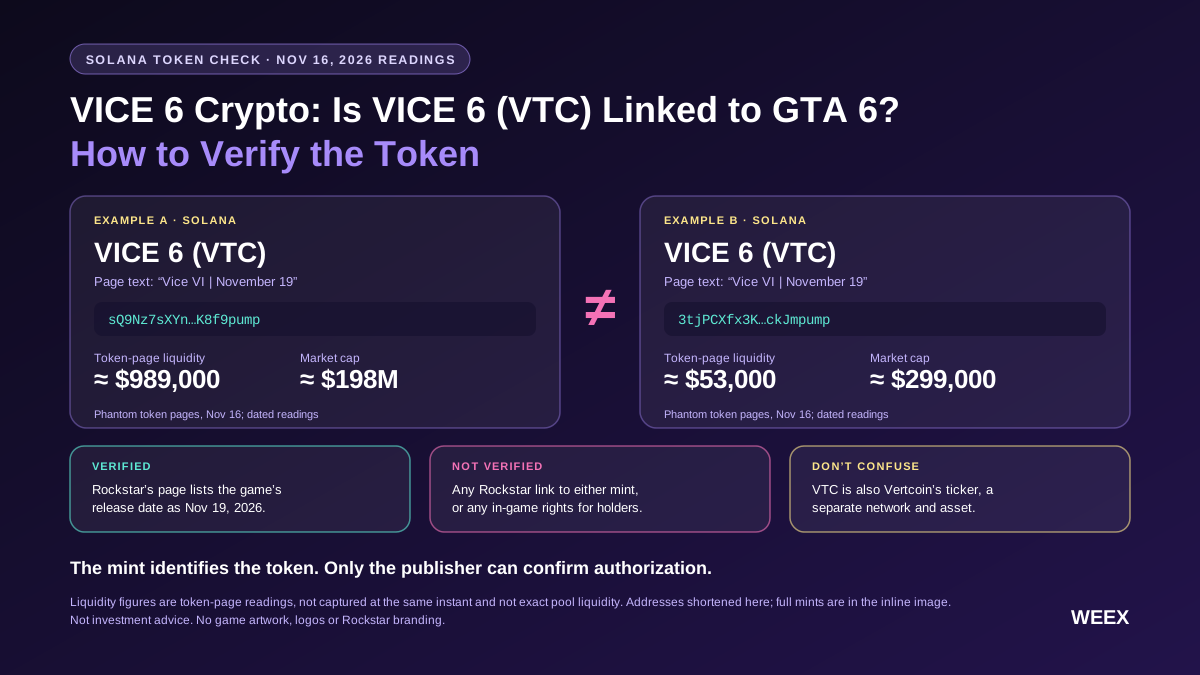
VICE 6 Crypto: Is VICE 6 (VTC) Linked to GTA 6? How to Verify the Token
Is VICE 6 crypto linked to GTA 6? Compare two Solana tokens using VTC, verify their mint and pool addresses, and see what Rockstar has confirmed.
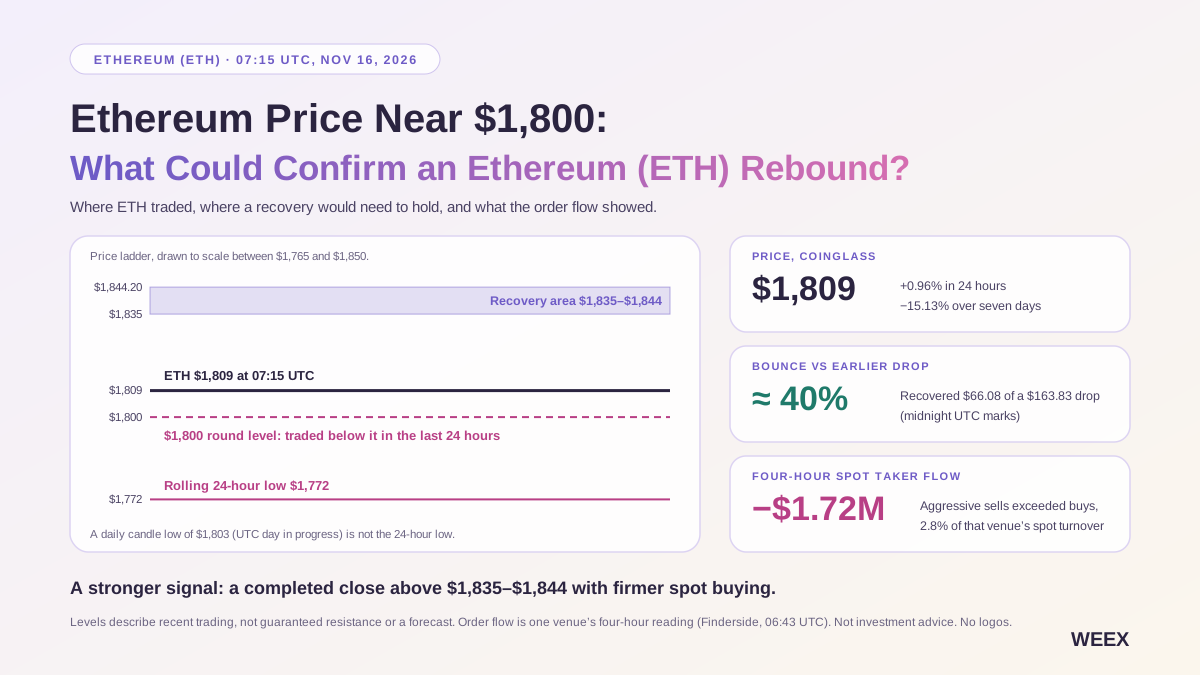
Ethereum Price Near $1,800: What Could Confirm an Ethereum (ETH) Rebound?
Ethereum traded near $1,800 on November 16. See what four-hour spot order flow, futures positioning, and Friday’s ETF flows say about an ETH rebound.
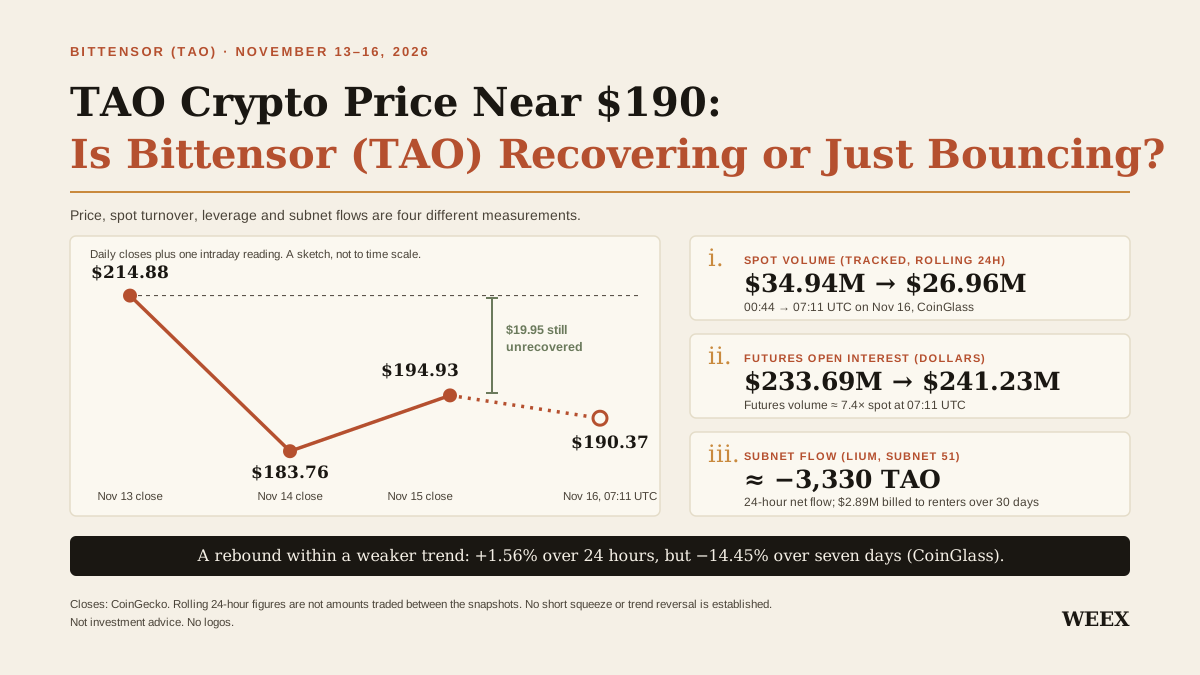
TAO Crypto Price Near $190: Is Bittensor (TAO) Recovering or Just Bouncing?
TAO bounced near $190. Compare spot volume, futures positioning, and Bittensor subnet flows to see what would confirm a more durable recovery.
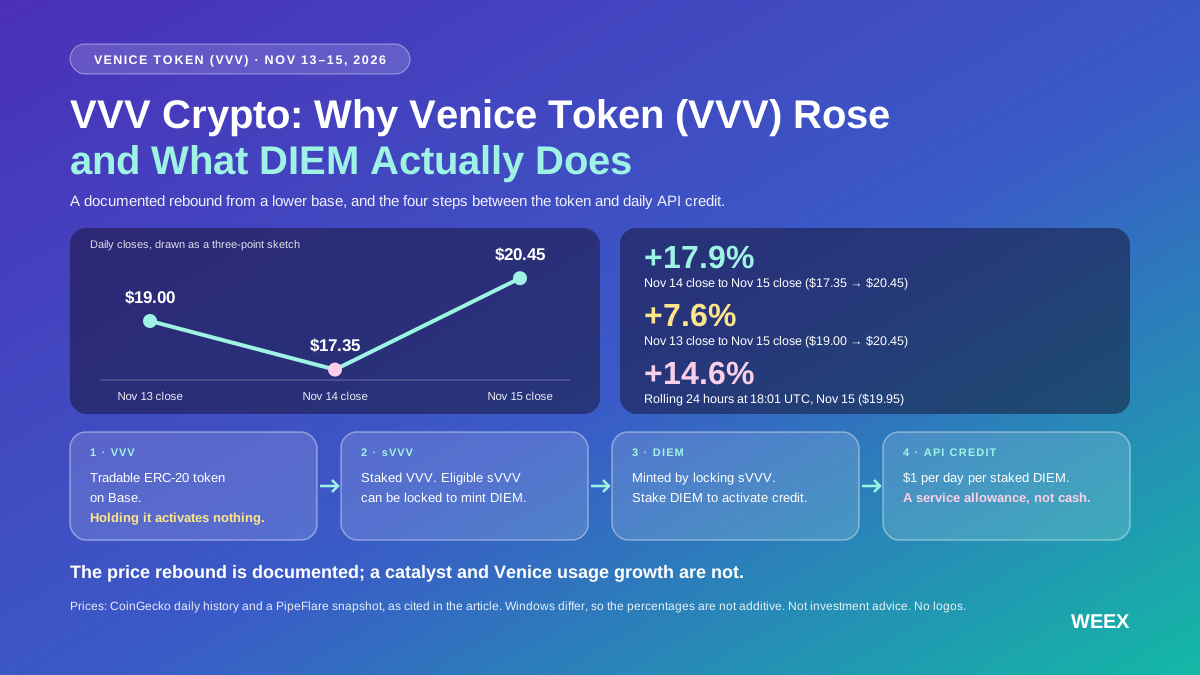
VVV Crypto: What Is Venice Token, Why Venice Token (VVV) Rose and What DIEM Actually Does
Venice Token rose about 14.6% in one November 15 snapshot. Learn what the data shows, how VVV staking works, and what DIEM’s daily API credit buys.
Why Did Bitcoin (BTC) Drop Below $70,000? What Long Liquidations Tell Us
See why Bitcoin fell below $70,000 on November 13, how long liquidations amplified the decline, and what to watch before calling a rebound. If you already plan to trade, you can check whether your activity qualifies for the WEEX Lucky Eggs event, scheduled to run through November 25, 2026 (UTC+8).

WEEX Lucky Eggs: How to Earn Daily Egg Cracks and Win Every Time
Learn how to earn daily WEEX Lucky Eggs from qualifying futures trading volume, check your progress, and understand what “Win Every Time” means.

Meta’s Internal Prediction App Uses Points, Not Cash — and That Distinction Matters

US Signs Silicon Peace Agreement with Eight Nations
Three Questions Every Investor Should Ask About Any Management Team

NuScale Stock Has Lost More Than Half Its Value in 2026, Its Worst Year Since 2023. Here's What Happened the Year After That One.
From 'Patching' to 'Eliminating Entire Classes of Bugs': How to Build Internet Resilience?
5 Dividend Stocks With High Yields That Are Safer Than You Might Think
MiCA gave crypto a passport, but customers still face borders
Regeneron Has $16 Billion in Net Cash and Trades Near 20 Times Earnings. Is It the Cheapest Big Biotech?
Unocoin halts all services after hackers bypass BitGo freeze
CFTC Blockchain Derivatives Approval: Does It Mean You Can Trade Yet?
Genesis AI CEO States Robots Don't Need Heads
Shiba Inu (SHIB) Price Prediction 2027: What Would It Take to Reach $0.00001?
See our Shiba Inu price prediction for 2027, including the $0.000006 base estimate, the market cap needed for $0.00001, and how much burns could help.
Samsung Electronics and Apple Close to Signing Long-term DRAM Supply Agreement
WEEX P2P now supports CAD —Merchant Recruitment Now Open
Cardano Foundation seeks 25M ADA for 2027 events despite $1.2M funding gap
Latest articles


Latest coin listings on WEEX


