
SPCX Stock Closes Above Its $135 IPO Price for the First Time in Weeks: What the Recovery Actually Signals

 Prefer us on Google


SPCX stock closing above $135 for the first time in weeks is a price milestone whose significance depends entirely on what the $135 level represents rather than what the absolute price implies about valuation. SPCX stock's IPO price of $135 is the most visible reference point available for assessing whether the post earnings selloff has been fully absorbed by the market, because it is the price at which the institutional investors who participated in the IPO broke even on their initial positions.
SPCX stock reclaiming that level after falling to $104 does not mean the stock is fairly valued at current prices. It means the sellers who had been most motivated to exit have done so, and the buyers who stepped in at lower prices have restored the stock to the starting line.
What the $135 IPO Price Actually Represents as a Reference Point
Before evaluating what reclaiming $135 signals, establishing why the IPO price is analytically meaningful rather than arbitrary prevents the most common misinterpretation of post-IPO price milestones.
SpaceX stock rebounds, closing above $135 IPO price for first time in weeks.
The $135 IPO price is meaningful as a reference point for three specific reasons rather than because it represents any fundamental valuation anchor.
First, it is the price at which the largest single cohort of new institutional investors entered the stock simultaneously. An IPO allocates shares to institutional investors at a single price, creating a concentrated cost basis among a specific group of shareholders whose selling behavior is predictable. Investors allocated at $135 who hold unrealized losses are more likely to sell than investors who bought at lower prices in secondary market trading. The stock recovering above $135 reduces the population of loss-motivated sellers by restoring breakeven status to the IPO cohort.
Second, it is the price the market established as SpaceX's initial public valuation based on the information available at the time of listing. Subsequent price action has reflected the market's incorporation of new information, specifically the Q2 earnings report's revenue beat alongside the capital expenditure disclosure, the Cursor acquisition announcement, and the August 6 lockup resolution. The stock returning to $135 after incorporating all of that new information is the market saying that the net effect of the post-IPO information flow is approximately neutral relative to the IPO valuation.
Third, it is the most widely referenced price level in all coverage of SPCX. Every news article about the post-earnings decline has referenced the $135 IPO price as the benchmark. A stock reclaiming a widely referenced benchmark produces psychological buying interest from investors who interpret the milestone as confirmation that the decline has ended.
What the Lockup Resolution Contributed to the Recovery
The most structurally important development in the recovery from $104 to above $135 is not any fundamental news event but the passage of the August 6 lockup expiration without the catastrophic additional selling that had been the most feared structural risk.
The August 6 date made eligible for trading a substantial number of shares held by pre-IPO insiders whose lock up period expired simultaneously. The anticipation of that supply event had been a persistent selling pressure on SPCX stock throughout the weeks between the IPO and the expiration date. Investors who did not want to hold through the lockup sold before August 6. Investors who believed the lockup selling would overwhelm buyers sold before August 6. And investors who simply wanted to reduce risk ahead of an uncertain supply event sold before August 6.
When August 6 arrived and the selling proved significantly smaller than the maximum fear scenario had implied, the investors who had sold in anticipation of catastrophic supply were no longer in the stock. Their exit had already happened at prices between $135 and $104.83. What remained after August 6 was a shareholder base composed primarily of investors who had either held through the decline with conviction or bought during the decline at prices below the IPO level.
A shareholder base composed of conviction holders and low cost buyers is a structurally more stable ownership base than one that includes investors positioned above current prices waiting for an opportunity to exit. The lockup resolution did not remove all potential sellers from the stock. Elon Musk's shares remain locked until June 2027, representing the largest single block of potential future supply. But it removed the most immediately predictable and concentrated supply event from the near-term calendar.
What ARK Invest's Accumulation Revealed About Institutional Confidence
One specific institutional behavior during the decline that the recovery above $135 partially validates is ARK Invest's continued purchases at prices below the IPO level.
ARK Invest, led by Cathie Wood, purchased shares across multiple sessions during the post-earnings decline and into the early recovery. The purchases occurred at prices meaningfully below $135, including during the session when the stock reached its all-time low. ARK's accumulated position makes SPCX one of its larger holdings across multiple funds.
The validation that the recovery provides for ARK's purchasing behavior is not that ARK was correct about SpaceX's valuation. Morningstar maintains a substantially lower fair value estimate than current prices, and the analytical disagreement between institutional investors about what SPCX is worth remains as wide as it was during the decline. The validation is that ARK's assessment of the near-term supply dynamics proved accurate. The lockup did not produce catastrophic selling. The Cursor acquisition did not produce sustained panic. And the stock returned to the IPO price faster than the most bearish scenario had implied.

-- Price
What the Cursor Acquisition Contributed to the Recovery Narrative
One specific development whose contribution to the recovery above $135 is difficult to isolate but analytically significant is the Cursor acquisition announcement and what it communicated about SpaceX management's confidence in the company's trajectory.
SpaceX announced its agreement to acquire Cursor at a substantial valuation that included a significant termination penalty payable by SpaceX if it fails to close the transaction. A management team that accepts a large termination penalty is expressing genuine commitment to completing the transaction rather than using the announcement as a signal without the obligation to follow through.
The Cursor acquisition changed the narrative around the post-earnings selloff in a specific way. The selloff had been interpreted in part as the market's concern that SpaceX's capital expenditure was consuming cash faster than revenue could replenish it. An acquisition funded in stock rather than cash simultaneously announced in the immediate aftermath of that concern communicated that management believed SpaceX's stock was a valuable enough currency to use for strategic acquisitions rather than a distressed asset to be preserved.
A management team that announces a major acquisition using its own stock at prices below the IPO level is implicitly communicating that it does not believe the stock is appropriately priced at those levels. The market's response to that implicit signal contributed to the recovery that has now returned the stock above $135.
What Reclaiming $135 Does Not Resolve
The honest assessment of what the recovery above $135 means requires equal attention to what it does not resolve rather than only what it confirms.
The Morningstar fair value estimate of approximately $62 remains the most specific bearish professional assessment available. Morningstar lists SPCX among the most expensive stocks it covers, and the recovery above $135 has moved the stock further from Morningstar's fair value rather than toward it. Investors who evaluate SPCX using Morningstar's methodology find the stock more expensive at $138 than at $104.
The capital expenditure concern that produced the post-earnings selloff has not been resolved by the price recovery. SpaceX reported capital expenditure substantially exceeding revenue in Q2 2026. The next earnings report on December 2, 2026 will be the first financial statement opportunity to assess whether subsequent quarters have shown the revenue trajectory catching up toward the capital expenditure pace or whether the gap has widened.
The retail investor behavior signal noted by multiple market observers is also worth acknowledging. Retail investors who had been consistent net buyers of SPCX since the IPO became net sellers for the first time in the weeks following the post earnings decline. A stock whose retail ownership base shifts from net buying to net selling even briefly has experienced a sentiment change among its most consistent demand source that does not automatically reverse simply because the price has recovered to a milestone level.
The Analyst Target Range That Provides Context for the Recovery
The recovery above $135 is most usefully evaluated against the range of professional analyst assessments rather than against any single target.
The analyst community is broadly constructive on SPCX, with the majority of covering analysts maintaining buy ratings and price targets substantially above current levels. Individual targets vary widely, with some institutional analysts publishing significantly higher bull case scenarios following the Cursor acquisition announcement. Deutsche Bank maintained its buy rating through the post-earnings decline.
At the other extreme, Morningstar maintains a fair value estimate substantially below current prices and lists SPCX among the most expensive stocks it covers.
The current price sits closer to the conservative end of the professional assessment range than to the bullish end. An investor who weighted the analyst consensus more heavily than Morningstar's model would view the recovery above $135 as the stock approaching fair entry territory rather than fair value. An investor who weighted Morningstar's model more heavily would view the same recovery as the stock moving further from fair value.
The $135 recovery resolves neither the valuation debate nor the competitive position questions that the post earnings period introduced. What it resolves is the specific question of whether the post IPO selloff had created a durable new price range below the IPO level or whether the factors driving the decline were temporary enough to be absorbed and reversed within weeks of their occurrence.
For those looking to participate in global financial markets, having access to the right trading platform matters. WEEX offers crypto and stock trading products, covering major global markets including stocks and digital assets.
Conclusion
SPCX stock closing above its $135 IPO price on August 11, 2026 signals three specific things about the post-earnings selloff rather than resolving the broader debate about SpaceX's valuation.
First, the seller cohort most motivated by losses relative to the IPO price has been substantially reduced by the recovery itself. Investors who bought at $135 and sold during the decline have been replaced by investors with lower cost bases whose selling motivation is correspondingly lower.
Second, the August 6 lockup expiration resolved without the catastrophic supply event that had been the most identifiable structural risk. Its passage has removed the most predictable near-term supply overhang from the calendar, leaving Elon Musk's substantially larger position locked until June 2027 as the next major supply event.
Third, the Cursor acquisition's implicit signal about management's confidence in the stock as a strategic currency has contributed to the recovery narrative without resolving the capital expenditure concern that the Q2 results introduced.
The December 2 next earnings report remains the most significant upcoming event for determining whether the recovery above $135 proves durable or whether the revenue trajectory relative to capital expenditure produces renewed selling pressure.
FAQ
1. Why is SPCX stock reclaiming the $135 IPO price significant?
The $135 IPO price represents the cost basis of the institutional investors who participated in the initial offering simultaneously. Recovery above this level reduces the population of loss-motivated sellers from the IPO cohort and eliminates the most visible negative price milestone that post-earnings coverage had established as the reference benchmark. The milestone is psychologically significant rather than fundamentally meaningful, as the business has not changed in proportion to the price movement.
2. What role did the August 6 lockup expiration play in the recovery?
The lockup expiration made a substantial number of pre-IPO insider shares eligible for trading. Its passage without the catastrophic selling that had been anticipated removed the most predictable near-term supply overhang from the calendar. Investors who had sold in anticipation of the lockup supply were no longer in the stock after August 6, leaving a shareholder base composed primarily of conviction holders and low cost buyers whose selling motivation is lower than the pre-lockup shareholder composition.
3. What did ARK Invest's purchases during the decline reveal?
ARK Invest purchased shares across multiple sessions during the post-earnings decline and early recovery, building SPCX into one of its larger holdings. The purchases occurred at prices below the IPO level, including during the session that reached the all time low. The recovery above $135 validated ARK's assessment of the near-term supply dynamics without resolving the broader valuation debate, as Morningstar and ARK maintain substantially different views on what SPCX is worth.
4. What does the Cursor acquisition contribute to the recovery?
SpaceX's agreement to acquire Cursor at a substantial valuation, accepting a significant termination penalty payable by SpaceX if it fails to close, communicated management's genuine commitment to the transaction. Funding the acquisition in stock rather than cash at prices below the IPO level implicitly communicated that management did not view those prices as appropriate. That signal contributed to the recovery narrative alongside the lockup resolution and ARK's purchasing behavior.
5. What does the recovery above $135 not resolve?
The Morningstar fair value estimate substantially below current prices remains unchanged. The capital expenditure exceeding revenue in Q2 2026 has not been addressed by subsequent financial statements. And retail investors who became net sellers for the first time since the IPO have not demonstrably returned to net buying. The December 2 earnings report is the first opportunity to assess whether the revenue trajectory relative to capital expenditure has improved since the Q2 disclosure that initiated the selloff.
This content is provided for general informational purposes only and doesn't constitute financial, investment, legal, or tax advice. Any events, rewards, online promotions, or related information mentioned herein should not be considered a recommendation, solicitation, or invitation to purchase, sell, trade, or otherwise deal in any crypto assets. Crypto assets are highly volatile and may result in loss. The availability of WEEX services, products, and related events may vary by region. You are responsible for ensuring that your participation is in accordance with applicable local laws and regulations.
You may also like
What Is Blockchain Interoperability? How Cross-Chain Bridges and Messaging Work

Best Crypto Trading Strategies for Beginners: What to Know Before You Trade
WEEX Broker Models: Strategy Bots, Copy Trading and Sub-Exchanges

What Is Orca (ORCA) Crypto? The Solana DEX, USDY Liquidity, and the ORCA Name Confusion

What Is a Decentralized Crypto Exchange (DEX)? How It Works, Costs, Risks, and When to Use One
How to Day Trade Crypto for Beginners: Fees, Hours, Risk Math

Self-Custody Wallets: When a Crypto Transfer Must Be Reported to Brazil's Coaf
WEEX Grid Trading: When a Grid Strategy Works and When It Fails
Ethereum Futures Trading: How to Size ETH Positions and Read PnL

What Is a White Label Crypto Exchange? A Complete Beginner's Guide
Is Hyperliquid Safe? Risks You Should Know Before You Trade

What a Blockchain Explorer Can and Cannot Tell You
How to Look Up a Wallet Address and Transaction History

How to Verify a Crypto Transaction With a Blockchain Explorer?

BTC Futures Trading on WEEX: Claim BTC Rewards Before Sep 25
What Is a Funding Rate? How Perpetual Futures Charge Longs and Shorts
Perpetual Futures for Beginners: Margin, Funding and Liquidation Explained
What the LUSD Attack Shows About DeFi Risk
What Is BONK? WEEX Spot and 1000BONK Futures Status and Risk Checks
What Is BRETT? WEEX Spot and Futures Status and Risk Checks
What Is FLOKI? WEEX Spot and 1000FLOKI Futures Status and Risk Checks
What Is WIF (dogwifhat)? WEEX Spot and Futures Status and Risk Checks

Who Is Attending TOKEN2049 Singapore 2026? Top Speakers, Exchanges and Exhibitors to Watch
USDC on Arc: What Circle's Mainnet Launch Changes for Holders
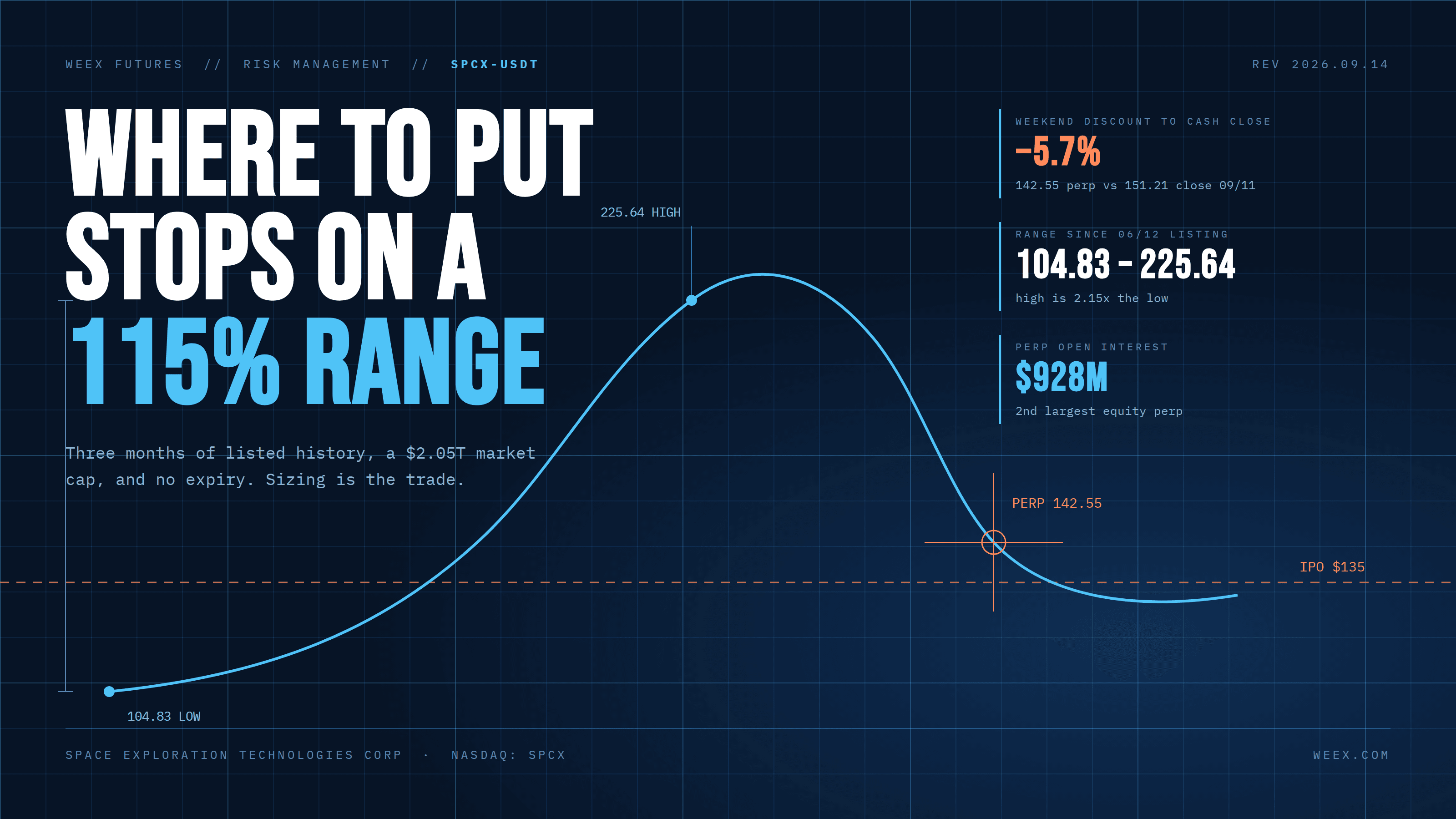
SpaceX Stock Futures: Where to Put Stops on a 115% Range
How to Trade Microsoft (MSFT) Stock Token with USDT on WEEX
How to Trade Apple (AAPL) Stock Token with USDT on WEEX
Crypto Futures Trading Explained: Leverage, Funding, Liquidation
Crypto Futures Trading: Leverage, Funding and Apple Perps

How to Trade Tesla (TSLA) Stock Token with USDT on WEEX: A Trading Guide for Beginers in 2026
What Is Blockchain Interoperability? How Cross-Chain Bridges and Messaging Work
Best Crypto Trading Strategies for Beginners: What to Know Before You Trade
WEEX Broker Models: Strategy Bots, Copy Trading and Sub-Exchanges
What Is Orca (ORCA) Crypto? The Solana DEX, USDY Liquidity, and the ORCA Name Confusion
What Is a Decentralized Crypto Exchange (DEX)? How It Works, Costs, Risks, and When to Use One
How to Day Trade Crypto for Beginners: Fees, Hours, Risk Math


